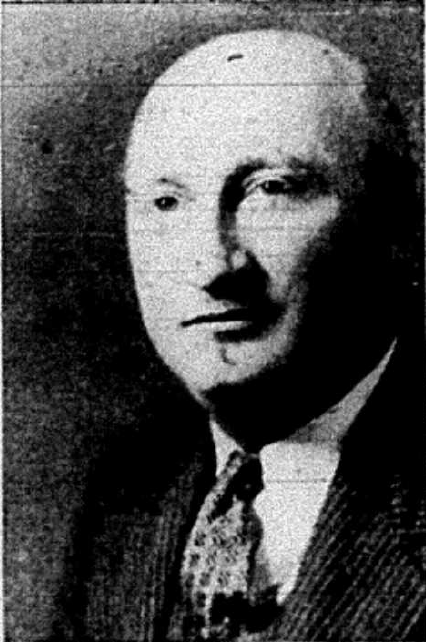
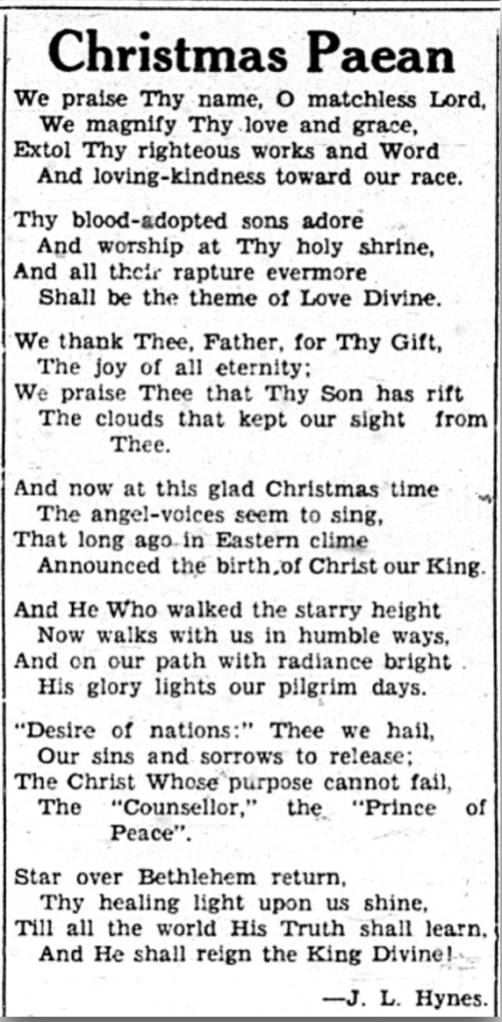
James brought his skills for promotion of his causes in the local newspapers, honed over his decade in Brooklyn, to his new post in Middleboro. James’s work and writings during this period follow the same patterns we have seen previously–a great deal of heavy-handed, inscrutable theology, with little hint of any cause other than religion for its own sake. On the softer end of the spectrum, James also wrote poetry on a regular basis (still inscrutable), to which he must have devoted a great deal of care and effort.
Middleboro Gazette, January 4, 1935
Middleboro Gazette, December 25, 1936
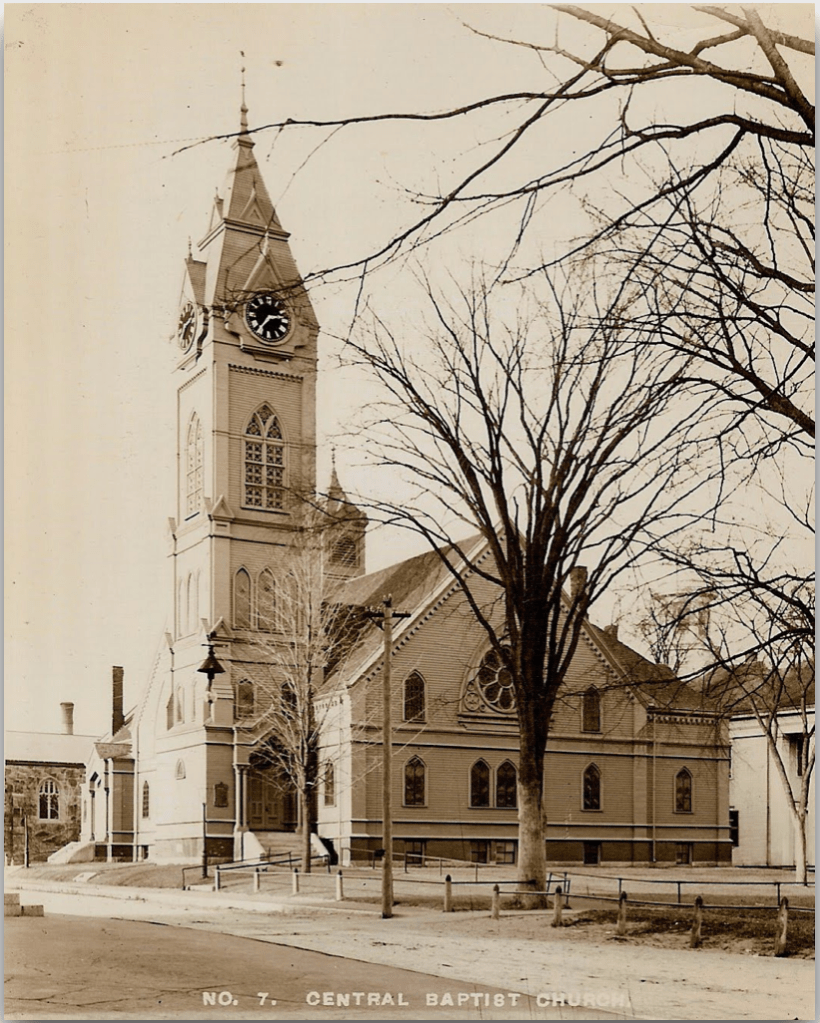
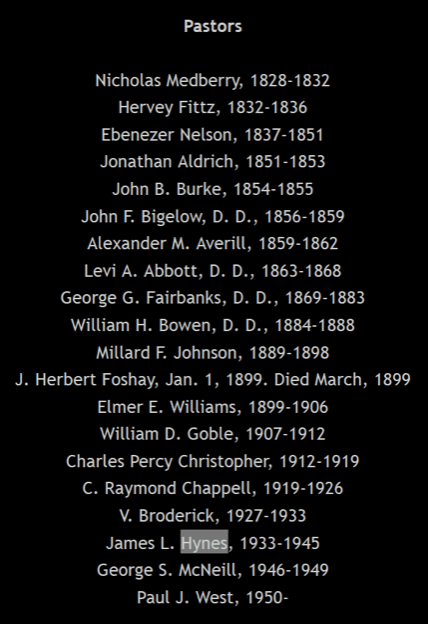
The Central Baptist Church in Middleboro, Mass.From the Central Baptist Church’s historical website
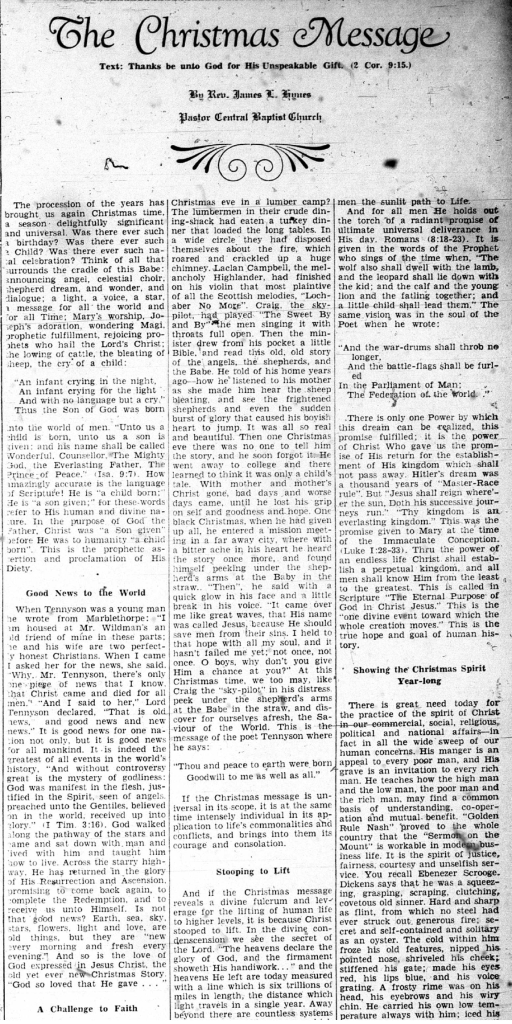
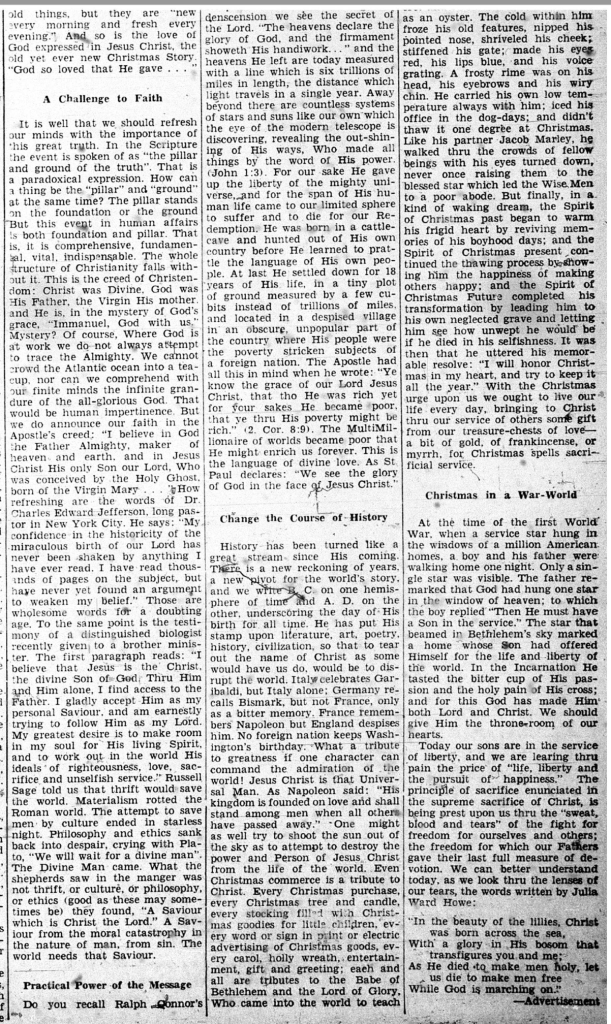
If James’ 1944 Christmas Message, published in the Middleboro Gazette was any indication, sitting through his sermons must have been tests of fortitude and patience.
Portions of James’ 1944 Christmas Message, published in the Middleboro Gazette. Brevity was not his strong point,
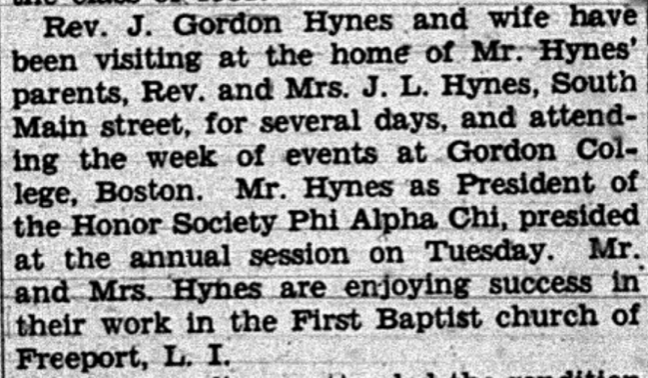
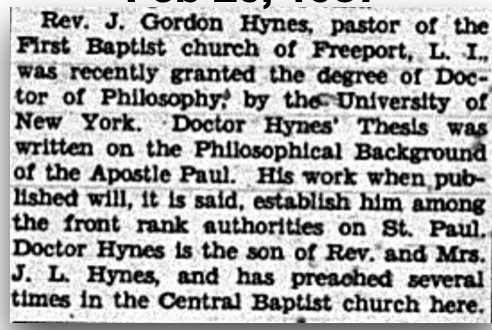
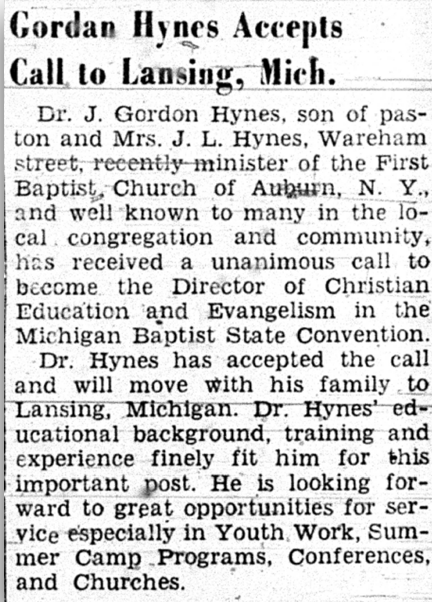
Surely with James’ encouragement, the Middleboro Gazette regularly followed the progress of the professional career of his son, Reverend Gordon Hynes, in Freeport and Auburn, New York, and in Lansing, Michigan.
Middleboro Gazette, June 7, 1935
Middleboro Gazette, Feb 26, 1937
Middleboro Gazette, March 9, 1945
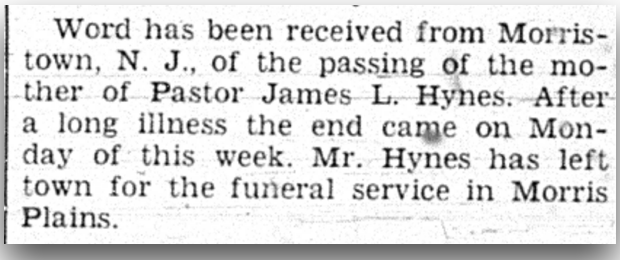
James’ mother, Hannah Cobb Hynes died in New Jersey in March, 1943 (apparently not having returned to Newfoundland, as previously thought). Hannah’s path to Morristown is unknown, her whereabouts having been unclear since 1910 when she lived with daughter Blanche in Brooklyn. At this time, Bessie still had family connections in northern New Jersey and Newburgh, but there is no evident explanation that would link James’ mother to this region. Recall that Hannah’s husband, James’ father Matthew Hynes had died in 1905 in New Haven.
Middleboro Gazette, March 12, 1943
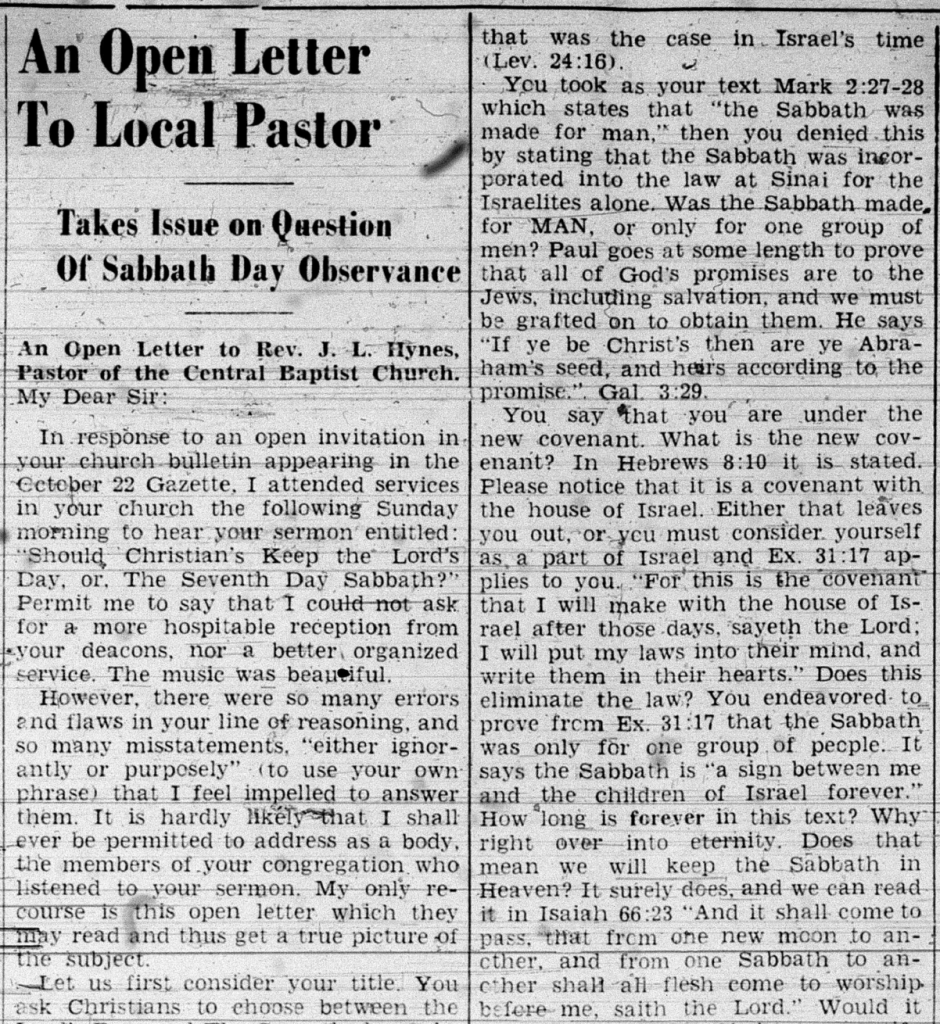
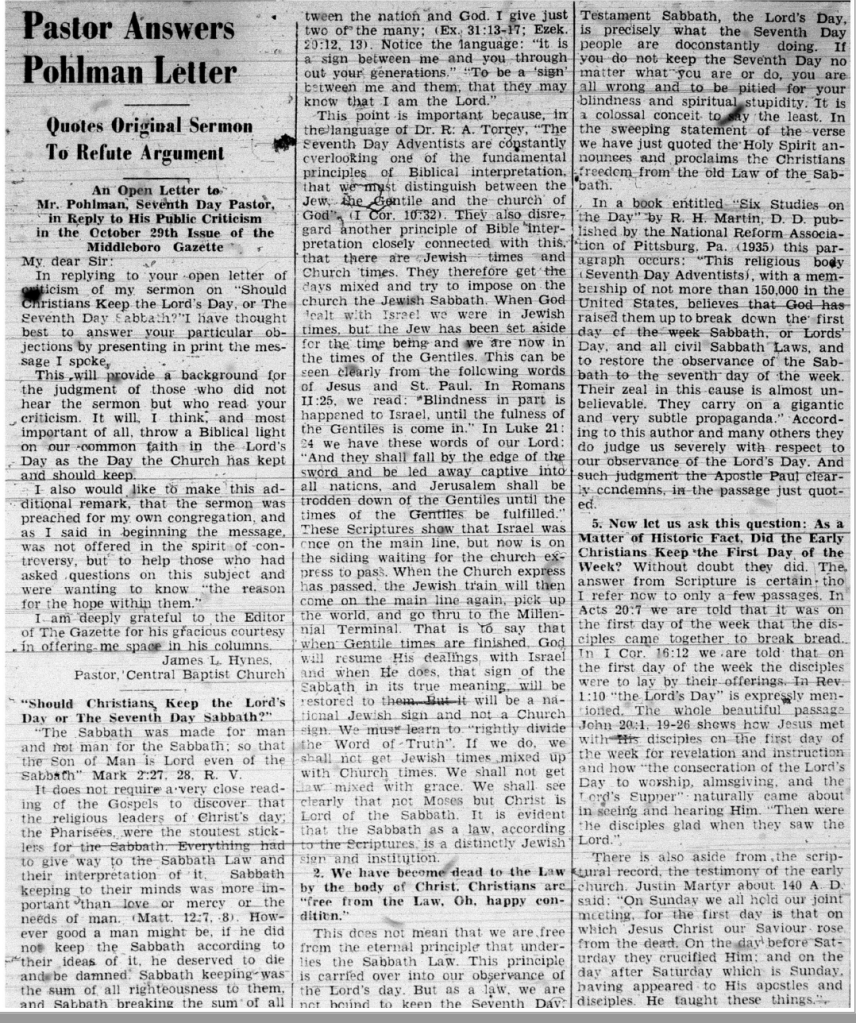
James continued to be a prolific writer and defender of his religious principles throughout his tenure in Middleboro. In 1943 he got into what would today be described as a troll fight with a critic, reverend A.B. Pohlman who took issue with his preachings. Pohlman’s letter occupies more than a half a page in the Gazette…
Middleboro Gazette, October 29. This is approximately a quarter of the full published letter from Reverend A.B. Pohlman
James replied a week later in a letter that took an entire newspaper page, and must have taken several days to write. Bonus points to anyone who can read, never mind understand, this debate all the way from start to finish.
Middleboro Gazette, November 5, 1943. The full published reply filled most of a newspaper page.
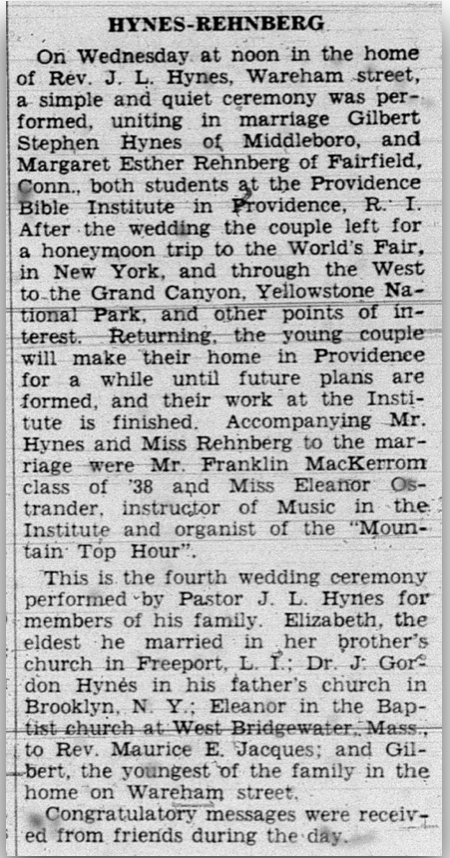
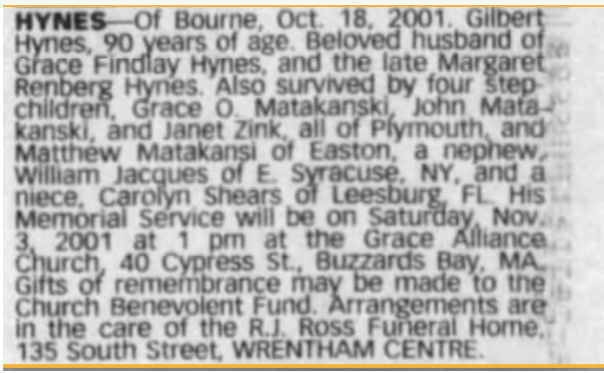
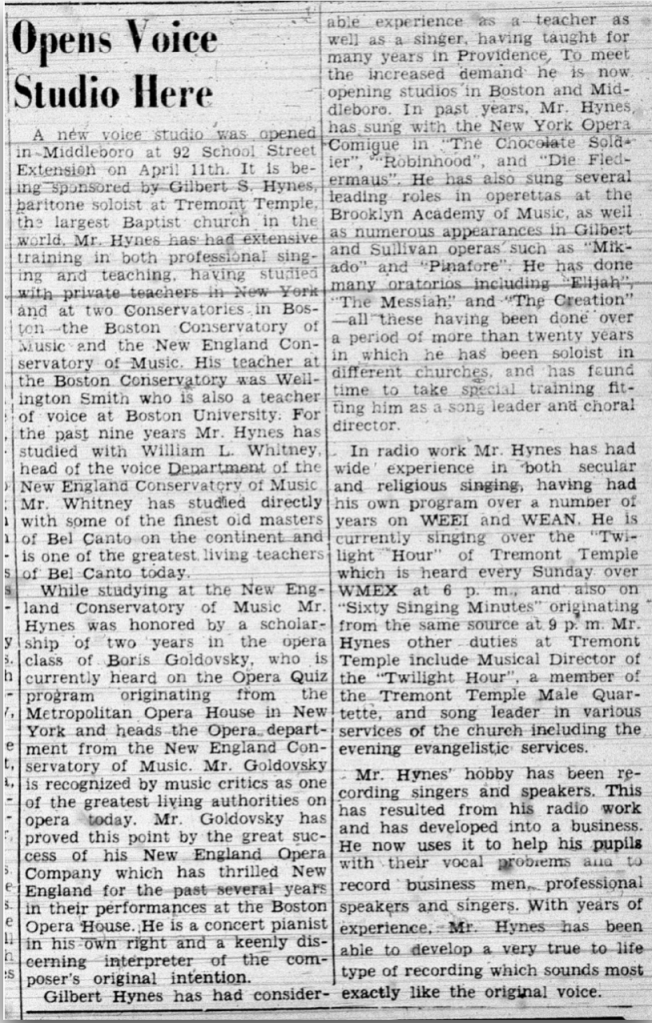
The Gazette also tracked the professional career of James’ and Bessie’s youngest son, Gordon’s brother Gilbert. Gilbert and his wife Margaret were successful classical musicians and gospel singers in Massachusetts and Rhode Island.
Middleboro Gazette, May 26, 1939Boston Globe, Nov 11, 2001
Middleboro Gazette, April 22, 1949
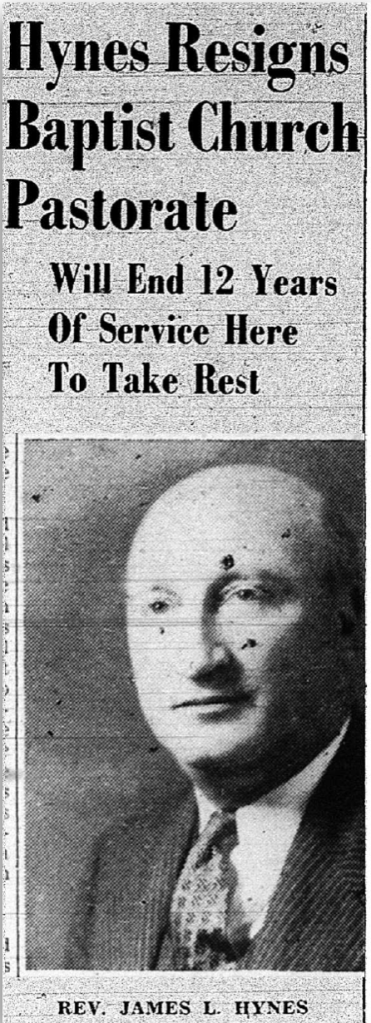
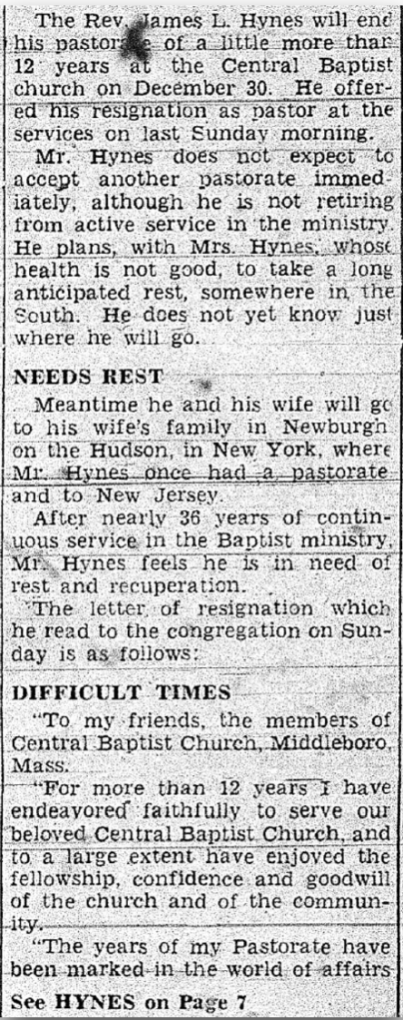
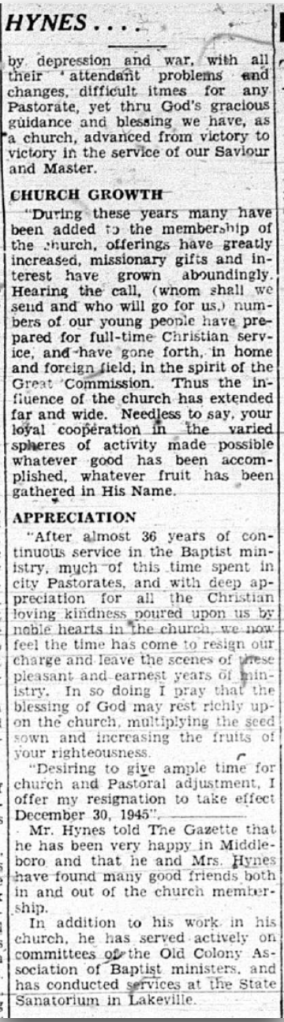
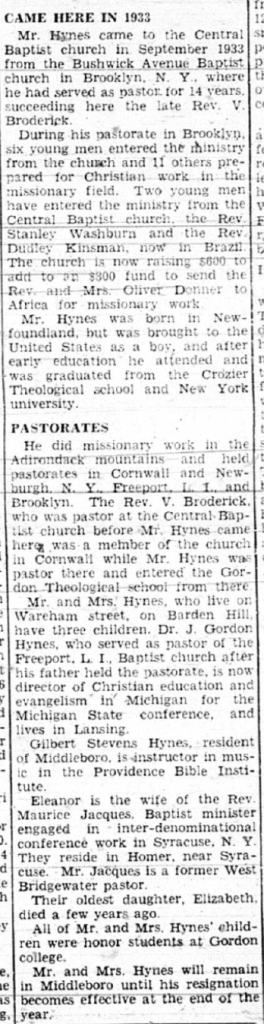
James Hynes resigned abruptly from the Central Baptist Church in 1945. The article explaining his resignation creates as many questions as it answers. It reads more like a cold exposition of (veiled) facts than the departure of a beloved leader (in both directions, the article’s descriptions of James as well as James’ descriptions of the church he is leaving).
Middleboro Gazette, November 16, 1945
James’ offered reason for resignation, “desiring to give ample time for church and Pastoral adjustment”, goes beyond obfuscation, and begs the question, “adjustment from what?”
James’ stated intentions to visit Bessie’s family in Newburgh upon his departure, then to move somewhere in “the South” are intriguing. They suggest that he was caught without a plan and that he and Bessie had no idea where else to go except back to Newburgh. The unknown details of Bessie’s poor health may also have driven them there. In 1945, Bessie’s sister Addie was living alone in Newburgh, the only other known family there being McClughan cousins, also on Bessie’s side of the family. (In 1947 Bessie’s and Addie’s brother Dr. Edward Gordon, having lost his wife Grace in 1939, would move back into the Newburgh house, living there with Addie until his death in 1958.)
James harmed a lot of people over the course of his life–that he was a hard-working, literary man who brought passion to his work cannot offset the damage inflicted on the other side of his double life. Whether or not his departure from Middleboro had anything to do with his past catching up with him, it seems fitting and ironic that his exit took him straight to the home of his sister-in-law Addie, probably the living person in the world most able to see right through him, the person who continued to devote her life to undoing the kinds of damage caused by people like him, before he disappeared into obscurity.
There is no evidence that James and Bessie stayed in Newburgh for any extended length of time, nor is there any trail of where they spent the final years of their lives, in the South or elsewhere. They do not show up in the 1950 census. It is unusual for there to be no trace of prominent people of this era in today’s massive genealogical database. There remains a chance that answers will emerge in the future as more records (perhaps some obscure Southern newspaper) are digitized and added to the record.
In 1945, James was 60, Bessie was 72, and Addie 68. James would live another 8 years, Addie another 26. No information has come to light on Bessie’s final years, or if she outlived her husband. The last word from James or Bessie that I can find is a brief notice of James’ death which appeared in the Middleboro Gazette in 1953. It is very brief and contains neither fond remembrances nor helpful details other than its publication date.
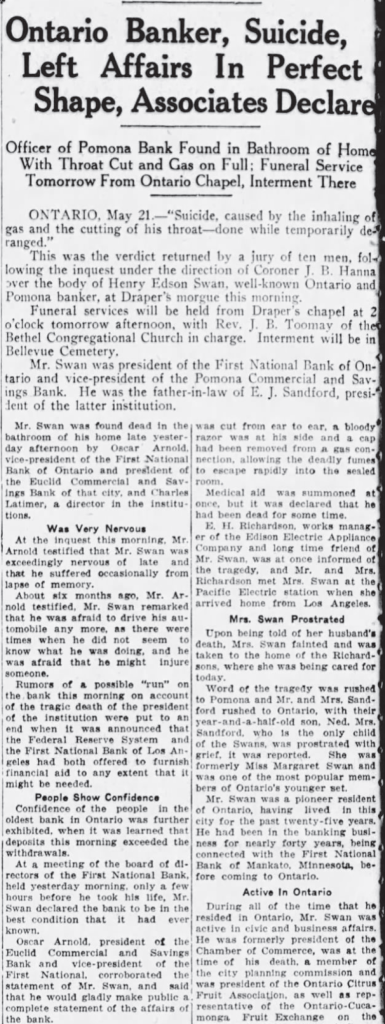
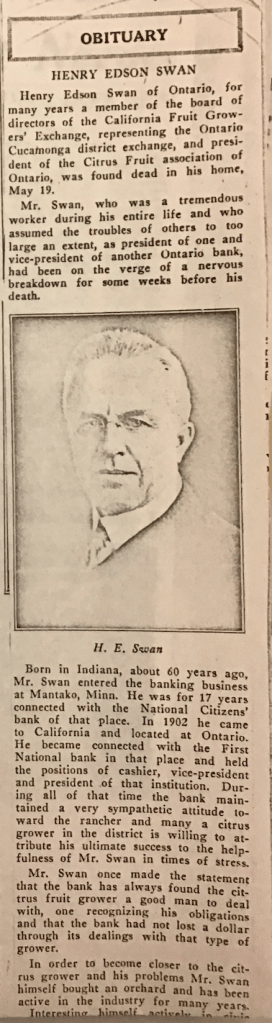
On the morning of Tuesday, May 20, 1924 our great grandfather Henry Swan presided over a monthly directors meeting of the First National Bank of Ontario, California, where he was the bank president. The routine meeting was adjourned and Henry left for lunch. That afternoon, there was scheduled a monthly board meeting of the Euclid Savings Bank, where Swan was a director. When the normally punctual Swan did not appear for the 3:30 meeting, his associates became concerned for his health, which was known to be poor. A call to the First National revealed that Swan had not returned from lunch. The board members got no answer when they tried telephoning the Swan home–his wife, our great grandmother, Mabel Swan was known to be spending the day in Los Angeles. Oscar Arnold, vice president of the First National Bank and president of the Euclid Savings Bank, and Charles Lattimer, a board member of the Euclid Savings Bank, then went to the Swan home at 501 North Vine Avenue. They found Marshall Sellman, the gardener, working at the home, but he had not seen Swan since early morning. When they found Swan’s car parked in the garage, the three men began searching the home. They found Swan in the upstairs bathroom, having taken his own life. Medical assistance was summoned, but it was quickly determined that he had been dead for several hours.
Family friends Earl and Mary Richardson were quickly informed of the situation. They waited at the Pacific Electric trolley station, intercepting Mabel as she returned from Los Angeles. Word was sent to Joe and Margaret, who had recently moved to Pomona. They rushed to Ontario with 14 month-old son Ned. The facts of the situation are so extreme–the sudden death, the news of suicide, the shocking facts of how it took place, and the absence of any note or explanation–that it is hard to fathom how one would go about breaking such news to family members, any withholding of detail providing only temporary respite from realities that would surely come to light in another day or two. The Richardsons would care for the family assiduously over the next few days.
News of the tragedy spread quickly through the Southern California region. The Ontario Daily Report published at least three extra editions devoted to the news of one of city’s most beloved leaders.
The suicide of a prominent banker inevitably raises questions of possible financial improprieties and such speculations arose within hours of the news breaking. Banking officials, including Oscar Arnold quickly released statements of the known facts, that the bank had passed state audits with flying colors a week earlier and that the monthly board meeting earlier in the day had been completely routine. Subsequent investigations found absolutely nothing out of order with the finances of the bank, nor with any of Swan’s personal finances.
The Pomona Progress Bulletin, May 21, 1924
The coroner’s official assessment of Swan’s death was “suicide caused by inhaling of gas and cutting his throat while temporarily mentally deranged.” A century of reflection and speculation on the circumstances of Henry’s death has revealed little more explanation than what was printed in the newspapers in the days immediately following. Here is a summary.
Henry’s bad health had been known in the family for about the previous three years. Henry himself was acutely aware of his health problems and was quoted, for example, as saying that he increasingly did not trust himself to drive. As his friend and colleague Oscar Arnold explained…
Mr. Swan has been suffering physically for some time. Three years ago he began to show signs of a nervous breakdown, not apparent to his friends, but to his family. He had high blood pressure and his immediate family feared that something might happen to him in the next few years, as he was just about 60 years old, and several of his family had broken down about that age.
Several weeks ago Mr. Swan said to me that he thought he must take a vacation of several months or he would break down, he felt like a nervous wreck. I told him to go at once, but he said he would wait a little while and then would like to go away for the summer to recover completely.
Oscar Arnold, Ontario Daily Report, May 20 1924.
Everyone must have deeply regretted that this anticipated summer retreat was only a few weeks away when Henry died.
Several of Henry’s relatives did indeed die during their early-mid sixties. He would have known that his older brother, Silas Swan, had died just a few months earlier in Minnesota at age 63. His father James Burroughs Swan had died at age 64. (Younger sister Bertha Swan would die at age 60 a few years later.) The specific causes and circumstances of these deaths are not known, but Henry’s odds were certainly not good, and he knew it.
Almost all remembrances of Henry noted that he worked too hard and took many of his clients’ problems (particularly the orange growers’ finances) too personally, adding to the stress of his job.
As to Henry’s state of mind on the day he took his own life, it was clearly irrational, well beyond that of a man deeply troubled by overwork and poor health, well-deserving of the label “temporarily mentally deranged”. His final actions were decisive and redundant, leaving no possibility that he would be discovered and revived. Beyond the suicide itself and the extreme nature of his methods, two things point to his state of total irrationality. First, his full opening of the gas jets in the room created a high danger of destroying the house and killing other people. Second, he gave no thought to who would find his body. Had the bank directors been a little less persistent in their search for Swan, it is most likely that Mabel would have been the one to find his body. No matter how desperate, had Swan retained any capacity for rational thought that afternoon, he would have rejected any actions leading to these possible outcomes. Henry simply was not Henry in his final hours.
I believe that in his final years Henry was not able to see a world in which he backed away from his commitments and lived quietly to prolong his life. If there was any window of time when this would have been possible, it would have started closer to the beginning of his three year health decline than the end. He just was not wired this way.
We can also look back on Henry’s actions in the year before his death and wonder how much was him deliberately getting his affairs in order. His entering into the partnership with Joe to purchase controlling interest in the Pomona bank surely had a strong element of wanting to set up his daughter, son-in-law, and grandson for the future. It surely must have occurred to him that the month spent with Mabel in the Hawaiian Islands the previous summer could have been his last opportunity to travel in the way he loved.
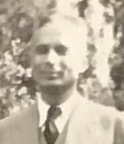
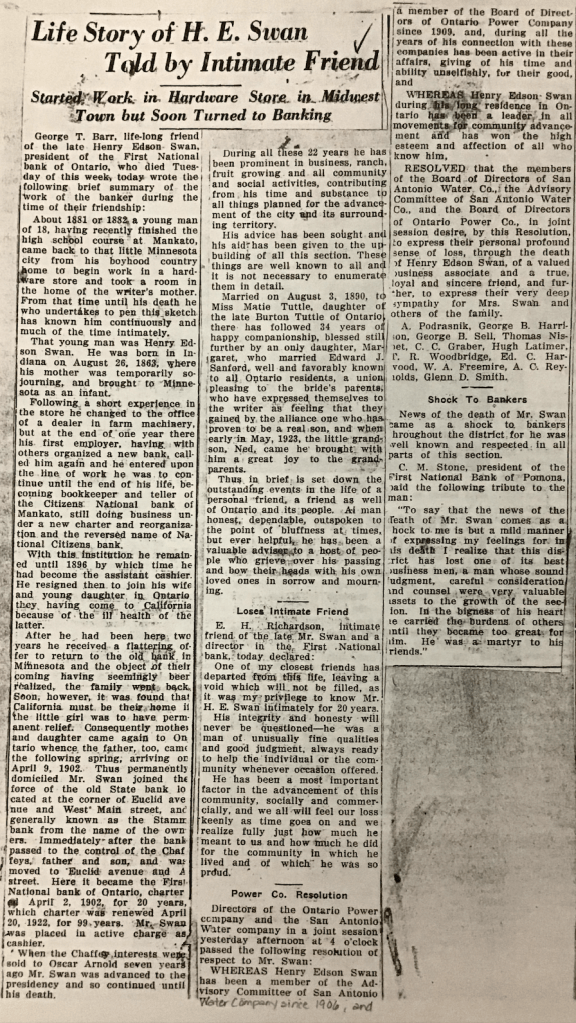
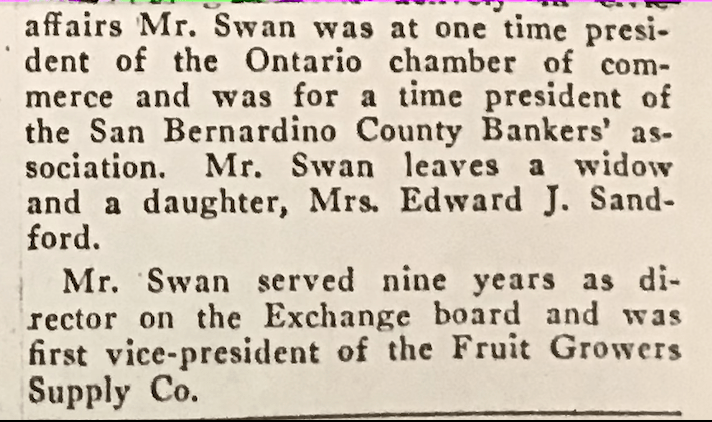
Remembrance of Henry Swan clipped by our grandparents and preserved in the Model Colony History Room of the Ontario Public Library
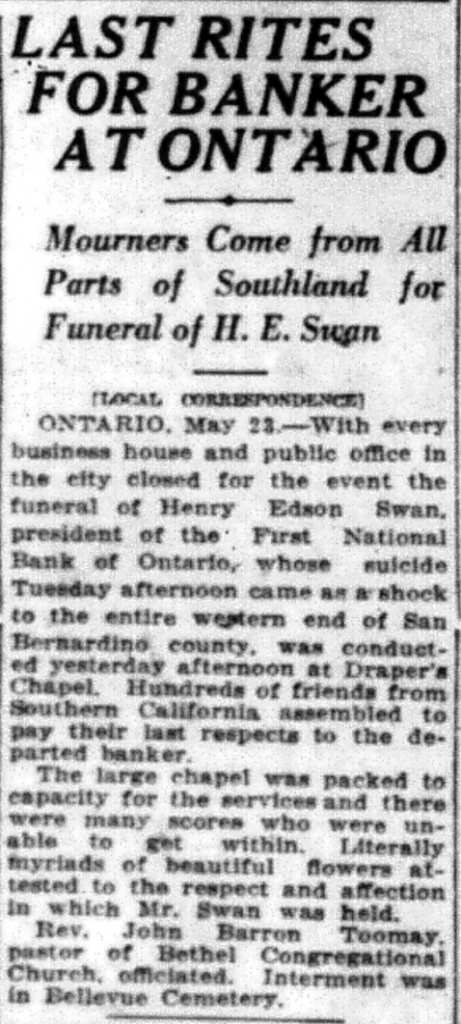
Henry was buried at Ontario’s Bellvue Cemetery Funeral that Friday. Ontario businesses were closed that day, and overflow crowds attended the funeral.
Los Angeles Times, May 24, 1924
The shock waves from Henry’s death dissipated over time but never completely faded. The subject was rarely discussed in the family. Joe, in his living history interviews decades later, would occasionally bring up Henry in making some general point on how things used to be. Sitting next to his wife, he would speak fondly of his father-in-law, but then quickly move on to another topic. Interviewers did not ask about Henry, probably understanding this topic to be off limits.
Margaret, who was 29 at the time of her father’s death, was never quite the same. Certainly her high-society-girl status had already begun to fade in the realities of family life, but she lost much of her enthusiasm for this type of life, settling down to raise her family and eventually become the grandmother we knew. And there must have come a day when she realized that her son Richard (and later several of his sons) bore a striking resemblance to her late father.
Joe, at age 32 lost a partner and a role model, perhaps responsible for nearly as much of his life-view as his own father who had died two years earlier. He stepped full-on into his banking career in the years to follow, guided by the icon of his deceased mentor. Henry’s death led to specific challenges in the Pomona bank, including a (constructive) takeover in the following months, which Joe, as bank president, would manage with the steady hand and confidence he had learned in large part from his father-in-law.
In the aftermath of Henry’s death, family plans were modified. Joe and Margaret sold their new home in Pomona and moved back into the Ontario home at 501 North Vine, eventually assuming ownership, and living there for most of the rest of their lives. Mabel remained there with them for the rest of her life. The reasoning behind the decision to live in the home haunted by Henry’s death is not known, but perhaps the obvious discomfort was weighed against the opportunity to preserve the home and orchard which Henry had loved. Joe and Margaret had not lived in Pomona for long and it may also be that they were a little homesick for Ontario, deciding to take the opportunity to reverse their decision to move. The five mile commute from Ontario to Pomona for Joe would never have been a big factor.
Mabel eventually got back on her feet with continued charity work, watching her grandchildren grow up, and doing some traveling in her later years.
Henry’s tools would remain locked in the shed next to the garage for the next half century, mostly undisturbed and unused. It was a curiosity for us to peer into the shed during our visits as children.
Perhaps the biggest sign of the family’s recovery came nearly a year after Henry’s death, when Margaret gave birth to the family’s second child, our future aunt Anabel.
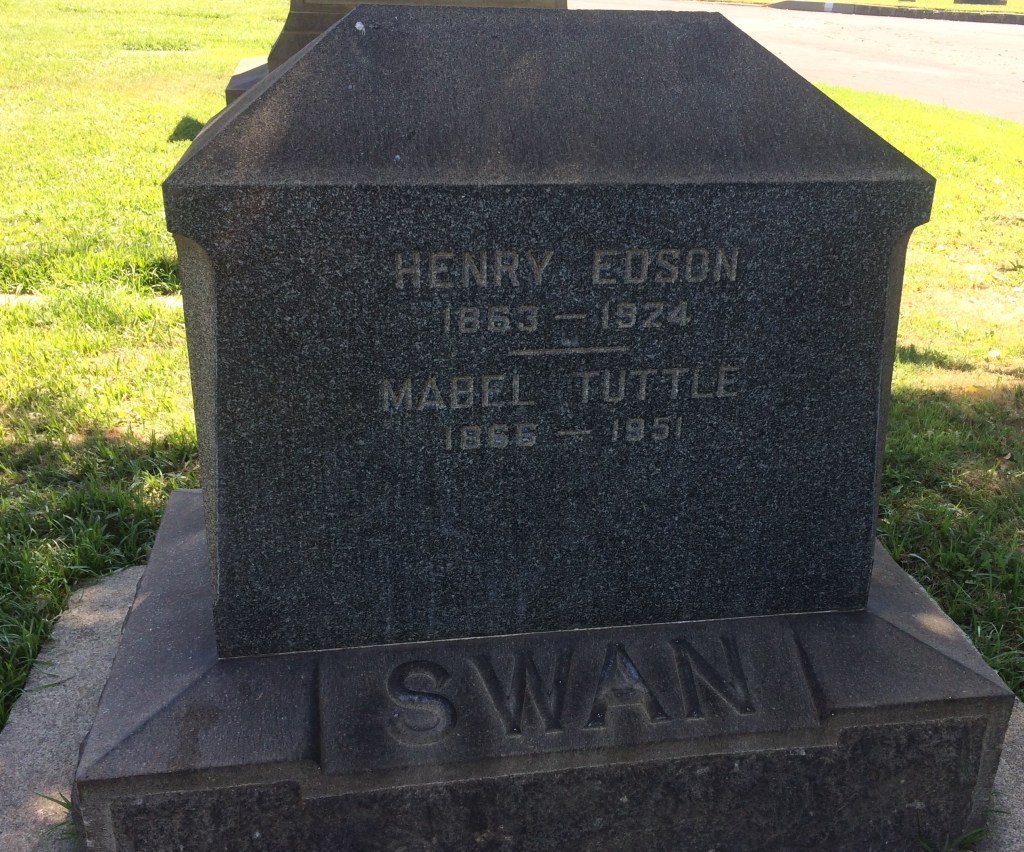
Swan memorial at the Bellvue Cemetery, Ontario, California
The Swan and Richardson families in happier times, circa 1910. Henry Swan on the right as he should be remembered.
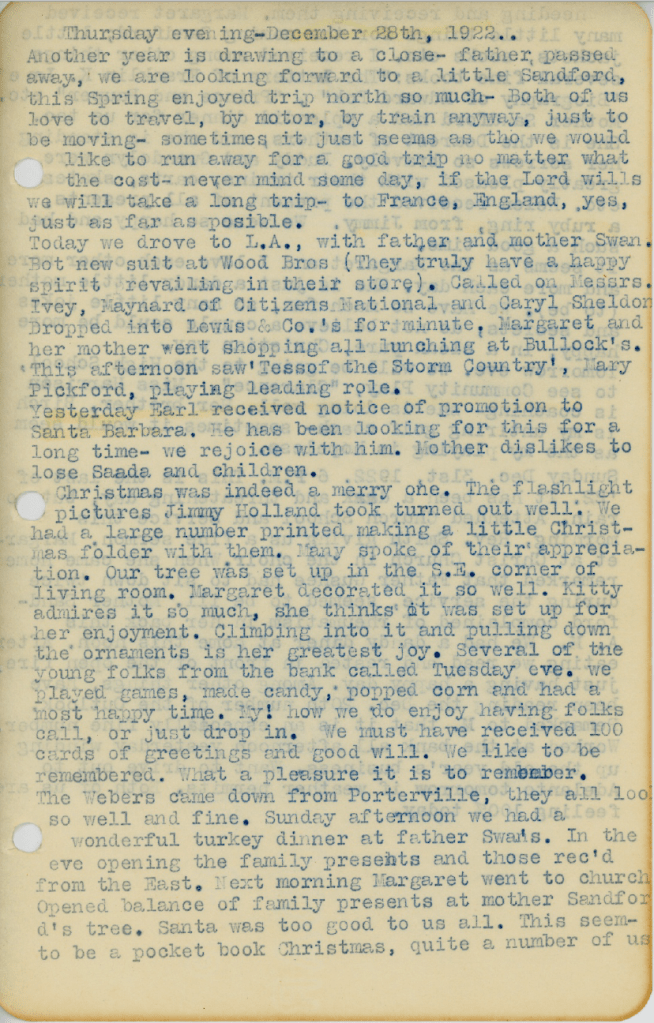
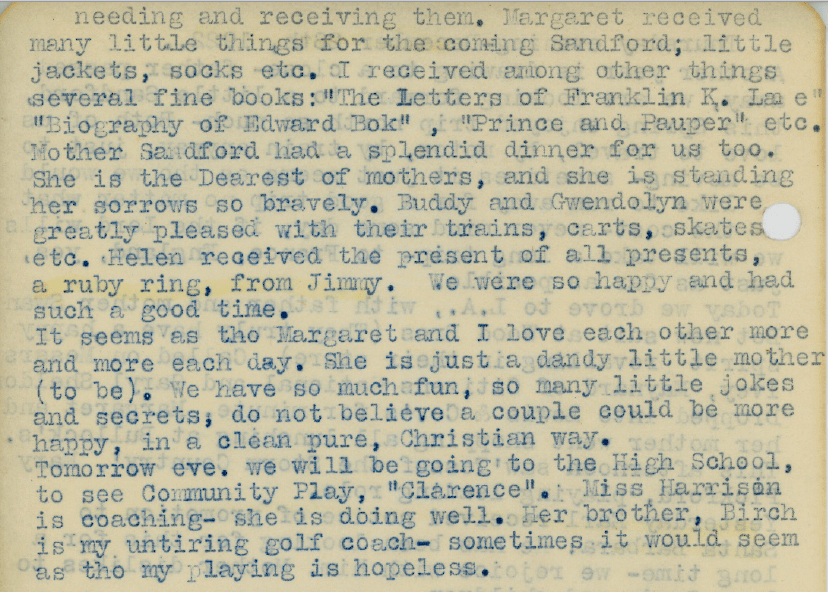
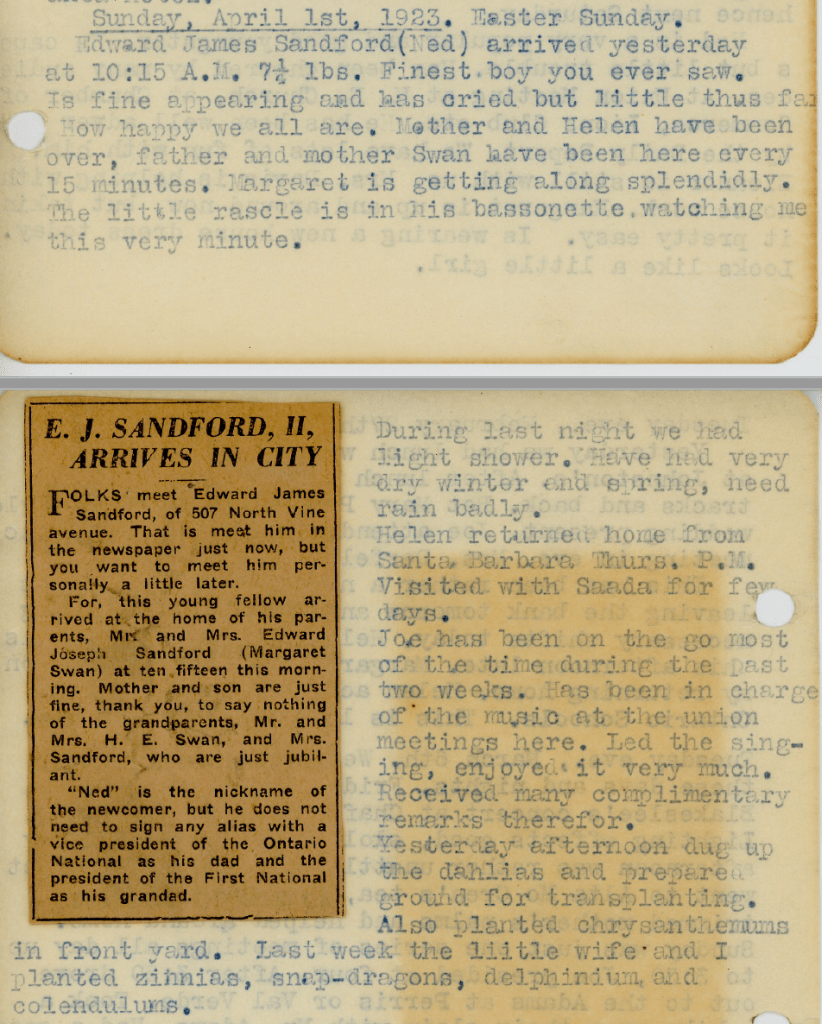
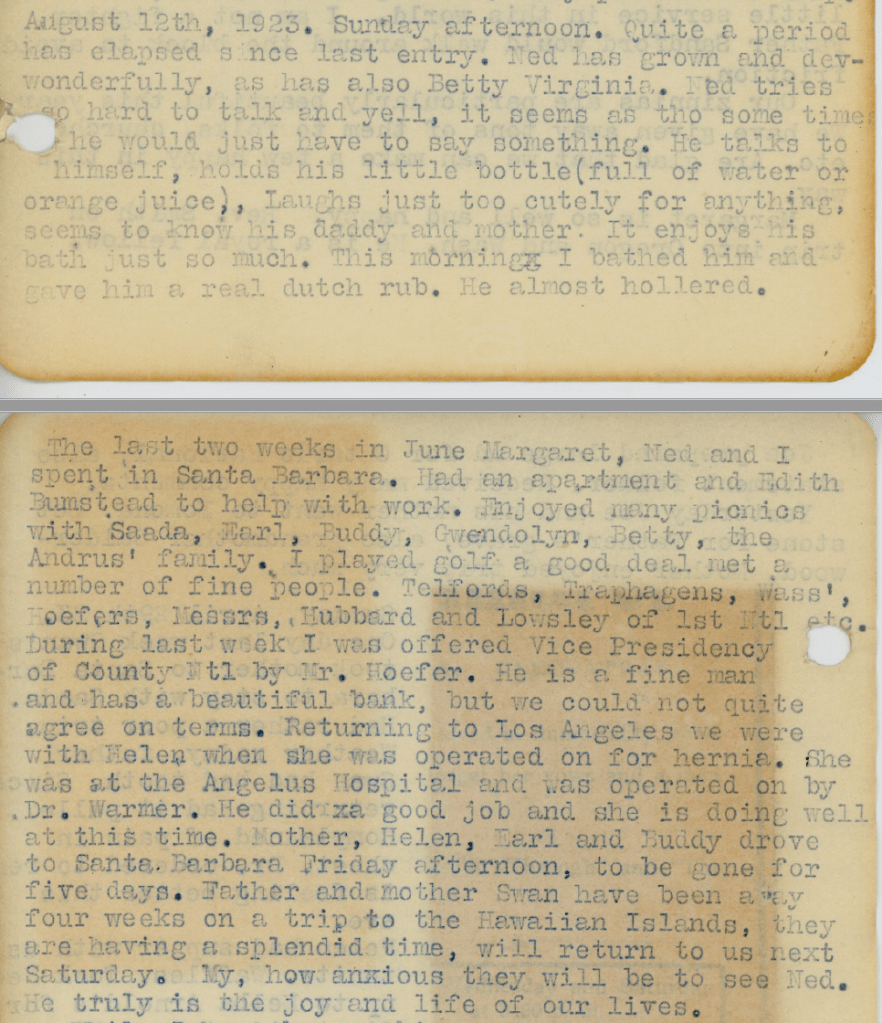
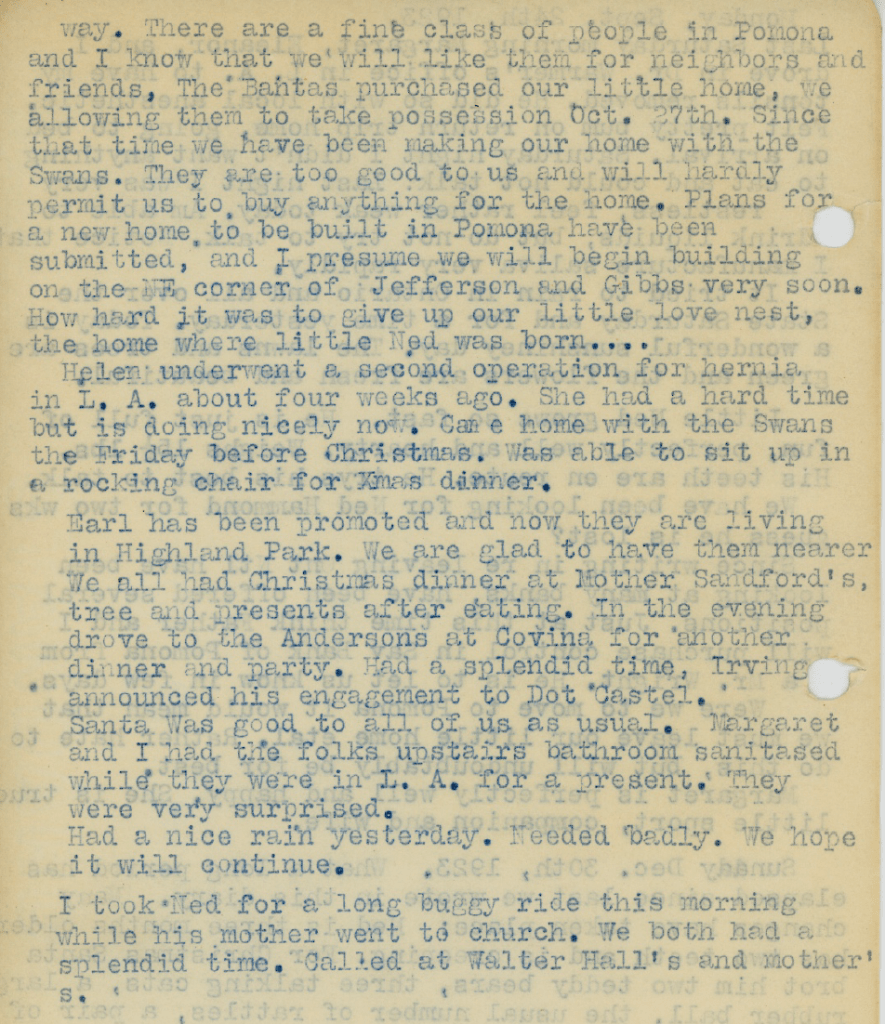
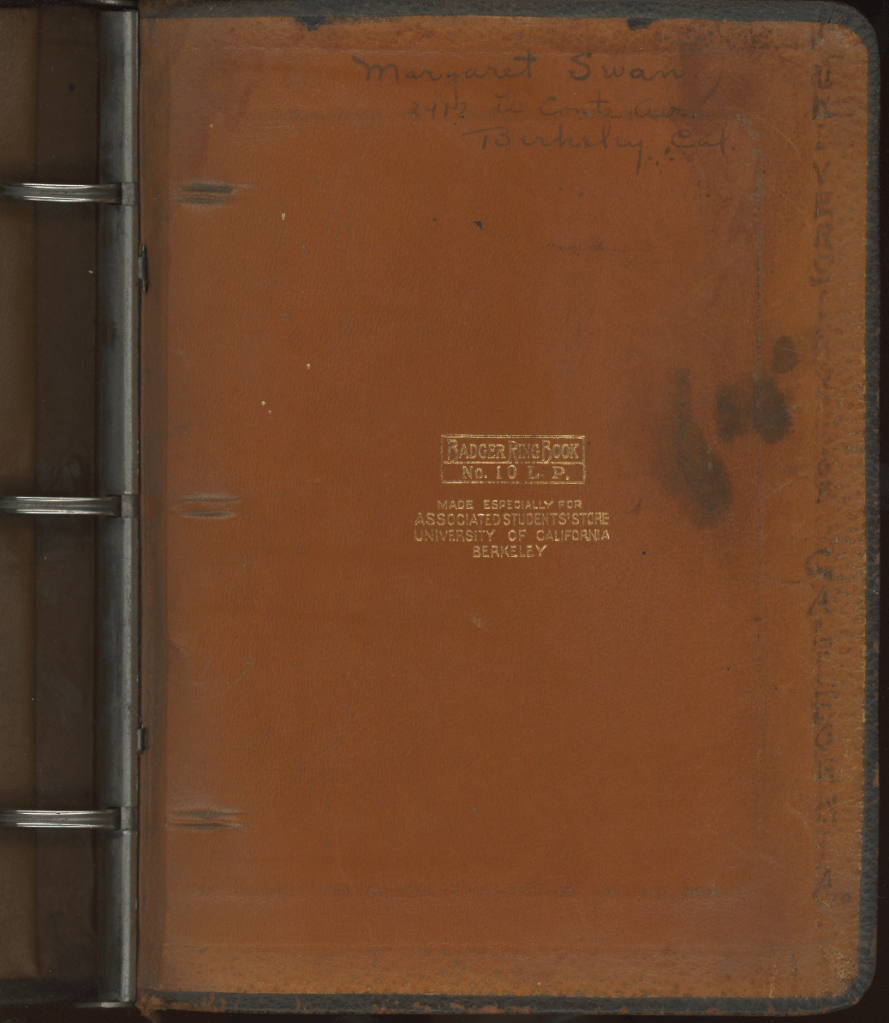
From 1922 to 1923 the best source of information on the Sandford and Swan families is grandfather Joe Sandford’s diary, two dozen typewritten pages in a notebook formerly used by grandmother Margaret during her studies at the University of California at Berkeley. The diary was found by cousin Robert in the crevices of Joe’s old roll-top desk.
After getting married, Joe and Margaret lived in the home at 507 North Vine Ave, next door to Margaret’s parents, Henry and Mabel Swan at the house at 501 homestead. The two families were very close, even taking extended trips together.
The months following the death of Joe’s father Edward in October, 1922 were eventful. By year-end, Joe and Margaret were expecting their first child, our future uncle Ned. Joes’s older sister Saada and her husband Earl Beck had plans to move from Ontario to Santa Barbara. Joe’s younger sister Helen was engaged to a bank teller named Jimmie Holland, although this relationship would come to an end early the next year.
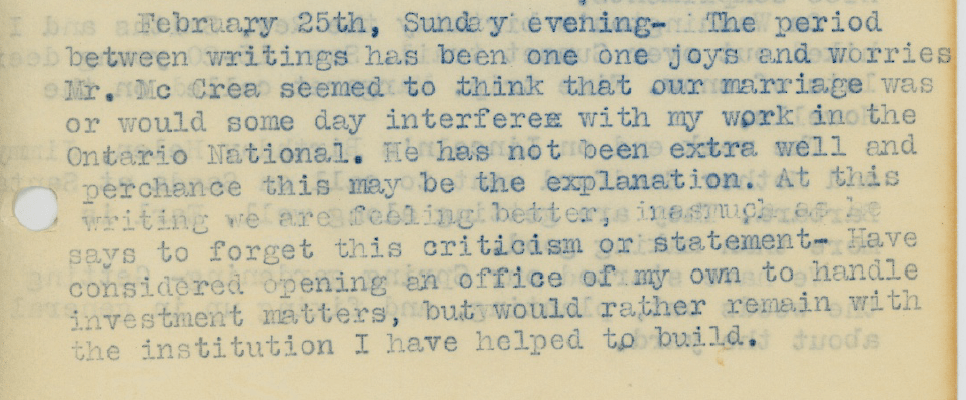
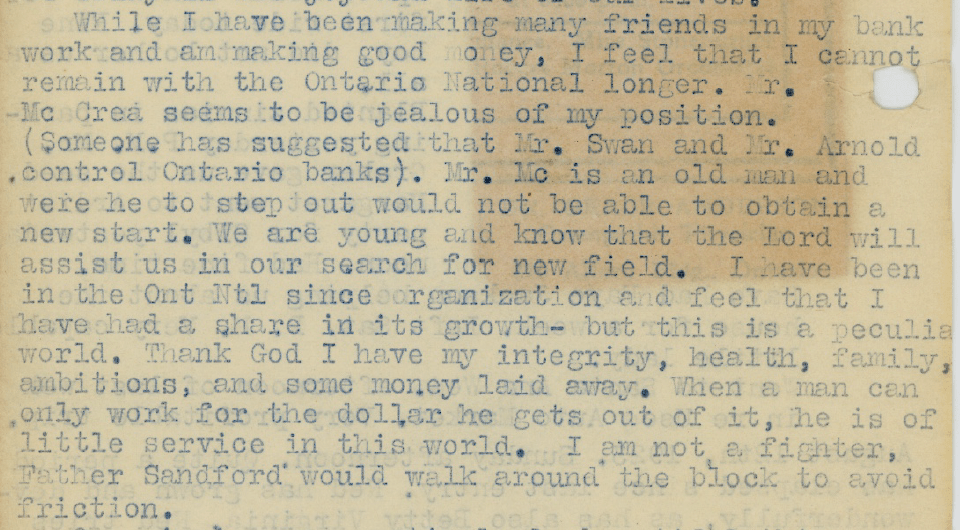
Not long into 1923 we begin to see signs of problems emerging with Joe’s job at the Ontario National Bank. At this time, Joe is Vice President, still working for George McCrae, the man who convinced Joe to return to work for him after World War I. That the elder McCrae was insecure in his position as bank president, excessively dependent on Joe to maintain his stature was predictable, given the content and tone of his 1919 letter to Joe in France.
Ned’s birth on April 30 brought happiness to all, and temporary distraction from Joe’s problems at work.
That summer, Joe, Margaret and Ned vacationed in Santa Barbara with Saada’s family. Henry and Mabel Swan spent a month in the Hawaiian Islands.
We also see that Joe has been looking around for job opportunities and getting offers. His unhappiness working for George McCrae continues to grow. It also appears that McCrae views Joe’s relationship to Henry, one of the most powerful bankers in Ontario, as an unfair advantage, adding to the friction.
This last sentence is illuminating. Like his father, Joe was, by nature, not a fighter. It is an enduring image, Reverend Edward Sandford (or banker Joe) walking around the block to let off steam.
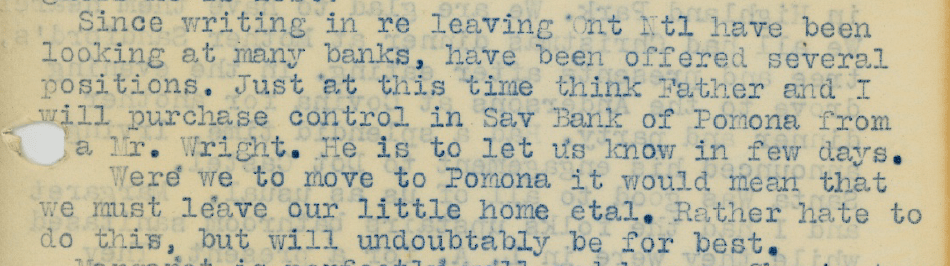
By September, 1923 we see a plan emerging between Joe and his father-in-law Henry Swan to take over the Savings Bank of Pomona. The plan includes Joe and Margaret leaving Ontario and building a new home in Pomona.
September 24, 1923
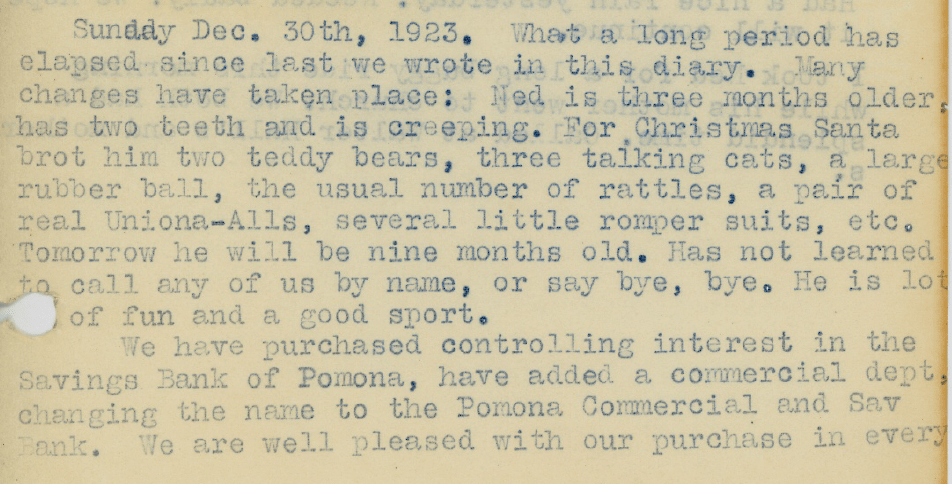
By the end of 1923 the plan has changed to reality–Joe and Henry have purchased the Pomona bank. Joe and Margaret have sold their home at 507 and moved in next door with Henry and Mable, everyone in good spirits and preparing for major changes at work and at home. The process of building a new home in Pomona is underway.
Joe and Henry would be partners in the new Pomona banking enterprise. Having solved their biggest problem, Joe and Margaret entered the new year filled with optimism and eager anticipation for what 1924 would bring. We will soon see that they could not have been more wrong.
The inside cover of the notebook containing Joe’s 1922-1923 diary. 2417 Le Conte Avenue is north/immediately adjacent to the main Berkeley campus.
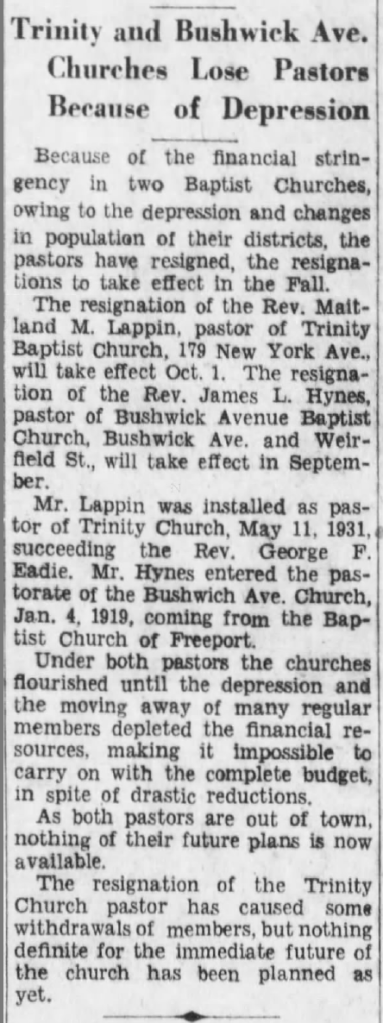
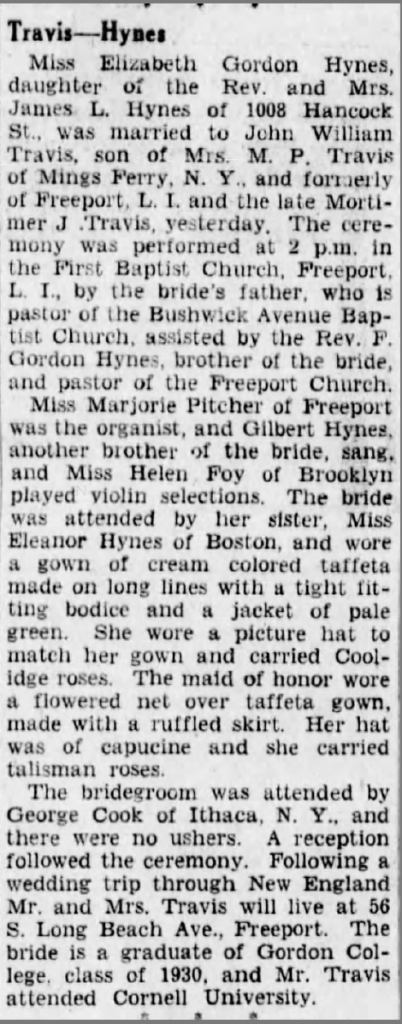
Gordon was 25 in 1932. His older sister Elizabeth (Betty) was 26, younger sister Eleanor 23, and brother Gilbert 22. That year, both Betty and Eleanor were married (by their father, in his church, sustaining the family mysteries surrounding their relationship with their abusive father) and left home.
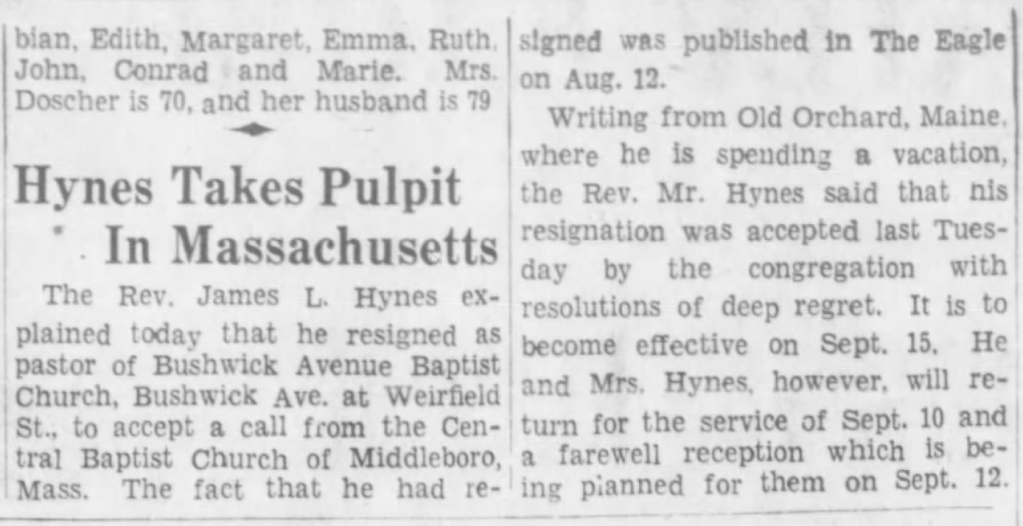
Eleanor was married to Maurice Jacques, a preacher from Bridgewater Massachusetts, from a Rhode Island family. Bridgewater is only 5 miles from Middleboro (south of Boston), so it is interesting to speculate who followed who there (between Eleanor and James). The Hynes family had strong ties to Massachusetts religious community going back to Betty’s 1906 birth in Watertown, Massachusetts (not New York as previously inferred from an odd misleading record in the New York birth register) at about the same time that James started his career in the ministry. Some component of James’ religious education must have taken place in the Boston area. Also, both Betty and Gordon attended Gordon College to the north of Boston. Some of the resulting family ties mush have led to Eleanor’s introduction to Maurice as well as James finding his new position in Middleboro. Eleanor and Maurice would go on to start their own large branch of the family tree.
Gilbert followed his parents to Middleboro. He would marry Margaret Rehnberg in 1939 and pursue a successful career as a classical singer in Massachusetts and Rhode Island.
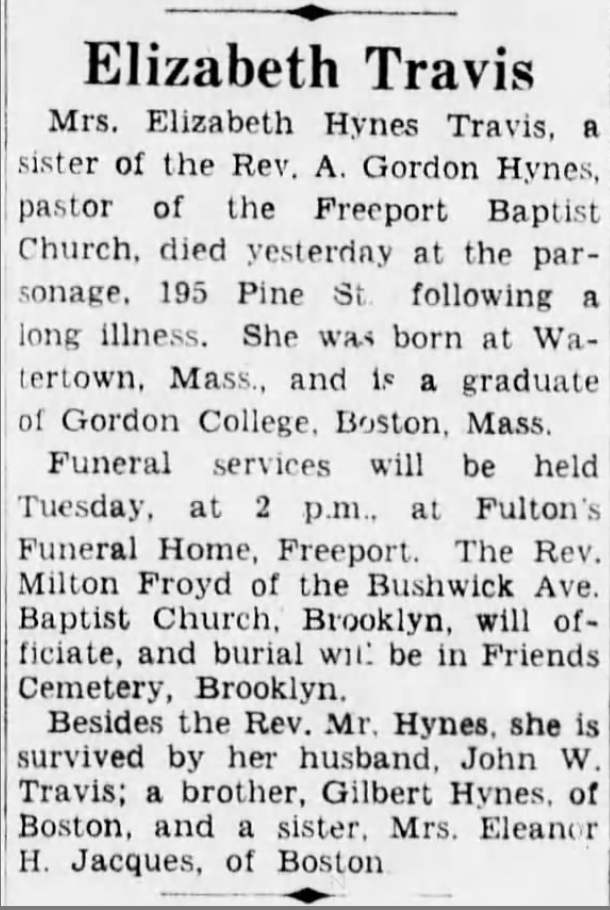
Betty fared poorly. Not long after marrying John William Travis in Brooklyn in 1932 she would fall fatally ill, succumbing to Diphtheria or Rheumatic Fever (according to the 2019 memories of Mom and her brothers) in 1935. One of mom’s earliest memories is of Betty lying ill in the family home in Freeport.
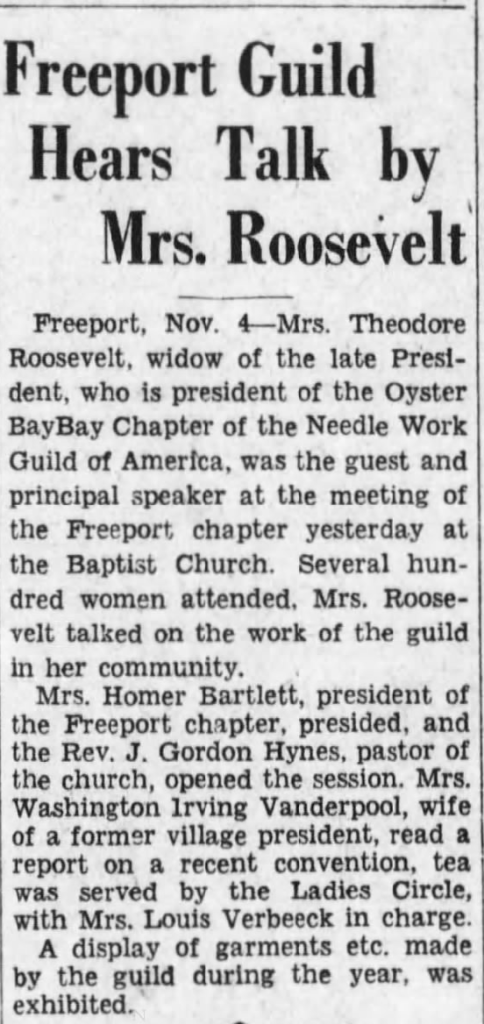
Newspaper accounts through the 1930s in Freeport show a successful ministry under the pastorship of Gordon Hynes.
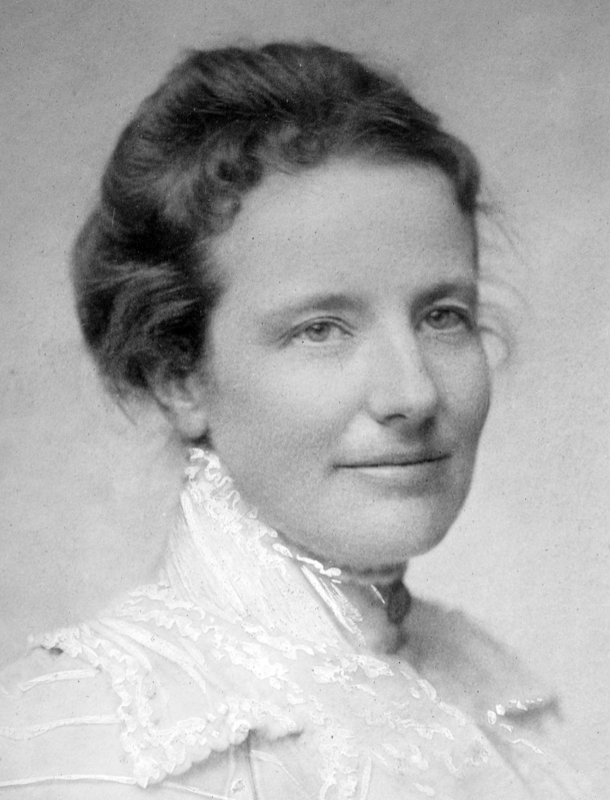
We close this chapter with an account of a family encounter with celebrity, the former first lady, Edith Roosevelt, from nearby Oyster Bay, Long Island.
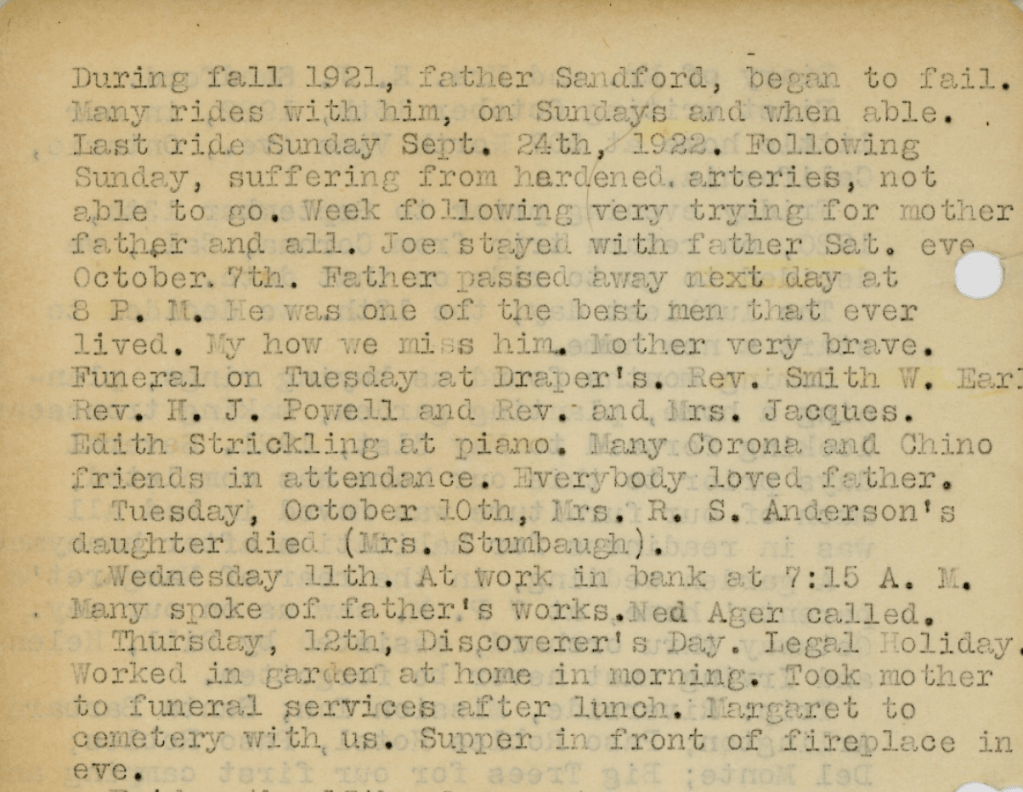
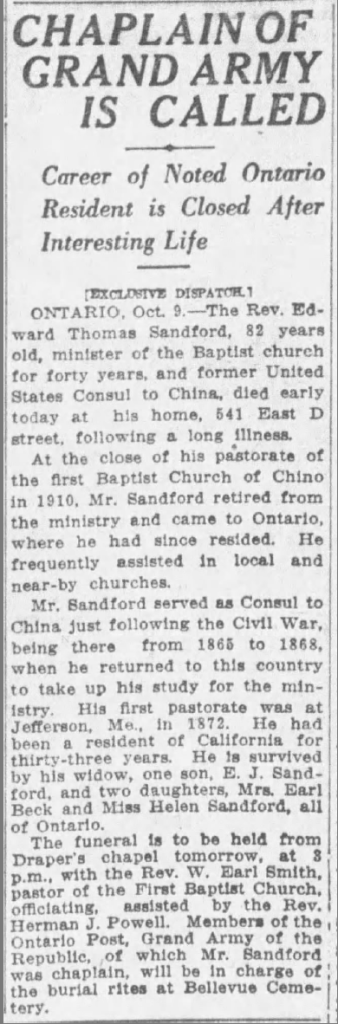
Edward had dealt with health concerns most of his life, beginning with his near-fatal battlefield wound in 1864. Non-specific, health concerns were cited among reasons for his decision to leave Vermont in 1890 in search of a warmer climate. In his final year of 1921-1922, Edward’s diagnosis was hardening of the arteries.
His son Joe left a few notes on his father’s last year in his diary.
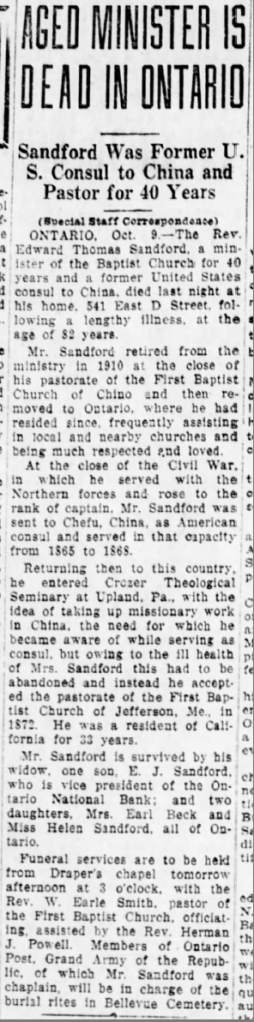
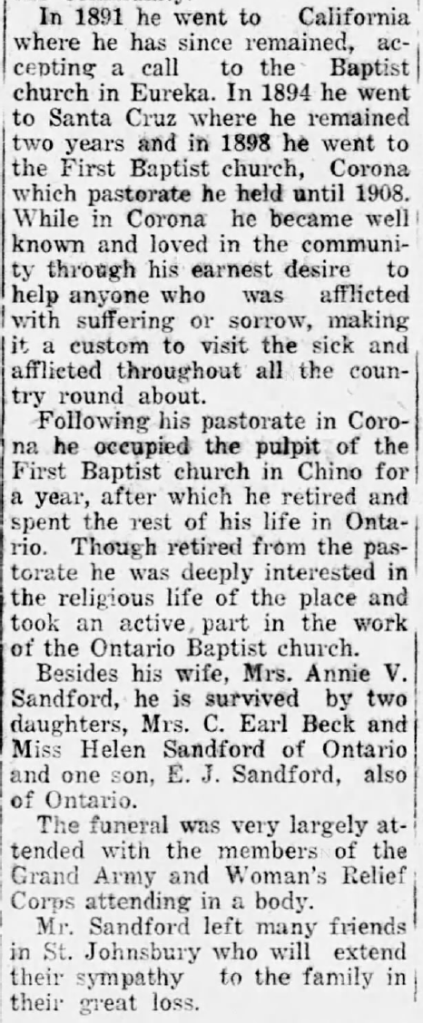
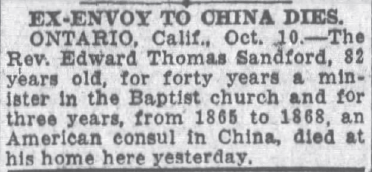
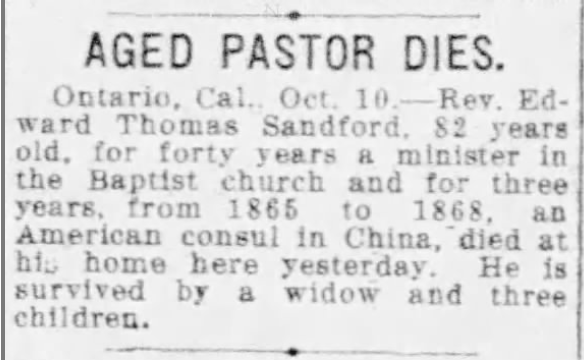
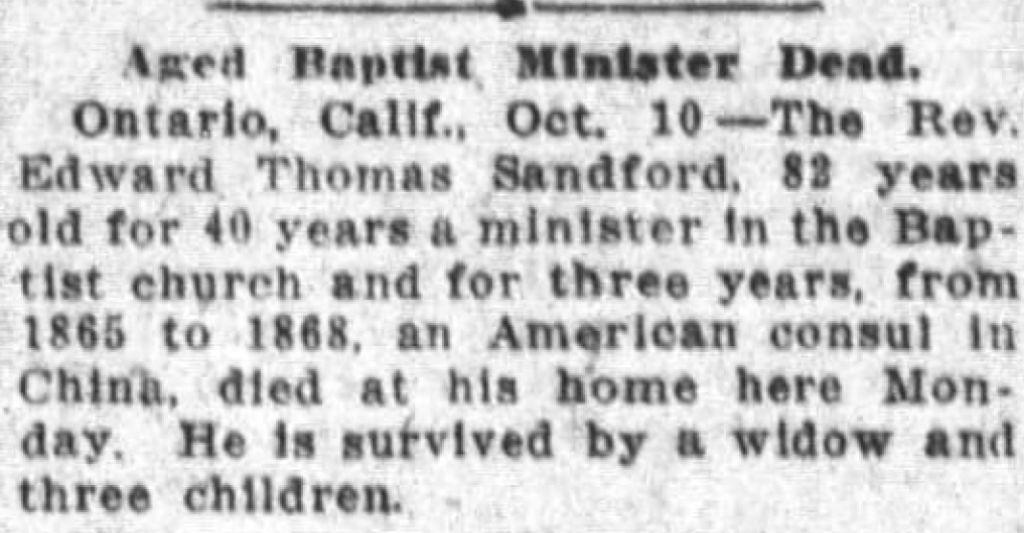
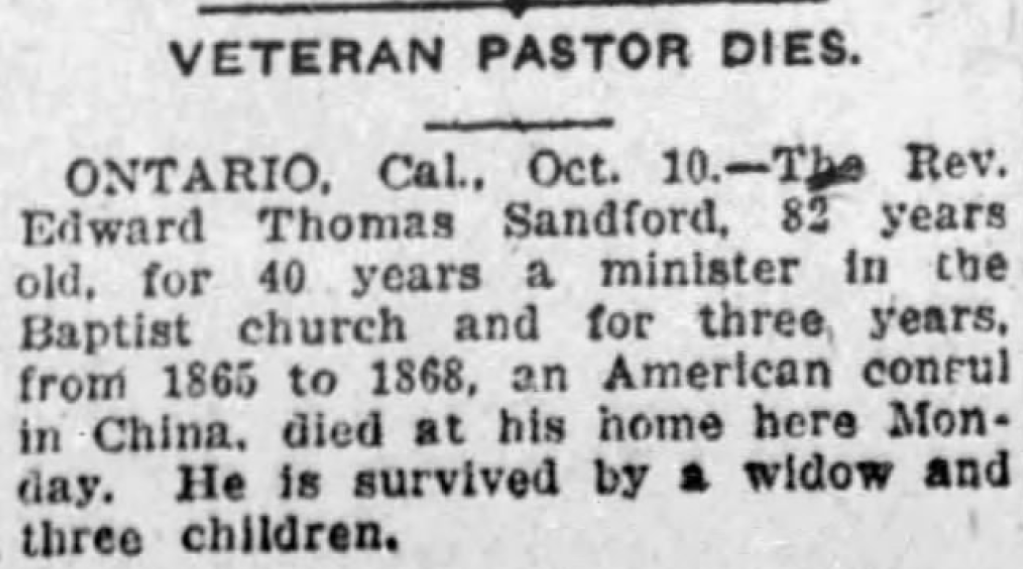
Edward died on October 8, 1922 at age 82. Joe was 30. Obituaries in the Los Angeles Times and San Bernardino County Sun acclaimed Edward’s life of service…
Los Angeles Times, October 10, 1922. The Grand Army of the Republic was Civil War Veterans association in which Edward was active.
San Bernardino County Sun, October 10, 1922
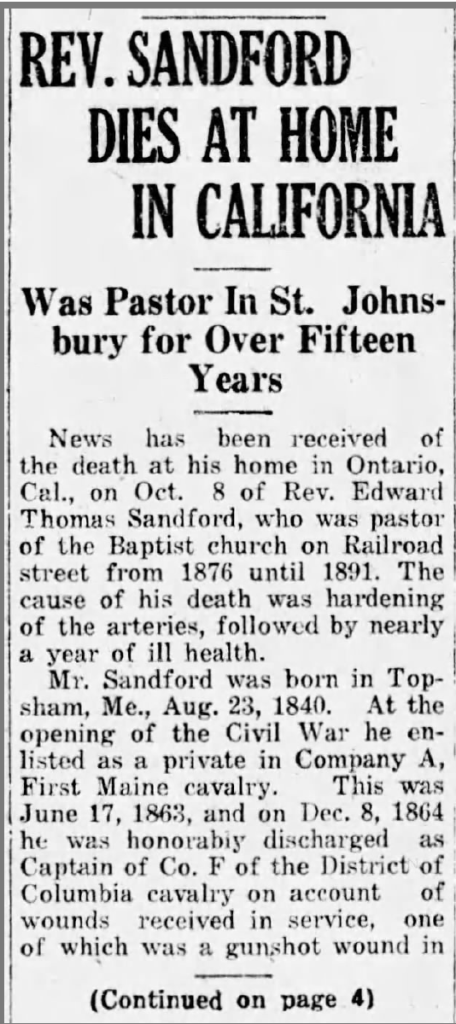
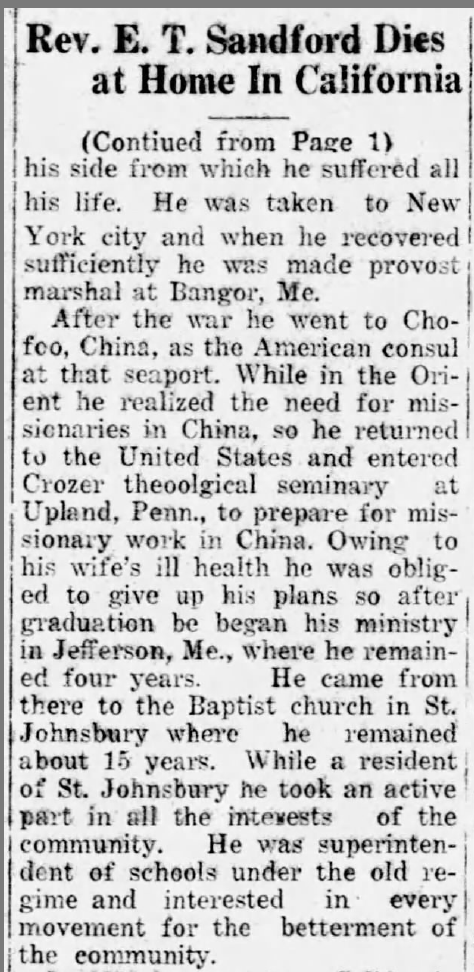
Saint Johnsbury, Vermont commemorated Edward’s life, as well, publishing a detailed remembrance two weeks later…
Saint Johnsbury Caledonian-Record, October 25, 1922
Notice of Edward’s death reached the wire services and appeared nationwide.
Oakland Tribune, October 10, 1922Des Moines Tribune, October 10, 1922
Greensboro Daily News, October 12, 1922Billings Weekly Gazette, October 12, 1922
Great grandmother Annie, age 64, remained in the family home on East D Street for the rest of her life. Daughter Helen, age 24 in 1922, lived with her mother until 1931 (also spending time overseas), when she married Edgar Bircsak.
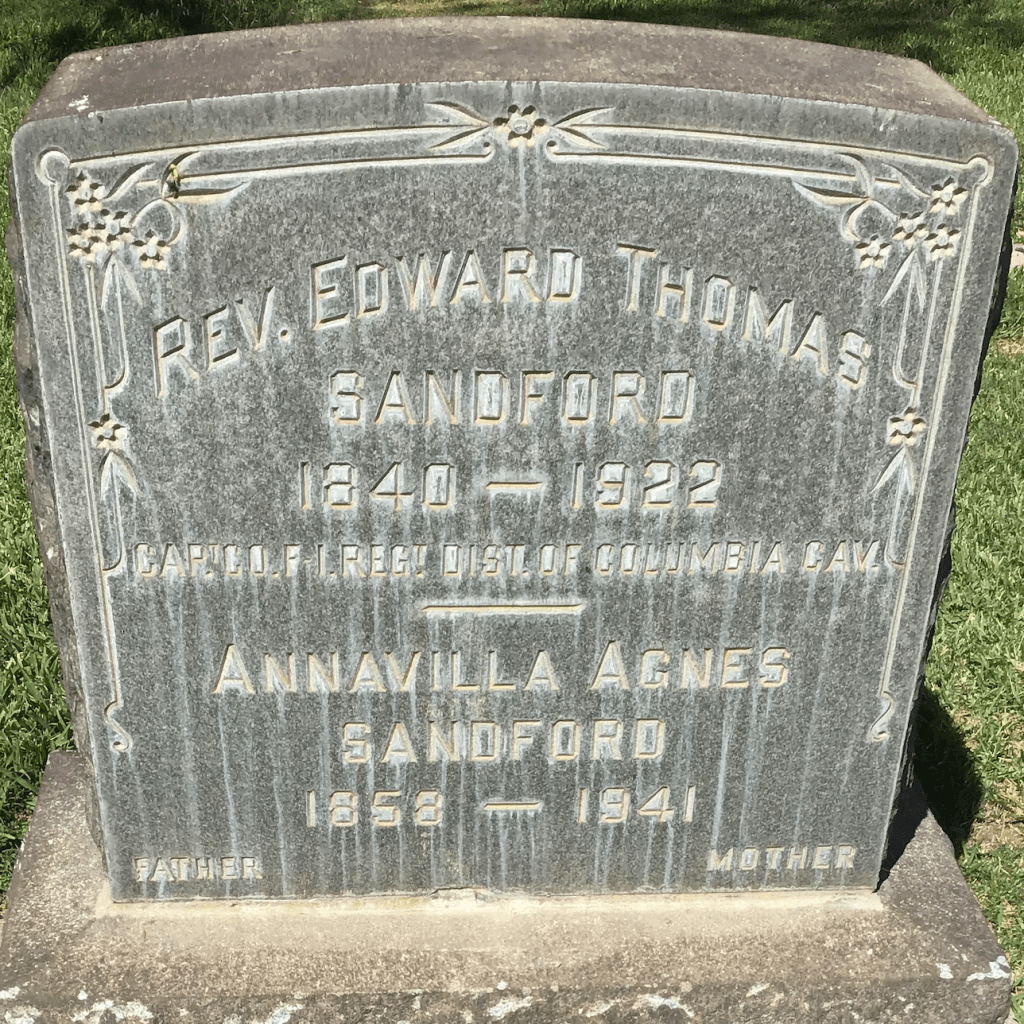
Edward and Annie (following her death in 1941), are buried in the family plot at the Bellvue Cemetery in Ontario.
Edward and Annie are buried in the Bellvue Cemetery in Ontario.
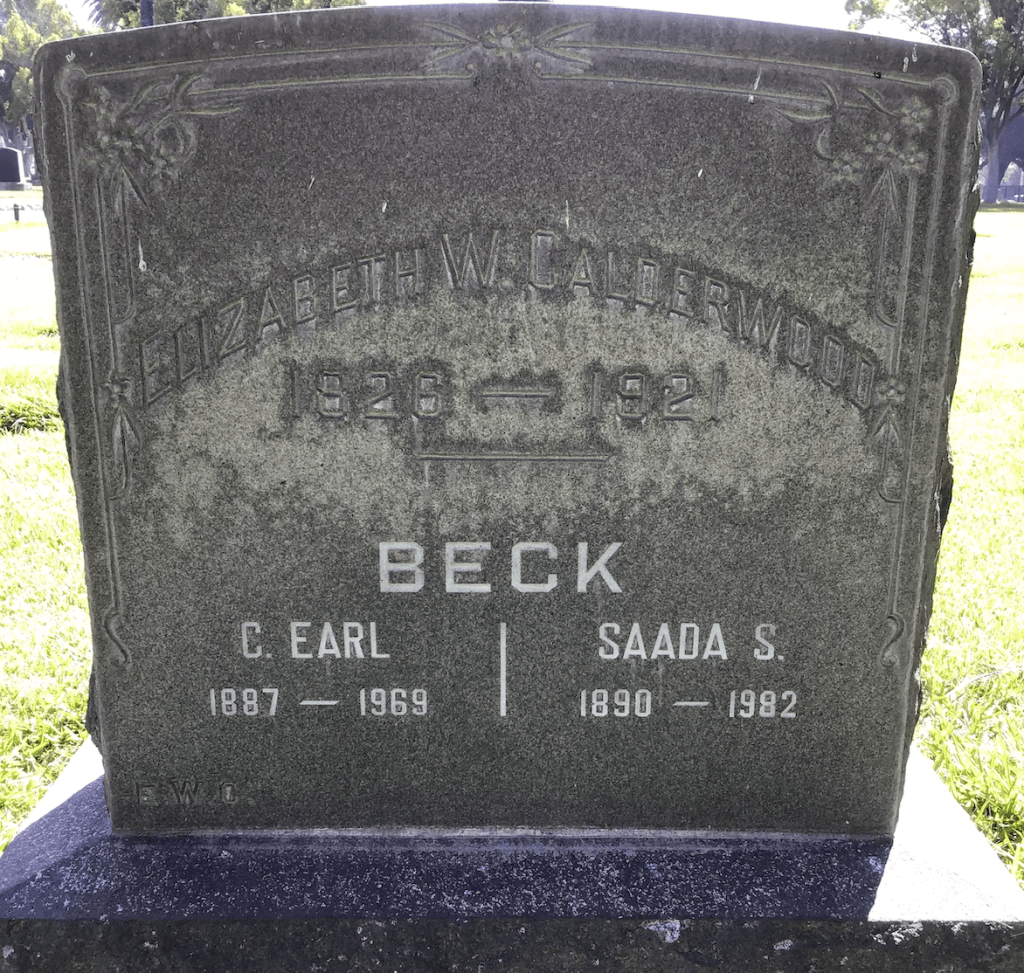
The back side of Edward and Annie’s gravestone commemorates Annie’s mother, Elizabeth, daughter Saada, and son-in-law Earl Beck.
Most of us would need five lives to accomplish what Edward did in one. He was a merchant sailor, a (wounded) Union soldier, an American diplomat in China, a minister, and a school administrator, giving his full measure to each task. He had two full, devoted marriages and raised three successful children. He sailed to the other side of the world twice. He was a pioneer in the American west.
In Joe’s words, “he was one of the best men that ever lived.”
Joe and (grandmother) Margaret Swan had been friends before the war, but no serious relationship formed at the time. Margaret was attending school at the University of California at Berkeley, so the two may just not yet have had much time together. Joe tells of his early encounters with Margaret, both before and after the war, in his Living History interviews.
I had kept company with Margaret a little, before we went to war. She was going to the university, but I didn’t think she had any interest in me. I went away to war, and I was supposed to go up to the university for a course, in the Ordnance Department. Her mother [Mabel Swan] told me she was up there, and I guess she wrote to her and told her I was coming up. Anyway, I got a change in orders and went to Augusta, Georgia. I was overseas for over a year. I returned home in 1919, in June. The next day after I returned home, I had my hobnailed boots <unclear> They put on a great <unclear> for the boys who won the world for democracy. Most of the boys were home. I was perhaps a little later than some. Everybody in the race went down Euclid Ave.
Interviewer: What kind of a race?
An automobile race. The old White Steamer, a little Buick, little cars. I’ve forgotten just where it started. Say it started at Chaffey: I could be wrong there. It went down Euclid Ave. to what’s Holt Ave. now, went west on Holt Ave. to Mountain Ave., which is a mile, up Mountain Ave. to Sixth or Seventh Street and across to Euclid and down. It made quite a place to race. People were everywhere. The town spirit. I was up in front of Chaffey there, with a lot of people.
This girl here [Margaret], Mr. Richardson’s daughter [Ardis] and her pals were there talking. She left that bunch and came over and walked me home. Well, that started things, and here we are.
Joe Sandford from 1973 Living History Interview with Esther Boulton Black
Mabel Swan having tried to set Joe and Margaret up to meet in Berkeley in the spring of 1918 suggests that perhaps there had already been at least a little speculation of Margaret’s interest in Joe going on between mother and daughter.
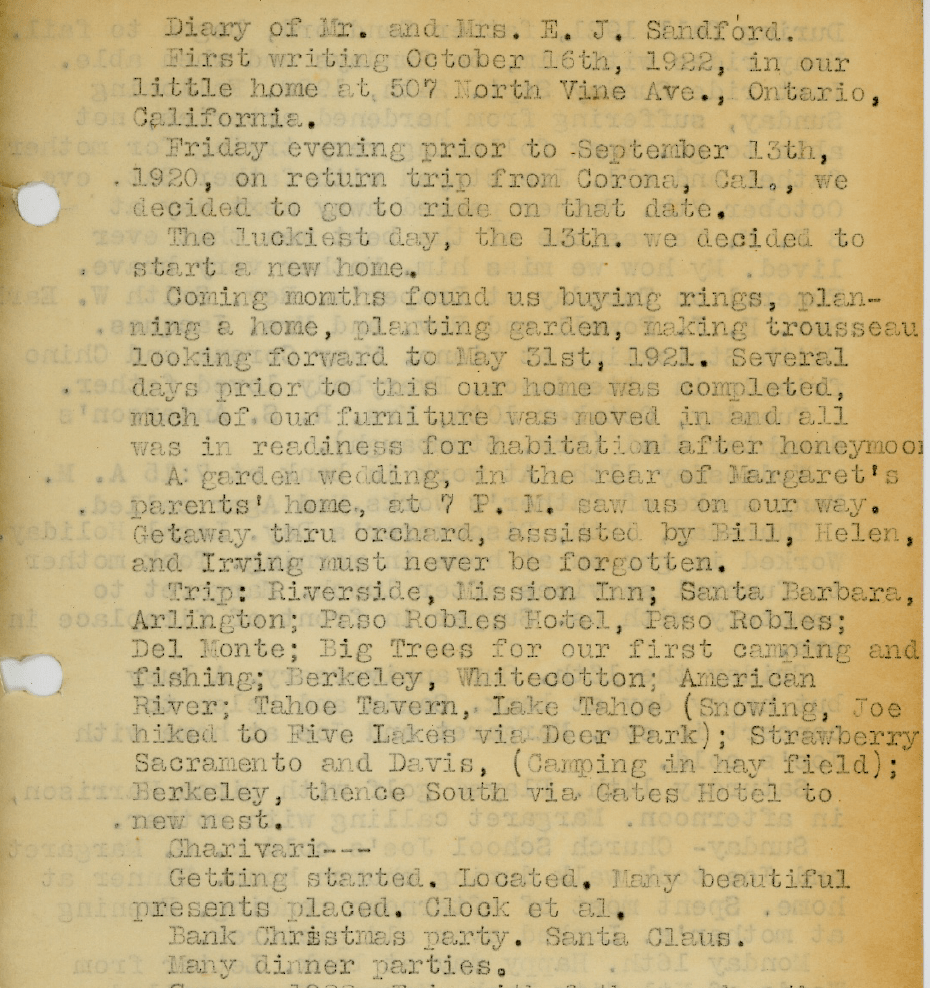
Joe began writing a diary in 1922, found later by cousin Robert in the crevices of grandpa’s roll-top desk. The first page of the diary has Joe’s terse, rough recollections of the period of their engagement two years earlier…
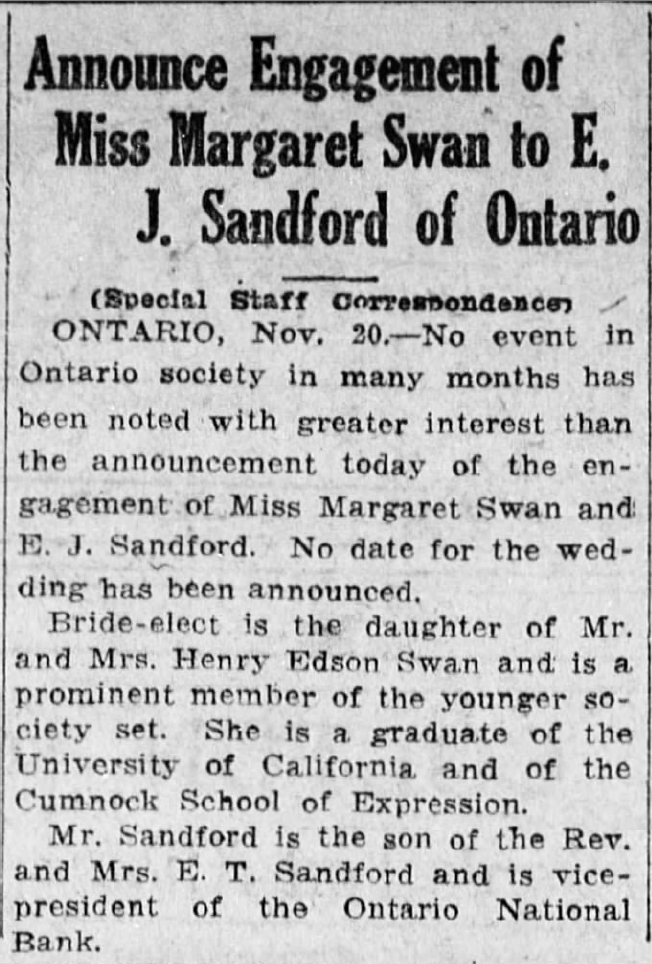
Although not completely clear from Joe’s notes, September 13, 1920 is evidently significant and seems to be the date of their engagement. This is consistent with the November 20 date of the public announcement of the engagement, a year and a half after Joe’s return from the war.
San Bernardino County Sun, November 21, 1920
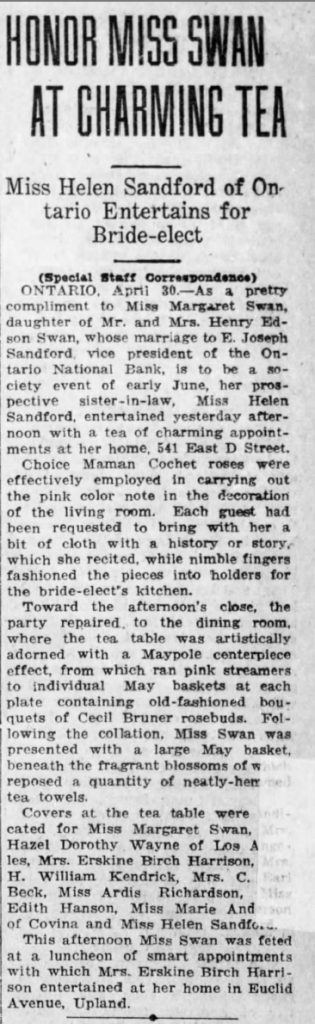
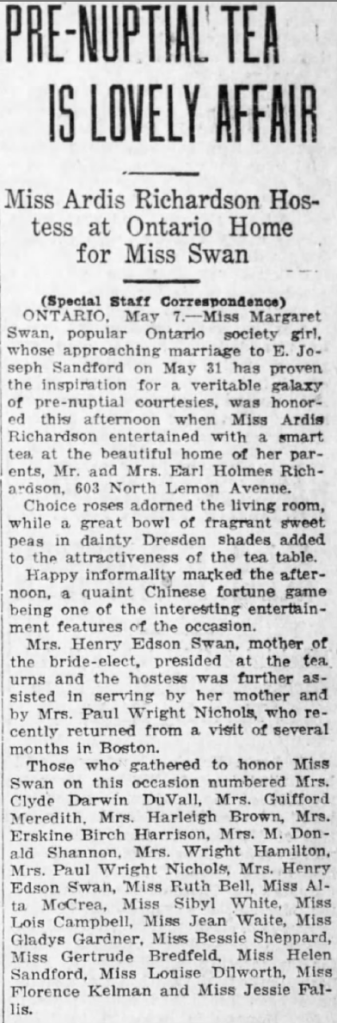
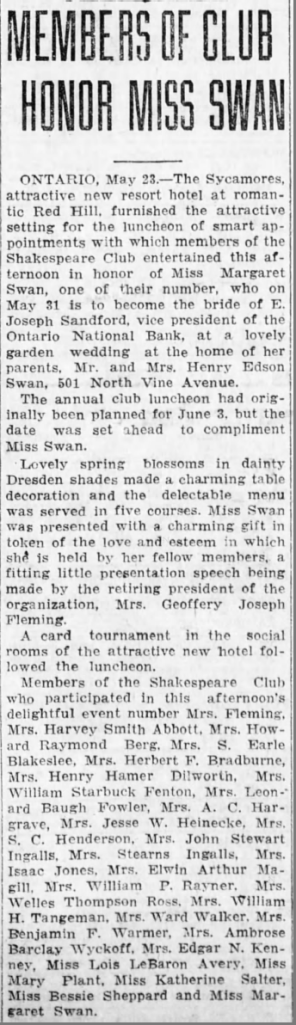
By the spring of 1921, the celebrations of the upcoming wedding were in full swing. Several parties were held for the bride-to-be…
San Bernardino County Sun, May 1, 1921. Margaret’s sister-in-law- to-be, Helen (“Honey”), hosted a party at the Sandford house on East D Street.
San Bernardino County Sun, May 8, 1921. Margaret’s long-time friend Ardis Richardson hosted another party.
San Bernardino County Sun, May 24, 1921. Margaret and Mabel’s society friends threw a big party at the Sycamores Hotel, near the site of the soon-to-open Red Hill Country Club.
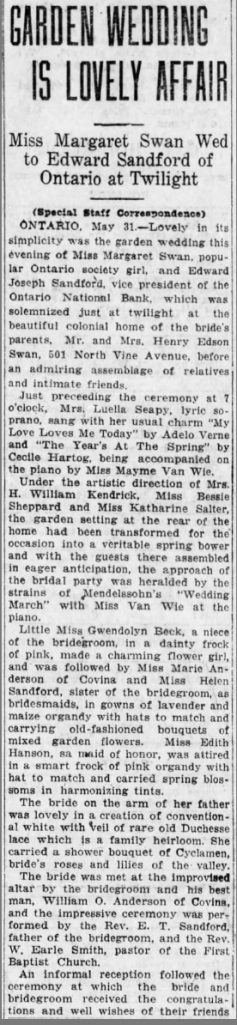
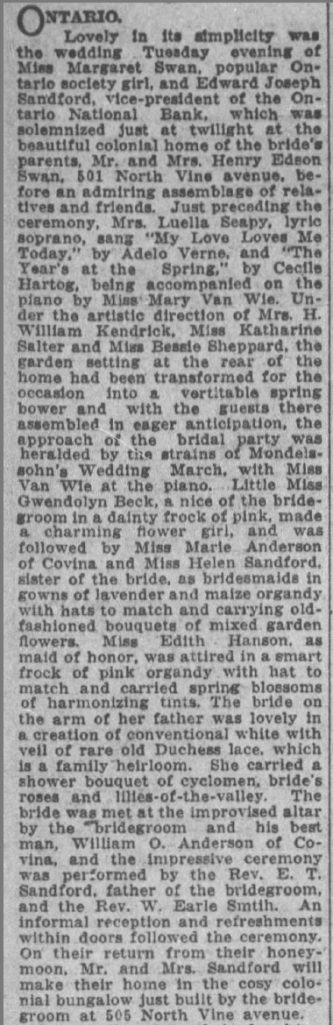
Joe and Margaret were married Tuesday May 31, 1921. The ceremony was held behind the 501 N. Vine Avenue home of Margaret’s parents, Henry and Mabel Swan. Joe’s father, the Reverend Edward Sandford, co-officiated at the ceremony.
San Bernardino County Sun, June 1, 1921
Los Angeles Times, June 5, 1921
Between Joe and Margaret there remained only one living ancestor of their grandparents’ generation at the time of the wedding. Elizabeth Smith Calderwood, Annie’s mother, had lived with Edward and Annie’s family since the family left Vermont, most recently at the house on East D Street. She would die on August 3, 1921, at age 95, two months after the wedding.
I don’t have proof that the other minister that presided over the wedding, the W. Earle Smith named in the news articles, was related to Elizabeth, but it seems quite possible and it would explain the presence of two ministers at the wedding. In Ontario’s Bellevue Cemetery near the family plots there is a marker for Frank P. Smith, 1852-1922. It may be that Frank was Elizabeth’s brother and Reverend Earle was Fran’s son, therefore Annie’s cousin. If so, then Frank would be the founder of another family branch to make roots in California, and would lead to another round of speculation on who followed who there (for example, perhaps the Smiths played a role in leading Edward and Annie to their retirement in Ontario). This will be something to try to prove in the future, although “Smith” is a difficult name to research.
Joe and Margaret’s honeymoon trip up and down California is described in the diary entry. It is interesting to note the low-key nature of both the wedding (held in the back yard) and the honeymoon (which included camping and hiking). We begin to see the transition of Margaret the high-society girl, to Margaret the more down-to earth grandmother that we knew. There was similar change in Joe’s life, as well–in his case, he transitioned from the simple son of a Baptist minister to a prosperous and successful banker. The two seemed to meet happily in the middle of the two worlds.
Once married, Joe and Margaret moved into the new house next door to the Swans at 505 North Vine Ave, which we later knew as the “Finsterbach house”. It is unclear whether the home was built specifically for them as implied in the newspaper articles–if so, it would have had to have been built very quickly following the announcement of the engagement six months earlier.
Margaret and I were to be married in this place here, in 1921, in this house on the hill. It belonged to her father and mother. They were living here then. We had built the little place next door. Anyway, that day, long about eleven o’clock in the morning, as I remember, Mr. Bucknell came up here with that grandfather clock. That cost a lot of money. That was our wedding present. A little thing, and that was so far-reaching.
Joe Sandford from 1973 Living History Interview with Esther Boulton Black
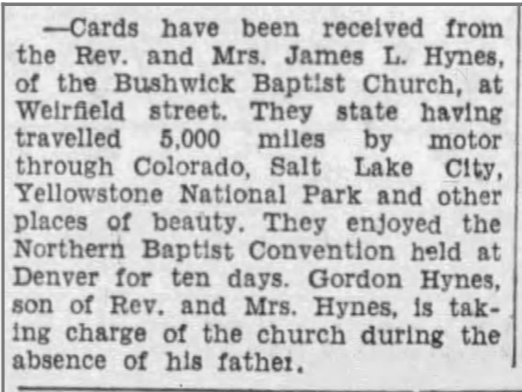
The Sechler and Hynes families came together in the 1920s in Bushwick, Brooklyn where they lived one block apart. Great grandmother Laura Sechler and daughter Ruth lived at 987 Hancock Street while Great grandparents James and Bessie Hynes lived at 1008 with their four children. The Bushwick Avenue Baptist Church, where James was preacher, was another block to the north.
Both families had lived in the neighborhood since at least 1924 (Laura appears on a 1924 voter registration list), Laura and Ruth having lived in various homes since returning to the neighborhood after the 1907 death of husband/father George, the Hynes family having moved there from Freeport in the early 1920’s.
Movements of the Wright, Sechler, and Hynes families in and around Brooklyn, before and after the convergence of the Sechler and Hynes branches of the family tree in the late 1920s and 1930..
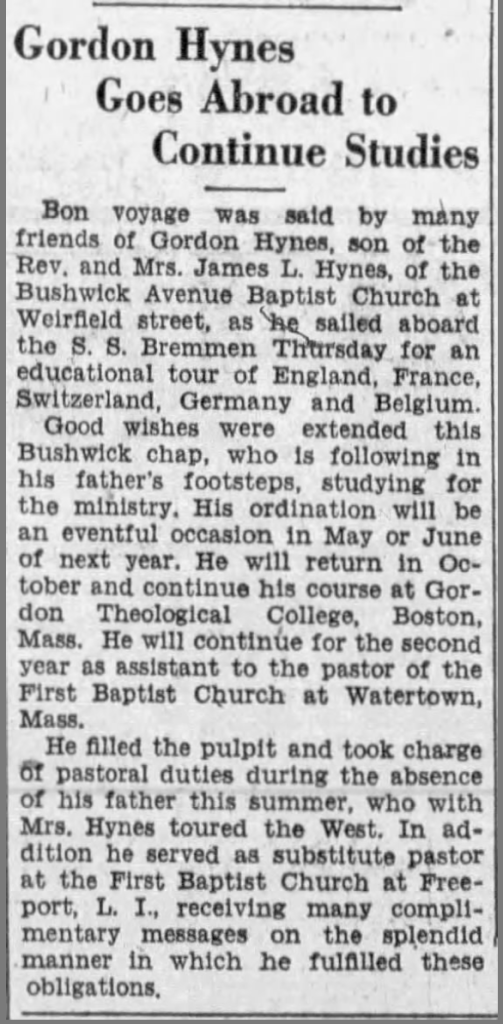
In 1929 we begin to see grandfather Gordon Hynes, at age 21, coming into the limelight as his father’s heir-apparent and a young phenomenon in the Baptist ministry. He was a student at Gordon College north of Boston, a Baptist school. In the summer of 1929 he began making substitute appearances at his father’s Brooklyn church and some Boston-area churches. In the fall of 1929, Gordon took an extended senior-year trip across Europe.
Brooklyn Times Union, July 26, 1929
The Chat, Brooklyn NY, June 28, 1929The Chat, Brooklyn NY, September 13, 1929
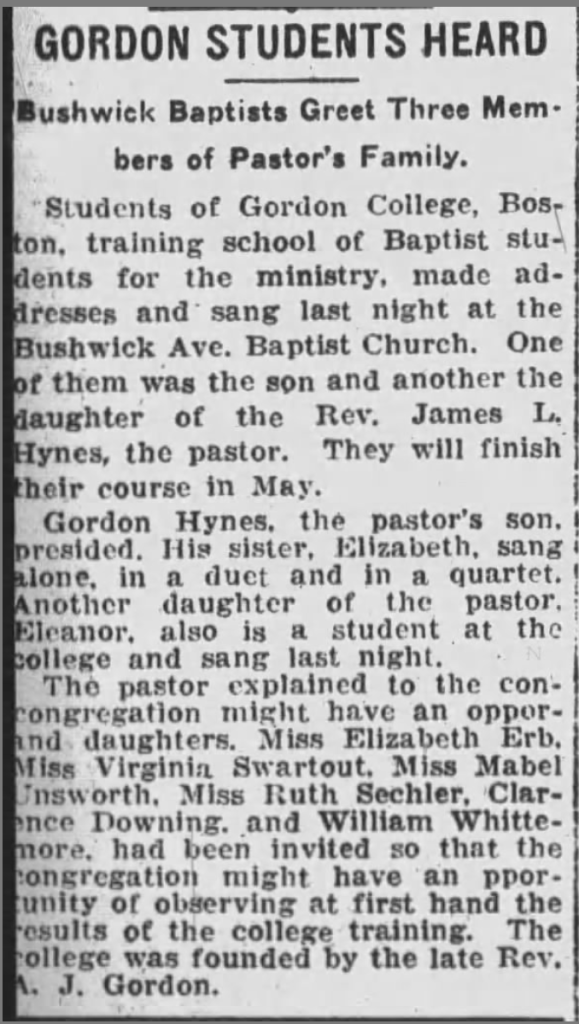
Brooklyn Times Union, March 22, 1930. Gordons’s sister Elizabeth (Betty) and future wife Ruth were also students at Gordon College.
Grandmother Ruth Sechler was also a student at Gordon College, a year behind her future husband. Assuming that Gordon Hynes entered the college in 1925, the two families must have gotten to know each other in Brooklyn in the first half of the 1920s. Mom thinks the initial friendship probably formed between Ruth and the Hynes sisters, Elizabeth (Betty) and Eleanor. Betty was a year older than Ruth (18 months older than Gordon). Eleanor was two years younger. Betty was also a student at Gordon College, the same class as her brother, both graduating in the spring of 1930. Ruth must have followed Betty and/or Gordon to the school, her relationship with Gordon developing in Brooklyn and/or Massachusetts following her initial friendship with Betty.
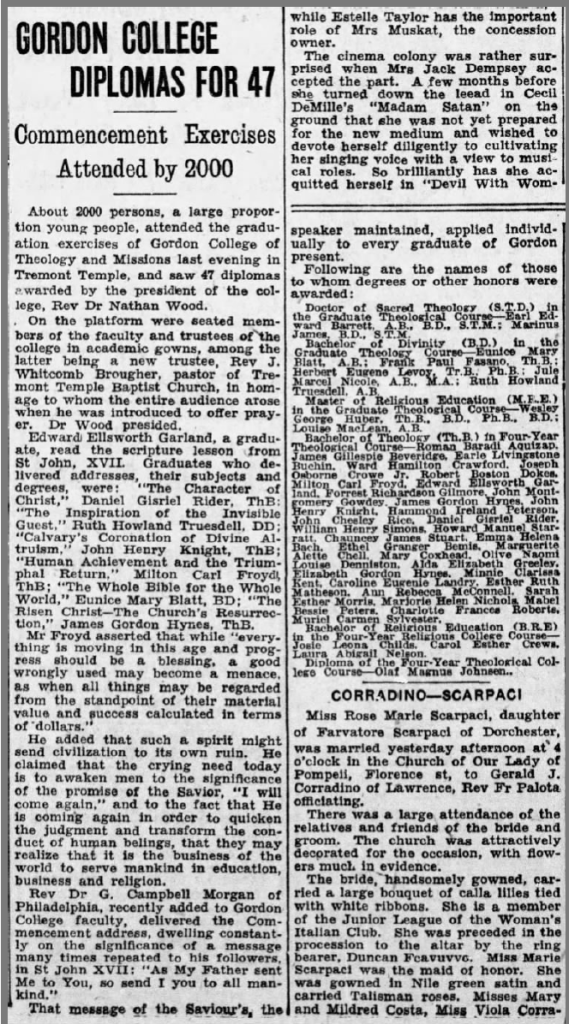
Boston Globe, June 5, 1930. Both Gordon Hynes and his sister Elizabeth (Betty) Hynes received Bachelor of Theology degrees from Gordon College.
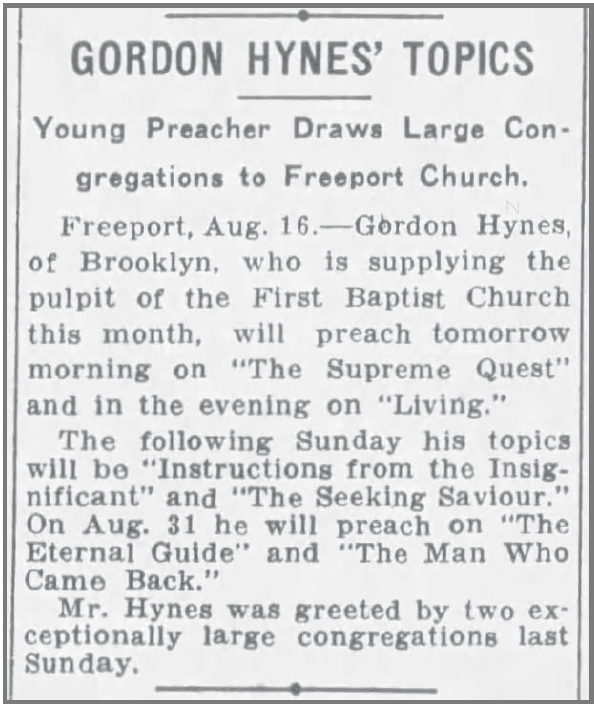
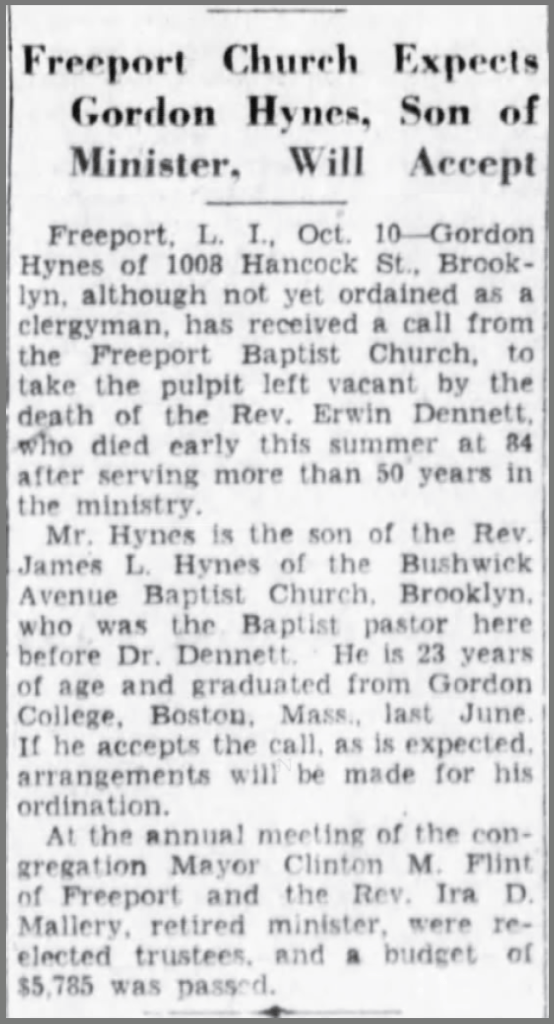
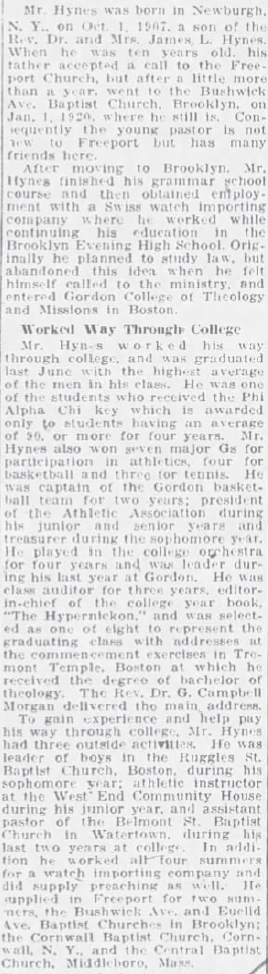
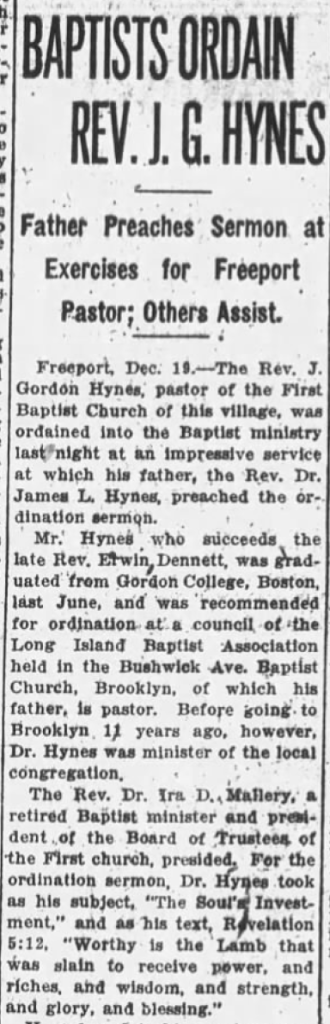
Following his graduation, Gordon became associated with the First Baptist Church in Freeport, Long Island, where the Pastor, Erwin Dennett, had died in the early summer. This was the same Freeport church that James Hynes had led in 1919 before moving to Brooklyn. Gordon did guest preaching engagements in the summer and by October had been offered the permanent position of minister.
Brooklyn Times Union, August 16, 1930
Brooklyn Daily Eagle, October 10, 1930
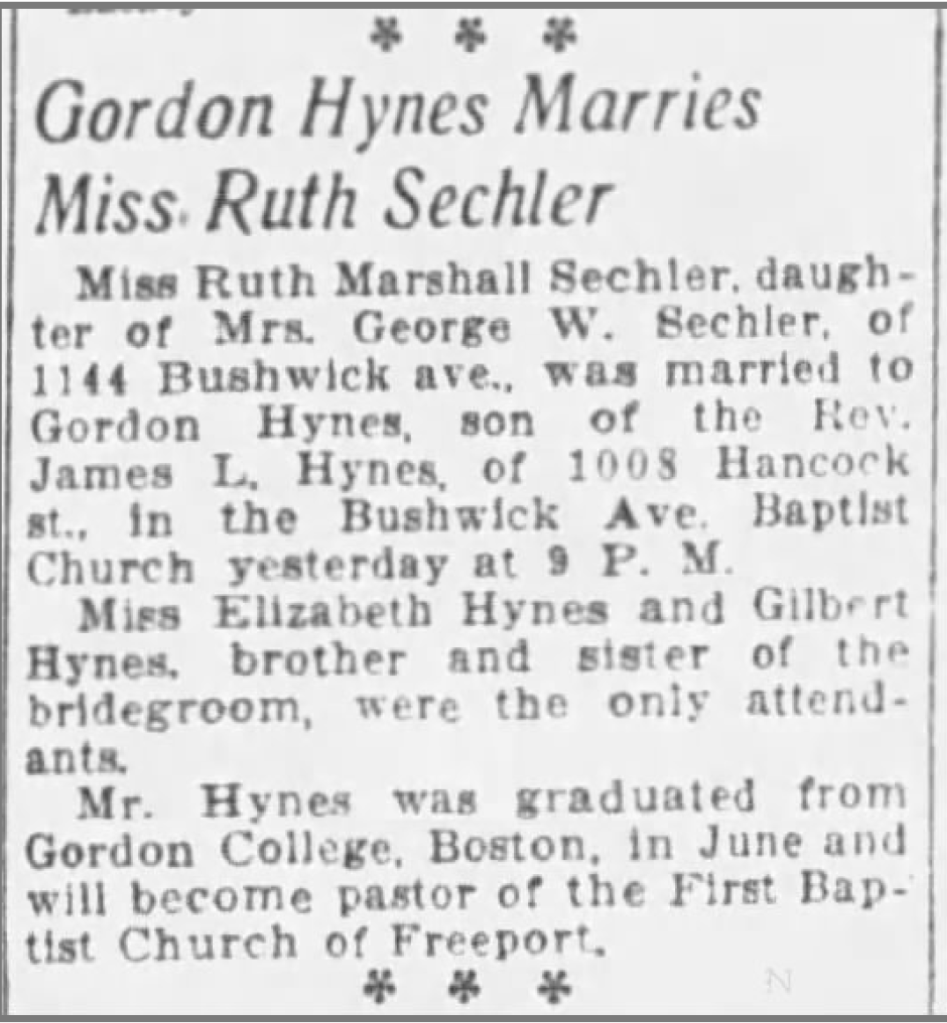
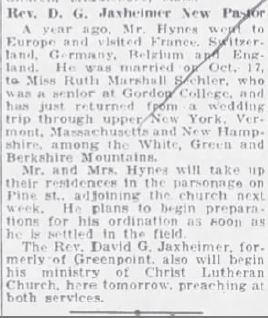
Gordon and Ruth were married the evening of Friday, October 17, 1930 in the Bushwick Avenue church. A brief wedding announcement reveals the odd nature of this wedding service.
Brooklyn Times Union, October 18, 1930
Aside from physically taking place in a church, this has all the feel of a City Hall civil ceremony (which surely would have been unthinkable in such a religious family). Some of the rushed nature of this ceremony could perhaps be attributed to the urgency of Gordon needing to move to Freeport and start a new job in a few weeks. However, this does not explain the absence of parents in the church, all three of whom lived blocks away. Mothers Laura Sechler and Bessie Hynes were not present. Father James Hynes does not appear to have been present, let alone involved in conducting the ceremony in his own church.
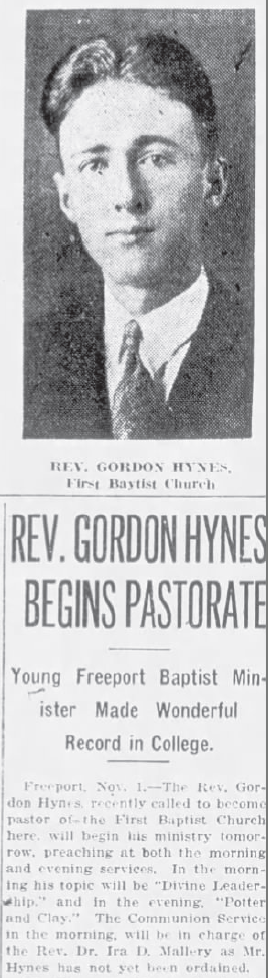
By November, the new family was living in the Pine Street parsonage in Freeport, next to the church. Ruth never returned to Gordon College to finish her final year of studies. Mom would be born 16 months later.
Whatever circumstances kept Laura from attending her daughter’s wedding service, she was, nevertheless, part of the deal, the bonds between mother and daughter remaining indestructible. Laura moved to Freeport with her daughter and son-in-law and would remain with them for the rest of her life.
Brooklyn Times Union, November 1, 1930
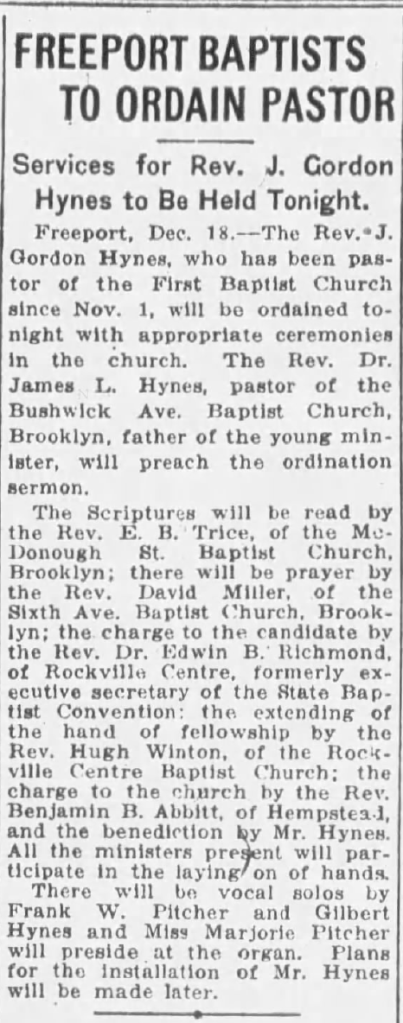
When Gordon began his new job as the pastor in Freeport, he had not yet been formally ordained. This was to take place six weeks later at formal ceremonies at the Freeport church.
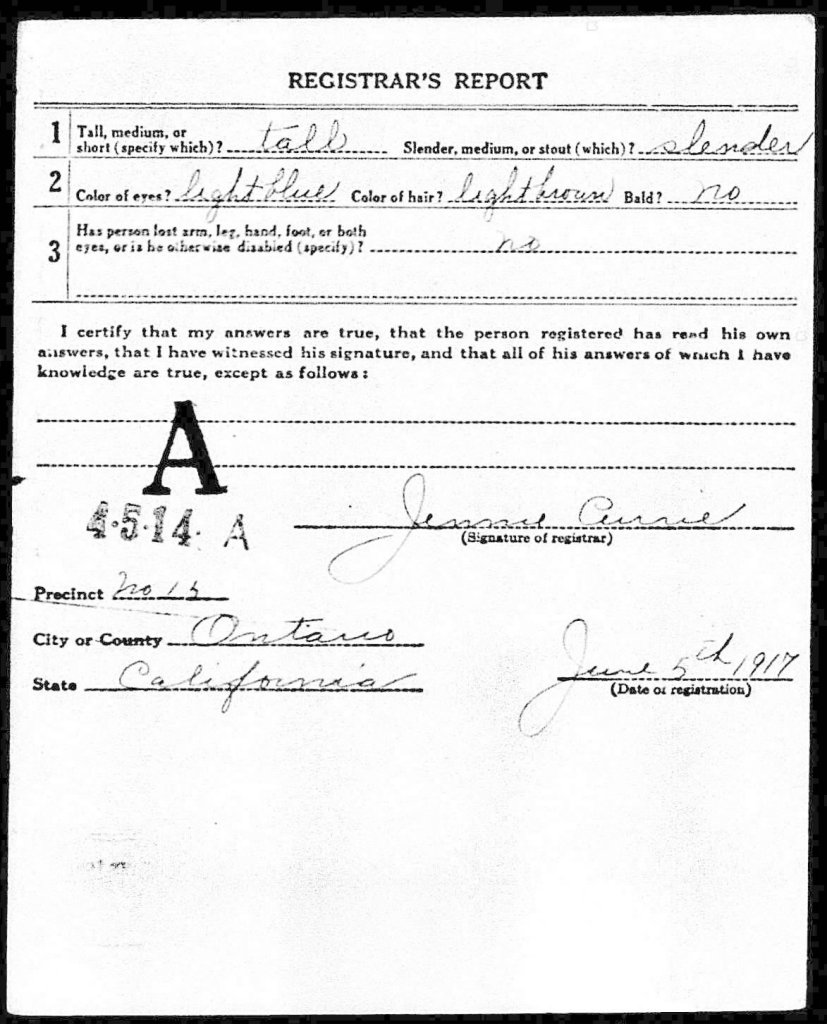
The Sandford family lives were interrupted in April 1917 when President Woodrow Wilson, followed by the United States Congress, declared war on Germany, ending years of attempts to maintain neutrality. Grandfather Joe Sandford’s draft registration form is dated June 5, 1917. He was 25 years old.
Signing up for the war was in line with popular sentiments of the era. Most of Joe’s friends and contemporaries from Ontario eagerly followed the same path. But for Joe there was an additional source of motivation: Owing to the advanced age of his father, Edward–he was 77 in 1917–Joe was unique in his generation for being the son of a wounded Civil War veteran, the son of a man who had gone on to serve his country in China in the following years. Edward was proud of his service and surely passed this sense of duty to his son.
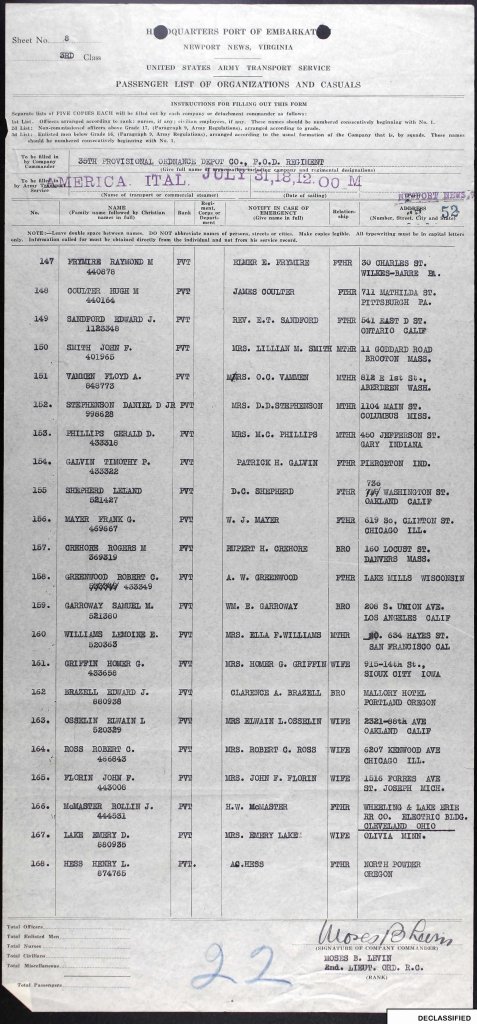
It was another year before Joe departed for France, shipping-off in July 1918 from Newport News, Virginia. Prior to this, he had spent time training in Augusta, Georgia.
Joe was a Private in the 35th Provisional Ordnance Depot Regiment of the Army’s Ordnance Department. The Ordnance Service was responsible for maintaining the flow of armaments and supplies to the war front–procurement, logistics etc. Joe probably drew this assignment because of his background in business and finance.
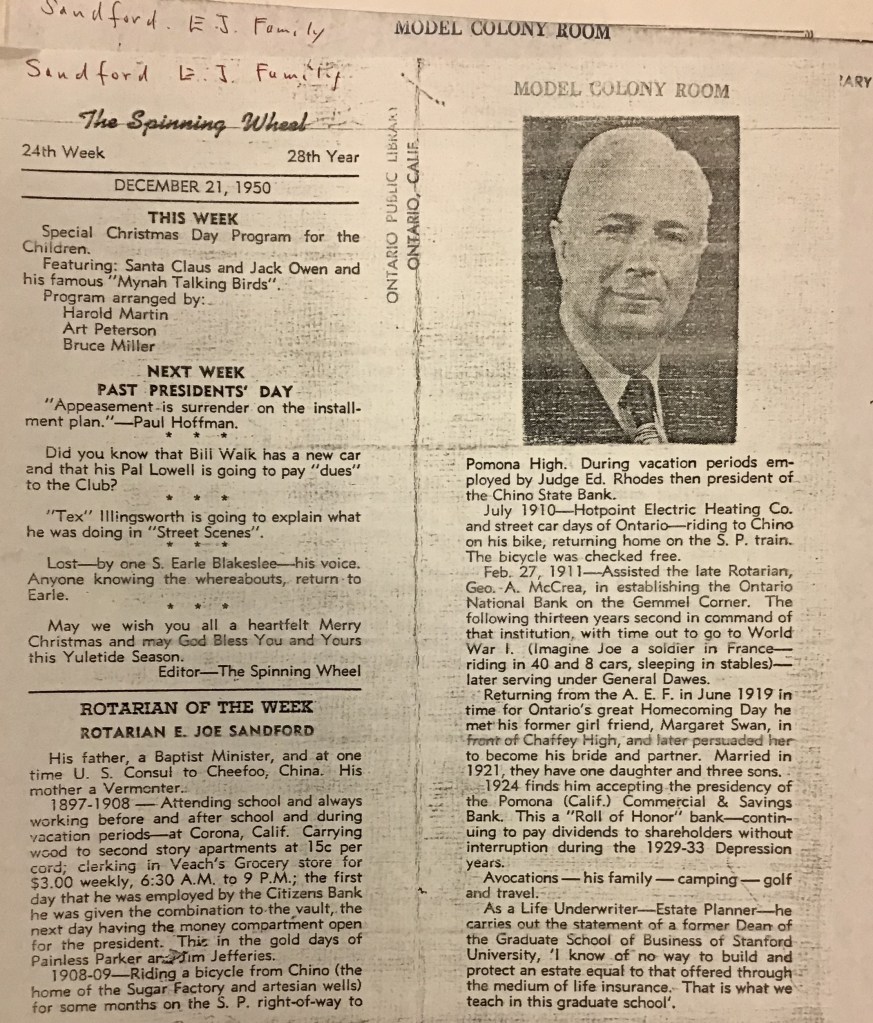
Recall that Joe’s 1950 Ontario Rotary Club biography included the following parenthetical line: “Imagine Joe a soldier in France–riding in 40 and 8 cars, sleeping in stables–later serving under General Dawes.”
From Joe’s arrival in France to the November 11 Armistice was only about 3 months. It appears that his work was primarily behind the lines, overseeing logistics and shipments. However, the bullet hole/dent in the helmet that always hung at the top of the basement stairs of his Ontario home suggests that he spent at least some time near the front.
“40 and 8” cars were boxcars on the French rail system that became the primary mode of cross-country transportation for troops fighting the war. When they arrived, American soldiers pondered the meaning of the words “40 Hommes / 8 Chevaux” stenciled on the car walls–a notice of the intended capacity of the cars in terms of men or horses. The mode of transportation seems to have been regarded fondly by the young soldiers, at least in the hindsight of veterans looking back on their war experiences. I imagine Joe shuttling across the countryside checking up on supply lines, flagging and riding the trains in a similar manner to what he had done during his younger days in Ontario.
I heard the story only once from Joe (therefore difficult to be sure of the details) about being in Paris on November 11 when the Armistice was announced. Everyone was celebrating, he was near the new (not yet consecrated) Sacré-Coeur Basilica in Montmartre, and he decided he wanted to ring the bell. So he went inside, found the bell tower, and rang the bell on the hill overlooking Paris on the last day of the war.
More than half of Joe’s time in France was after the Armistice. Joe’s mention of his service under General Dawes gives clues to his activities during this time. Charles Gates Dawes (1865-1951) was an American banker, general, diplomat, and composer who became Calvin Coolidge’s Vice President from 1925 to 1929.
Dawes advanced from Major to Brigadier General during the war, overseeing purchasing operations. When the war ended in November, he became part of the Liquidation Commission of the War Department. He developed the Dawes Plan for WWI reparations, for which he won (shared) the Nobel Peace Prize in 1925.
It seems that Joe, after the Armistice, was assigned and/or drawn-into some kind of support of these post-war financial cleanup activities, somewhere within the organization of General Dawes. By December 1918 he was attending some kind of schooling to prepare him for this work.
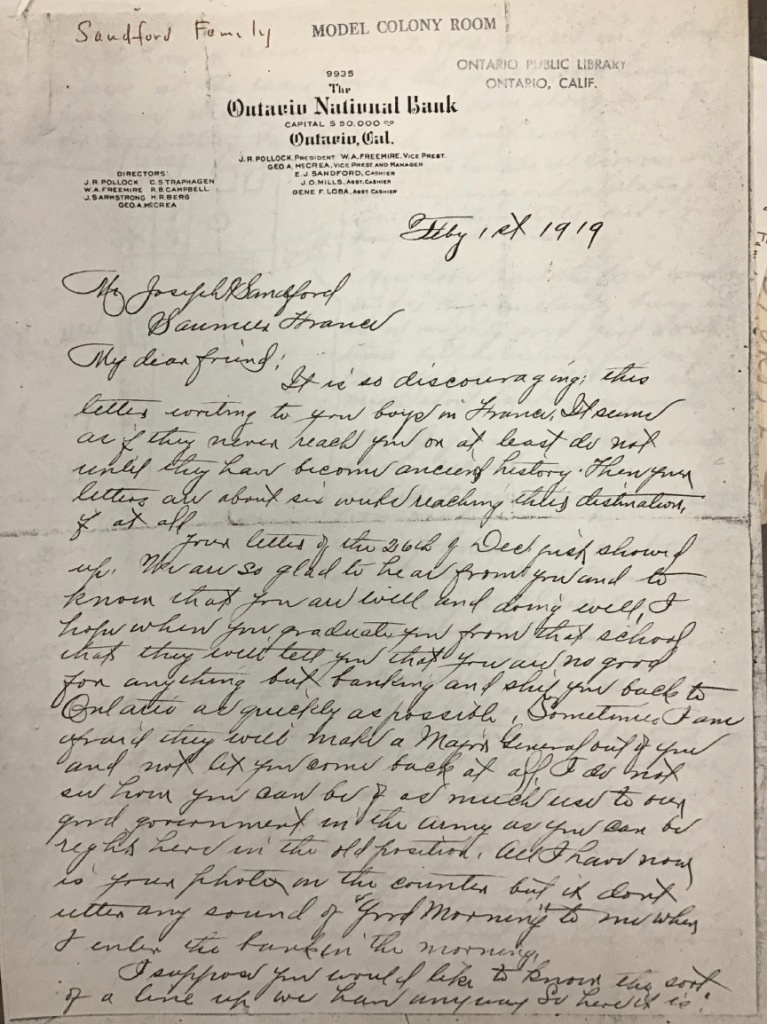
This is mentioned in a letter to Joe from his boss back at the Ontario National Bank, written in February 1919. The handwritten letter is 6 pages long (3 sheets front and back) and was found in the Sandford file of the Model Colony History Room of the Ontario Public Library. A transcription of the letter is provided below.
February 1st, 1919
Mr. Joseph Sandford
Saumur (?) France
My dear friend:
It is so discouraging; this letter writing to you boys in France. It seems as if they never reach you or at least do not until they have become ancient history. Then your letters are about six weeks reaching this destination, if at all.
Your letter of the 26th of Dec. just showed up. We are so glad to hear from you and to know that you are well and doing well. I hope when you graduate you from that school that they will tell you that you are no good for anything but banking and ship you back to Ontario as quickly as possible. Sometimes I am afraid they will make a Major General out of you and not let you come back at all. I do not see how you can be of as much use to our good government in the army as you can be right here in the old position. All I have now is your photo on the counter bit it doesn’t utter any sound of “good morning” to me when I enter the bank in the morning.
I suppose you would like to know the sort of a lineup we have anyway, so here it is:
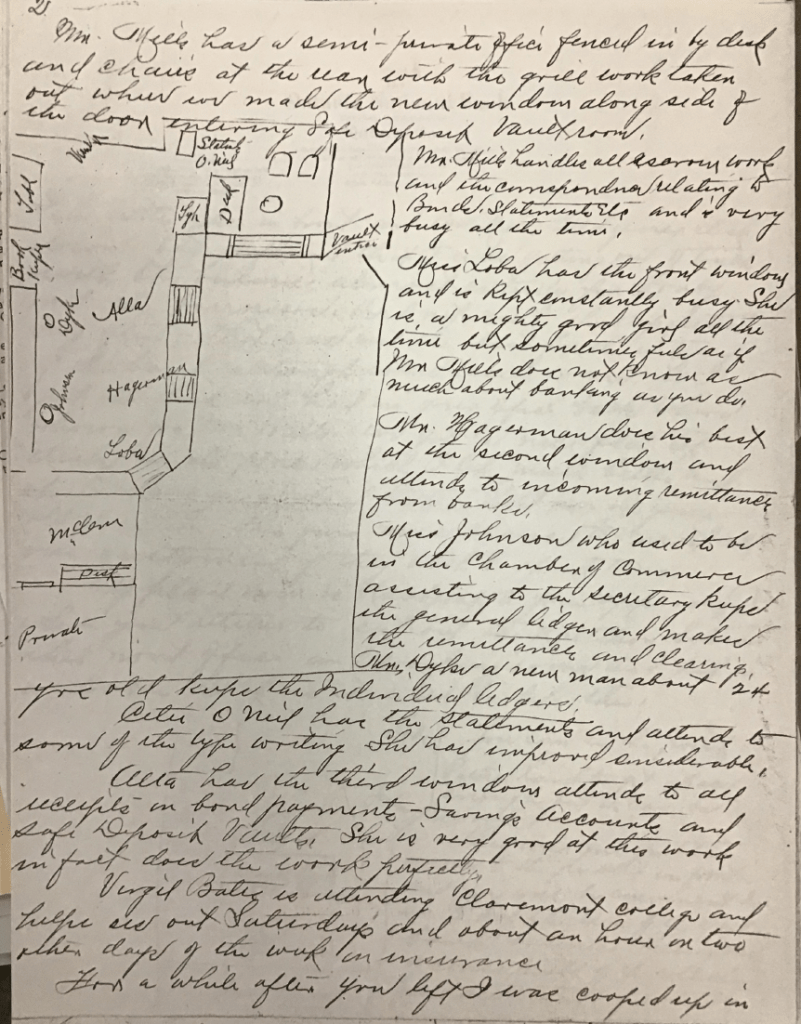
Mr Mills has a semi-private office fenced in by desk and chairs at the ? with the grill work taken out when we made the new window along side of the door entering Safe Deposit Vault room.
Mr Mills handles all escrow work and the correspondence relating to Bank statements, etc, and is very busy all the time.
Miss Loba has the front window and is kept constantly busy. She is a mighty good girl all the time but sometimes feels as if Mr. Mills does not know as much about banking as you do.
Mr Hagerman does his best at the second window and attends to incoming remittances from banks.
Miss Johnson who used to be in the Chamber of Commerce assisting to the secretary keeps the general ledger and makes the remittances and clearings.
Mr. Dyke a new man about 24 years old keeps the Incidental ledgers.
? O’Neil fas the statements and attends to some of the typewriting. She has improved considerably.
Alta has the third window attends to all receipts in bond payments—savings accounts and safe deposit vaults. She is very good at this work in fact does the work perfectly.
Virgil Bates is attending Claremont College and helps us our Saturdays and about an hour on two other days of the week in insurance.
For a while after you left I was cooped up in the little office in front and Mr. Mils held your desk down but I found that I was getting out of touch with the business almost entirely for I only met the borrowers. Did not meet the depositors very often—that was not the best for the entirety of the bank although ? easier on me. So I put the desk we had in your office back where shown for Mr. Mills. We got a nice flat top desk in its place which I like much better and it looks a great deal better. So I am in your old location. This gives me a chance to meet all our customers if they wish to speak to me.
My plan now is (subject to your approval) when you return to cut out the partition between this front office and working room and put in a double desk so it will be like this:
(drawn map)
You can see the point. Rather hard to get space enough but it can be worked.
This will give you the access to the public in front and you will be convenient so as to keep the run of the regular bank business, relieving me of considerably of the collection and settlement of notes, etc.
But as soon as you boys are all back on when you and Russell are here I want a good long rest for a couple of months or more. I am really just tired out. There had been a little more responsibility on me than is real good for my nerves.
Business is improving right along, however. Our holdings are around $725,000.00. Deposits about $600,000.00. Net earnings las year 12%.
On Tuesday the 15th of this month we will hold an adjourned meeting of the shareholders for the purpose of increasing the capital to $75,000.00. The increase issue of stock of $25,000.00 will be sold at $140.00 per share—this will give us additional surplus—at present surplus is $8,000.00 and $2,000.00 undivided profits. So you see we will have $100,000.00 capital and surplus.
With your help and that of Russell and Douglas this new Ontario National will soon exceed the million dollar mark.
Well just now our board of directors is in bad shape.
Judge Pollock has been on his back in bed for three weeks with a very bad heart condition. His pulse has been running at 150 to 160 all the time and no improvements. May drop off anytime although we hope for the best.
Mr. Armstrong is flat on his back with a very bad case of the flu. He is better today and will very likely recover.
Mr. Freemans heart went bad yesterday so he is out of the ring—his pulse is too low and might stop altogether anytime. He is better today.
Mr. Giaconi came awfully near dying with the flu. One day we thought he was dead as we got work in the morning that he had died—but the next day heard hew was still alive but could not recover. But he did get well however and is as smart as ever now.
My old friend in Drayt? Mr. Strong died about two weeks ago—Flu and pneumonia. He had a great funeral, however. I am very sorry about his death. He went off very suddenly.
Rosco is on the way home we think—had four letters from him this week. He was to start for Brest on January 6th and would embark for home as soon as they could from Brest. How glad we will be to see him. No words can tell.
We hear that Douglas Lusin has been placed in the army of occupation. So there is no knowing when he will be home.
Russel Jenkins writes that he will be on the way home very soon.
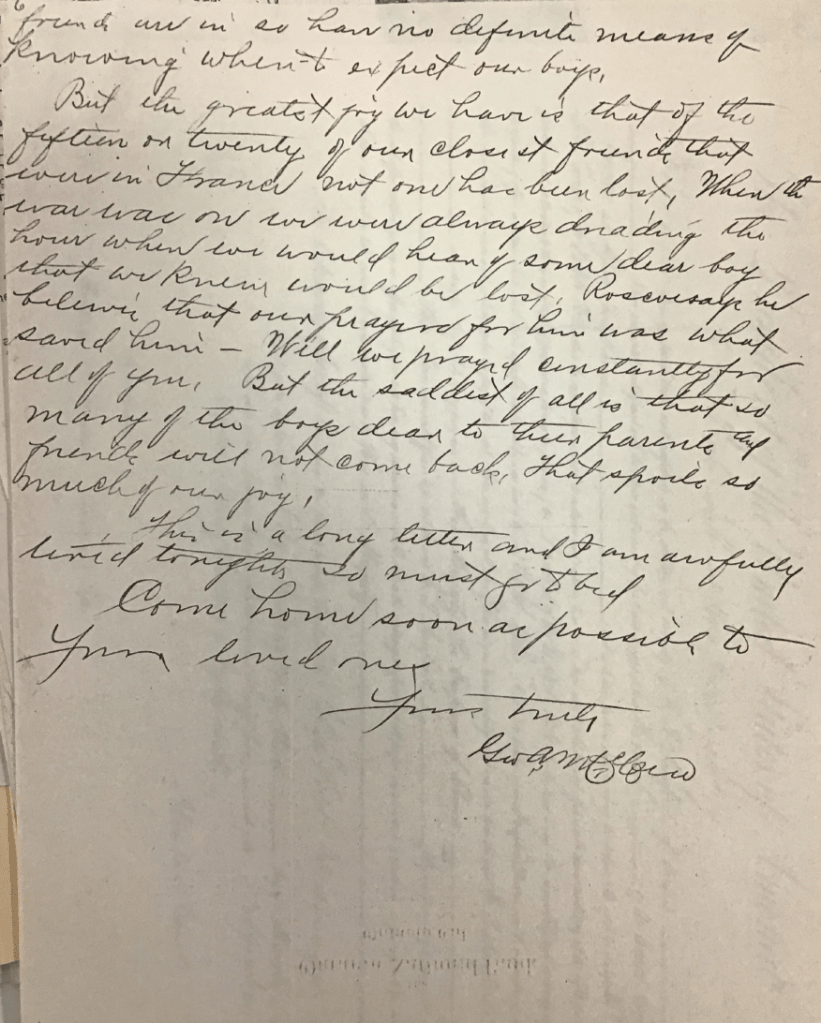
We cannot become familiar with the numbers of regiments and divisions our friends are in so have no definite means of knowing when to expect our boys.
But the greatest joy we have is that of the fifteen or twenty of our closest friends that were in France not one has been lost. When the war was on we were always dreading the hour when we would hear of some dear boy that we knew would be lost. Rosco says he believes that our prayers for him was what saved him. Well we prayed constantly for all of you. But the saddest of all is that so many of the boys dear to their parents and friends will not come back. That spoils so much of our joy.
This is a long letter and I am awfully tired tonight so must go to bed.
Come home soon as possible to your loved ones.
Yours truly,
George McCrea
Transcript of George McCrea letter to Joe Sandford in France, February 1, 1919
George McCrea’s February 1919 letter to Joe Sandford
There is a lot to unpack from this letter…
The destination of the letter is difficult to read, but it appears to be Saumur, France, a city far removed from the former WWI battle sites, located on the Loire in French chateau territory. (The region is consistent with the record of Joe’s eventual departure from nearby Saint Nazaire, France.) That Joe was involved in training pertaining to long-term post-war economic recovery support suggests that he was at least considering extending his tour of duty in France to be a part of this effort.
The McCrea letter is an odd mixture of sincere expressions of support with clear attempts to stake a claim on Joe’s post-war career. Later sources will reinforce the idea that the aging McCrea was past his prime as a bank president in dire need of Joe’s young talent to sustain his position.
We can also note the naming of numerous McCrea colleagues stricken with the flu at the time of the Spanish Flu epidemic in the United States (and that Joe eluded the ravages of this same epidemic among the ranks of American soldiers overseas).
Apparently, Joe faced a major decision at this point of his life. He had an opportunity to attach himself in service to the historic effort to manage reparations in post-war Europe–indeed, he had already taken the first steps in this direction. Given his customary work ethic, he must have been in high demand for this work. It would not have been lost on Joe that, had he remained in Europe, his situation would have been very similar to what his father had done in the 1860s, following his war service with years of additional foreign service for his country.
Pulling in the other direction, exacerbated by the McCrea letter, was the stable, comfortable life and continued banking career that awaited him back home in Ontario.
We can’t know whether McCrea’s letter had a significant influence on Joe’s decision. He was surely already grappling with questions of what to do next, regardless of the letter. That Joe kept the McCrea letter for the rest of his life and finally donated it to the Model Colony history file is evidence of its importance. I suspect that the “what-ifs” associated with this decision remained with Joe for many years to come.
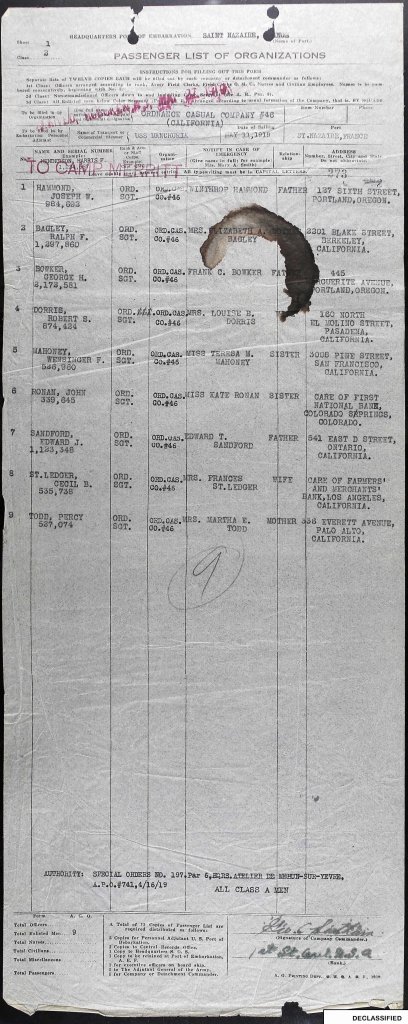
Joe made his decision in the months that followed, opting to return to Ontario to resume his position as Vice President of the Ontario National Bank. He left France, as a Sergeant, in June 1919, about a year after he arrived.
The passenger manifest for Joe’s voyage to France in July 1918, sailing from Newport News, Virginia
Joe made the return trip to the United States in May 1919, leaving from Saint Nazaire, France aboard the U.S.S. Manchuria
In the early 20th century, the Hotpoint Company became one of the first companies to locate in Ontario, California, beginning its transformation from a purely agricultural town to a sizable Southern California city. Hotpoint, which later merged into General Electric, would remain a cornerstone of the Ontario economy for the next 80 years. The company was founded by Earl Richardson, a self-made electrical engineer who played a major role in the electrification and modernization of the valley, including the transformation of the mule-drawn Euclid Avenue trolley into the an electric streetcar.
The Hotpoint Iron
Earl H. Richardson, a native of Wisconsin, moved to Pomona in 1895 with his wife Mary who suffered from tuberculosis. Soon he was hired by Charles Frankish to manage the Stone Castle power house in San Antonio Canyon. He, Mary, and their daughter Ardis lived at the Stone Castle. To make their lives more comfortable, Richardson began building small household appliances, one of which was a flat iron. The devices were well received by his wife, except that she complained that the iron’s point did not get hot enough, and he worked on that for a bit. Because electricity was a new resource in those days, folks generally used it only to light their homes at night. So Richardson was asked to come up with ways to get folks in town to increase their power consumption during the day. He decided to employ his friend Harry Strunk and the two men began building more of Richardson’s small appliance inventions, which Richardson gave away to the locals. Upon receiving favorable feedback on his appliances, he determined that he could make a pretty good living by manufacturing and selling his own inventions. So 110 years ago, in May 1904, the
Pacific Electric Heating Company incorporated. Richardson soon developed a flat iron using nickel chromium alloy for its heating element which provided even heating throughout the sole plate – even to the iron’s point – and the Hotpoint iron was born. The Hotpoint iron would become the signature appliance of the Hotpoint factory, which grew over the years eventually merging with General Electric. The plant was in operation in Ontario until GE moved its flat iron manufacturing to Singapore in 1982.
City of Ontario Government, Facebook post, July 16, 2014
It is interesting to note that the brand name Hotpoint originated from Richardson’s work to ensure that the heat in early electric irons would be distributed to the front point of the iron.
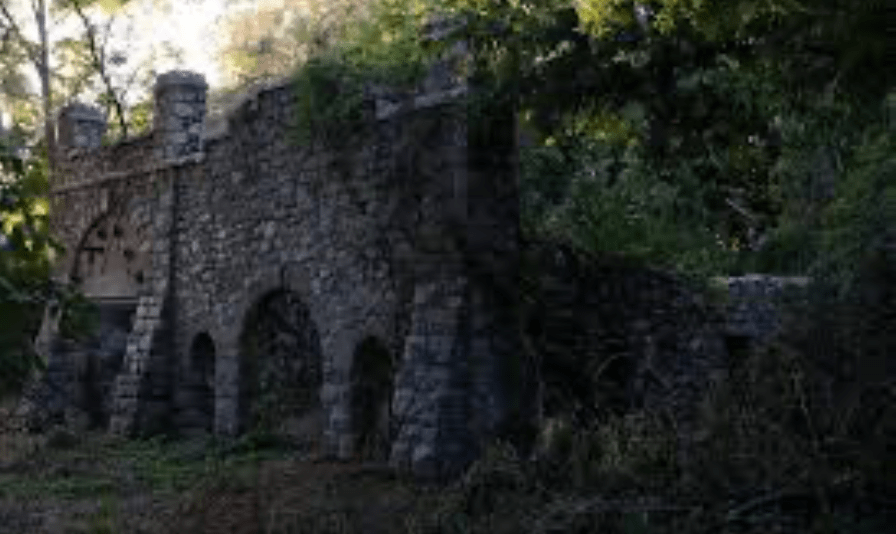
Today’s remnants of the Stone Castle Power House
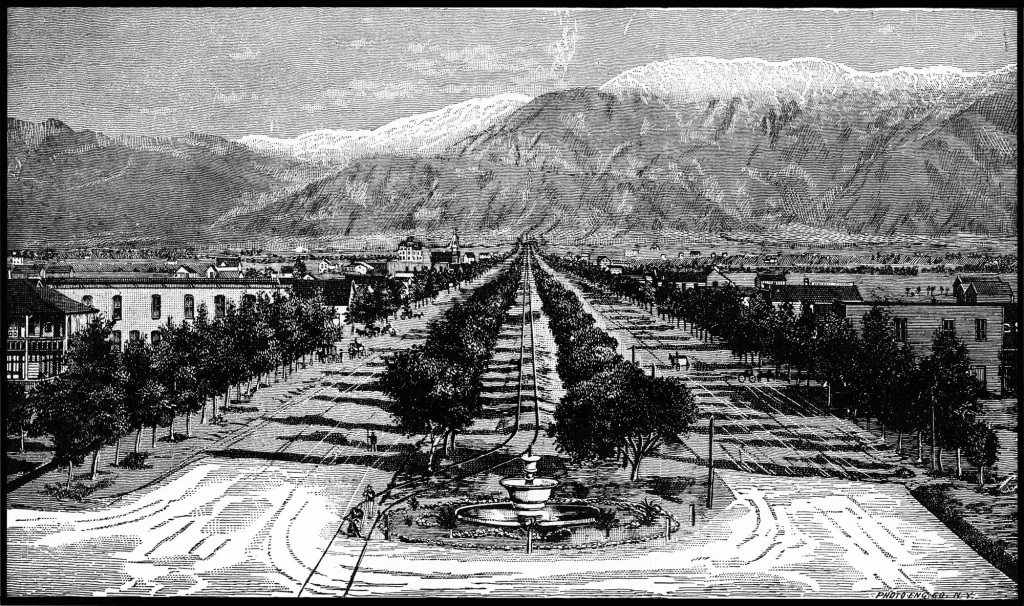
The Euclid Avenue electric trolley of Ontario and Upland California, which Earl Richardson helped to develop
Stories and legends of Earl Richardson abound in Ontario history, related by historians as well as our grandfather, Joe Sandford. Joe tells some of these in his Living History interviews…
Joe: Mr. Richardson, E.H. Richardson had come out here from the middle west, and his background was electrical engineering. And he was living way up on the heights, at the canyon there, there used to be an old power house—you may be familiar with it—and they had a little girl, a little daughter. And like all children, it was quite a chore for Mrs. Richardson to rock the little cradle, to put the little one to sleep. Mr. E.H. Richardson conceived the idea of using electricity to rock that cradle.
And so it was his privilege to have to do with developing electricity to take over the work that the mules had done with the old mule cars back there, and then later he founded the Hotpoint Electric Heating Company which is now the General Electric. A great man, Margaret knew him well, I knew him well, greatly admired, he came from the Scandinavian countries, long gone, and so forth.
Interviewer: Oh he moved here from…he wasn’t a native born American…?
Joe: Dearest, do you know what community they came from, the Richardsons?
Margaret: (inaudible)
Joe: A very fine, a very strong man…we could always get that….
Margaret: I didn’t think he was a foreigner.
Joe: Ah, his background was Scandinavian. He was a little stubborn, you know what I mean, he was….
…The Hotpoint Electric Heating Company was a splendid company, it grew. And they manufactured not only the irons or the Hotpoint, but they went into different phases, the stoves and what have you, and the heaters and what not.
Margaret’s folks were guinea pigs…and when he [Richardson] would develop a stove they would take one and prove it for him. But that’s history.
Joe Sandford from 1974 Living History Interview conducted by the Upland Public Library
So our Swan great grandparents were beta-testers of some of the original Hotpoint Company products!
Indeed, the Richardsons and the Swans were very close. Richardson was probably a business associate of Henry Swan ‘s bank. Margaret was good friends with Ardys Richardson (the girl rocked in the electric cradle as an infant in the legend) at least through high school. Her name comes up in some of Joe’s stories about how he met Margaret in 1917 and 1918.
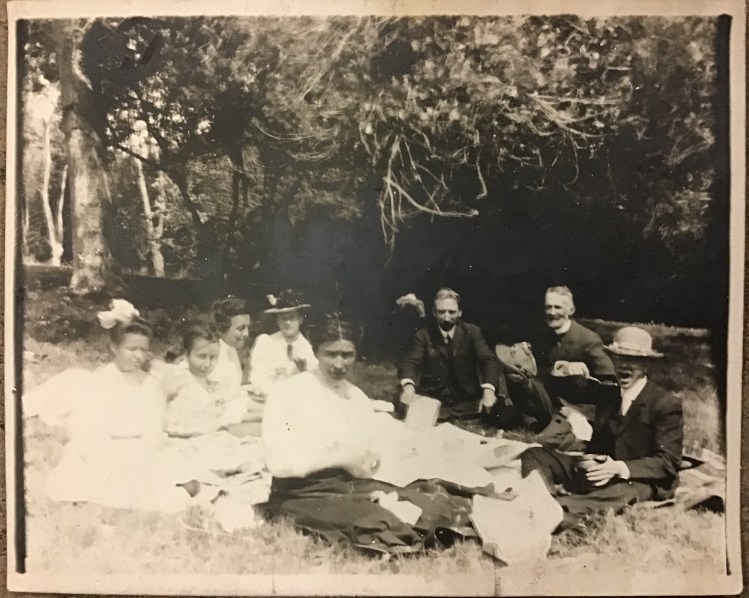
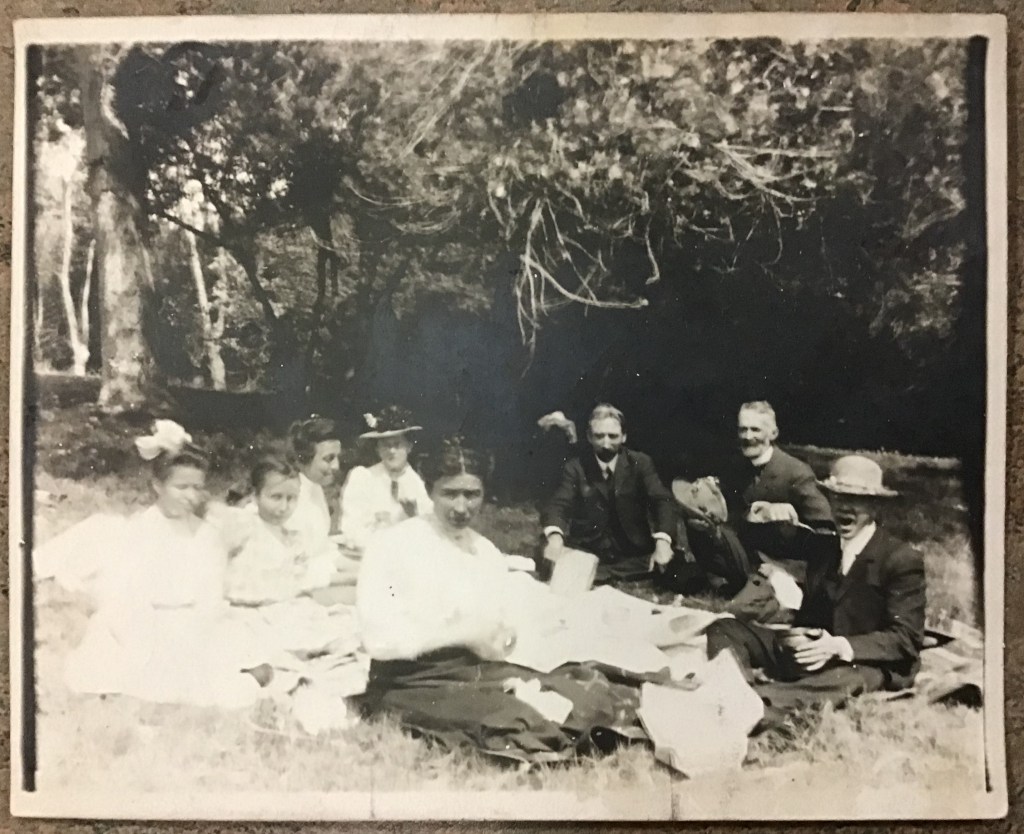
Confirming this close relationship between the families is a photo found in the Ontario Model Colony History Room. It shows the Swans, the Richardsons and other acquaintances picnicking in the country, perhaps near the Stone Castle. The photo must have been taken around 1910, judging from the apparent ages of Margaret, Mabel, and Henry (in 1910 Margaret was 15, Mabel 44, and Henry 47).
This is certainly the most relaxed Henry Swan I’ve seen in any photo.
Caption from the photo in the Model Colony History Room: “From left: Margaret Swan, Ardys Richardson, Mrs. Richardson, Mrs. Barr, Mr Richardson, Mr. Barr, Mr. and Mrs Swan in front.” Photo (4×5) donated to Model Colony Room by Margaret Swan Sandford.
In 1911, his parents retired, our grandfather Joe Sandford was 18 years old and entering young adulthood with a promising career and social life.
After a brief time working in the Ontario California bank of his future father-in-law Henry Swan, Joe went to work for George McCrea who had come to California from North Dakota to start the Ontario National Bank. George hired Joe, who helped him with the startup and became one of the bank’s first cashiers. Joe would work for George for most of the next 13 years, working his way up to the level of Vice President of the bank.
George McCrea would prove to be an important influence on Joe’s life over this time period. We will see that he comes up at several very significant times.
Resume of Joe’s life experiences as summarized for Ontario Rotary Club honors in 1950. (The reference to “40 and 8 cars” will be explained in an upcoming post.)
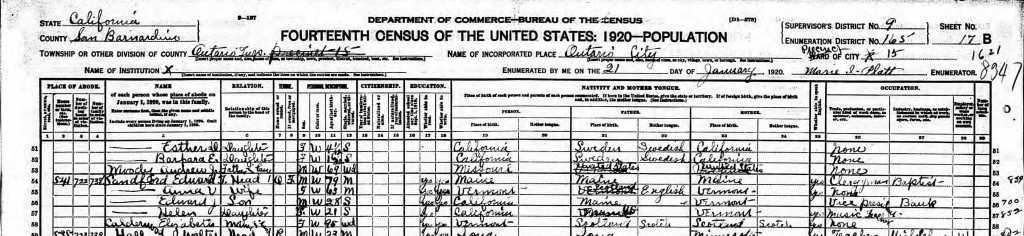
Joe had an established career and independent life, but he remained close to his sizable extended family. The 1920 U.S. Census shows that Joe and his sister Helen remained living at home at 541 East D Street through the 1910s. Joe’s grandmother Elizabeth Calderwood also lived with the family. Joe’s older sister Saada married Earl Beck in 1915 and lived two blocks away at 517 East Nocta Street. By 1920 Saada and Earl had two young children, Earl and Gwen.
The 1920 U.S. Census shows that Joe lived at home with his parents, younger sister Helen, and grandmother Elizabeth Calderwood. His older sister Saada lived nearby with her family.
Joe continues to be the best source of information about his own life, through the stories he left in his living history interviews…
The young people of the community…we had good times. We used to hike in the mountains, groups of us. A little story that Margaret loves to hear, this was before we were engaged. Me a young man, showing what young people did in those days. A little later on, at this period of the year, maybe four of us or six of us, after a rain, would start here, leave Saturday afternoon or a holiday, and we would hike through the orange groves to Pomona. We’d arrive in Pomona, maybe at 5:30…and there was a very nice cafeteria, just off from about Second and Main there. We could go down and have a lovely dinner for twenty five cents at the cafeteria. Probably at seven o’clock we’d be through, and we’d go over to the picture show…ten cents, maybe, fifteen cents. And in those days you just had one subject, one picture. And about nine o’clock that would be over…of course the pictures were accompanied by a pianist, or something. At nine o’clock we would leave the theater and hustle up to the Union Pacific Railroad…it was called the Salt Lake in those days…and there was a train came through there, going to Chicago, at 9:20. And we’d get on that overland train and ride over here for twenty cents. But we’d had a lot… following the rain, everything was lovely, perhaps the trees were in bloom, the orange blossoms…a supper over there, the picture show, and then the ride back on this trans-continental train.
I remember one night, we were a little late getting there to the depot, and we didn’t have time to buy our tickets. If you paid the conductor on board you had to pay extra. Well that didn’t seem fair, and so we paid under protest. And me a young banker…when I got back the next morning at the bank I wrote a letter to the railroad…and I said I didn’t think that was fair and I recounted the experience. (Laughing) In a few days the traveling passenger agent from Riverside had received a letter. He came over and said Mr Sandford you’re right, but he says the law forbids us to return that overage to you. He said if you should happen to find some money on the counter after I’ve gone you just keep it…(laughing)…I can’t return it. Well, a little experience…
Joe Sandford from 1974 Living History Interview conducted by the Upland Public Library
Joe knew everybody and everybody knew Joe. He was respected throughout the community. He applied his go-getter attitude equally to his work life and social life…
Another thing that has to do with today and the problems we’ve had with younger people…and I was young. I belonged to the Baptist Church over here…and in those early days there was no Baptist Church in Upland, there was no Congregational Church in Upland. There was a Christian Church here, a Baptist Church here, a Methodist Church here, and the members of those churches from Upland came down and were a part of the Ontario congregation, and so forth. Well anyway, I wasn’t too interested in the girls in the Baptist Church. I was very active…meetings, singing, and those things in the church. And I conceived the idea of forming a local organization of the young peoples’ societies of all the churches in the community, and I did, I was president of it. And so the Epworth League from the Methodist, the Christian Endeavors from the Congregational, and the other churches we all came together and once a month we had a union young people’s service, and it went over big. And then probably twice a year we’d have a big social and good times, wonderful times and that way you met everybody. In 1916 we had a very heavy rain here, and Euclid Avenue was all plowed-up, before that it had been dirt and later macadam and so forth and they were getting ready to surface it..
Interviewer (reacting to the pinpointing of the time Euclid Avenue was paved): …oh for heavens…
The rain was terrible and it washed gutters. There were two places you could cross from this side of town to the other. One was up at fourth street, the High School. Another was down at what’s Holt Avenue today. So that night in 1916, the night of the social, the night it was raining. So there weren’t too many there but we had a good social and a good time under those conditions. I just touch on it because it had to do with the early day history, and so forth.
Interviewer: That’s very interesting, what people did.
Joe Sandford from 1974 Living History Interview conducted by the Upland Public Library
The comment about being less interested in the girls in the Baptist Church speaks to a trend in Joe’s young life. Although he lived at home and remained very close to his parents throughout their years, and although he carried his parents’ ethics with him throughout his life, he deliberately followed a different path in life than his parents had. He lived a much less spartan life than his parents. Similar patterns emerged in the lives of Joe’s sisters. There is no evidence that Edward and Annie did anything to discourage this.
Joe had an encyclopedic knowledge of Ontario history (the reason he was in such demand for the Living History projects), including this example…
Something that you might like to know, too. You probably have noticed the rock piles in Upland in the groves.
Interviewer: …yes…
Way back there somewhere probably in 1916, 1917, a group of Hindus came in, that had those turbans, and so forth….might have been 25 or 30 of those Hindus. They all came into the bank that I was vice president of, probably at that time… the Ontario National. Probably 25 or 30 came in, and they all had cash, and they wanted to open accounts. They couldn’t…their name was Singh, perhaps another surname…it didn’t mean anything to us (laughing) they all looked alike to us. But we opened accounts for them all and the only way we could do was to take a thumbprint, and then we’d write something on their card trying to identify them, and so forth. And those men moved into Upland. And they accumulated the rocks from the groves and piled them up, as you’ve seen there. They were here for quite a while. There were little problems because they came from a different country, their lives were different from ours. But they were here for some time. The day came when it seemed best for them to move…and when they moved, they moved. And so they all came into the bank again (laughing), they all wanted their money. Which was some kind of a problem to make sure…we gave the money…and they all wanted money, they didn’t want anything else. But that was a little bit of history that was very interesting.
Interviewer: Yes that is, I hadn’t known that the Hindus did that…
Joe Sandford from 1974 Living History Interview conducted by the Upland Public Library
In reading this story, it may be helpful to keep in mind that Joe’s father had been to Asia twice and lived there for several years. At the time of telling these stories, Joe himself had traveled extensively in Europe and Asia. Despite occasional phrasings that may seem politically incorrect by 21st century standards, he was quite enlightened about cultural differences in the world. I think the fact that they went the extra mile to welcome these men as customers in their bank, at a time when they surely encountered discrimination elsewhere in the community, speaks well to Joe’s inherited ethics and self-made business sense.
In one instance, Joe reveals a personal story. Margaret is sitting there as he tells the story, so she must have heard it many times before…
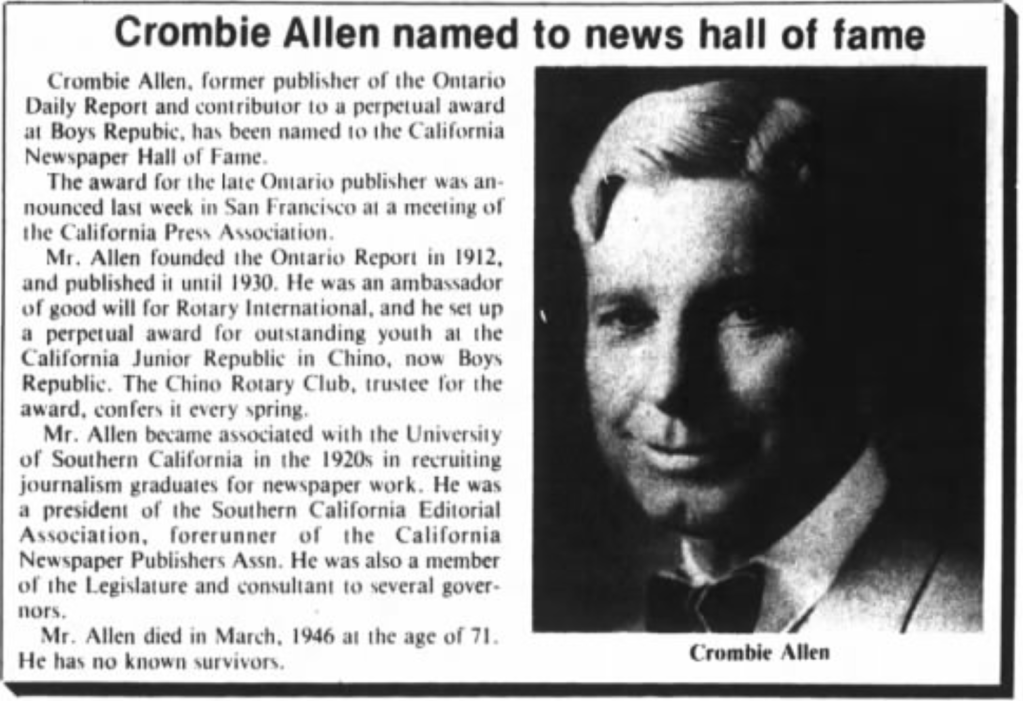
Another thing that’s very personal–you may want to sue me for this. Archie, do you remember Crombie Allen, and Harold Allen, the brothers that used to own the paper here? Wonderful men. They seemed to respect me, and I loved them. Crombie Allen had a lovely wife, then his father and mother lived on Euclid Ave., about F St. One day the mother, dressed like Mrs. Farrell with the long dress and little lace collar, came into the bank. “Joe, we want you to wait for Jane.” In other words, they wanted me to marry Crombie Allen’s only daughter Jane. She wasn’t ready to get married, but that was a compliment. Crombie Allen, as long as he lived, had implicit confidence in me and I in him. He had one of the first televisions and radios and all those things, too.
Joe Sandford from 1976 Living History Interview with Bryce Denton
The Mrs. Farrell reference must have to do with the movies. The life of Crombie Allen (who looks a little like Stilwell in A League of Their Own) is summarized in his 1946 obituary. Apparently Jane did not survive him.
One more amusing story from Joe’s young life makes me wonder what his parents would have thought as he came into the house at 1:30am.
One thing happened one night with the Pacific Electric running to Pomona. You’ll all like the story. I used to keep company with one of the girls that was studying to be a nurse……I took her home about Christmas time probably about 11 o’clock, and I think the last car in Pomona came by there about 11:00 or 11:30, so I was there waiting for that last car. When they came in from Pomona, the motorman had his back to the front, and he was kidding with the conductor, and they went by that crossing fifty miles an hour. I walked home. If I’d had one of these fellows as my attorney, we’d have sued somebody, wouldn’t we? But that’s an actual fact.
Joe Sandford from 1976 Living History Interview with Bryce Denton
Nothing lasts forever. Joe’s carefree life and the world order were about to be interrupted by war, the subject of our next post.
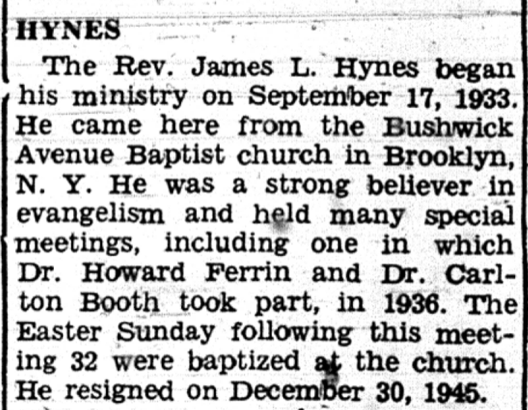
 In the fall of 1933, our great grandparents James and Bessie Hynes moved to Middleboro, Massachusetts, south of Boston, following the depression-driven decline of the Bushwick Avenue Baptist Church in Brooklyn. Recall that we previously examined James’ welcome as pastor of the Central Baptist Church in Middleboro, skipping ahead because of the important biographical information revealed in newspaper summaries of the event.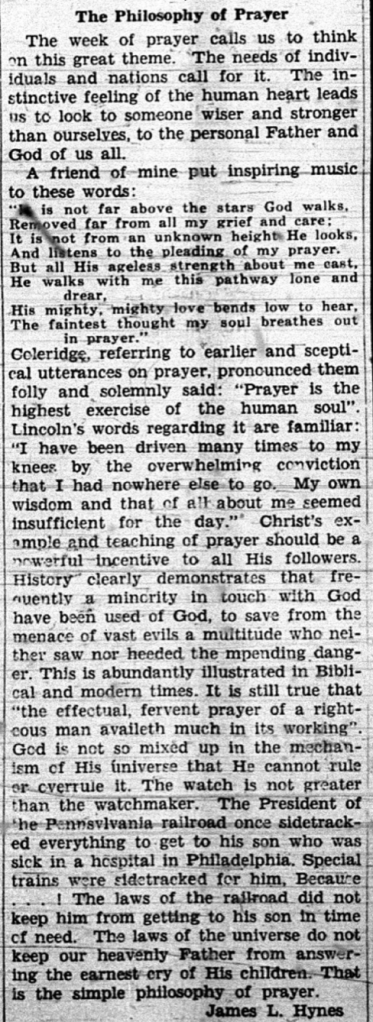
 On the morning of Tuesday, May 20, 1924 our great grandfather Henry Swan presided over a monthly directors meeting of the First National Bank of Ontario, California, where he was the bank president. The routine meeting was adjourned and Henry left for lunch. That afternoon, there was scheduled a monthly board meeting of the Euclid Savings Bank, where Swan was a director. When the normally punctual Swan did not appear for the 3:30 meeting, his associates became concerned for his health, which was known to be poor. A call to the First National revealed that Swan had not returned from lunch. The board members got no answer when they tried telephoning the Swan home–his wife, our great grandmother, Mabel Swan was known to be spending the day in Los Angeles. Oscar Arnold, vice president of the First National Bank and president of the Euclid Savings Bank, and Charles Lattimer, a board member of the Euclid Savings Bank, then went to the Swan home at 501 North Vine Avenue. They found Marshall Sellman, the gardener, working at the home, but he had not seen Swan since early morning. When they found Swan’s car parked in the garage, the three men began searching the home. They found Swan in the upstairs bathroom, having taken his own life. Medical assistance was summoned, but it was quickly determined that he had been dead for several hours.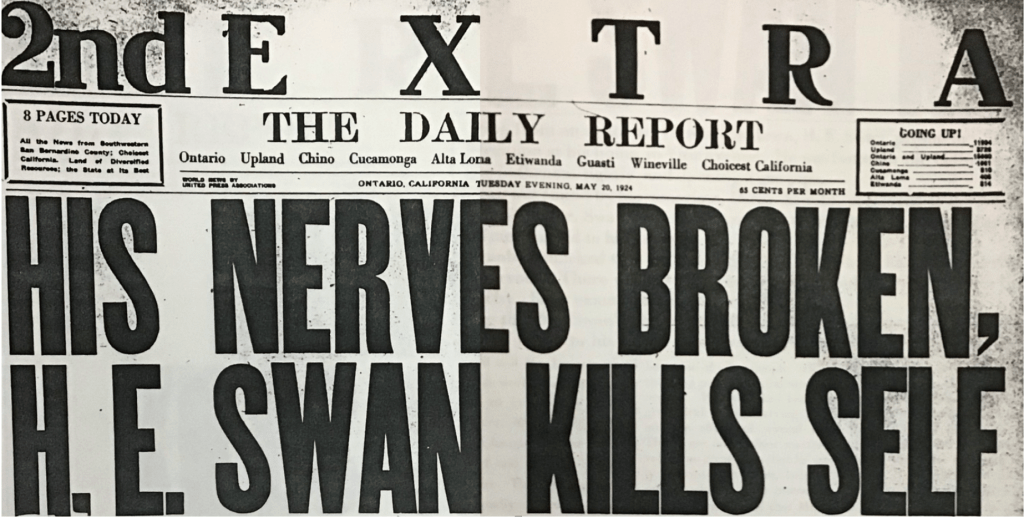

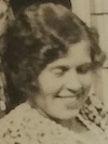 By year-end 1930, our grandparents Gordon and Ruth Hynes were living in Freeport, Long Island, New York.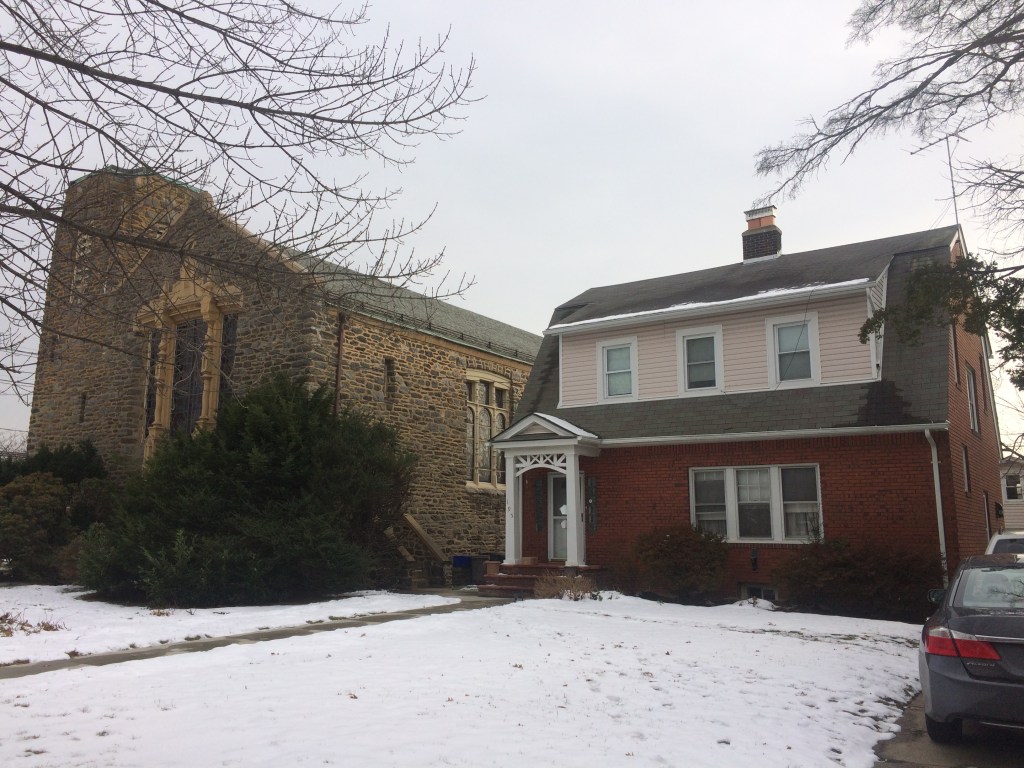
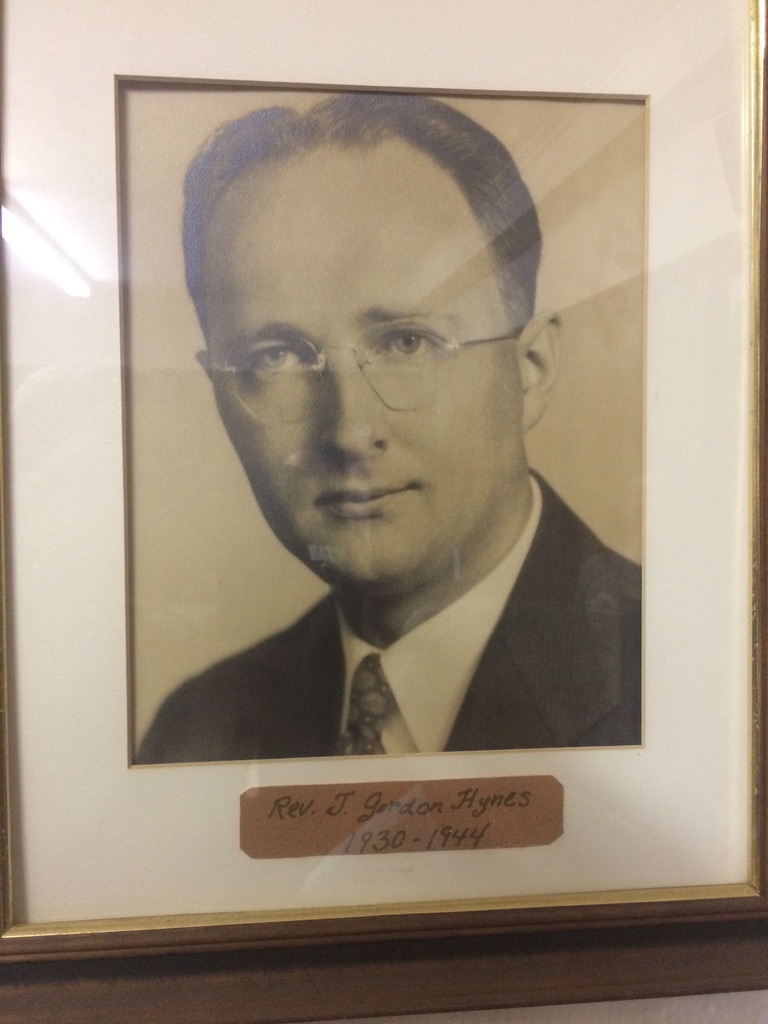
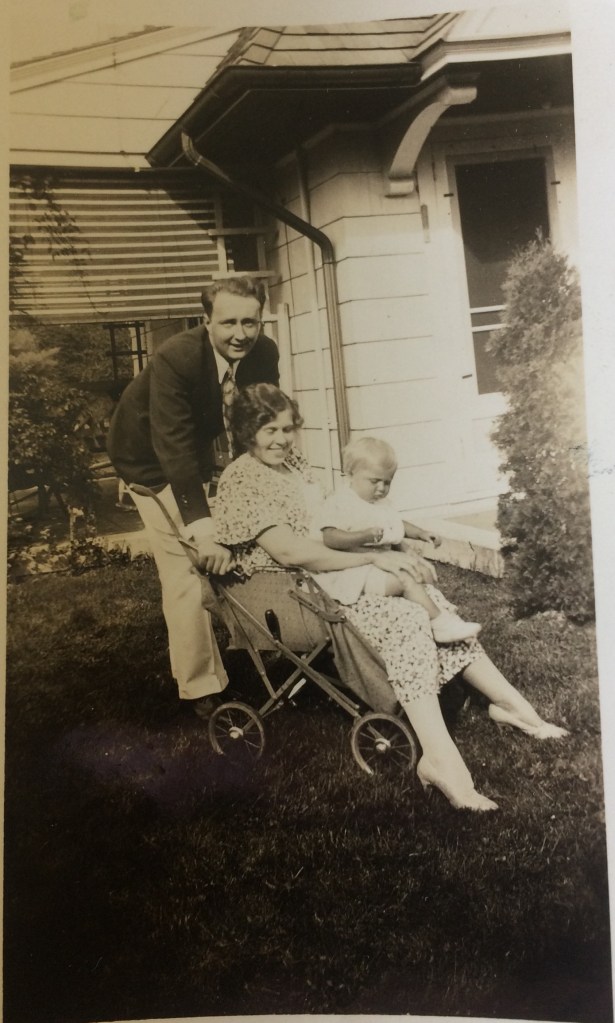
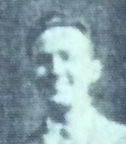
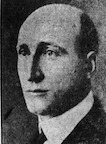 The Sechler and Hynes families came together in the 1920s in Bushwick, Brooklyn where they lived one block apart. Great grandmother Laura Sechler and daughter Ruth lived at 987 Hancock Street while Great grandparents James and Bessie Hynes lived at 1008 with their four children. The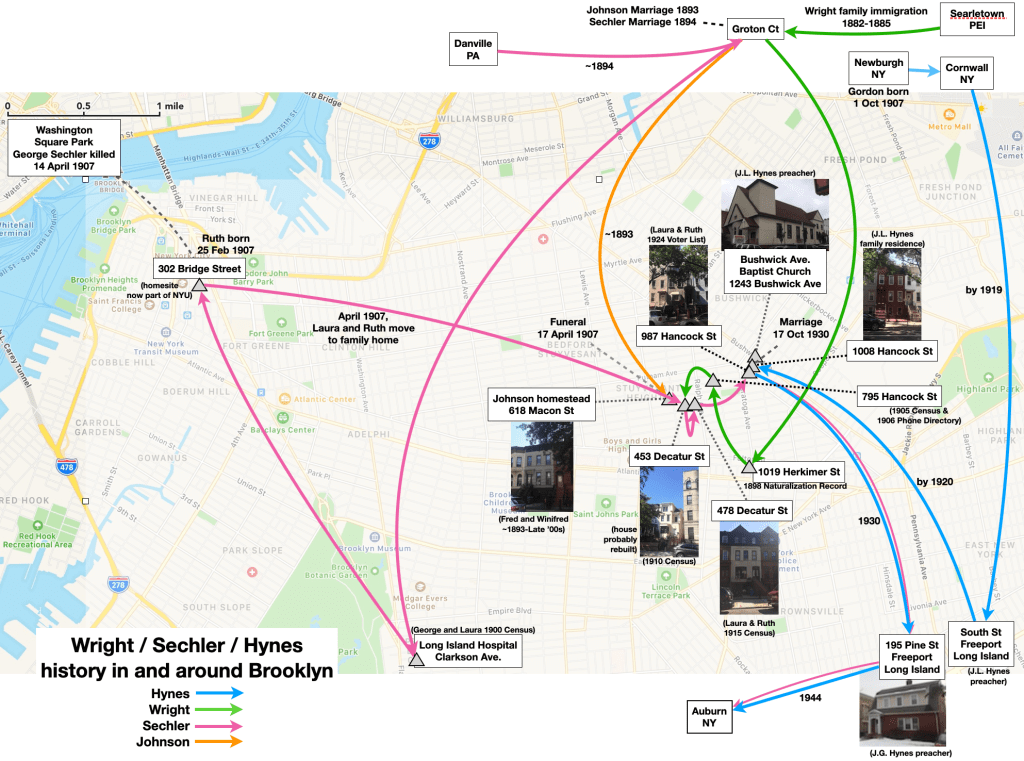
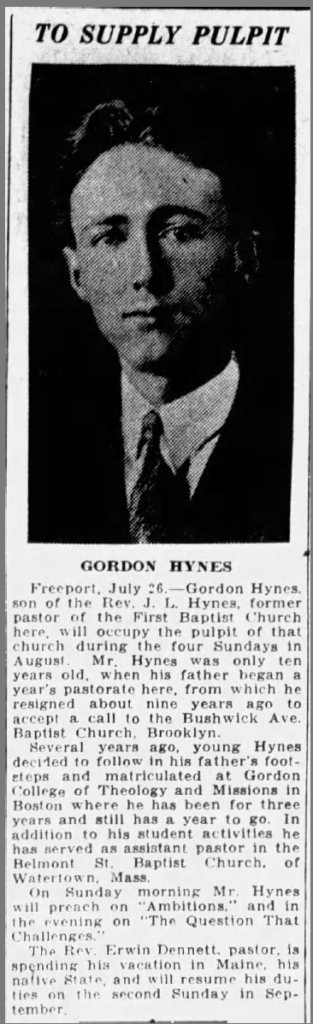
 The Sandford family lives were interrupted in April 1917 when President Woodrow Wilson, followed by the United States Congress, declared war on Germany, ending years of attempts to maintain neutrality. Grandfather Joe Sandford’s draft registration form is dated June 5, 1917. He was 25 years old.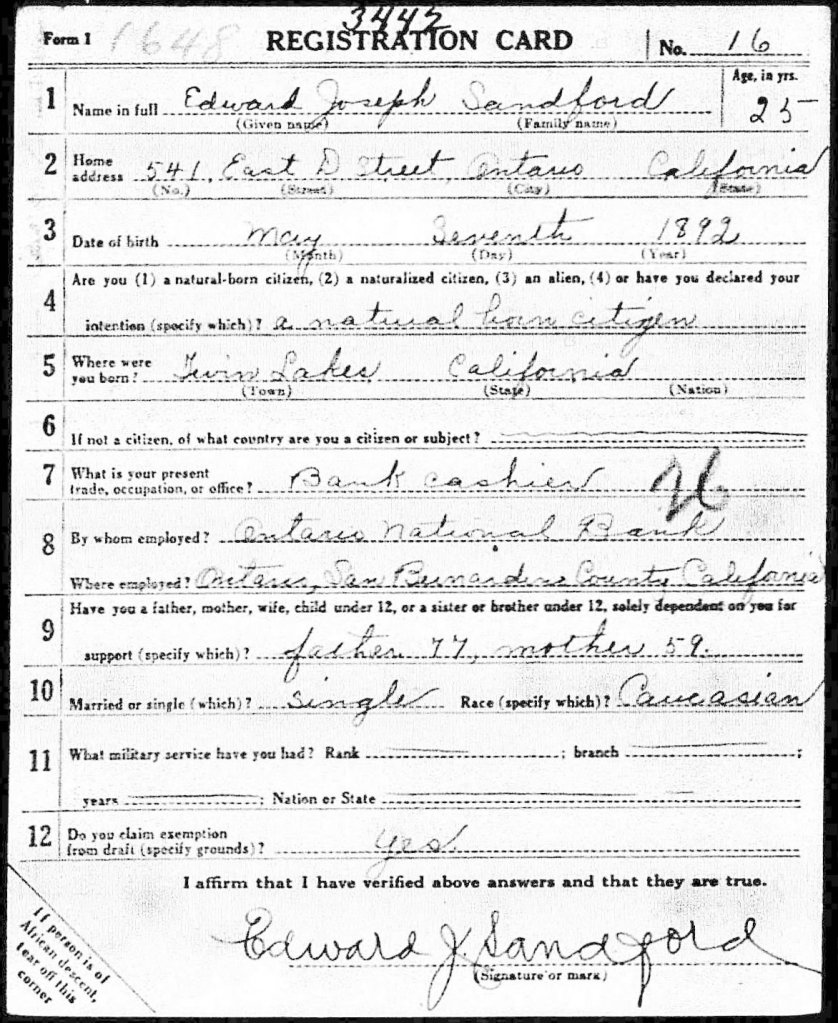
 In the early 20th century, the Hotpoint Company became one of the first companies to locate in Ontario, California, beginning its transformation from a purely agricultural town to a sizable Southern California city. Hotpoint, which later merged into General Electric, would remain a cornerstone of the Ontario economy for the next 80 years. The company was founded by Earl Richardson, a self-made electrical engineer who played a major role in the electrification and modernization of the valley, including the transformation of the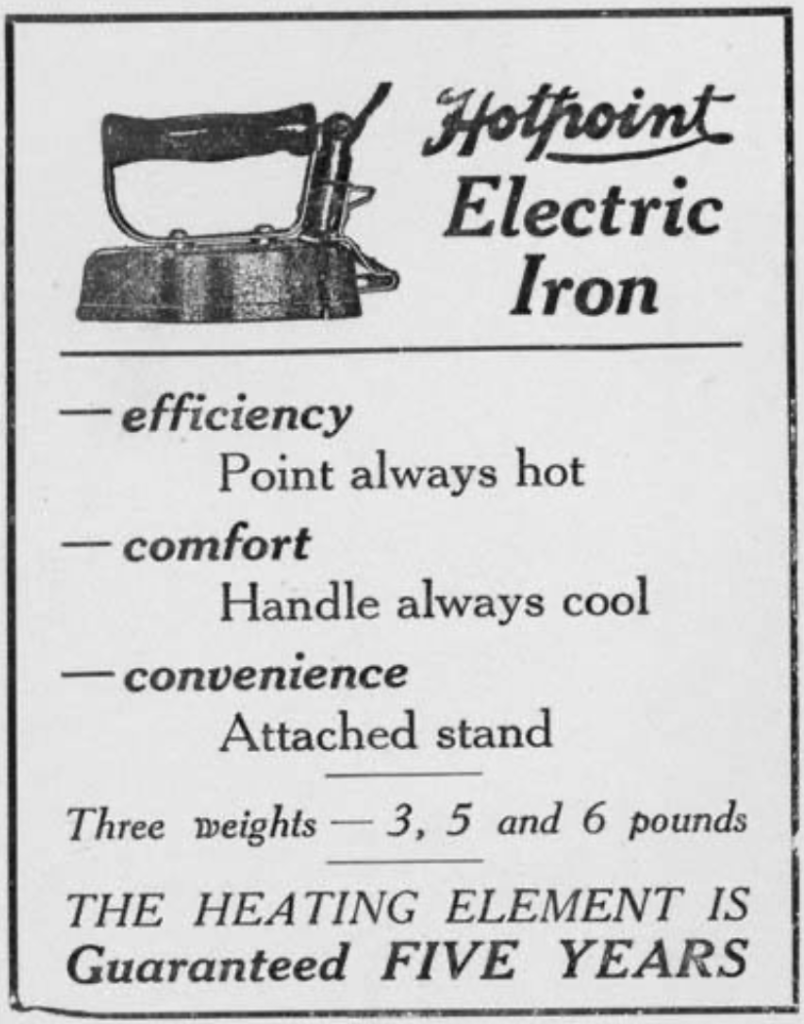
 Bridging the Silences