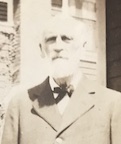
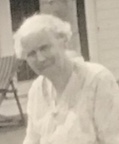
 Leaving Vermont, great grandparents Edward and Annie Calderwood Sandford, with infant daughter Saada, made their way west. They passed through Cheyenne, Wyoming in the Spring of 1981, where Edward had found a temporary engagement with the Baptist Church, and settled in Northern California later that year.
Edward became pastor of the Baptist Church in Eureka, California between 1891 and 1894. Voter registration records show the family living in Eureka in Humboldt County in far northern California in 1892.
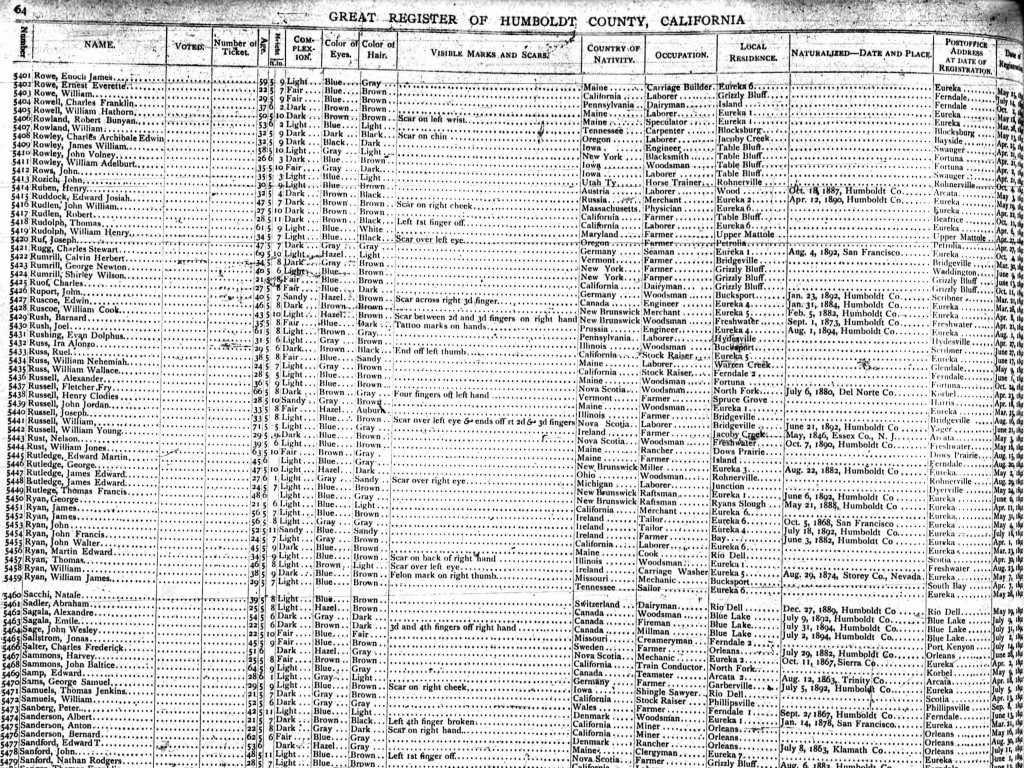
Grandfather Joe Sandford was born in Twin Lakes, near Santa Cruz in May 1892, so there must have been some juggling between Eureka and Santa Cruz (which are about 200 miles apart) during this time, the details of which are not clear. The family would have arrived in California in 1891 by the transcontinental railroad to San Francisco, so they may have waited there for the baby to be born before proceeding to Edward’s new job in Eureka. The railroad did not reach Eureka until early in the 20th century, so it must have been a boat trip up the coast.
After living in Eureka, the family returned to Santa Cruz for a two year engagement with the Baptist Church there, somewhere between 1894 and 1897.
In 1897 or 1898 they moved to Corona in southern California, 45 miles east of Los Angeles, where Edward preached at the Corona Baptist Church.
Their third and last child, Helen (“Honey”), was born in Corona in 1898. The family stayed in Corona for about 10 years.
The motivations for Edward’s westward migration make themselves clearer in looking at his life in California. Edward had entered the ministry after his diplomatic tour of duty in China with the specific ambition to become a missionary in China. However, his family life, specifically the ill heath of his first wife Sarah, precluded that for the next two decades. He remained in Vermont but, following Sarah’s death and his remarriage to Annie, he had another chance to pursue his vision, although by this time his age and health made a return (third) trip to China unrealistic. He took what was perhaps the next most ambitious path, following the expanding frontier of the United States to its extreme in California. Indeed, the work he did in Corona appears to have taken on more of a missionary flavor than his work in Vermont. Edward’s obituary, still decades in the future, would later summarize this period in his life as follows:
While in Corona he became well-known and loved in the community through his earnest desire to help anyone who was afflicted with suffering or sorrow, making it a custom to visit the sick and afflicted throughout all the country round about.
Saint Johnsbury Caledonian Record, October 25, 1922
Around this time in our story, the source of the narrative shifts to our grandfather Joe, who left many detailed notes and remembrances in his later years, beginning with his recollections from Corona, where he lived between ages 5 and 15.
Joe loved to tell stories. He recorded at least three sets of living history interviews years in the 1970s, sponsored by local historical societies and libraries. The three sets of interviews have a lot of repetition between the stories, which makes it possible to correlate and select between versions. Some of the stories are somewhat familiar to me–I have vague recollections of having heard them from him.
And my father and family moved out to Corona, California, a little community across the valley, about 1897. I was a little boy then. We lived in Corona for some ten years, perhaps twelve years. I went to grammar school there. ……. Corona is a circle city—crown. You’re familiar with it probably. It was a lovely community.
Joe Sandford from 1973 Living History Interview with Esther Boulton Black
My father was a minister and pastor of the First Baptist Church in Corona. We’d moved from Santa Cruz, California to Corona in the later part of the century, about 1897. And sometime you’d love to have his history, it’s from Abraham Lincoln and so forth. And, one little story there….I’ve always worked, father they told us if we would move to Corona that we could have all the oranges we wanted. We arrived there, occupied a lovely two-story home, that’s been owned by a doctor. I can remember as a little chap I went to the house and out the back door and there was an orange tree, covered with oranges.
Joe Sandford from 1974 Living History Interview conducted by the Upland Public Library
My father was pastor of the First Baptist Church of Corona from 1897 to about 1908. Those were the horse and buggy days. They had a livery stable….in Corona. My father out of his own pocket would rent a rig, as we called it, and he would drive out into the valley, to Auburndale, to the Pioneer district, and visit the farmers there. Then he would hold services in the different schoolhouses on Sunday. Me, a little termite going with him out into this south country here, I would see smoke coming along here, and I’d say, “Dad, what’s that smoke over there?” “Joe, that must be a train.” I wondered as to whether I would ever get over where that railroad was.
Joe Sandford from 1976 Living History Interview with Bryce Denton
Joe describes in detail his early work experiences…
As a boy, my father always wanted me to work, and I always wanted to work. My father was a minister. Our funds were limited. Salaries–there weren’t salaries. You had to limit yourself. Anyway, I was asked to peddle bills [i.e., handbills–ads]. One of the merchants over there would have me peddle bills. I had to do it walking. He would give me a dollar for a half day or a day; if there weren’t enough houses for the bills, I’d stick them in the hedges. The boys today still do that.
Anyway, the day came when one of the merchants said, “Joe, you’ve been delivering these bills for us, why don’t you come in and work after and before school, and holidays? How much would you charge?” It was a grocery store. I said, “Well, you’re paying me a dollar a day for half day’s work to get these bills out, how about a dollar a day?” Well, he said he couldn’t pay me that much. But I learned a lesson.
Another man bought the store in Corona–C.W. Veach and Son. I used to hold father’s hand and go down there when he’d buy groceries, and Mr. Veach–my father asked him if he’d like to hire me. He said, “Well, how much would you ask?” Well, I’d learned that a dollar a day was too much. I wanted a job. I said, “Well, how about fifty cents a day, three dollars a week?” “You’re hired.”
Well that man, I stayed with him for years, loved him. They taught me so much.
Joe Sandford from 1973 Living History Interview with Esther Boulton Black
Joe has specific memories of adventures and mishaps during his time working for the market….
Over in Corona I was working for Veach and Sons. We bought a team of mules, and they were wild; they’d never been broken in. We had a delivery wagon with a cab to deliver our groceries and things. They would always send two men out. One man would take care of the mules while the other would go in with the groceries. They didn’t have a brake on this delivery cart. After a year, one day, they let one man go out. The mules were supposed to be trained. I can remember in Corona I went off West Sixth St., and it was contoured like this. In those days you could park on either side. Today they put you in jail if you park … And I saw this flock of sheep off toward Rincon, toward Prado. I could see the mules were a little bit restless. They saw this flock of sheep coming and the dust. I thought I had plenty of time to get in there with those groceries and get out. Well, I came out just in time to see them make a turn and head back to town. They went around so fast that they turned the cab over and the whole thing, and broke away harness and all, and ran away. The boss was awful nice and never reprimanded me.
Joe Sandford from 1973 Living History Interview with Esther Boulton Black
Another time, an older gentleman in the store had taken those mules down to have them shod. We didn’t have the cart for long, but they were all harnessed. He said, ” Joe, you stand up at the front and hold on to the bridle, and I’ll drive them. To me, that was kind of foolish; it made it so slow, you know. So I said, “Why don’t we drive them?” And he said, “You come drive them.” So he turned the reins over to me and he didn’t stay at the head. Well, they walked about two steps. Then they commenced to trot. I couldn’t keep up with them; they just ran away. He knew something I didn’t know, you see. I thought I knew it all. But the lesson I learned there. You have to learn. So it goes.
Joe Sandford from 1973 Living History Interview with Esther Boulton Black
Joe’s path to becoming a banker began early in his life, in Corona, directly resulting from his work in the market…
And, I worked before and after school as a little fellow, and one day one of the directors of two banks over there, the Citizens Bank and the First National Bank of Corona, came down to the bank and he said “Joe,” he said, “that Mr. Kinney, the president of the bank, wants to see you.” I was probably about 14 years old.
Well, you didn’t need to tell me anything twice, so pretty soon I went up to see Mr. Kinney. And he said, “Joe we’ve been watching you, you’ve been sweeping out down at the store working there before you went to school and coming back after you went to school and so forth, working weekends, the holidays. We’d like to have you do that in the bank.” I did that.
Interviewer: That’s how you got started?
That’s the way I got started, in the bank. Just think of it, the director of the bank.
Joe Sandford from 1974 Living History Interview conducted by the Upland Public Library
Joe carried his work ethic from the store to his new job at the bank…
And it was fun. And I did just as he said–go down in the morning and sweep up, in the afternoon I’d go down and do the bookkeeping and some of those things. One morning he came in where I was working and he said “Joe, come over here.” And he pulled out a drawer in a desk and he taught me the combination to the vault. He said “Joe, you can have this, and you can have this open for me tomorrow.” Well after he left, I said “well why’d he pull out that drawer?” Well the numbers he’d given me were written on the margin. Well, he came in, probably at 9:30, and he pulled out another drawer, and he went and opened up the time lock. Well after he left, I went and looked at the other drawer, and the numbers were there. Well, it didn’t take me long to prove–they were the ones–so the next day I had the money out for him. He came in and said “well, Joe, who taught you to do this?” Well, I told him the story. Well he was (?) and he had confidence in me and said “Joe, don’t tell anybody, you can have it out after this..” Well, he could have fired me. But I’ve always tried to do that, to anticipate and do things.
Joe Sandford from 1974 Living History Interview conducted by the Upland Public Library
Joe got his work ethic from his father, but also his moral compass, even as he moved further into a line of work much different from that of his father….
My folks, father having been and was a Baptist minister at that time, and my mother, they were always against saloons and liquors. We had two saloons in Corona at that time. And each saloon paid $300 a month license fee. And so, I was kind of prejudiced against the employees of saloons. One day one of the men from the saloon came in and he wanted 50 pennies, along with some other things. And I gave him what though was–they were rolls, you know–and I gave him a roll. Pretty soon he came back. He said “Joe, didn’t you make a mistake? You gave me 50 dimes.” Five dollars. I said “gee there must be some good in these saloon keepers.” I learned a lesson, there’s good in everybody, he was honest in other words. And the saloon keepers all loved my father because he said “I admire you, I don’t like your business, but you have wives, you have children, you want them to be in church and Sunday school, and anything I can do for you, I want to.” He didn’t kick ’em out of town, but he rendered a service to them.
Joe Sandford from 1974 Living History Interview conducted by the Upland Public Library
Joe became an astute banker. Even in the 1970s he was able to recall details about the workings of the banks, the financial world, and many of his clients over his long career….
One day in the bank, in 1906 we had a depression, and they called in all the gold. The Los Angeles banks were issuing certificates, and so forth. Well one day a sheepherder came in–they used to have a lot of sheep in the hills, southwest of Pomona and down in the Corona hills–one day a sheepherder came in with a can of $20 gold pieces. There was something about gold, the feel and the ring of it and all that I loved. I used to keep those as part of our reserve in the little bank. I never sent it in to Los Angeles.
Joe Sandford from 1974 Living History Interview conducted by the Upland Public Library
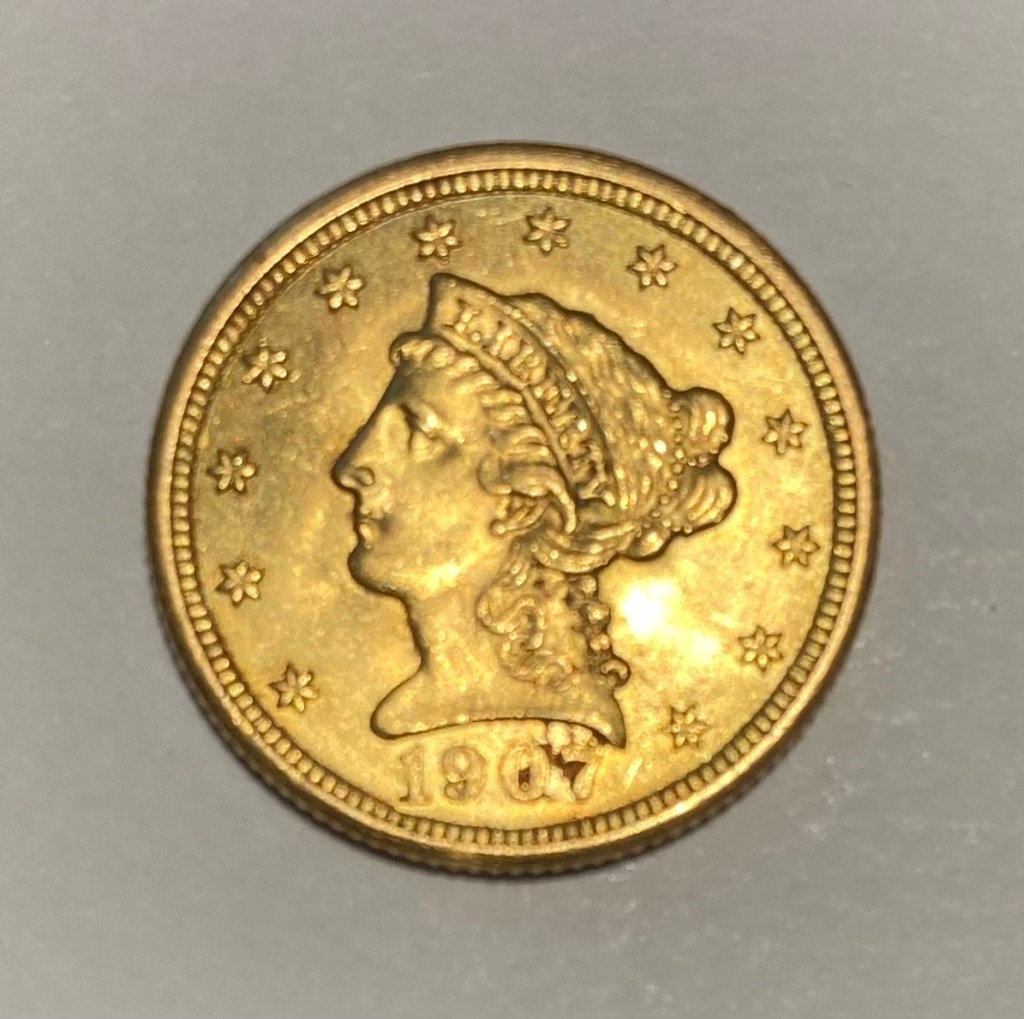
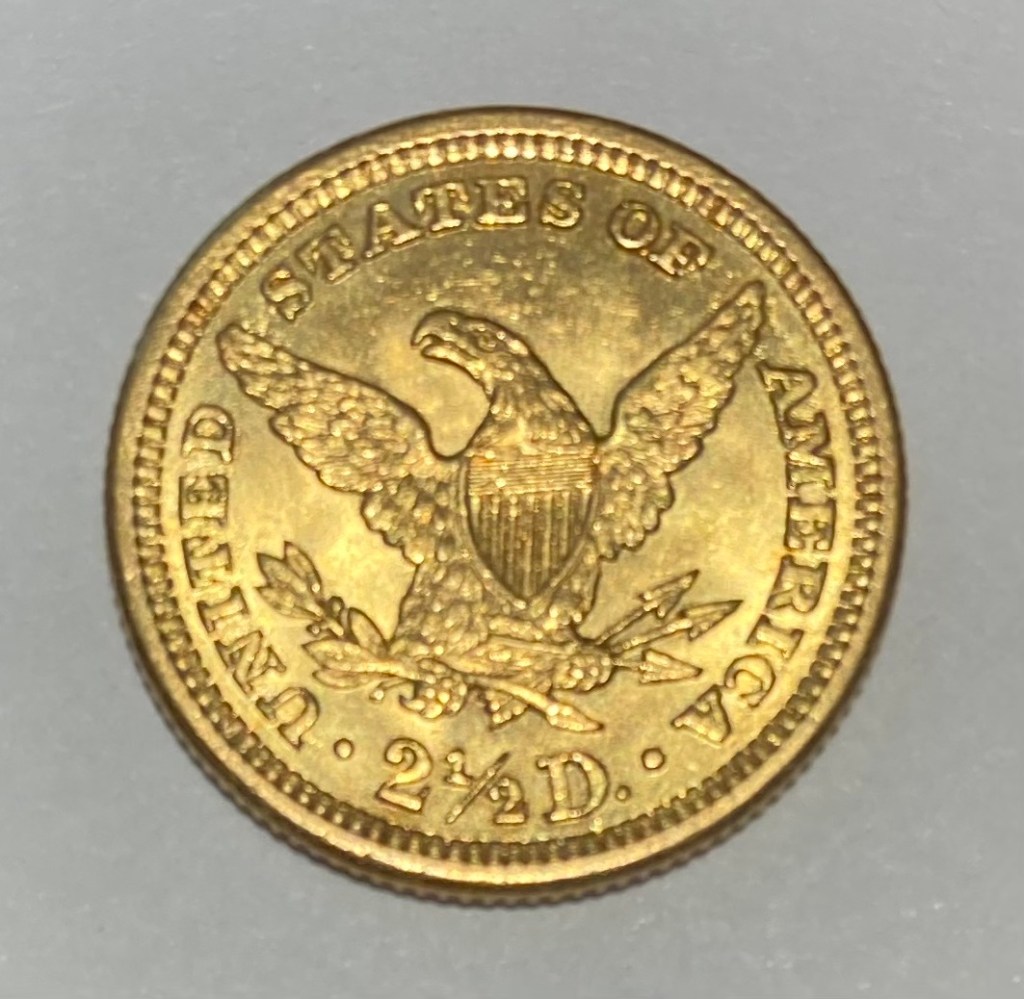
A $2.50 gold piece was maybe a little bigger than a dime. We used to have some, but we gave them to one of our boys for souvenirs.
Joe Sandford from 1973 Living History Interview with Esther Boulton Black
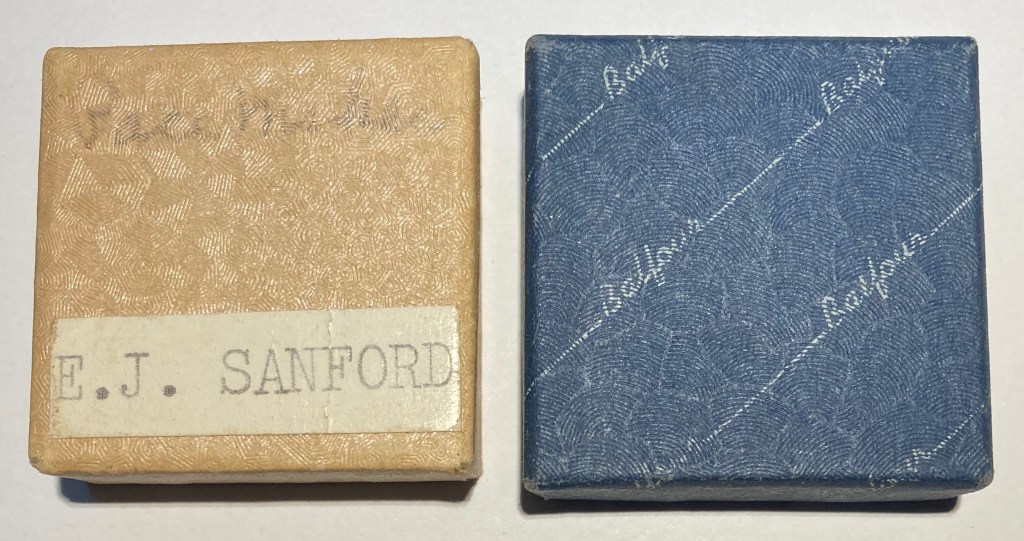
It may be one of these $2.50 gold pieces that was given to me by my grandfather as a child and which I still have today.
I will close this chapter on the Corona years with the following words which Joe used to end one of his Corona stories and which captures the spirit with which he recalls of these early days in Corona and the nearby towns that were to come next.
In the early days, the pioneering people of the valley were very proud. They came out here very interested in improving the valley–what could be grown here in the way of fruit, grain and stoop labor products? Our largest product in this area up here in Upland were oranges and lemons at that time. Then south of the railroad, the Southern Pacific Railroad, we had deciduous trees: peaches, apricots. And we grew alfalfa and some of those products. It was a lovely period for everybody. Horse and buggy days. The automobiles were just beginning to come in. These people that came here, perhaps they would have ten acres of oranges, lemons or what have you. It seemed to me at that time, they would cultivate the groves one day, and then once a month they would irrigate, and they would furrow out [??] to receive the water and irrigate the trees. Another day they would close the furrows. The rest of the time it seemed like they were visiting each other with their horses, and going to church. It was a lovely class of people. Each man was a king, you might say.
Joe Sandford from 1973 Living History Interview with Esther Boulton Black
By the time his family left Corona, Joe was a young man, 15 or 16 years old, with a firm set of ethics inherited from his parents, and a firm foothold in the banking business where he would work for the next half century.


4 thoughts on “Corona, The Crown Colony”