Searching for Crossing Paths in the Civil War

Great grandfather Edward Sandford was not our only ancestor to fight in the United States Civil War. Our second great grandfather Aaron Sechler, the father of our great grandfather George Sechler, served in the war for three years. Although they were a generation apart, Aaron Sechler was only three years older than Edward.

The 1860 U.S. Census shows 22 year old Aaron living in Danville with his family, including two brothers and two sisters. Aaron’s father Jacob was a farmer (referred to as Jacob Jr. because he lived with his uncle Jacob after the death of his father Joseph in 1804.)
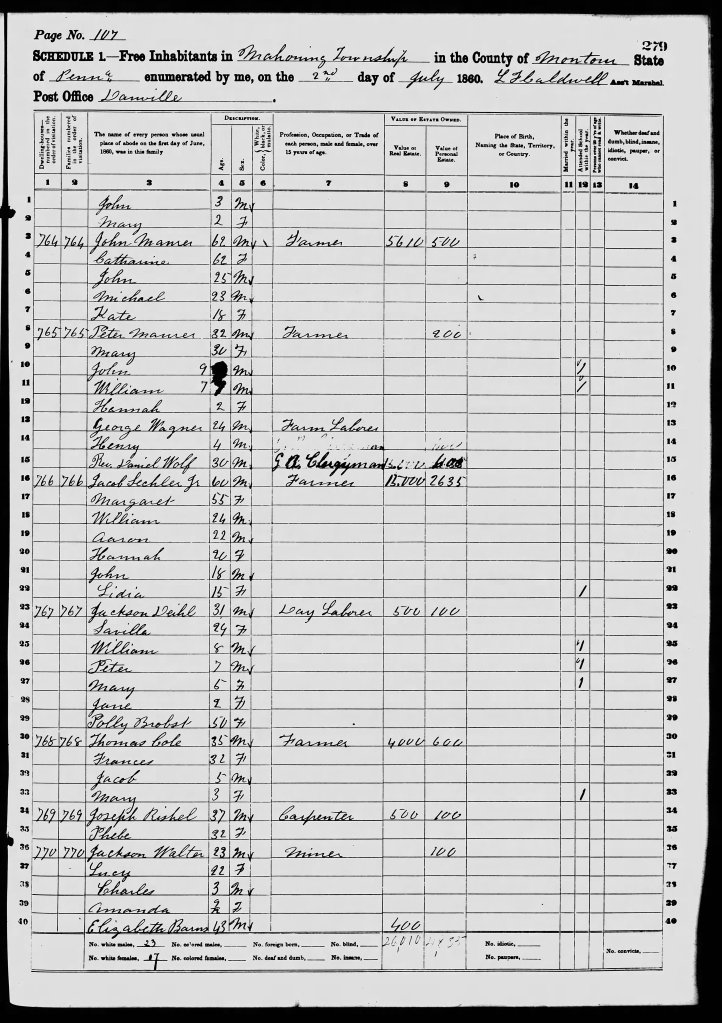
1860 United States Census showing Aaron Sechler living at home in Danville, Pennsylvania at age 22

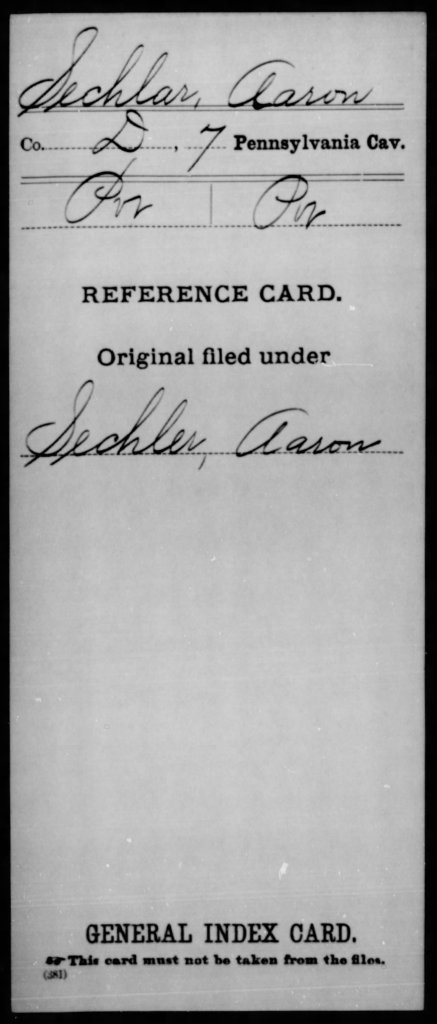
Aaron’s war records indicate that he served in two units during the war, the 132nd Pennsylvania Infantry and the 7th Pennsylvania Cavalry.
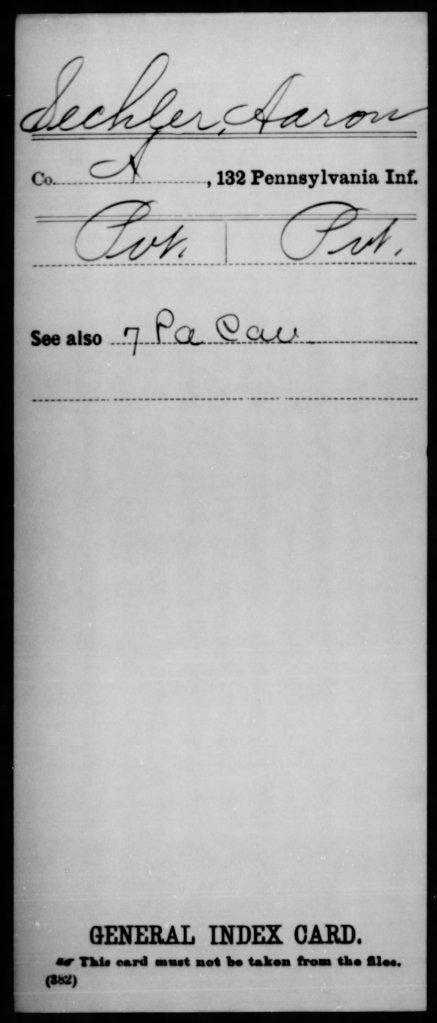
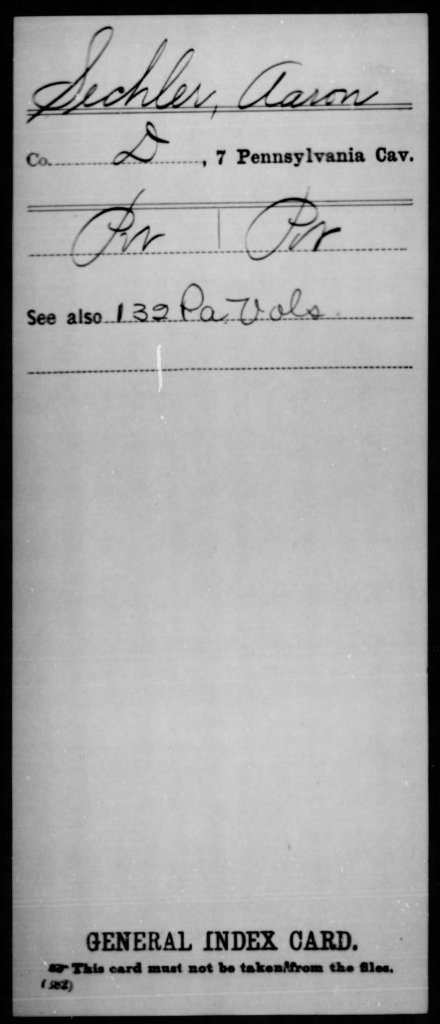
Records of the 132nd Pennsylvania Infantry show that it was in action earlier in the war, between August 1862 and May 1863, and that it moved up the Potomac River from the Washington DC region, participating in the Battle of Antietam, then back through Harper’s Ferry and into Virginia where it fought in the Battle of Fredericksburg.

The 132nd Pennsylvania Infantry was organized at Harrisburg, Pennsylvania, in August 1862 and mustered in under the command of Colonel Richard A. Oakford.

The regiment was attached to 1st Brigade, 3rd Division, II Corps, Army of the Potomac, to November 1862. 2nd Brigade, 3rd Division, II Corps, to May 1863.

The 132nd Pennsylvania Infantry mustered out May 24, 1863.

Detailed Service: Moved to Washington, D.C., August 19, and performed duty there until September 2. Ordered to Rockville, Md., September 2. Maryland Campaign September 6-22, 1862. Battle of Antietam, Md., September 16-17. Moved to Harpers Ferry, Va., September 22, and duty there until October 30. Reconnaissance to Leesburg October 1-2. Advanced up Loudon Valley and movement to Falmouth, Va., October 30-November 17. Battle of Fredericksburg December 12-15. Duty at Falmouth until April 27. Chancellorsville Campaign April 27-May 6. Battle of Chancellorsville May 1-5.

The regiment lost a total of 113 men during service; 3 officers and 70 enlisted men killed or mortally wounded, 40 enlisted men died of disease.

Wikipedia

Muster-Out Roll records from the 132nd confirm that Aaron joined the unit on August 7, 1862 and remained with the unit through its decommissioning. That Aaron’s name does not appear on a separate list of men discharged from duty at that time is consistent with other sources showing that he remained in service after his tour with the 132nd was complete.
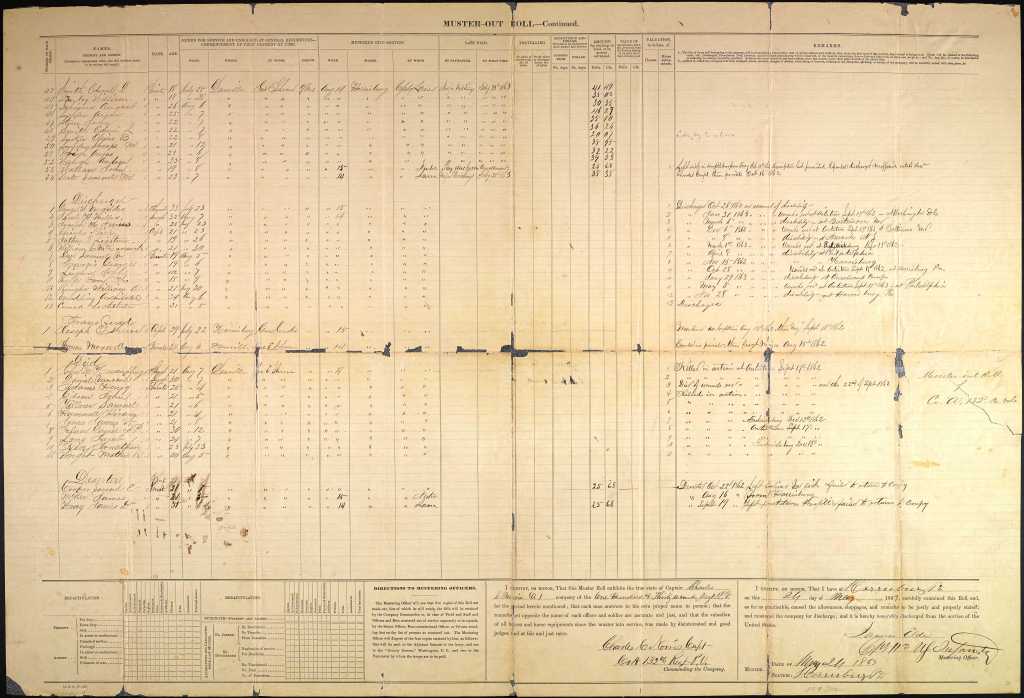
Muster-out records from the 132nd Infantry of Pennsylvania. Aaron Sechler is listed in the fourth row from the top.

A year later, Aaron appears in records affirming his attachment to the 7th Pennsylvania Cavalry, where he remained through August 1865.
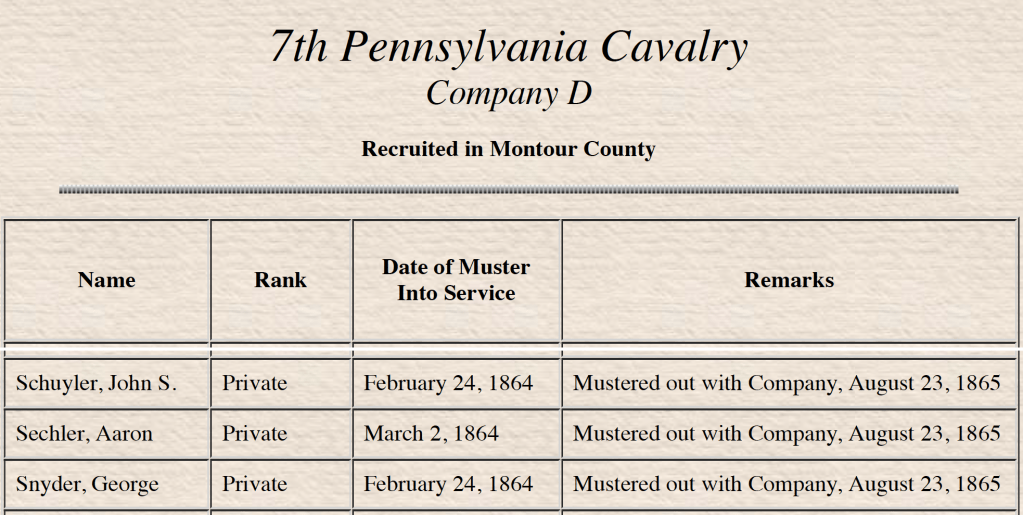
By 1864, the war had moved deep into the South (this being the time when General Sherman was driving toward the burning of Atlanta in July). Records of the 7th Cavalry list its involvement in many campaigns in locations in Kentucky, Tennessee and Alabama.

The 7th Pennsylvania Cavalry was organized at Camp Cameron in Harrisburg, Pennsylvania September through December 1861 and mustered in for a two-year enlistment on December 19, 1861, under the command of Colonel George C. Wynkoop. The regiment was recruited in Allegheny, Berks, Bradford, Centre, Chester, Clinton, Cumberland, Dauphin, Luzerne, Lycoming, Montour, Northumberland, Schuylkill and Tioga counties.

The regiment served unattached, Army of the Ohio, to March 1862. Negley’s 7th Independent Brigade, Army of the Ohio (1st Battalion). Post of Nashville, Tennessee, Department of Ohio (2nd Battalion). 23rd Independent Brigade, Army of the Ohio (3rd Battalion), to September 1862. Cavalry, 8th Division, Army of the Ohio (1st and 2nd Battalions), Unattached, Army of the Ohio (3rd Battalion), to November 1862. 1st Brigade, Cavalry Division, Army of the Ohio, to January 1863. 1st Brigade, 2nd Division, Cavalry Corps, Army of the Cumberland, to November 1864. 2nd Brigade, 2nd Division, Cavalry Corps, Military Division Mississippi, to July 1865.

The 7th Pennsylvania Cavalry mustered out of service at Nashville, Tennessee, on August 13, 1865.

Detailed Service: Moved to Louisville, Ky., December 19, and ordered to Jeffersonville, Ind. Duty there until February 1862. 1st Battalion (Companies A, D, H, and I) sent to Columbia, Tenn. Expedition to Rodgersville May 13–14. Lamb’s Ferry, Ala., May 14. Advance on Chattanooga June 1. Sweeden’s Cove June 4. Chattanooga June 7–8. Occupation of Manchester July 1. Paris July 19. Raid on Louisville & Nashville Railroad August 19–23. Huntsville Road, near Gallatin, August 21. Brentwood September 19–20. Near Perryville October 6–7. Battle of Perryville, October 8. Expedition from Crab Orchard to Big Hill and Richmond October 21. 2nd Battalion (Companies C, E, F, and K), under Gen. Dumont, in garrison at Nashville, Tenn., and scouting in that vicinity until November. 3rd Battalion (Companies B, G, L, and M), in Duffield’s Command, scouting in western and middle Tennessee. Lebanon and pursuit to Carthage May 5. Readyville June 7. Murfreesboro July 18. Sparta August 4–5 and 7. Regiment reunited in November 1862. Nashville November 5. Reconnaissance from Nashville to Franklin December 11–12. Wilson’s Creek Pike December 11. Franklin December 12. Neal, Nashville December 24. Advance on Murfreesboro December 26–30. Lavergne December 26–27. Battle of Stones River December 30–31, 1862 and January 1–3, 1863. Overall’s Creek December 31. Manchester Pike and Lytle’s Creek January 5, 1863. Expedition to Franklin January 31-February 13. Unionville and Rover January 31. Murfreesboro February 7. Rover February 13. Expedition toward Columbia March 4–14. Unionville and Rover March 4. Chapel Hill March 5. Thompson’s Station March 9. Rutherford Creek March 10–11. Snow Hill, Woodbury, April 3. Franklin April 10. Expedition to McMinnville April 20–30. Middletown May 21–22. Near Murfreesboro June 3. Operations on Edgeville Pike June 4. Marshall Knob June 4. Shelbyville Pike June 4. Scout on Middleton and Eagleville Pike June 10. Scout on Manchester Pike June 13. Expedition to Lebanon June 15–17. Lebanon June 16. Tullahoma Campaign June 23-July 7. Guy’s Gap or Fosterville and capture of Shelbyville June 27. Expedition to Huntsville July 13–22. Reconnaissance to Rock Island Ferry August 4–5. Sparta August 9. Passage of Cumberland Mountains and Tennessee River, and Chickamauga Campaign August 16-September 22. Calfkiller River, Sparta, August 17. Battle of Chickamauga September 19–20. Rossville, Ga., September 21. Reenlisted at Huntsville, Ala., November 28, 1863. Atlanta Campaign May to September 1864. Demonstration on Rocky Faced Ridge May 8–11. Battle of Resaca May 14–15. Tanner’s Bridge and Rome May 15. Near Dallas May 24. Operations on line of Pumpkin Vine Creek and battles about Dallas, New Hope Church and Allatoona Hills May 25-June 5. Near Big Shanty June 9. Operations about Marietta and against Kennesaw Mountain June 10-July 2. McAffee’s Cross Roads June 11. Powder Springs June 20. Noonday Creek June 27. Line of Nickajack Creek July 2–5. Rottenwood Creek July 4. Rossville Ferry July 5. Line of the Chattahoochie July 6–17. Garrard’s Raid on Covington July 22–24. Siege of Atlanta July 22-August 25. Garrard’s Raid to South River July 27–31. Flat Rock Bridge July 28. Kilpatrick’s Raid around Atlanta August 18–22. Flint River and Jonesborough August 19. Red Oak August 19. Lovejoy’s Station August 20. Operations at Chattahoochie River Bridge August 26-September 2. Operations in northern Georgia and northern Alabama against Hood September 29-November 3. Carter Creek Station October 1. Near Columbia October 2. Near Lost Mountain October 4–7. New Hope Church October 5. Dallas October 7. Rome October 10–11. Narrows October 11. Coosaville Road, near Rome, October 13. Near Summerville October 18. Little River, Ala., October 20. Leesburg October 21. Ladiga, Terrapin Creek, October 28. Ordered to Louisville, Ky., to refit; duty there until December 28. March to Nashville, Tenn., December 28-January 8, 1865, thence to Gravelly Springs, Ala., January 25, and duty there until March. Wilson’s Raid to Selma, Ala., and Macon, Ga., March 22-April 24. Selma April 2. Occupation of Montgomery April 12. Occupation of Macon April 20. Duty in Georgia and at Nashville, Tenn., until August.

The regiment lost a total of 292 men during service; 8 officers and 94 enlisted men killed or mortally wounded, 5 officers and 185 enlisted men died of disease.

Wikipedia

Altogether Aaron served two tours of duty separated by a year away from action, the first tour about 9 months long, the second 17 months. Determining Aaron’s exact roles in the battles fought by the 7th and 132nd would be a good topic for future research. In any case, this is an extraordinary amount of time to be serving under such difficult conditions, facing so many significant battles and skirmishes along the way.

By contrast, Edward Sandford enlisted in June 1863 (recall that he was sailing in Asian waters when the war started) and only reached the war front in the spring of 1864. His path took him directly south from Washington DC through Virginia and North Carolina. By mid-June he had been wounded and was making his way back north through various hospitals and stages of recovery.

So the two men were fighting at the same time in the same broad offensive for a couple months in 1864, but several hundred miles apart. This is as close as they came to crossing paths.

Aaron returned to Danville and was married to Rebecca Roberts a short time later in 1865. They had six children between 1866 and 1879, including fourth child George who was born in 1873.

Having survived a war where as many died of disease as from fighting, Aaron succumbed to typhoid pneumonia in 1887, at age 50, when George was 13.
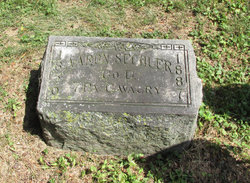
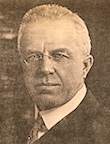
Aaron Sechler is buried in the Shiloh Cemetery in Danville

An Early Crossing of Paths Between The Swan and Sechler Families

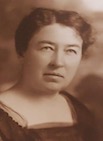
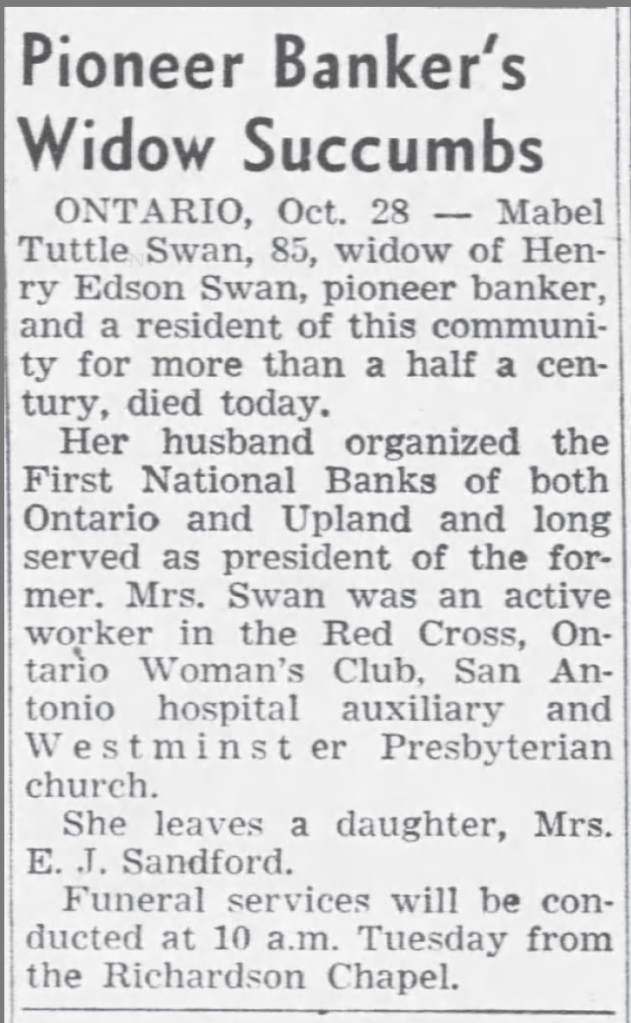
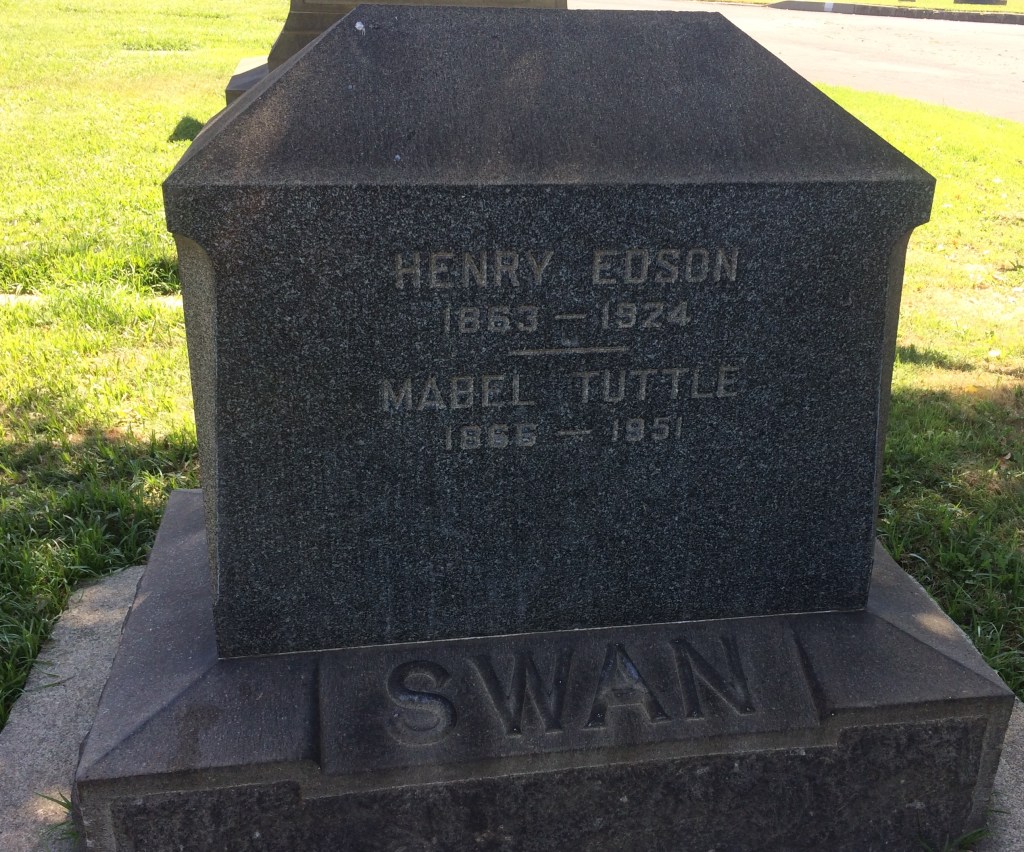
Our mother recalls that her first planned meeting with the Sandford family at the Ontario homestead had to be postponed because of the death of our father’s grandmother. Our great grandmother Mabel Tuttle Swan died in October 1951 at age 85.

Los Angeles Times, October 29, 1951
Bellevue Cemetery, Ontario, California

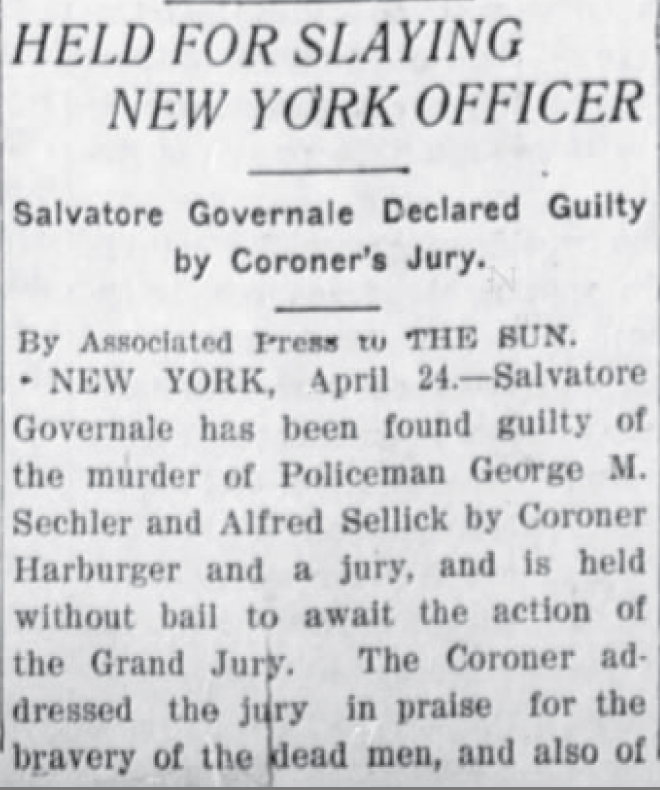
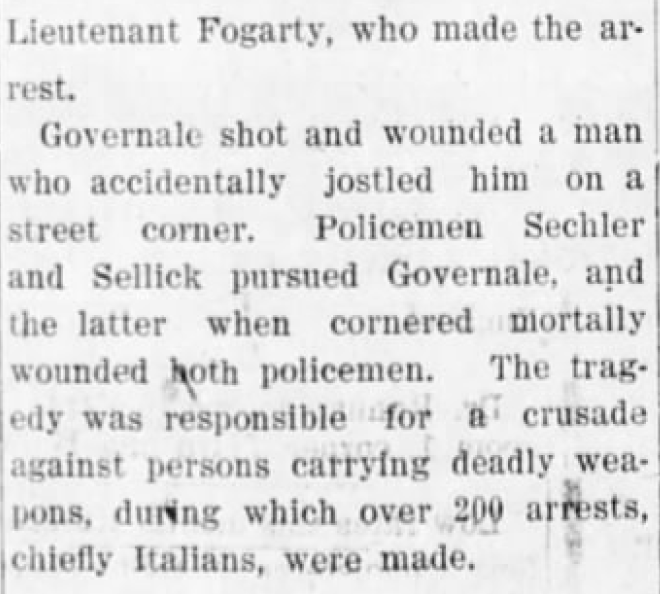
Had our mother met Mattie Swan, there is a small possibility that they could have figured out the connection with a story that Mattie might have read 44 years earlier in the San Bernardino County Sun. News of the death of our great grandfather George Sechler in Manhattan, and subsequent events, appeared nationwide.

San Bernardino County Sun, April 25, 1907

Both our parents grew up in households that included their maternal grandmothers following the tragic deaths of their husbands. This common experience could easily have come up in introductory conversations between the two families. Whether or not Mattie would remember a news story from 44 years ago, it is an example of family paths crossing long before the connecting of two branches of the family tree.

There are several examples of this kind of coincidental path-crossing in our family history, for example, the Calderwood and Swan families both coming from the same area in Vermont a century before the 1921 marriage of our grandparents in California. I’ll point out some other examples in future posts.

Joe’s Family Provides a Business Advertising Boost

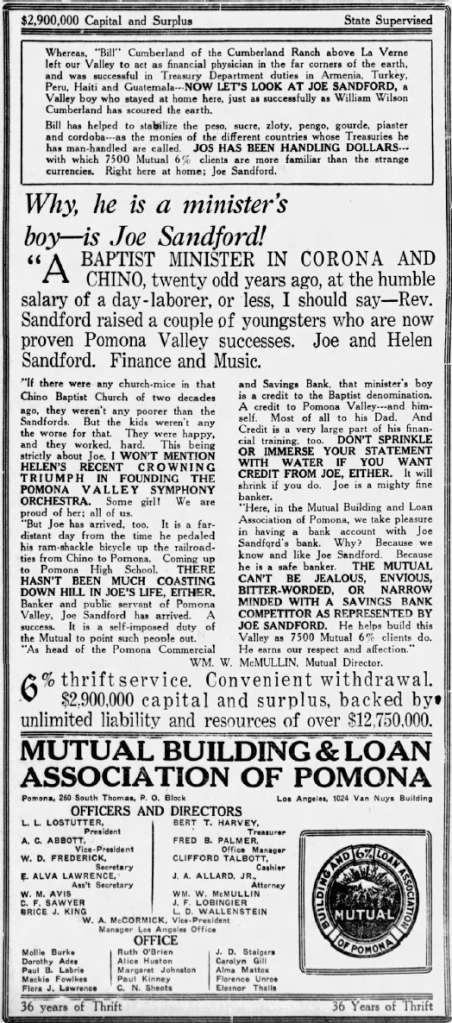
Before concluding that our grandfather Joe Sandford was always a completely proper banker and businessman, we should consider an advertisement found in the Pomona Progress Bulletin in May 1929.

Pomona Progress Bulletin, May 25, 1929

Somewhere along the line Joe began selling insurance as a sideline to his job as President of the Pomona Commercial and Savings Bank.

In 1929, Joe’s sister Helen was at the height of her career as a musician and founder of the Valley Symphony Orchestra, which was receiving rave reviews throughout the region. No point in having a groundbreaking successful sister if you can’t use her to boost your business a just a little.

Not to mention your deceased father. Well, Joe was a natural as a salesperson, always happy to be talking with people, telling stories….and making sure everyone’s insurance portfolios were up to date.

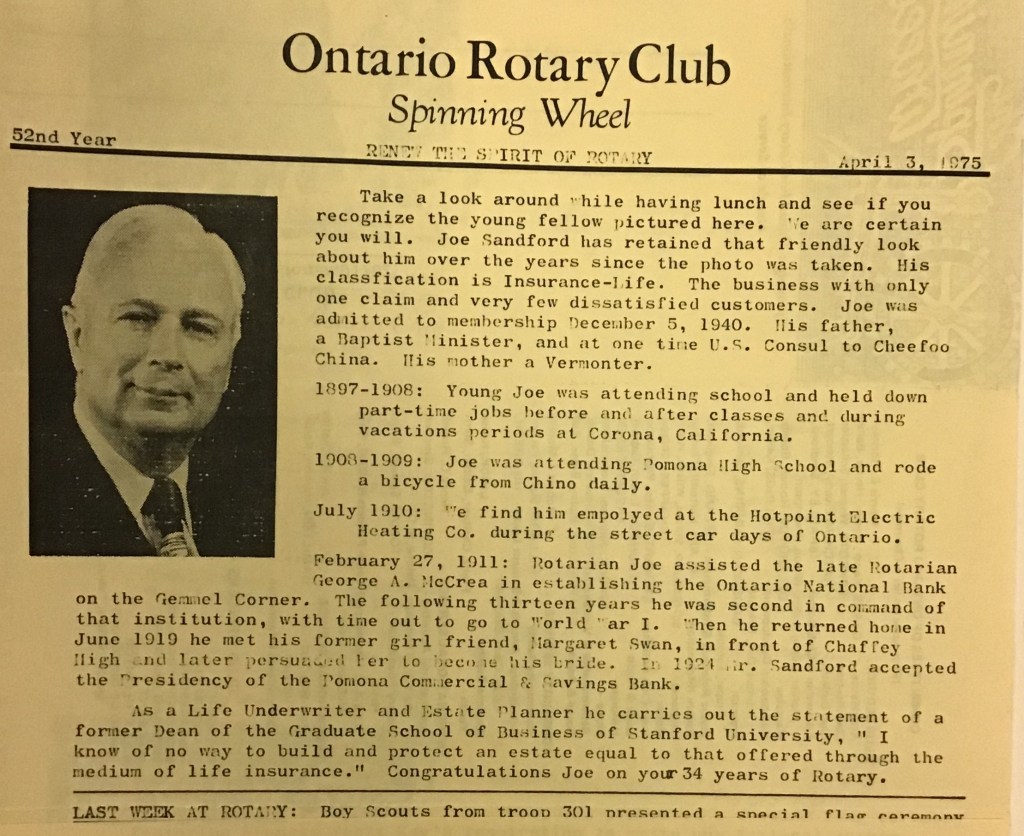
Joe continued selling insurance well beyond his retirement as a banker. In a 1975 Rotary Club bulletin, we can see that he was still selling, although the words were practically identical to those that had been used in a similar bulletin 25 years earlier.

Linked Memories: Traces of George and Laura Sechler

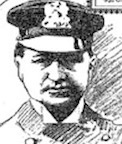
Can we find anything in our present memories that links us back to the life of our great grandfather George Sechler, who died at age 33 in 1907 in the line of duty as a New York City police officer? This is no easy task–his wife, Laura, apparently spoke very little about her husband to her grandchildren as they were growing up. We can recall that our grandmother, only 7 weeks old when her father died, made occasional references to growing up without a father, but there were never any details.
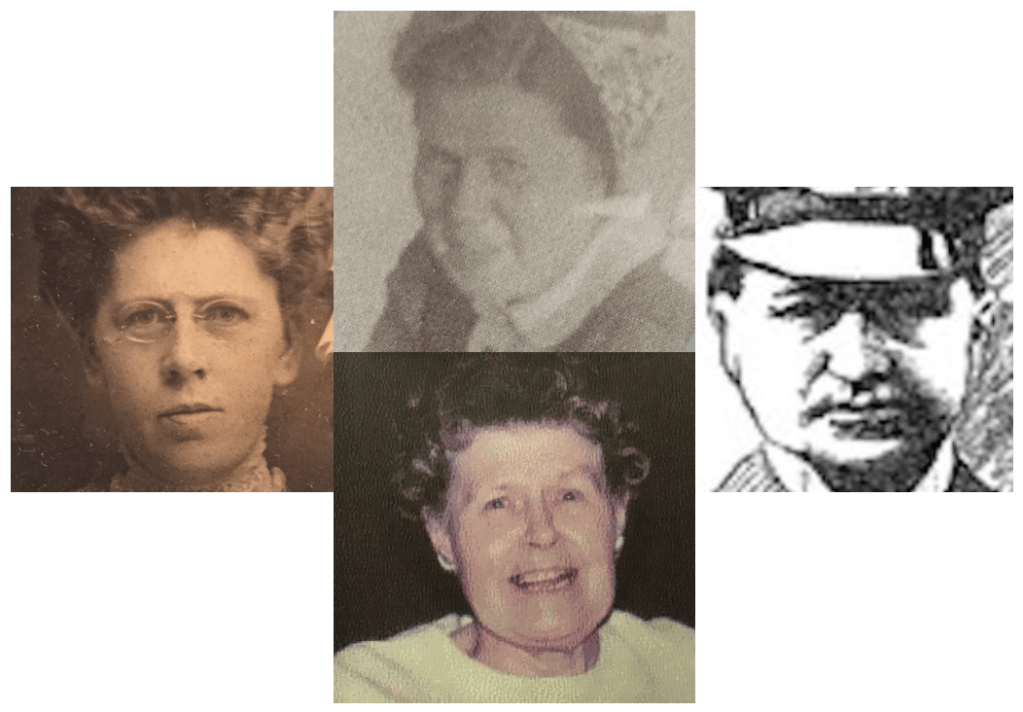
We only have the one image of George, the circa 1905 sketch, the source of which remains unknown. Photography remained rare in 1907–not even pictures of fallen police officers made it into the newspapers, if any photos of George even existed at the time.

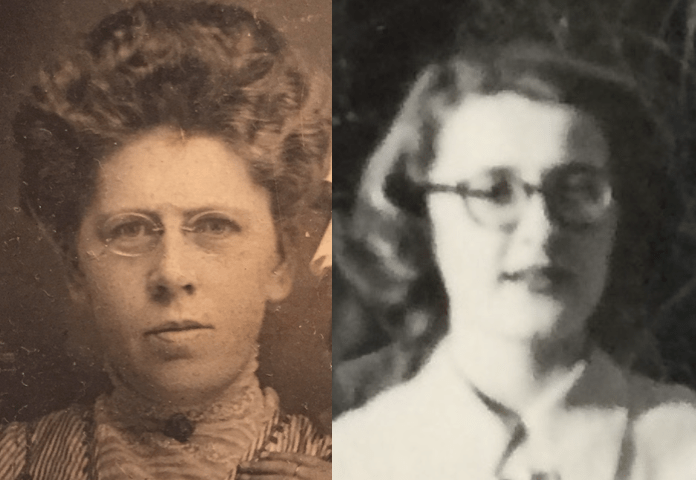
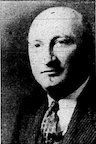
But if we look closely at the images we have, comparing daughter Ruth with her parents, I believe there is a clear resemblance to her father.

Mother Laura, left; daughter Ruth, center, father George Sechler, right.

In particular, the square shape of Ruth’s face seems to come straight from her father, not apparent in the face of her mother. After seeing this, for me, the overall father/daughter resemblance becomes difficult not to see. George is there, in the grandmother we knew (and perhaps also in the face of our mother, who bears some resemblance to her mother).

As for Laura’s influence, it is perhaps most apparent in her granddaughter, our aunt, Joan.

Laura Sechler and granddaughter Joan

Linked Memories: Two Generations, Two Double Lives

The combined evidence on the lives of our great grandfather James Louis Hynes and his son, our grandfather, James Gordon Hynes is abundant, decisive and powerful–they were astoundingly alike in their strengths and, sadly, their faults. We can learn much about each of them from the other.
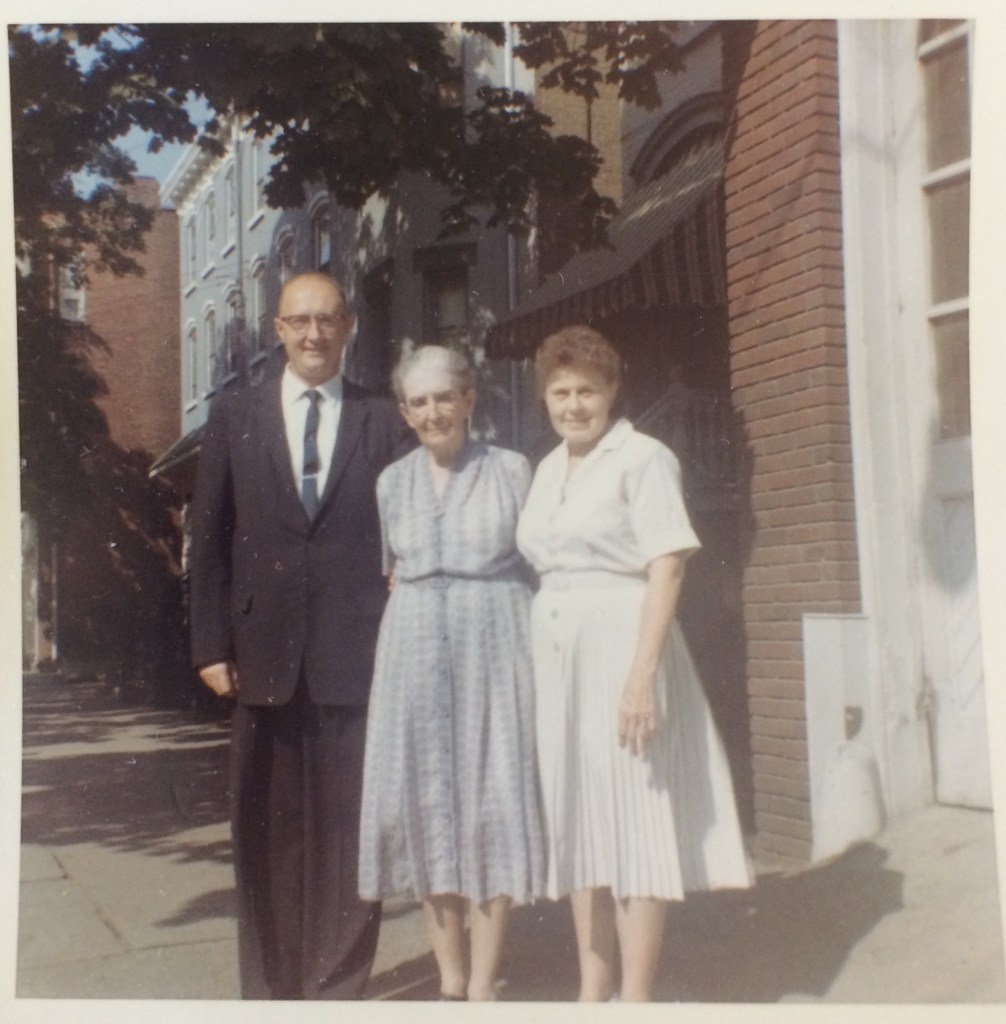
On the surface, both men were successful Baptist ministers, our grandfather following literally in the footsteps of his father in taking over in 1930 the Freeport church his father had led a decade earlier.

But both led troubling double lives, inflicting lasting damage on their families. We have documented the details of this for our great grandfather. In the case of our grandfather, it was a matter of incrementally revealed hints that leaked through the family defenses through the 1980s and early 1990s–comments and revealed incidents reinforced by our comparing notes in later years. The grandfather we knew for three decades was as deeply flawed as his father.

Because the events in question have serious implications to our parents’ generation, I am being deliberately vague about the specific transgressions of our grandfather, only that they were on-par with those of his father. I do not believe there is anyone living who was directly harmed, but it is difficult to be certain.

What we have learned about our great grandfather further reinforces our understanding of our grandfather. The father’s life provides a template for the life of his son, the outrages and absurd contradictions repeating from one generation to the subsequent one. This is particularly difficult to understand with the knowledge that our grandfather grew up on the front lines defending his family against the outrages of his father– knowing the worst wouldn’t he surely have wanted to defend against the possibility of repeating them? I must conclude that there is a genetic component to the behavior, bred (perhaps inbred) through generations of unimaginable hardships in the northern reaches of Newfoundland, not able to be compensated-for in only a single generation of union with the genteel nature of the family of Bessie Gordon.

We can conversely glean a positive view of our great grandfather through our memories of our grandfather. Although it has been tempting to dismiss our great grandfather as a sort of cynical con-man, it is more likely that he was like his son who we knew to be a serious academic and clergyman, despite his serious flaws. We might have already guessed this from a man who wrote seasonal religious poetry that filled an entire page of a newspaper.

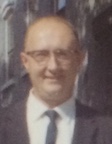
A 1961 or 1962 photo speaks volumes. It shows our grandparents on a visit to our grandfather’s Aunt Addie, in front of the Gordon family homestead at 182 Liberty Street in Newburgh. We have previously noted that Addie was the person in the world most able to see right through her brother-in-law. It is difficult to imaging that she, the person who devoted her life to aiding and defending young women, was not equally aware of the behaviors of her nephew.

We know this 1961/1962 photo is taken in front of the Gordon homestead in Newburgh, New York by comparison of the features of the buildings with other images.

Linked Memories: The Grass Beneath Our Feet

Following Edward’s death in 1922, great grandmother Annie continued to live at the family home at 541 East D Street. Daughter Helen remained with her, studying music with prominent musicians in the region until mid 1926, then spending two years in Vienna. Returning in 1928, Helen lived at home as she built the Pomona orchestra and took it through its first concert season. Helen left home for good in late 1929, moving to New York to marry Edgar Bircsak.

Annie lived alone in the East D Street home for 11 more years until her death in December 1941. She was 10 blocks away from son Joe’s family at 501 North Vine Ave.

The former Sandford homestead at 541 East D Street in Ontario, as it appears today

Personal information about Annie remains hard to find. Even Joe’s stories and detailed diaries don’t give us much beyond mentions of frequent visits. That she lived in Edward’s bigger-than-life shadow may also have contributed to our knowing less about her.

But we have managed to assemble a reasonable profile of Annie, her ancestry in Scotland and Vermont, the burden she shared with Edward in caring for Sadie Spear in her final decade of bad health, and the bargain she happily struck with fate in marrying a man 18 years her senior. She was a true pioneer, crossing the western frontier, following Edward through Cheyenne and Eureka with infant children in tow, and forging a new life in the tiny frontier town of Corona.

With Edward, Annie raised three talented, successful children, giving them the freedom to pursue diverse paths much different from their own–philosophy and practices of raising children that were passed down to future generations. Whatever Annie said when when young Joe came home at 2am after walking home from Pomona having missed the last train, or when Helen was sweeping through Los Angeles building a groundbreaking musical career unheard of for women in the 1920s, she did not discourage them.

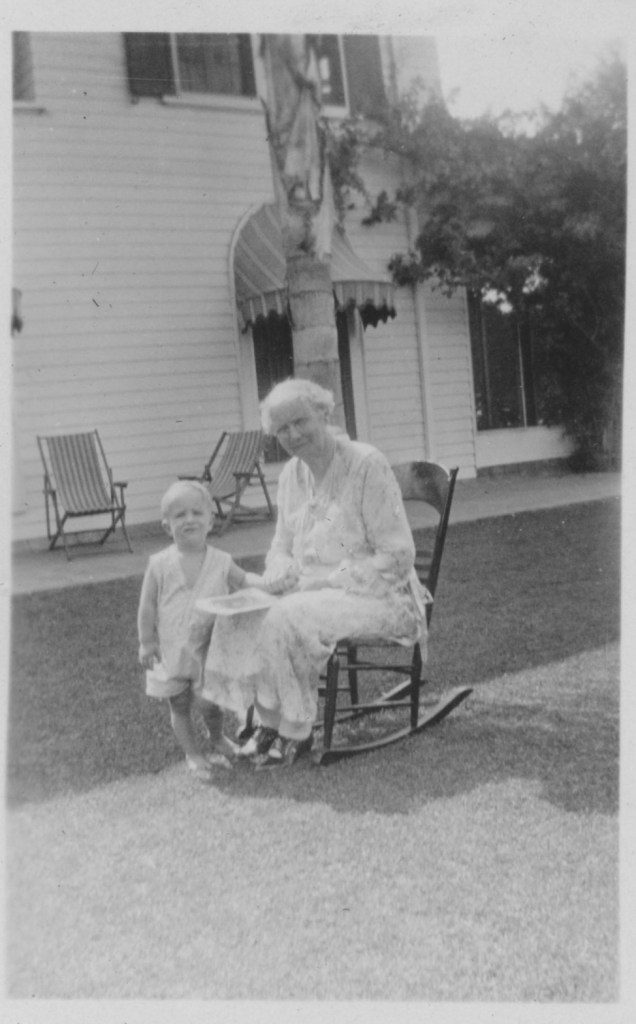
With other sources of information dwindling, we can turn to our own memories which link us to ancestors we never knew. A family photo circa 1932 shows Annie at about 74 years of age, sitting in the front yard at 501 North Vine with our father, her young grandson, Gordon.

The linked memory evoked by this photo is simple: I (we) know exactly what it feels like to sit in this exact spot, in the warm, dry late afternoon air, the short, stiff grass crinkling underfoot. That sensation, engrained from early childhood for the rest of our lives, also shared with our father, was equally familiar to our great grandmother, Annie.

Linked Memories: Irrigation Day

Memories of the citrus grove at our grandparents’ home at 501 North Vine Ave in Ontario, California shed light on our ancestry. One evening during a visit in the mid 1960s a tractor came down the alleyway and proceeded to plow trenches along the length of the grove. The entire process took perhaps an hour. I also seem to recall our Grandfather Joe having been on the telephone at the desk in the hallway nook earlier in the day requesting the man to come with the tractor.
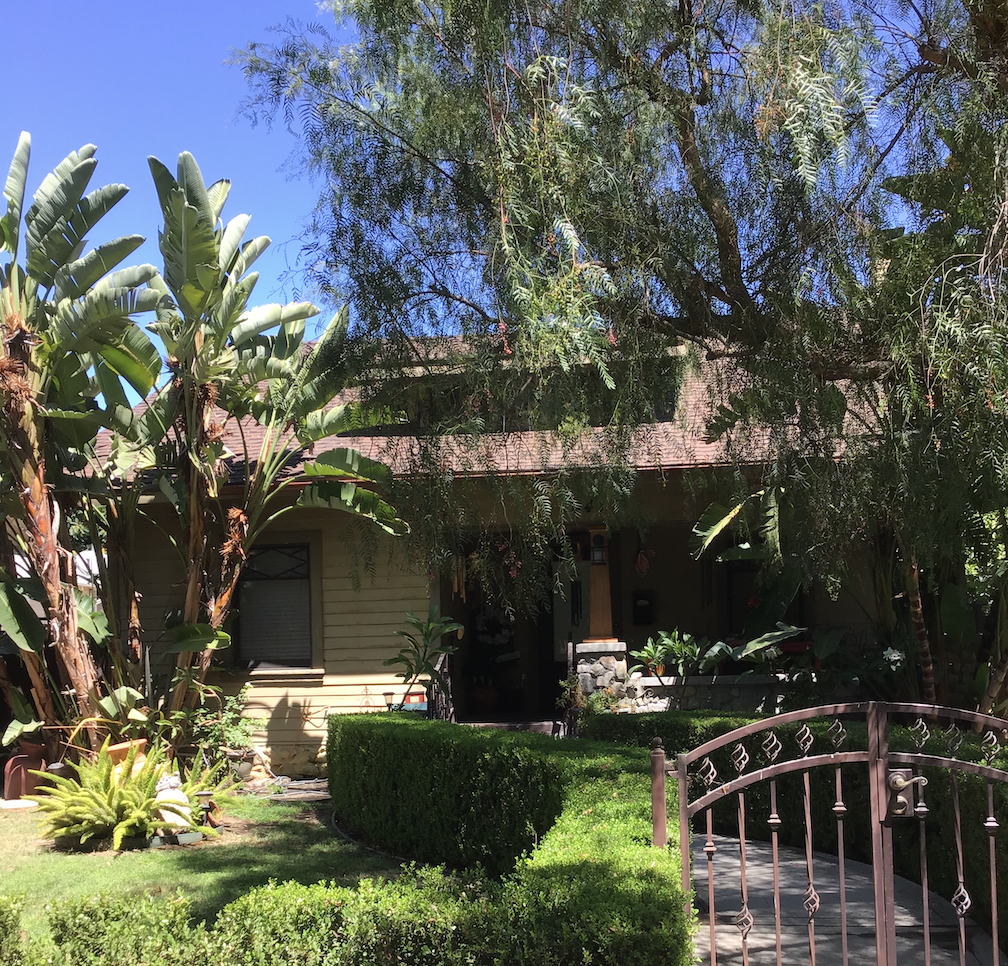
A subsequent memory, although perhaps not from the same cycle as the trench plowing, was visiting the home on a Saturday that turned out to be irrigation day. For a couple of hours water magically flowed from the pipes at the west end of the orchard into the recently dug trenches–pipes that surely connected to the irrigation system built by the Chaffey brothers 75 years earlier. All morning and into the afternoon, Grandpa walked around in his boots using a hoe to channel water to the individual trees as it flowed down the trenches from west to east. As each tree received its share of the water, he closed off a little dam around it and move on to the next tree.

I don’t know how often this process took place, I would guess a few times a year. I only recall seeing it once or twice.

I believe that, with care, memories of the grandparents we knew can be transferred to the ancestors we never knew. We can theorize about characteristics handed-down and find support for these theories in family and genealogical records. We can thus capture “linked memories” of ancestors we never met.

Usually we look to each grandparent’s parents as the main source of inherited traits and habits. In the case of our grandfather Joe, the generational transference was more complex, and we have seen ample evidence that grandfather Joe turned out to be more of an even split between his father and father-in-law than just his father. Joe got much of his ethical compass from his father, Edward, but he was a banker and businessman very much like Henry Swan. Henry and Joe also both loved the citrus industry and were both spare-time fruit growers. Both men’s lives mixed the business world with home lives built around cultivation–lives where there were always ample quantities of fresh fruit on the back porch ready to be eaten.

The Vine Street orchard passed through three generations of our family. Both the Tuttle and Swan families, each having had a single female child, passed it down to their daughters’ families. Memories of the orange grove are also glimpses of the lives of our great grandfather Henry Swan and second great grandfather Barton Tuttle.

We know the Swans had servants, including a gardener, so it is hard to say whether Henry Swan, himself, trudged through the grove with a hoe, or supervised others in the process. But we know he had detailed knowledge of the industry which he applied to his business relationships with the growers he served.

Ultimately, Henry paid a big price for becoming too emotionally invested in the problems of the orange growers he served. Had he lived beyond 1924, Joe and Margaret would probably not have moved back to Ontario to take over the home and grove, and we would not have first-hand memories of the grove to link to Henry Swan.

Today the orchard is gone, as are most of the orchards of the San Gabriel Valley. About half the land remains as woodlands which still surround the home. Our memories of the grove, and linked memories of Henry Swan, live on.

Helen’s Orchestra

After the death of Edward Sandford in October 1922, his wife, Annie, and their daughter, Helen, remained in the family home at 541 East D Street in Ontario, California. Helen, who we knew as Aunt Honey (our grand aunt), was 24 in 1922.

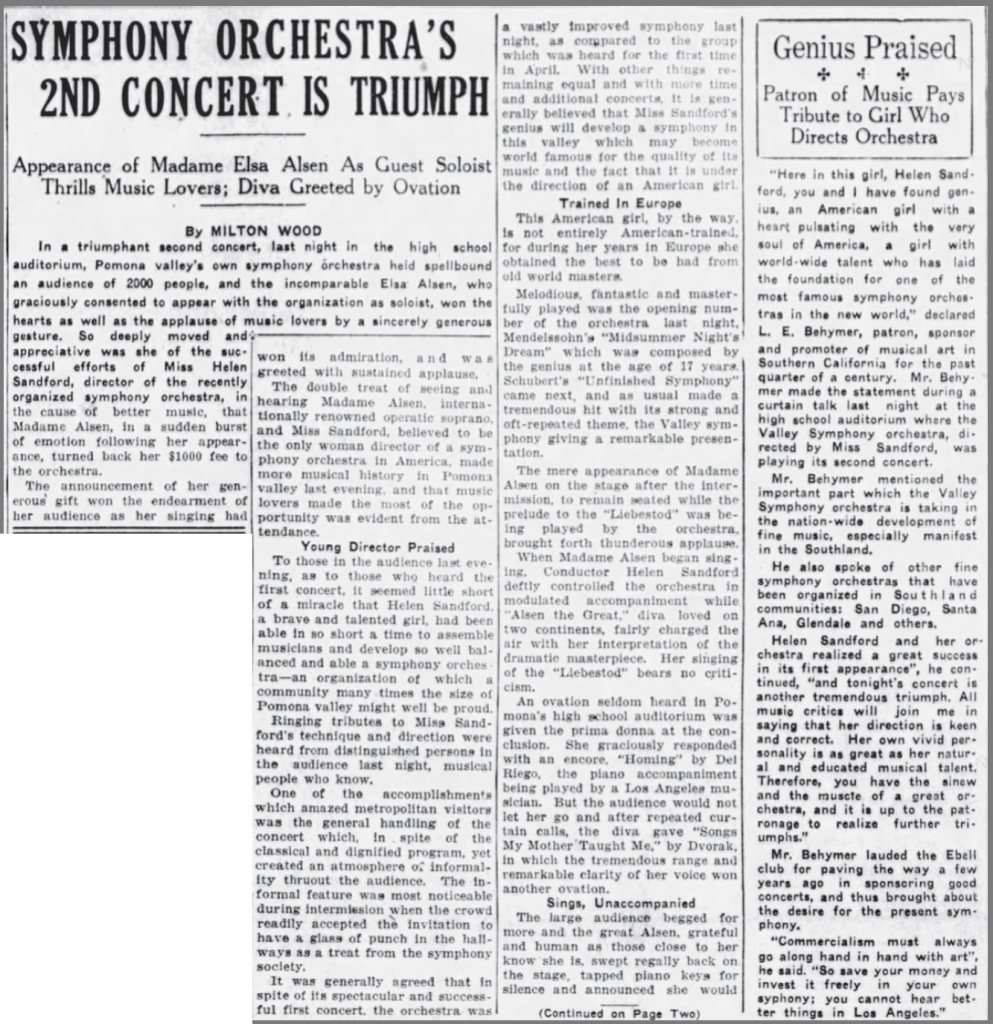
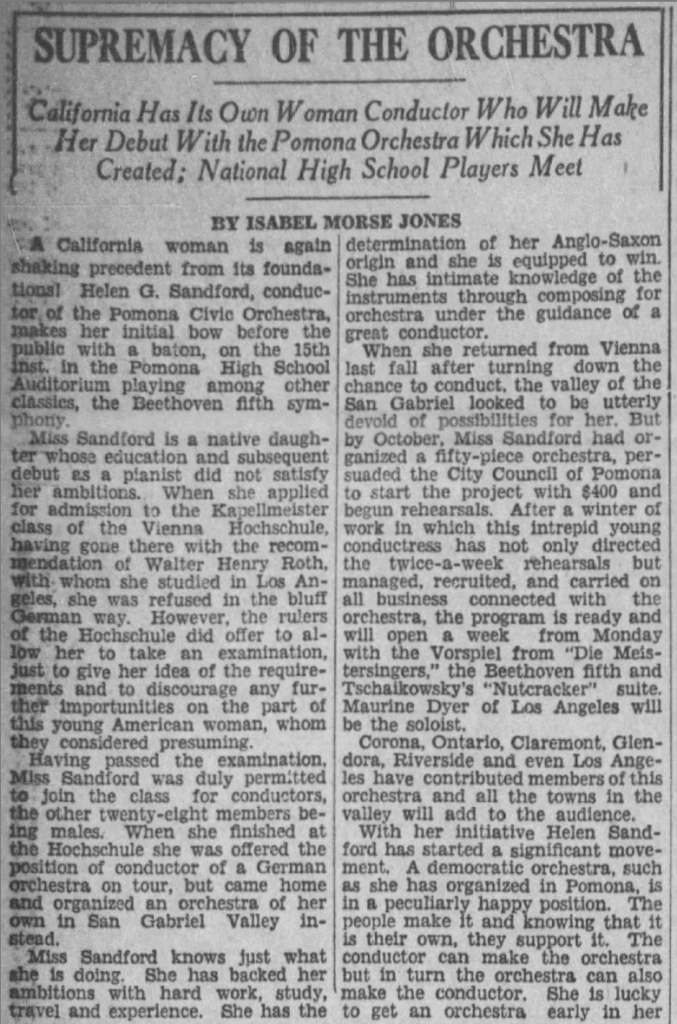
Census and city directory entries through the 1920s list Helen initially as a clerk, but soon as a music teacher and a pianist (I do not know if Annie was a musician and developed Helen’s interest and talent), but Helen had extreme ambitions and was not satisfied. Through a combination of talent, genius, hard work, and stubborn persistence she studied with prominent musicians in the Los Angeles area, eventually setting her sights on becoming an orchestra conductor, something unheard-of for a woman in the 1920s. She muscled her way into some of the most prestigious music programs in the world, winning them over with her abilities and ultimately spending two years between 1926 and 1928 in Europe, including Vienna. The following article from the Los Angeles Times in April 1929 explains Helen’s path.

Los Angeles Times, April 7, 1929

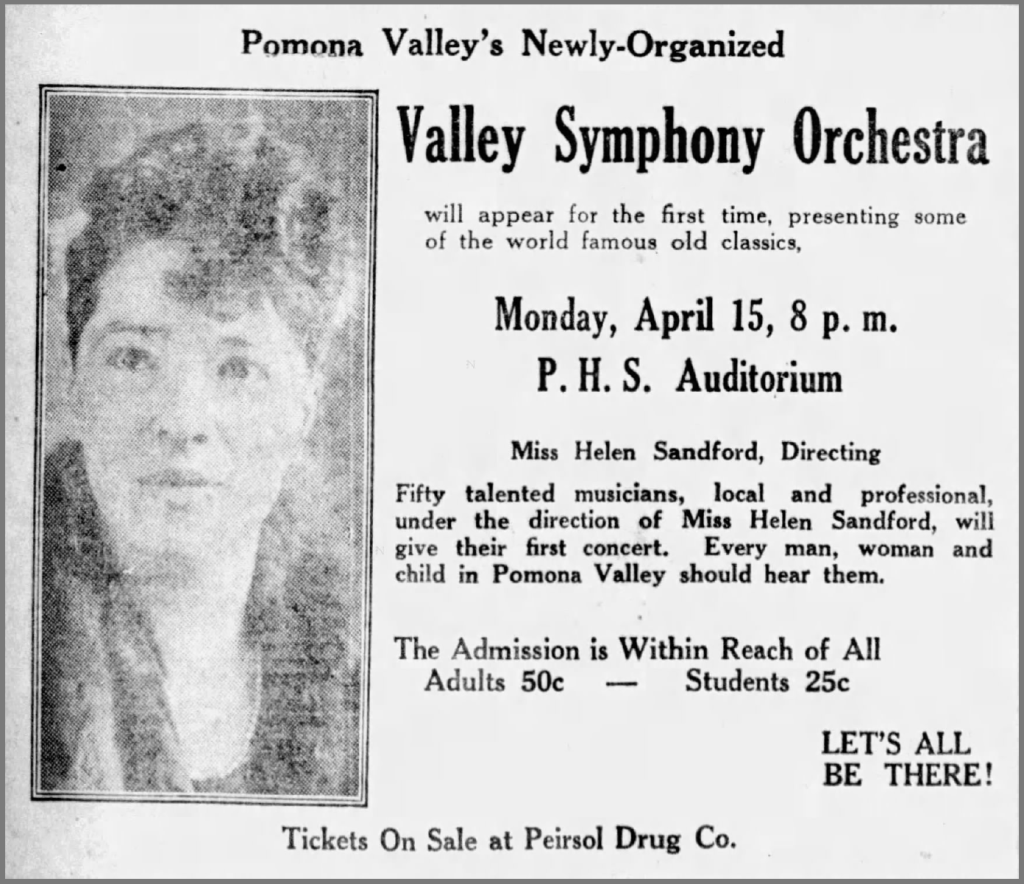
It is extraordinary that Helen turned down an offered conducting position with a German orchestra, opting instead to return home and start her own orchestra. But this is exactly what she did, the Valley Symphony Orchestra giving its first performance in April, 1929 in Pomona.

Pomona Progress Bulletin
April 12, 1929

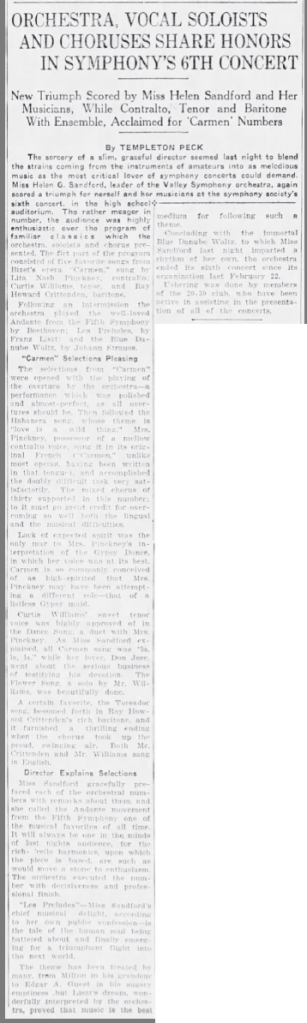
Helen and her orchestra received reviews that went far beyond the norm for even the best of community orchestras, rising to the level of “Genius Praised”. It was not only a matter of performance quality–the level of ambition and planning of her programs was off the charts, including guest performances by some of the most talented performers in Southern California.

Pomona Progress Bulletin, May 28, 1929

The orchestra’s rave reviews continued through the season, each performance topping the one before…

Pomona Progress Bulletin, September 7, 1929

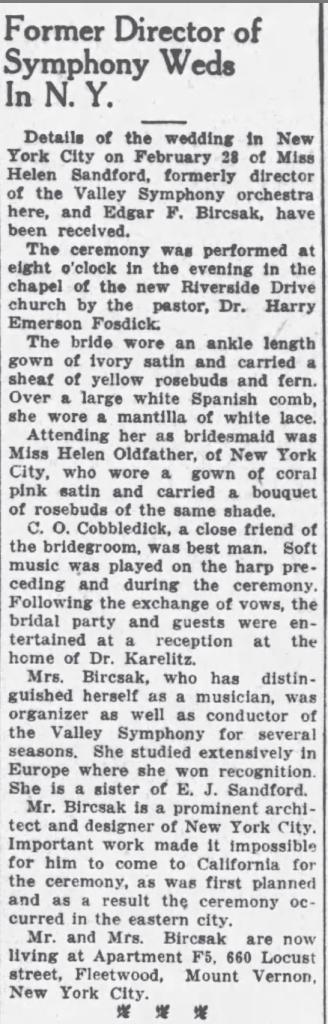
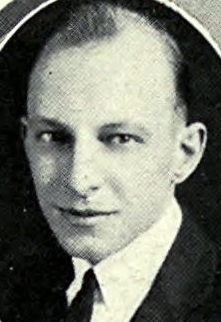
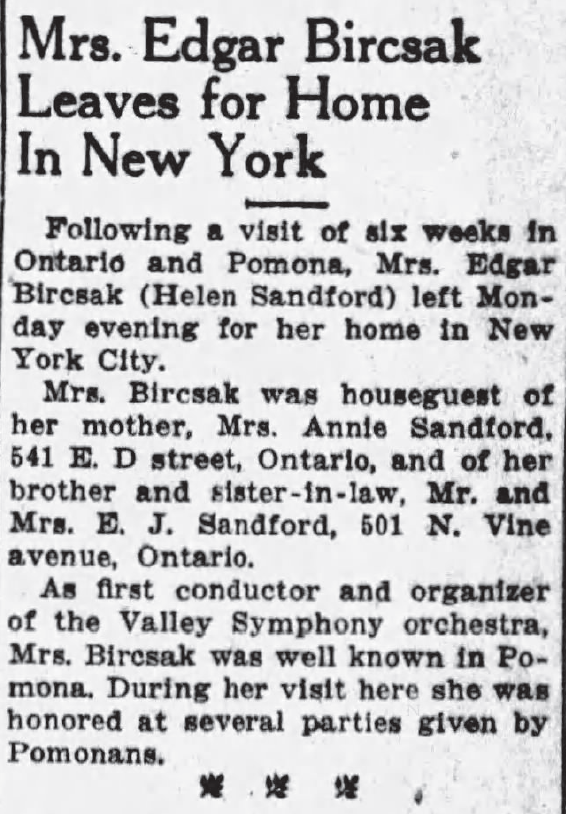
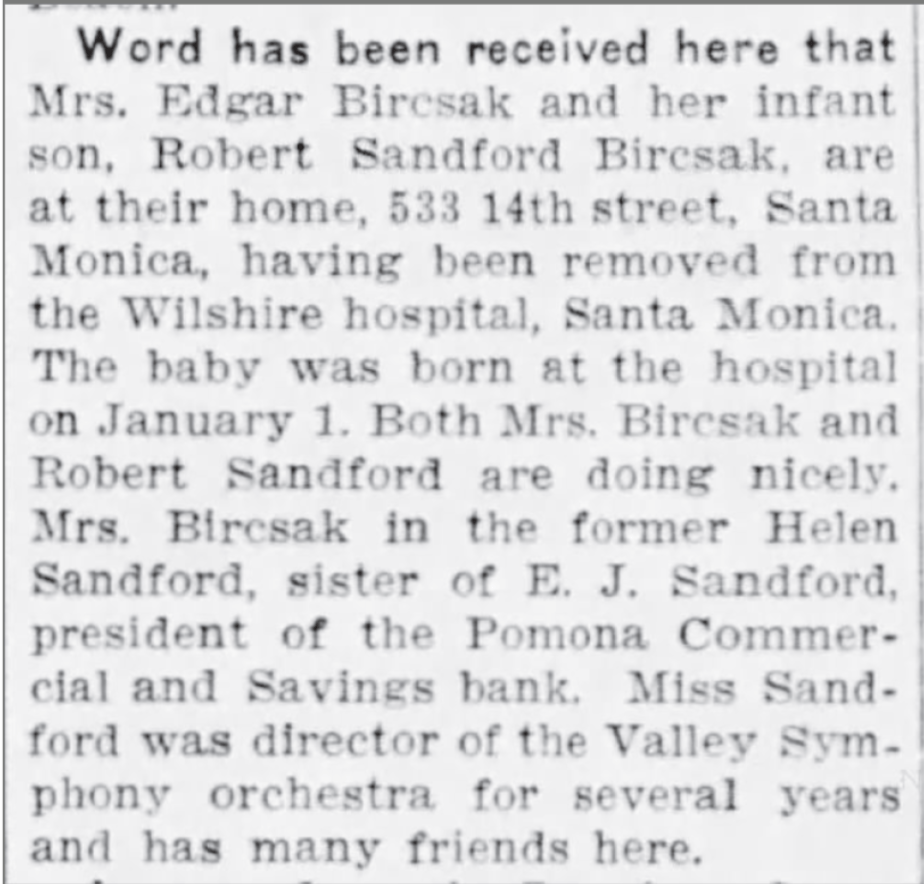
Things changed quickly around 1930 when Helen was drawn to New York, turning leadership of the orchestra over to other talent. What drew her away was probably her future husband, Edgar Bircsak, a prominent architect, of German family heritage, born in Michigan and raised in Missouri and Kansas. Edgar lived in Lawrence, Kansas until around 1923, then apparently spent time in Europe where he must have studied architecture. It seems likely that Edgar and Helen met somewhere during their overlapping studies in Europe–if so, their relationship must have been a complicating factor as Helen was making career decisions and forming her orchestra. They were married in New York in March 1931, where Edgar must have returned to work after completing his studies overseas. They remained in New York over the next few years, making regular visits to Ontario. By 1936 the couple had permanently moved back to Southern California and had their first son, Robert.

Pomona Progress Bulletin
March 30, 1931
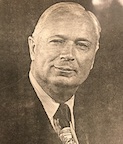
Edgar Bircsak
Pomona Progress Bulletin
Feb 17, 1932
Pomona Progress Bulletin
Jan 15, 1936
Pomona Progress Bulletin
Dec 7, 1936

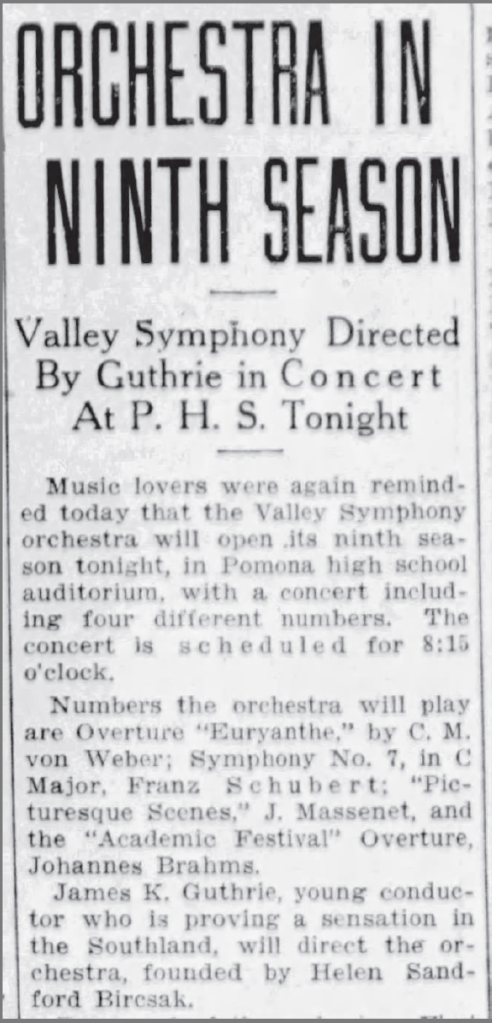
The orchestra lived-on. In 1936 they were still giving concerts, and Helen was still being credited as the founder. Wikipedia identifies James Kelley Guthrie, who occasionally conducted Helen’s orchestra, as “an American symphony conductor and newspaper executive who, at the age of 15 [1929], founded the San Bernardino Community Orchestra, which is today the San Bernardino Symphony“.  It appears that Helen’s Pomona Valley Symphony Orchestra provided inspiration and direct competition to James Guthrie’s nearby orchestra, today’s San Bernardino Symphony.

Annie remained at the home on East D Street until her death in December 1941 her son Joe and his family living blocks away.

Helen and Edgar remained in California for most of the rest of their lives–we can remember visiting the home where they intrepidly, happily remained (and raised sheep) long after it had become surrounded by some of the worst Los Angeles neighborhoods of the 1960s and 1970s. Edgar passed away in 1981. Helen spent her final time with family in Chelmsford, Massachusetts where she passed away in 1993.

The Flight of The Southern Cross and a Memorial to the Founder of Ontario

Two of our grandfather Joe’s favorite stories were…

  • his role in arranging the funeral and burial of George Chaffey, the founder of Ontario, California, on behalf of the Chaffey family, as well as his contributions to the George Chaffey biography, and…
  • his contribution to organizing the first airplane flight from the United States to Australia

Recall that in the late 1870s the Chaffey brothers George (1848-1932) and William (1856-1926), originally from Ontario, Canada, engineered the irrigation system upon which the city of Ontario California was founded. They later made similar accomplishments in Victoria, Australia, hence the Australia connections in Joe’s stories. George and his sons Andrew and John returned to live in Ontario for the rest of their lives, becoming friends and business associates of Joe and his father-in-law Henry Swan.

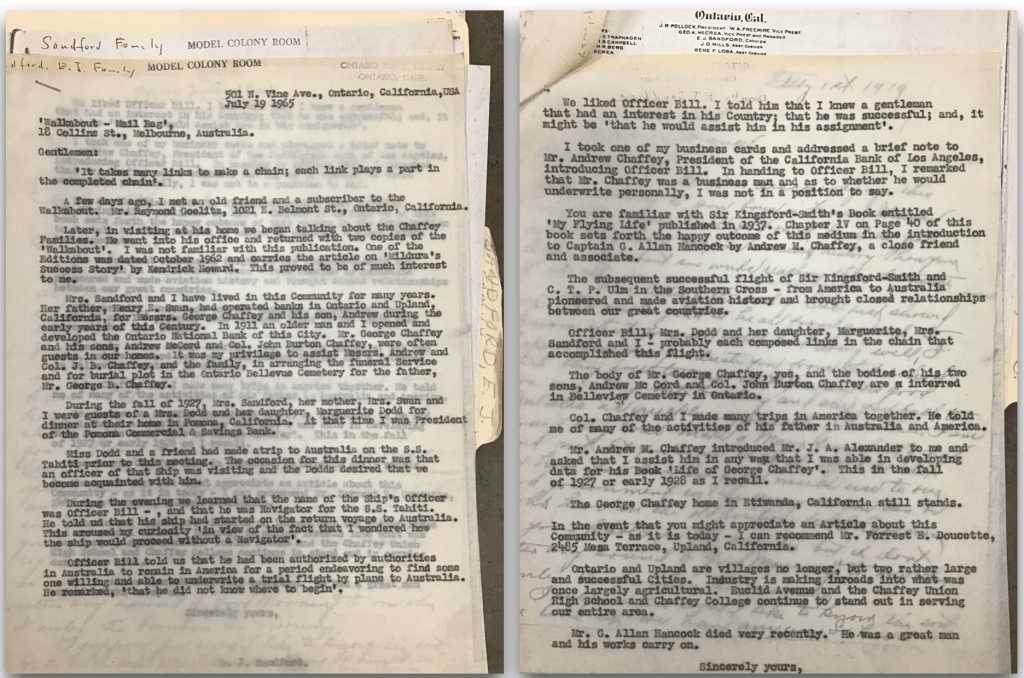
Joe intertwines these stories in a letter he wrote in 1965 to the editor of Walkabout Magazine, a sort of Australian National Geographic. A transcription follows the image of the two page typed letter.

Joe Sandford’s letter to Australia’s Walkabout Magazine, July 19, 1965, found in the Model Colony History Room of the Ontario Public Library. This is probably a draft copy, so perhaps Joe was able to recall the last name of Officer Bill in the mailed version.

501 N. Vine Ave., Ontario, California, USA

July 19, 1965

‘Walkabout – Mail Bag’

18 Collins Str., Melbourne, Australia

Gentlemen:

‘It takes many links to make a chain;  each link plays a part in the completed chain’.

A few days ago, I met an old friend and a subscriber to the Walkabout.  Mr. Raymond Goelitz, 1021 E. Belmont St., Ontario, California.

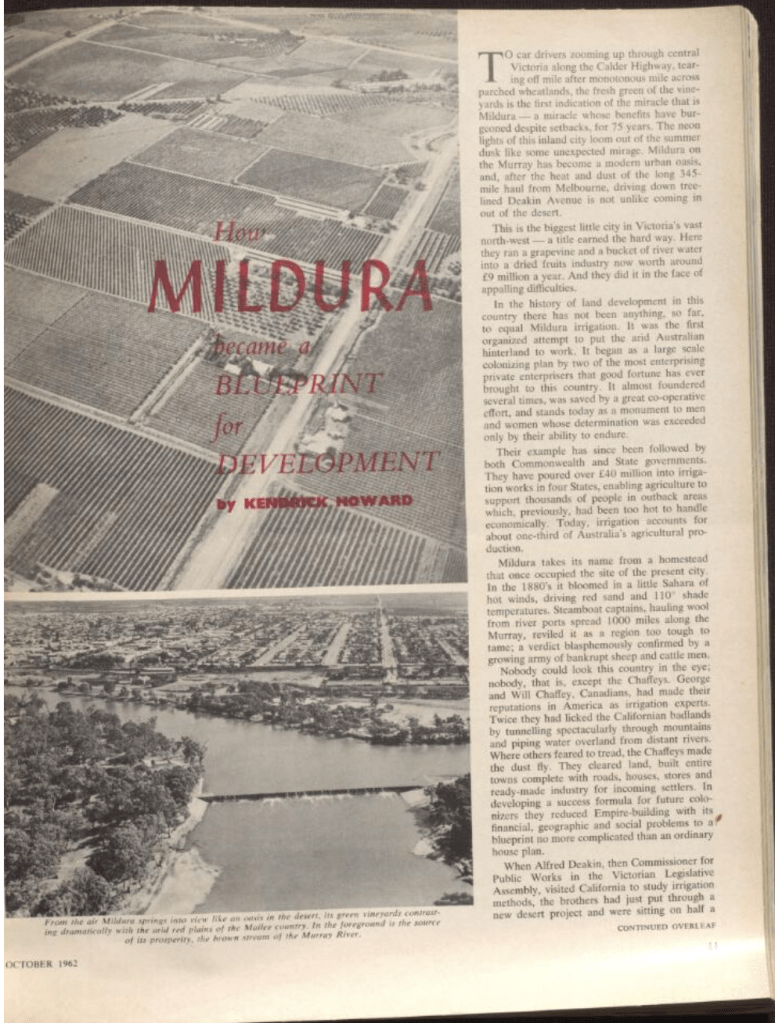
Later, in visiting at his home we began taking about the Chaffey Families.  He went into his office and returned with two copies of the ‘Walkabout’.  I was not familiar with this publication.  One of the Editions was dated October 1962 and carries the article on ‘Mildura’s Success Story’ by Kendrick Howard.  This proved to be of much interest to me.

Mrs. Sandford and I have lived in this Community for many years.  Her father, Henry E. Swan, had operated banks in Ontario and Upland, California, for Messrs. George Chaffey and his son, Andrew during the early years of this Century.  In 1911 an older man and I opened and developed the Ontario National Bank of this City.  Mr. George Chaffey and his sons, Andrew McCord and Col. John Burton Chaffey, were often guests in our homes.  It was my privilege to assist Messrs. Andrew and Col. J. B. Chaffey, and the family, in arranging the funeral Service and for burial plot in the Ontario Bellevue Cemetery for the father, Mr. George. B. Chaffey.

During the fall of 1927, Mrs. Sandford, her mother, Mrs. Swan and I were guests of a Mrs. Dodd and her daughter, Marguerite Dodd for dinner at their home in Pomona, California.  At that time I was President of the Pomona Commercial & Savings Bank.  

Miss Dodd and a friend had made a trip to Australia on the S.S. Tahiti prior to this meeting.  The occasion for this dinner was that an officer of that Ship was visiting and the Dodds desired that we become acquainted with him.

During the evening we learned that the name of the Ship’s Officer was Officer Bill —, and that he was Navigator for the S.S. Tahiti.  He told us that his ship had started on the return voyage to Australia.  This aroused my curiosity ‘in view of the fact that I wondered how the ship would proceed without a Navigator’.

Officer Bill told us that he had been authorized by authorities in Australia to remain in America for a period endeavoring to find someone willing and able to underwrite a trial flight by plane to Australia.  

We liked Officer Bill.   I told him that I knew a gentleman that had an interest in his Country; that he was successful; and, it might be ‘that he would assist him in his assignment’.

I took one of my business cards and addressed a brief note to Mr. Andrew Chaffey, President of the California Bank of Los Angeles, introducing Officer Bill.  In handing to Officer Bill, I remarked that Mr. Chaffey was a business man and as to whether he would underwrite personally, I was not in a position to say.

You are familiar with Sir Kingsford-Smith’s Book entitled ‘My Flying Life’ published in 1937.   Chapter IV on Page 40 of this book sets forth the happy outcome of this medium in the introduction to Captain G. Allan Hancock by Andrew M. Chaffey, a close friend and associate.

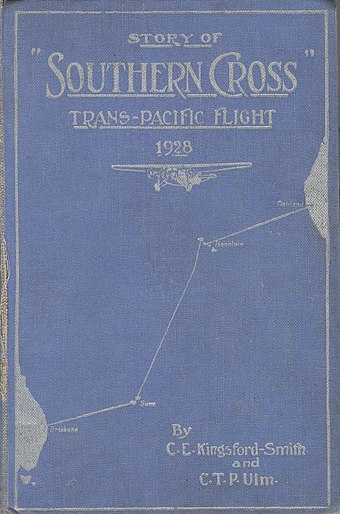
The subsequent successful flight of Sir Kingsford-Smith and C. T. P. Ulm in the Southern Cross – From America to Australia pioneered and made aviation history and brought closed relationships between our great countries.

Officer Bill, Mrs. Dodd and her daughter, Marguerite, Mrs. Sandford and I – probably each composed links in the chain that accomplished this flight.

The body of Mr. George Chaffey, yes, and the bodies of his two sons, Andrew Mc Cord and Col. John Burton Chaffey are interred in Bellevue Cemetery in Ontario.

Col. Chaffey and I made many trips in America together.  He told me of many of the activities of his father in Australia and America.

Mr. Andrew M. Chaffey introduced Mr. J. A. Alexander to me and asked that I assist him in any way that I was able in developing data for his Book ‘Life of George Chaffey’.  This in the fall of 1927 or early 1928 as I recall.

The George Chaffey home in Etiwanda, California still stands.

In the event that you might appreciate an Article about this Community – as it is today – I can recommend Mr. Forrest E. Doucette, 2485 Mesa Terrace, Upland, California.

Ontario and Upland are villages no longer, but two rather large and successful Cities.  Industry is making inroads into what was once largely agricultural.  Euclid Avenue and the Chaffey Union High School and Chaffey College continue to stand out in serving our entire area.

Mr. G. Allan Hancock died very recently.  He was a great man and his works carry on.

Sincerely yours

E. Joseph Sandford

Transcription of Joe Sandford’s letter to Australia’s Walkabout Magazine, July 19, 1965

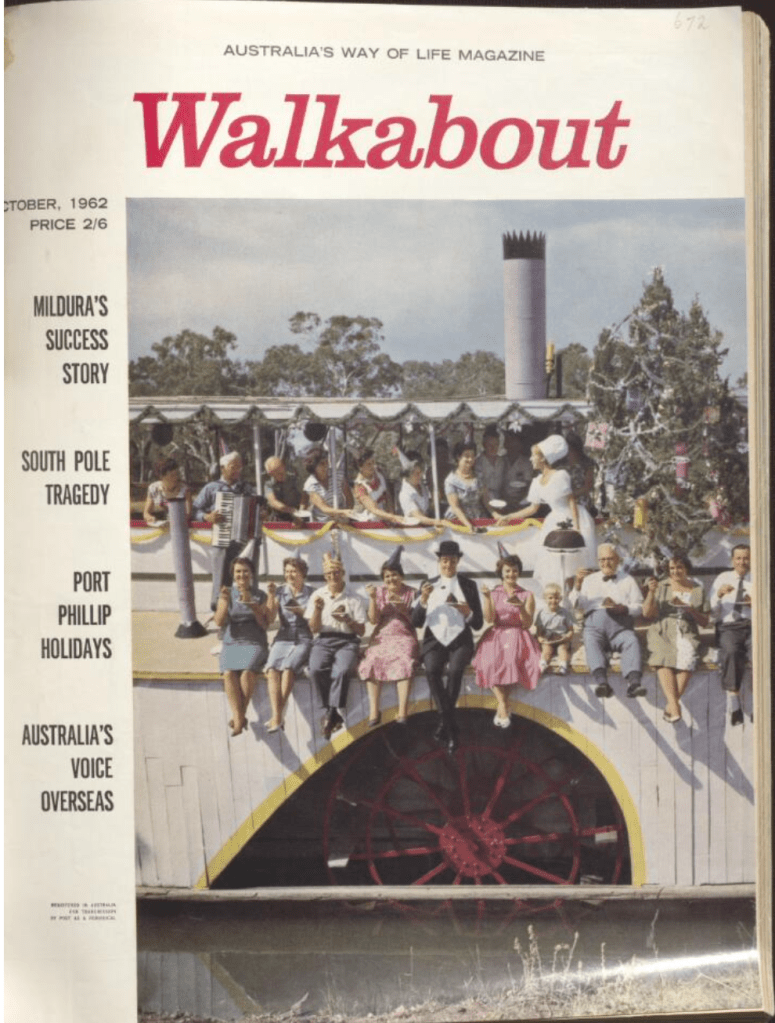
Joe’s letter comes three years after The Walkabout’s publication of the article describing the Chaffey’s work in Mildura, Australia, and nearly 80 years after the work itself. I have no evidence of whether anyone at The Walkabout responded to Joe, let alone published his letter. The article, itself, can still be found with a simple internet search.

October 1962 issue of Walkabout Magazine, containing a historical account of the Chaffey’ efforts bringing irrigation to the town of Mildura

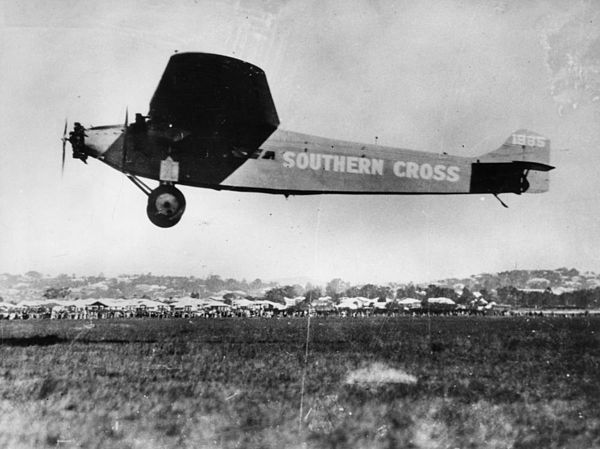
With assistance from Joe’s link in the chain, the airplane Southern Cross completed the first flight from the United States to Australia (with stops in Hawaii and Fiji) in June 1928, piloted by Kingsford Smith, about a year after the Lindbergh flight from Long Island to Paris.

On 31 May 1928, the crew—Charles Kingsford Smith, Charles Ulm, and Americans Harry Lyon (navigator) and James Warner (radio operator)—took off from Oakland, California, United States. The Southern Cross first stopped for rest and refuelling in Hawaii before setting off for Fiji. This leg of the journey took 3412 hours of flight across open seas before gliding past the Grand Pacific Hotel in Suva, where a large and enthusiastic crowd saw the first aircraft to land in Fiji touch down at Albert Park. The Southern Cross landed at Eagle Farm Airport in Brisbane, Queensland, Australia, on 9 June, where a crowd of 25,000 people were waiting to greet the Southern Cross on its arrival at the airport. The Southern Cross flew on to Sydney the following day (10 June).  The aircraft was in constant radio communication with ships and shore during the flight using four transmitters and three receivers powered by a propeller-driven generator attached to the fuselage below the cockpit. The first paid commercial messages were sent and received during the flight and a new world record distance for radio was set with a short-wave reception at Bloemfontein, South Africa, the long way around the world at 12,800 miles. Direct short-wave aircraft-to-shore communications were maintained with the Pacific Coast until the flight was four hours out of Honolulu which had been monitoring the flight from two hours after departure with a similar reception overlap on the Honolulu to Suva leg. Success on this flight influenced Admiral Byrd to equip his three Antarctic Expedition aircraft with similar equipment.

Wikipedia

Joe’s letter also strengthens our understanding of the professional relationships between the Chaffeys, Henry Swan and Joe. It appears that both Henry (from George’s generation) and Joe (a contemporary of Andrew) operated banks within the larger banking system of the Chaffey family. Henry and Joe’s purchase of the Pomona Savings Bank in 1923 and the ownership change of the Pomona bank after Henry’s death must have all been conducted in close coordination with the Chaffey family.

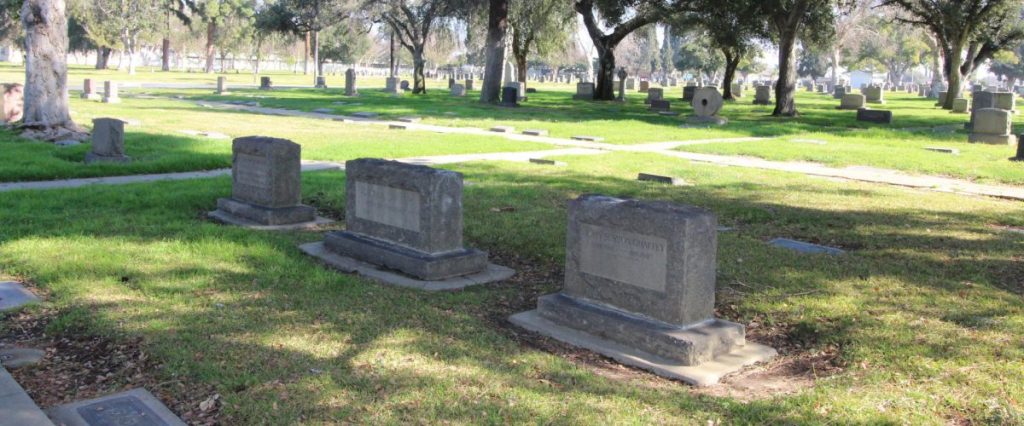
The Chaffey plot in the Ontario Bellevue Cemetery includes the memorials for George and his sons Andrew and John.

Chaffey burial site in Bellevue Cemetery, Ontario, California, originally arranged by Joe Sandford. Left: Andrew McCord Chaffey (1874-1941) and Maud Taylor Chaffey (1878-1951); Center: George Chaffey, “Founder of Ontario” (1836-1932); Right: John Burton Chaffey (1883-1940)

Joe was immensely proud of his association with the Chaffey family–he tells these same stories in several of his Living History interviews in the 1970s. He also makes references to letters received from the Chaffey family commending his role in both endeavors. I do not know if any of these letters have survived.

Banking Through The Great Depression

Grandfather Joe Sandford was President of the Pomona Commercial and Savings Bank from 1924 until his retirement. He approached his life and work with strong ethics learned from his parents, Edward and Annie, and his in-laws, Henry and Mattie Swan. Several of his favorite stories were proudly told and retold during his Living History interviews in the 1970s, in which interviewers were naturally curious about being a banker during the Great Depression. The following quotes and stories speak for themselves.

Interviewer:  You were able to weather those times, the depression?  

Joe: We came through wonderfully, you might say had no problems…we were small, everything was small in those days.  This inflation you see, with current prices got out of hand.  We were awfully lucky, we paid dividends all during that time.  And then, being small we could do certain things that the big ones couldn’t do.  Their problems were colossal, a great hurricane going on with many of these things coming in…and they were scared to death, many of them went broke as a matter of fact.

Joe Sandford from 1974 Living History Interview conducted by the Upland Public Library

It’s been a happy life. I could tell you stories that would make you cry about things we did as bankers.  I’ll tell you just one story. I was president of the bank in Pomona during the terrible Depression of ’29, ’30 and so forth. A small bank. Everything was small then. Didn’t have as many dollars. I was all for trying to help others, because they were going through a terrible time.  You’ve read about how freight trains were covered with people.  Everybody was broke.  One day a man came into the bank and introduced himself. I had him come into my office.  He said, “Mr. Sandford, I’ve been vice-president of Richfield Oil Company, $25,000 a year.”  That was a lot in those days.  He says, “I’m fired.  We had a nice home over in the Altadena district.  I had a loan on that.  The bank foreclosed, and took that away from me. The only thing my wife and I have left is the little home that was her folks’ home here in Pomona. Your bank has a loan on it.  We can’t even pay the interest on it.  We can’t pay the taxes. Are you going to take it?”  

I said, “No, our loan doesn’t amount to anything.  Let me find out more about you, let’s get you back to work.”  He was a man about 55.  He had his degree in geology, in oil and so forth.  At that time, the schools were all advocating, “Take care of the graduates, let the older fellows sweat.”  Well, that’s a pretty hard philosophy.  When a young fellow comes out of school, he has book knowledge, but he’s never applied it.

I said, “Now, look here, you’ve got these degrees, you’ve had experience. Let’s get you back on the job.”

I said, “Does your wife, can she work?  He said she’s never had to work, she used to be a secretary.”  I said, “Can’t we get her a job first, so you can eat?”  He cried, right there in my office. Cried.

He said, “The city bankers have no sympathy.  They just took my property, everything I had, and told me to get out.” But we were lucky. He was a stranger to me, but I had time. I took a personal interest in him.  We got his wife a job.   It wasn’t long we got him back on his feet. 

Two tellings edited together: (1) Joe Sandford from 1973 Living History Interview with Esther Boulton Black and (2) Joe Sandford from 1974 Living History Interview conducted by the Upland Public Library

Another story I love to tell.  A man in town, a very kind man, came over one day. I knew him, and I could see he had a problem.   I was busy or something.   “Sit down, I’ll get to you pretty quick.”   When I got through I called him over and he came and sat down and I said, “What’s going on, Charley?”  He was Charlie Rankin. “Well, the president of the bank over at Ontario is going to take my business.” He had a little manufacturing company out here.  “I can’t pay the interest, I can’t pay the taxes.” I said, “Charley, you don’t mean to say that he’s going to foreclose?” “Yes.” 

I said, “Can you sell your Edison stock?”, because everybody had a little.  He said, “I had to sell that a long time ago.” 

“Well, Charley, you have a trust deed on your house?”  “Yes, he’s going to foreclose.”  I was trying to find–he was a kind man. 

Finally I said, do you happen to have any life insurance?  He said, well yeah, I’ve got  $10,000 policy, New York Life.  I said, “well where’s that policy, have you borrowed against it?” He said, “Borrowed?  Is there a loan value?”  I said, “I don’t know, where’s that policy?”  He said, “well it’s down at that bank.”  

I said Charlie, you go down and get that policy, but don’t let that banker see you. (laughing) He did.  There was a $700 loan value.  The other fellow had overlooked it. He said, “Good Lord.”  This was the last…things were beginning to…the end.  He borrowed that $700 and it put him on his feet. It saved his industry, it saved his home.  Didn’t mean a thing to me.  I knew the man.  He was active in scouting here. I could do that.

But they were scared to death–it was a terrible period.  Those are very personal things.  It was fun.  We came through our little bank fine. Paid dividends all the time.  We didn’t have any runs here. 

Two tellings edited together: (1) Joe Sandford from 1973 Living History Interview with Esther Boulton Black and (2) Joe Sandford from 1974 Living History Interview conducted by the Upland Public Library

Little things, taking an interest in others. 

I could go on and tell about another boy here that I helped out that went clear to the top of the barrel.  Things you’re doing every day–you fellows have all done it.   This young man was a teller in the then—Citizens’ Bank here.  He was keeping company with Gladys Gardner, a nice girl, a friend of Margaret’s.   Margaret came home one day and said, “Joe, they want to get married, but they can’t afford to.  He doesn’t get much for working at the bank.” I said, “Well, let’s find out what he’d like to do.” Come to find out, he wanted to learn the securities business.  I said, “Well, that’s easy; we can fix that up.” So I gave him an introduction to John Burbaugh, the head of the bond department of the Citizens’ Bank of Los Angeles.  That man went clear to the top of the National City Co. in New York, which was one of the biggest at that time, and after he’d been there a number of years, he resigned.  He came back, and he called on Andrew Chaffey.  Andrew Chaffey was on the board of the University of Southern California. He told Mr. Chaffey of his experience, and he said, “I wonder if the University wouldn’t like to have me take over their endowment portfolio.”  Mr. Chaffey laughed.  He said, “Well, we don’t have much in the way of investments other than land, but give me a summary of your experience, leave it with me.”  He did.  Mr. Chaffey called him up in a couple of weeks and he became the head of the bond department of the Western Bank Corp., that’s UCB and banks all over the West.  He’s retired, living in Los Angeles today.

In other words, little things that way you do to help others, it pays off in the long run.

Joe Sandford from 1976 Living History Interview with Bryce Denton