The war was coming to an end, and President Lincoln was looking ahead to rebuilding the country. He and/or his Secretary of State William Seward noticed Edward and named him to the post of United Status Consul to CheeFoo China. His Civil War service record combined with his maritime experience and previous trip to China must have made him an ideal candidate in a time when men to fill any position were in short supply.
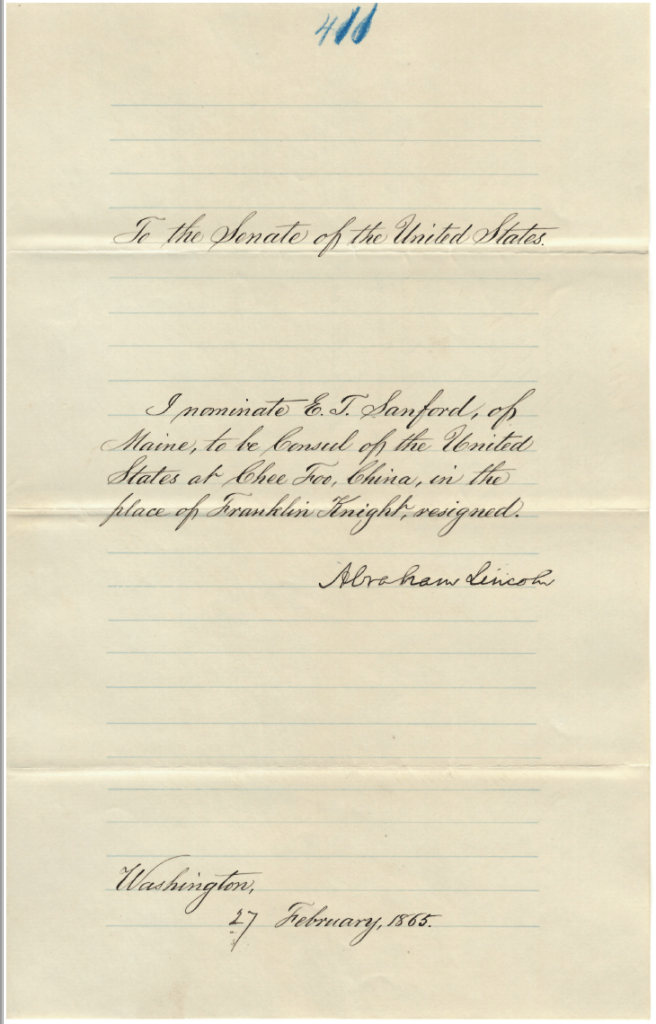
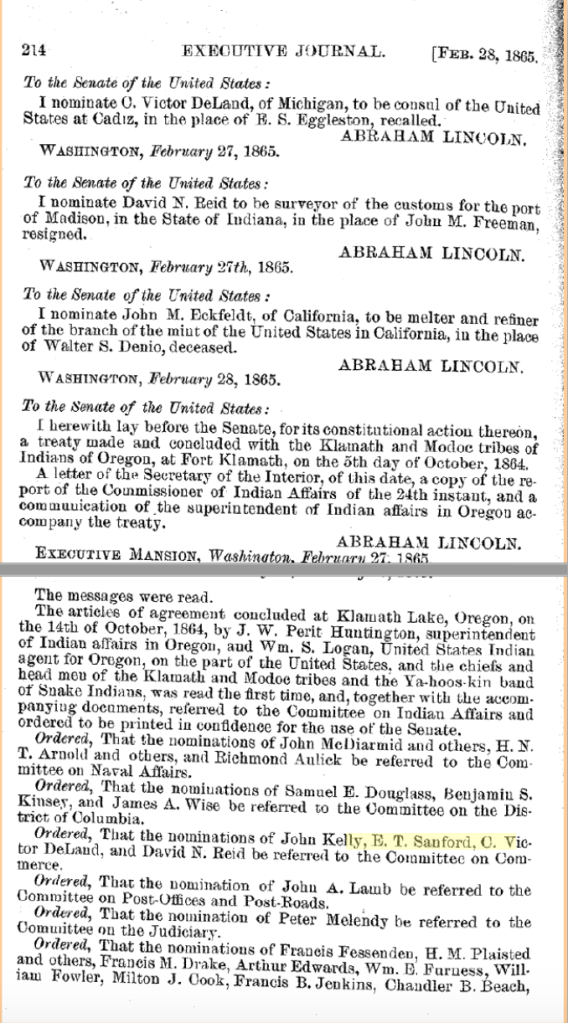
Lincoln nominated Sandford to the post on February 27, 1865, signing a simple statement on note paper, written-out by an aide.
Lincoln’s February 27, 1865 nomination of Edward T. Sandford to the post of United States Consul to CheeFoo, China
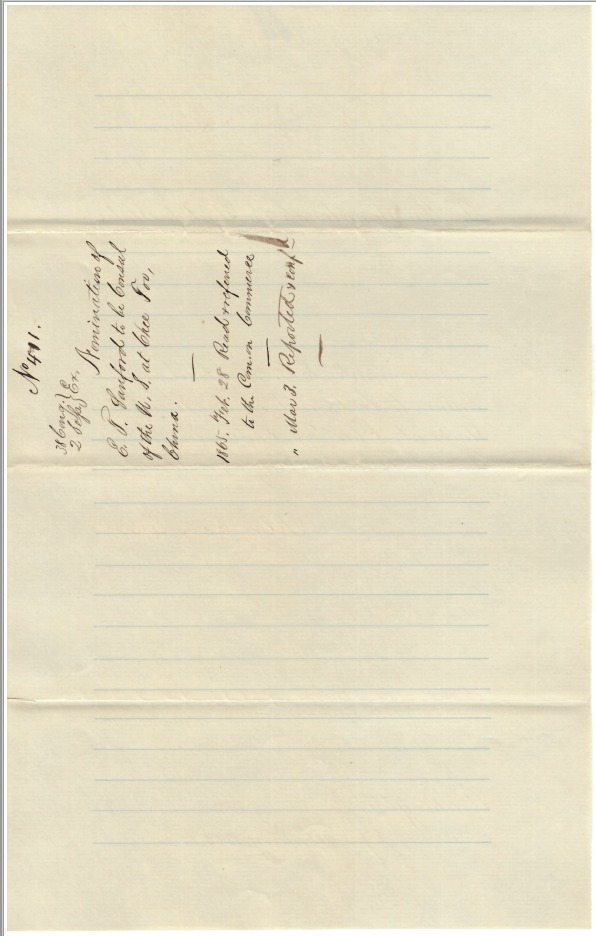
Reverse side of nomination with folds for filing. The nomination was referred to the Senate Committee on Commerce on February 28.
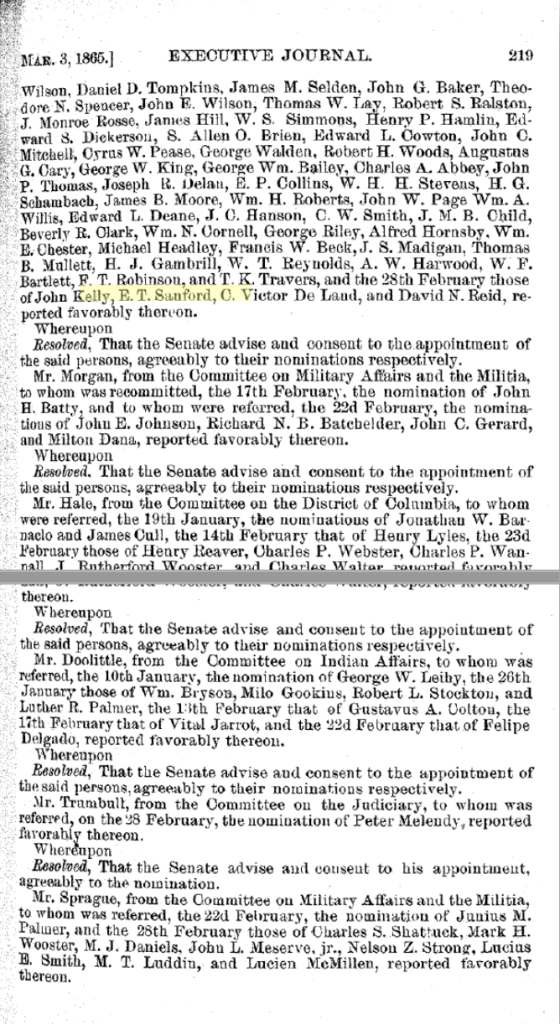
Sandford’s nomination quickly moved through the United States Senate where perhaps there was some institutional memory of Senator Nathan Sanford from New York, who had retired 34 years earlier, a subject for a future post. Although Nathan had adopted a different spelling of the last name, Edward was his cousin (several times removed). The nomination moved quickly through the Senate, being confirmed within a week.
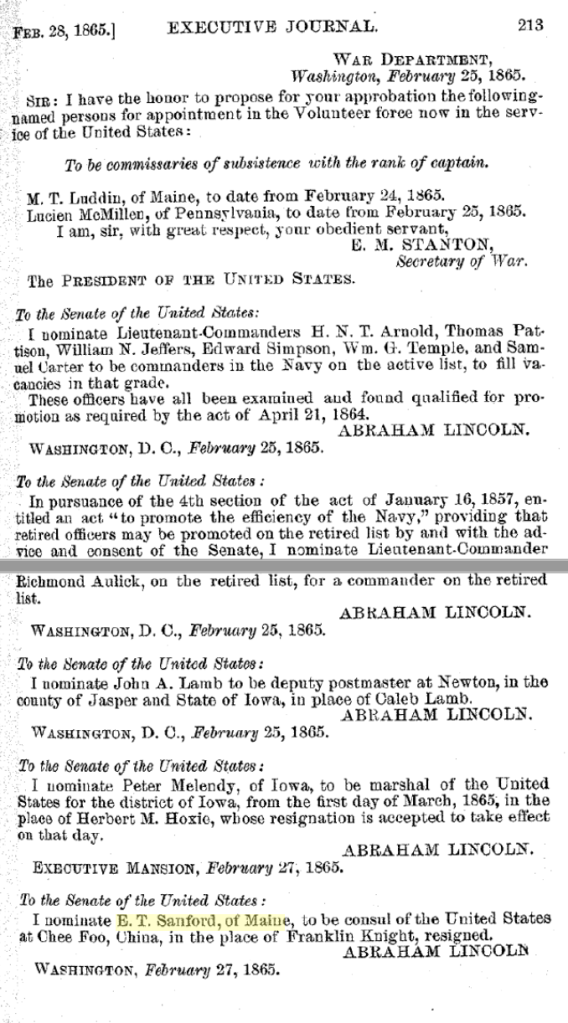
Senate records showing (1) The nomination of Edward Sandford by President Lincoln…
…(2) assignment of the nomination to the Committee on Commerce…
…and (3) approval of the nomination on March 3, 1865.
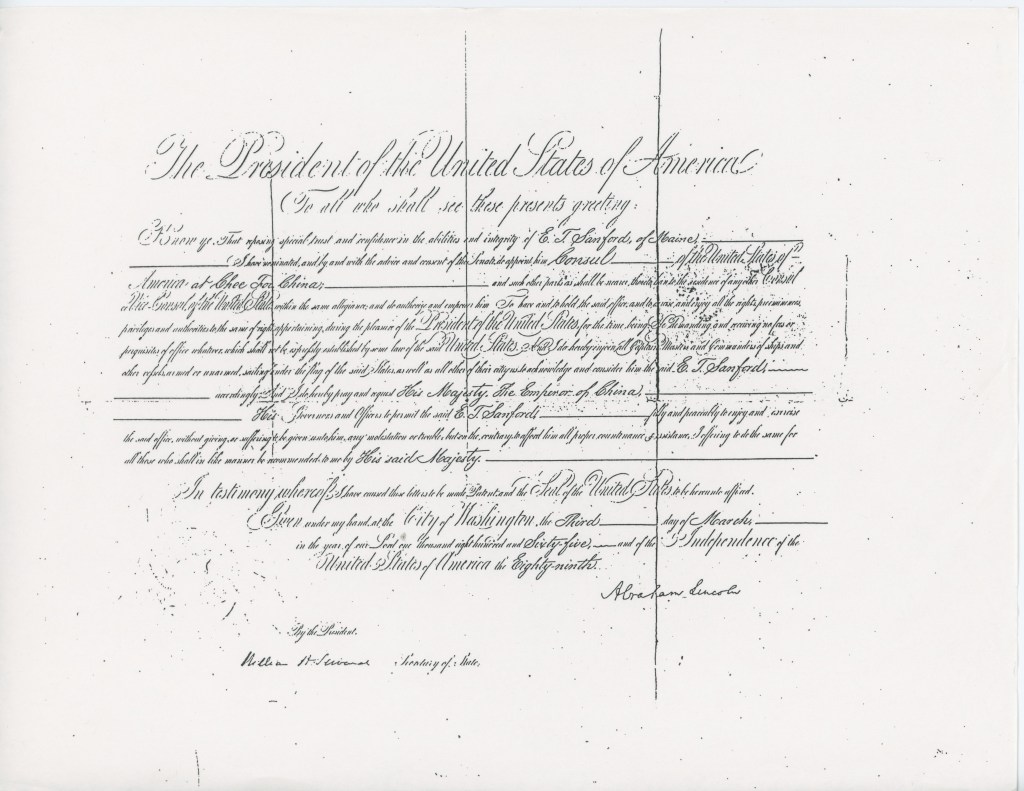
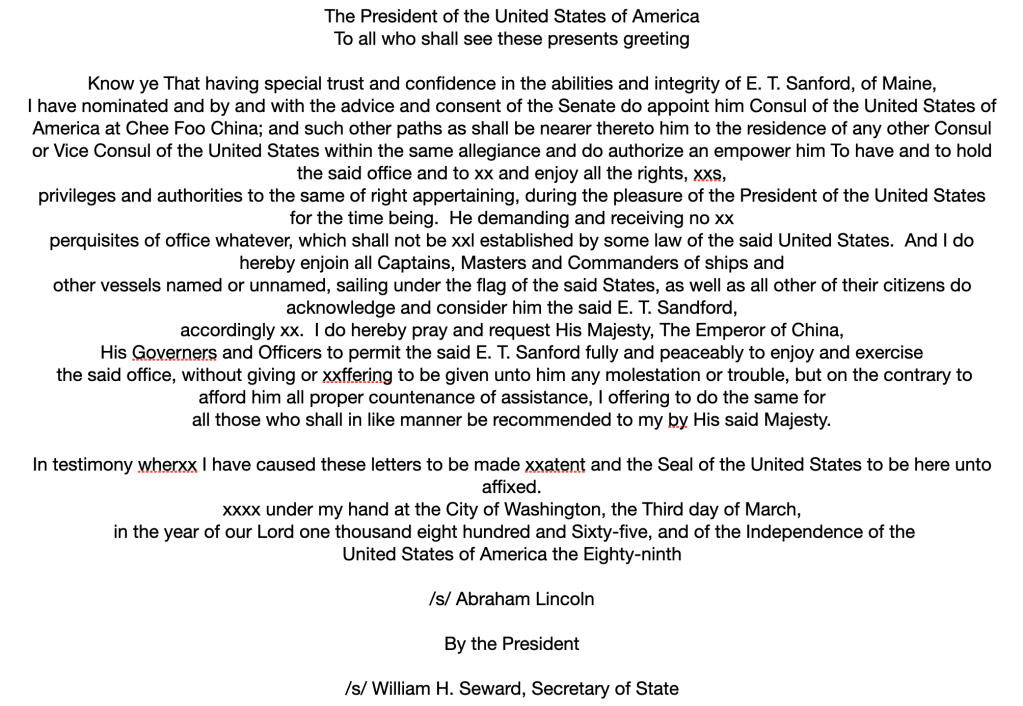
Lincoln’s formal letter appointing Edward to the post is dated March 3, 1865. The framed original of this letter used to hang in the home office of our grandfather Joe in Ontario, California.
Lincoln’s letter appointing Edward Sandford as United States Consul to CheeFoo, China…… and the transcribed text of the letter, as best as can be deciphered.
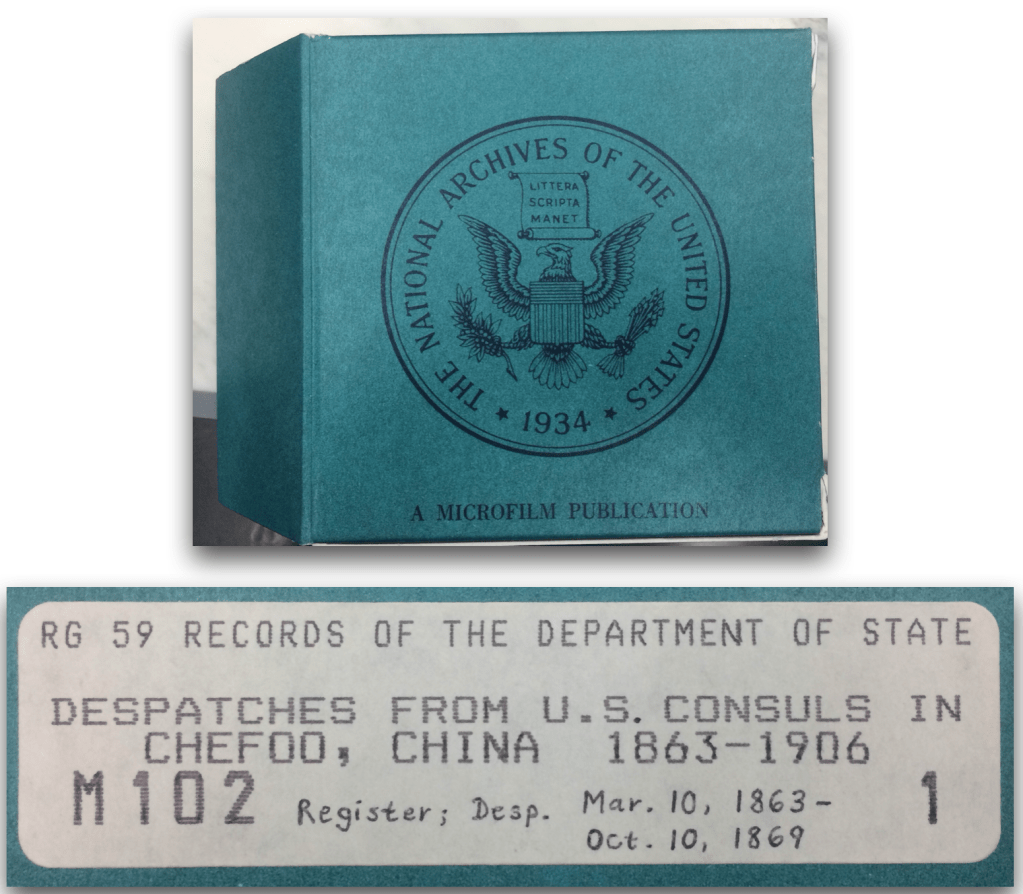
The National Archives annex in College Park Maryland has records of Edward’s foreign service correspondence saved on microfilm. Most of the correspondence is addressed to Secretary of State William Seward.
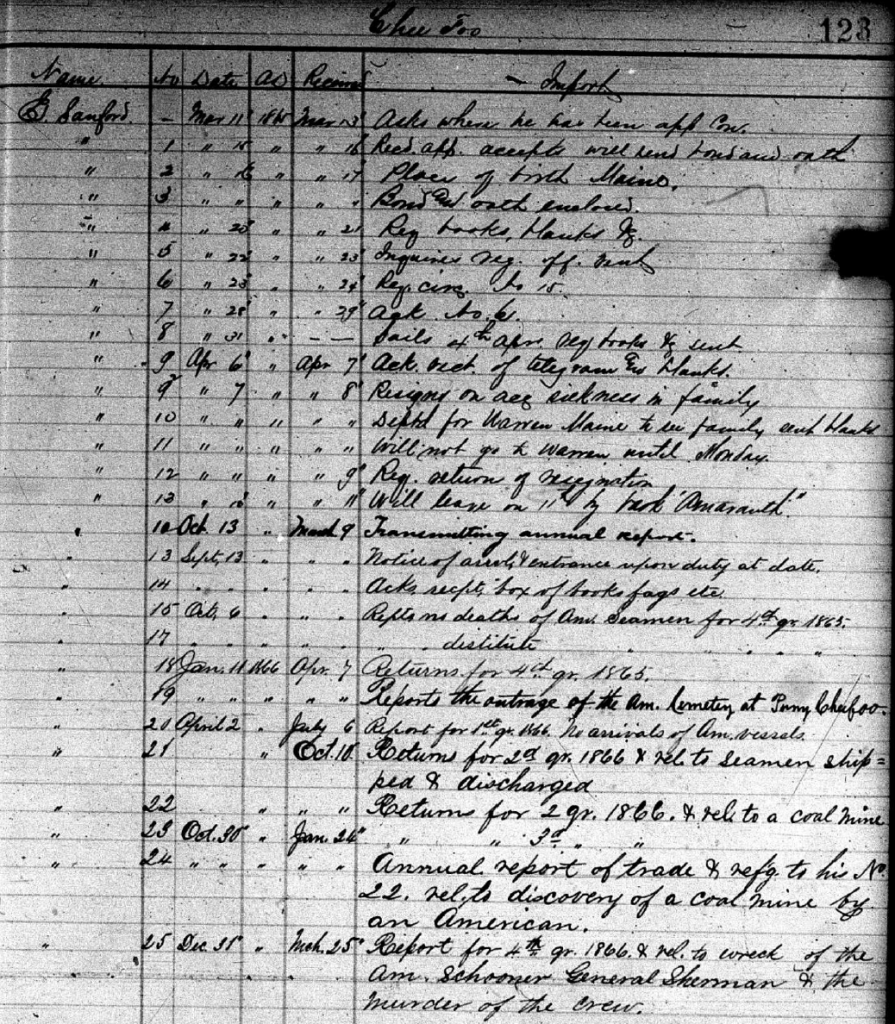
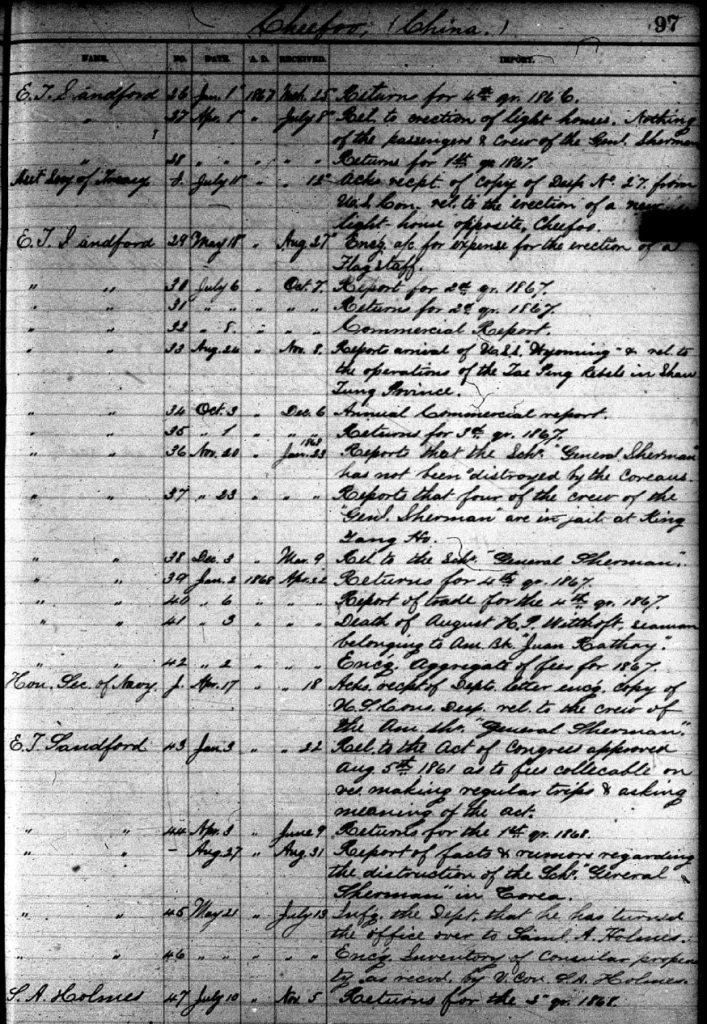
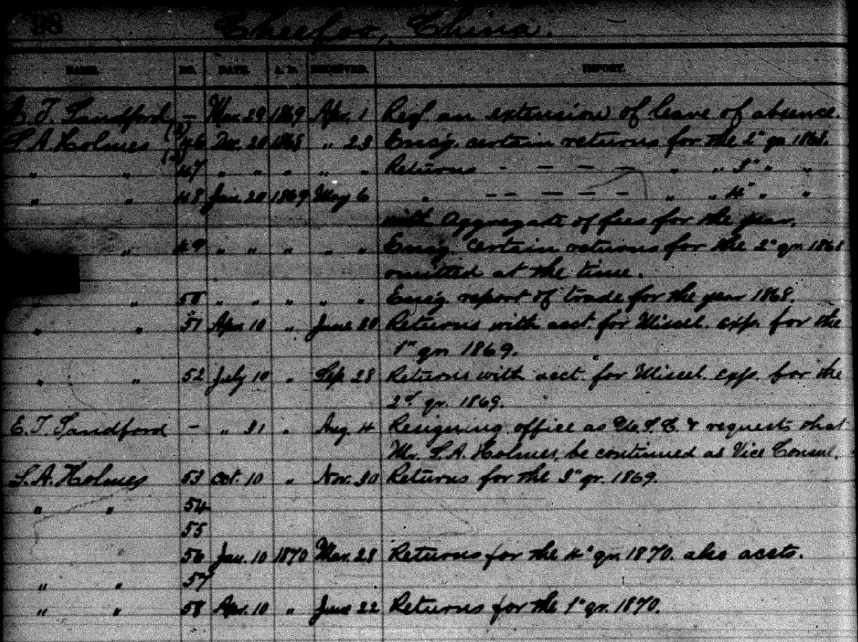
A log of the correspondence (I believe this is an actual Government log from the 1860s, not something created later by an archivist) records over 50 entries (there are a few clerical mistakes in the numbering system so a few of the log entry numbers are used more than once) between March 11, 1865 and July 31, 1869. Separate columns record the date the correspondence was sent and the date it was received in Washington–for correspondence originating in China, these dates can be several months apart.
The log of Edward Sandford’s correspondence with the Secretary of State before, during, and after his assignment as United States Consul to CheeFoo China. The correspondence takes place between March 11, 1865 and July 31. 1869
United States government interaction with China was in its infancy. From earlier parts of the log, it is clear that Edward was only the second person to be assigned to this particular post.
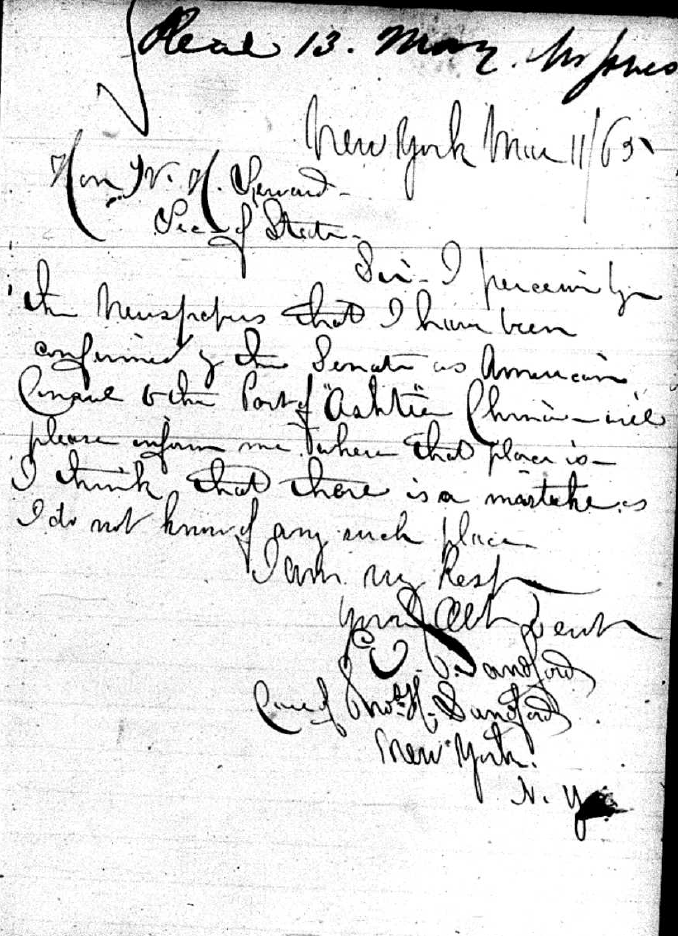
Edward seems to get off to a shaky start with his new job–His nomination and appointment seem to take him off-guard, and it is not clear how he first learned of it. In his first letter, dated March 11, 1865 he proclaims to Seward, referring to CheeFoo, “I think that there is a mistake as I do not know of any such place.” Even though he has already had a lifetime of experiences, Edward is only 24 years old at this time. Seward, in his 60’s, if he ever saw this letter, must have rolled his eyes and turned to an aide and asked him to get this kid straightened out.
Edward Sandford’s fist letter to William Seward in which he proclaims, referring to CheeFoo, “I think that there is a mistake as I do not know of any such place.”
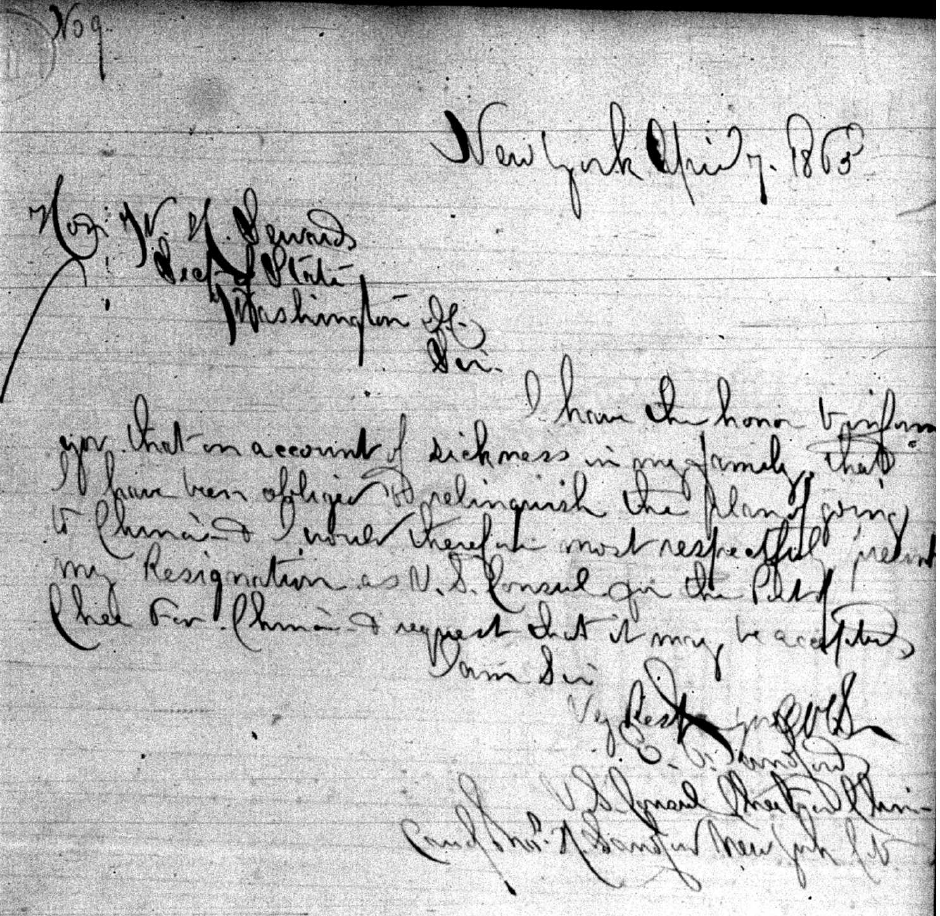
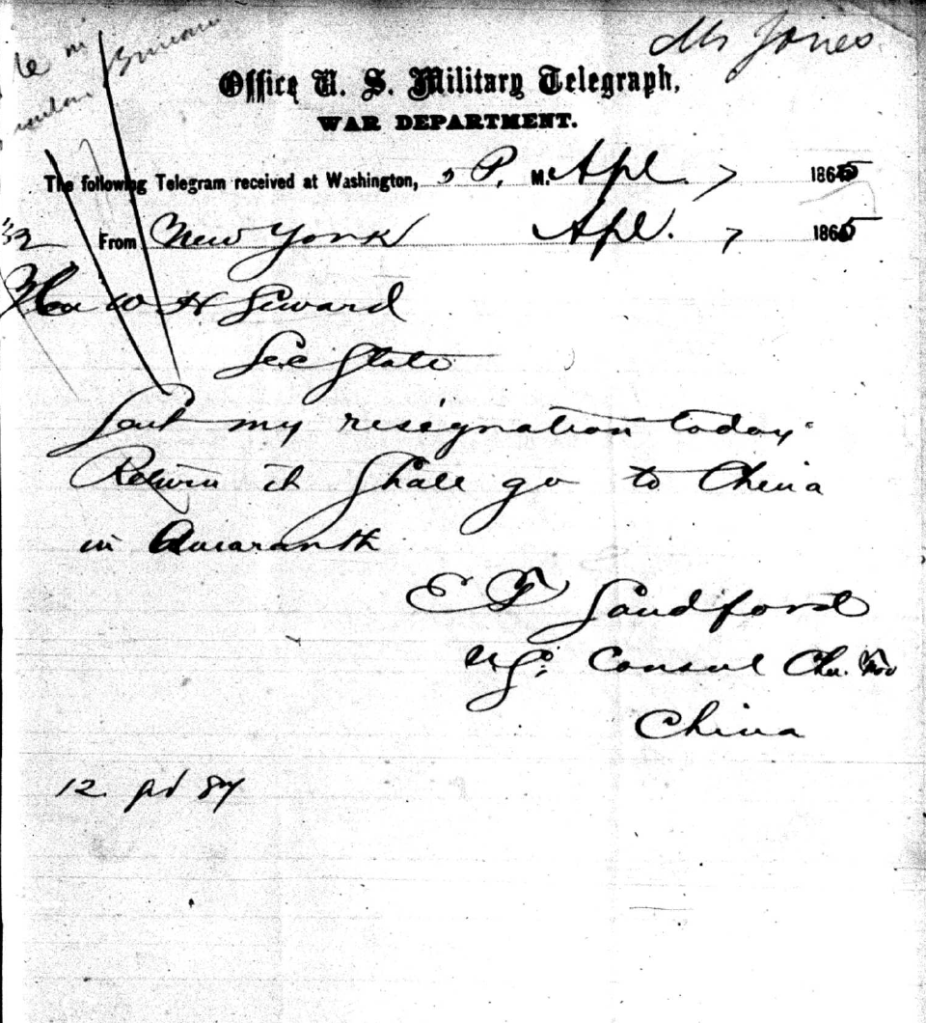
There is a series of letters in March dealing with administrative affairs, then on April 7 Edward sends a letter of resignation due to an illness in his family. He seems to regret this decision almost immediately–the same day he sends a telegram to Seward asking him to ignore the resignation. This is quickly followed by other awkward letters where he provides status of his trip back to his home in Warren to check on the situation with the illness, in each letter he has to reiterate his previous communications rescinding his resignation.
It is not clear who the family illness referred to. His wife, Sarah, was sick much of her later life, but this would be the earliest reference to her being ill, if it was her. Edward’s mother had died a in 1847 and his father would live to 1898.
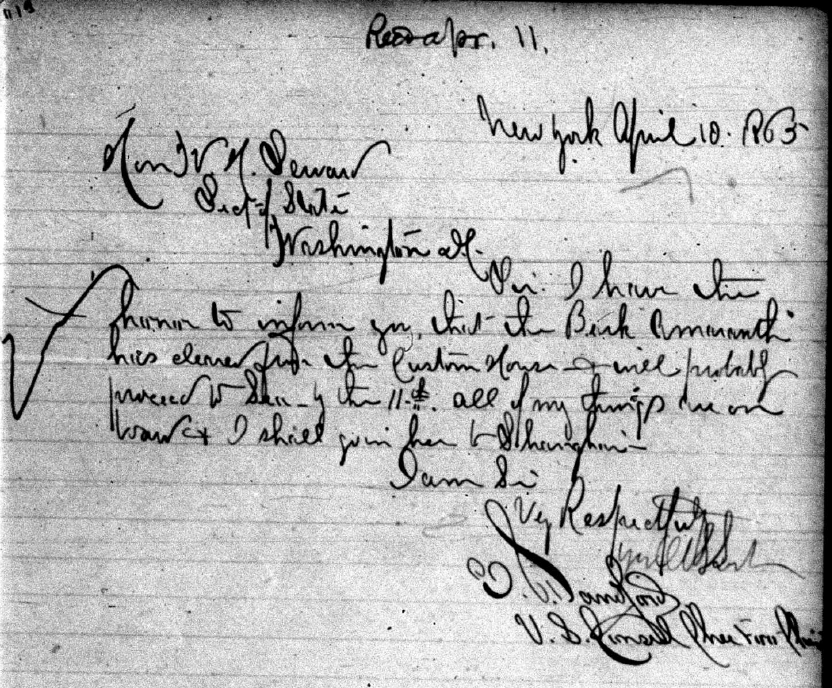
Somehow Edward got his affairs in order quickly. In an April 10 letter he states that his possessions are loaded on a ship that is preparing to sail.
On April 10, Edward reports that he is ready to go and expects to sail shortly.
Lincoln was assassinated April 15, so Edward must have sailed just a few days before and received the news at a port along the way. Based on information from Edward’s previous trip to China, I assume he took the route around South America (the Suez Canal would not open until 1869), so there would have been ports along the U.S. east cost. I found no correspondence that spoke of the assassination. It seems that the norm of the time was that people stayed in their Government posts across administrations, more than would be the case today—both Edward and Seward stayed on the job under the new president Andrew Johnson.
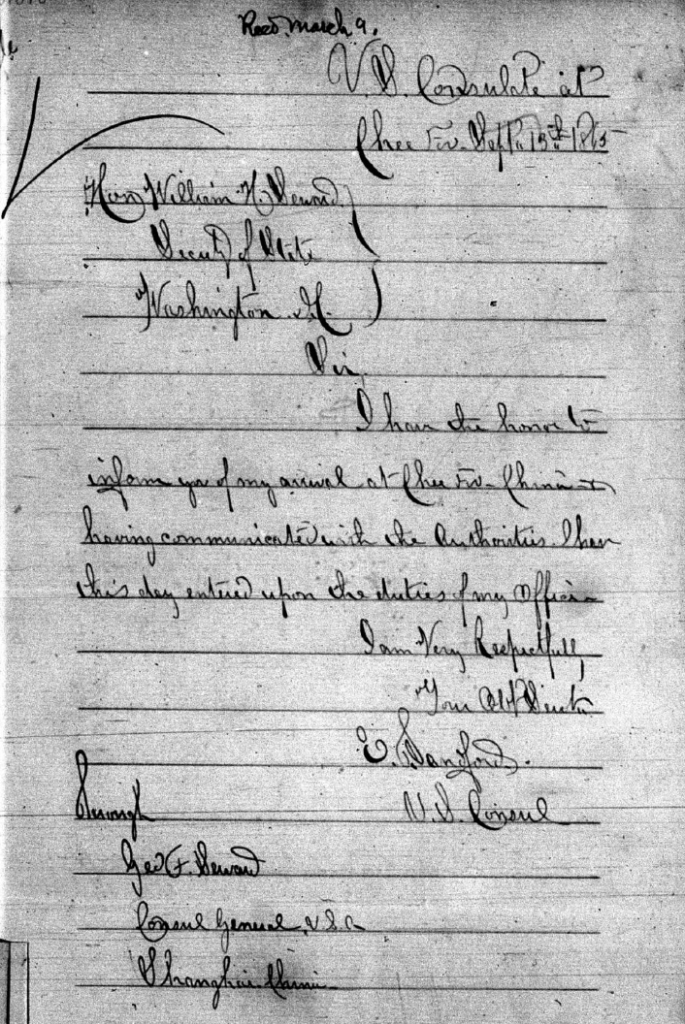
The next correspondence from Edward is dated September 13, 1865 (received in Washington March 9 of the following year) and announces his arrival and start of duties in CheeFoo. His handwriting is much improved in this short letter, so it may have dawned on him somewhere along the way that he was now in the big leagues. Edward’s handwriting slopes to the left, and can be difficult to decipher.
As Consul, Edward had a set of determined duties. Much of his correspondence over his tenure consisted of routine filings of required reports. Much of his initial correspondence, back in March 1865, dealt with him getting the instructions and sets of forms (referred to as ‘blanks’) needed to carry out his duties.
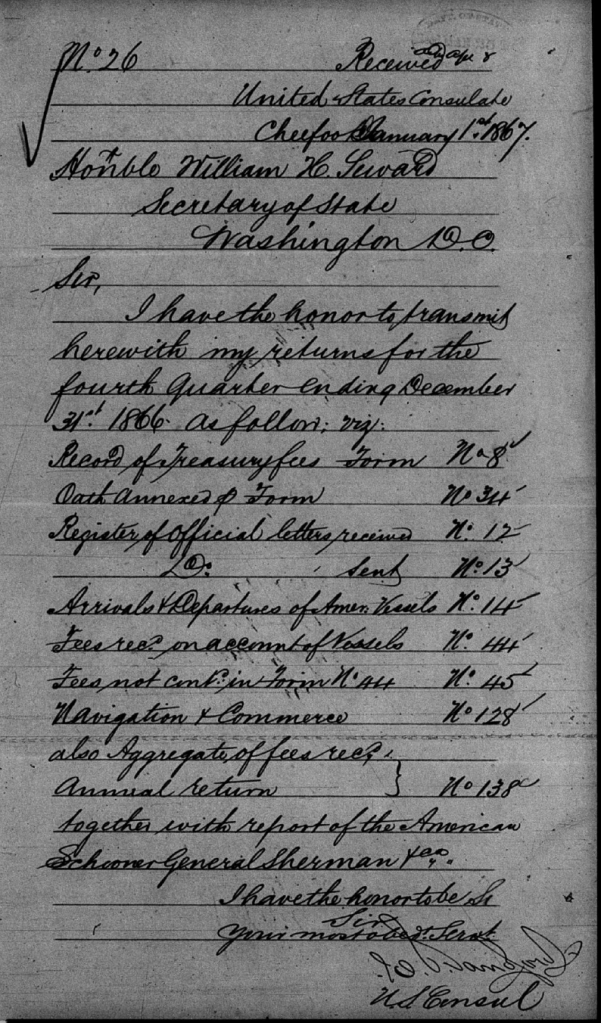
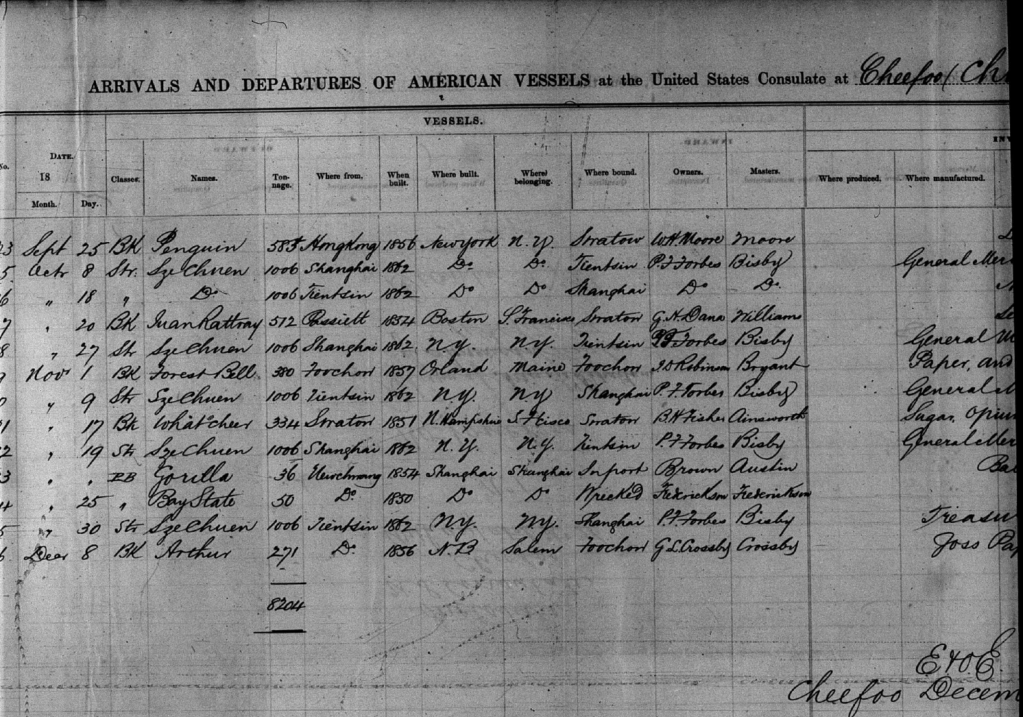
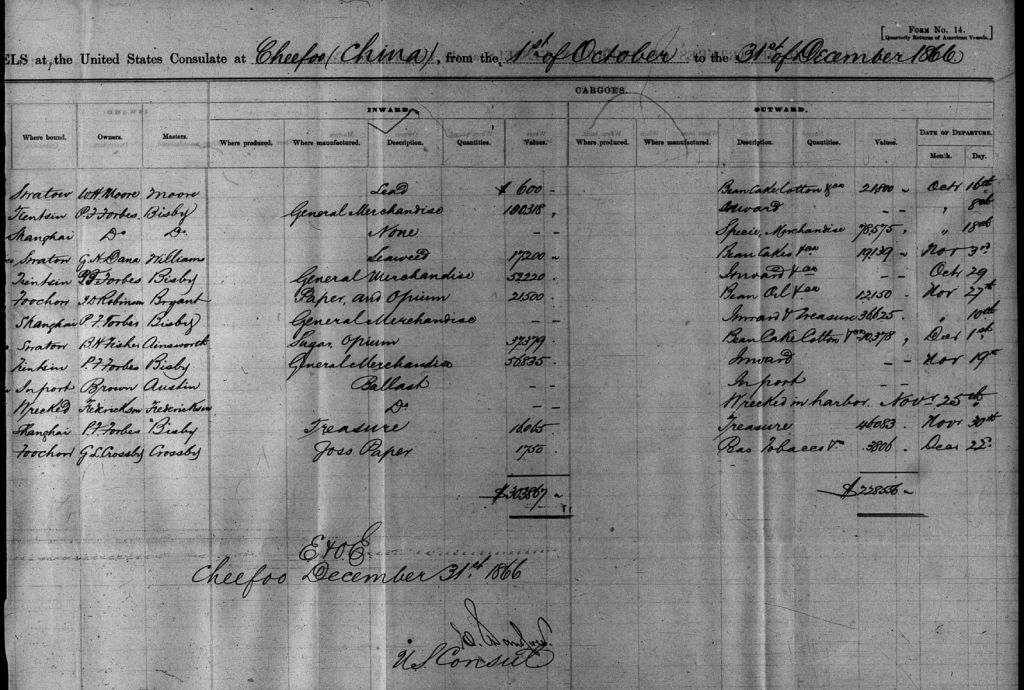
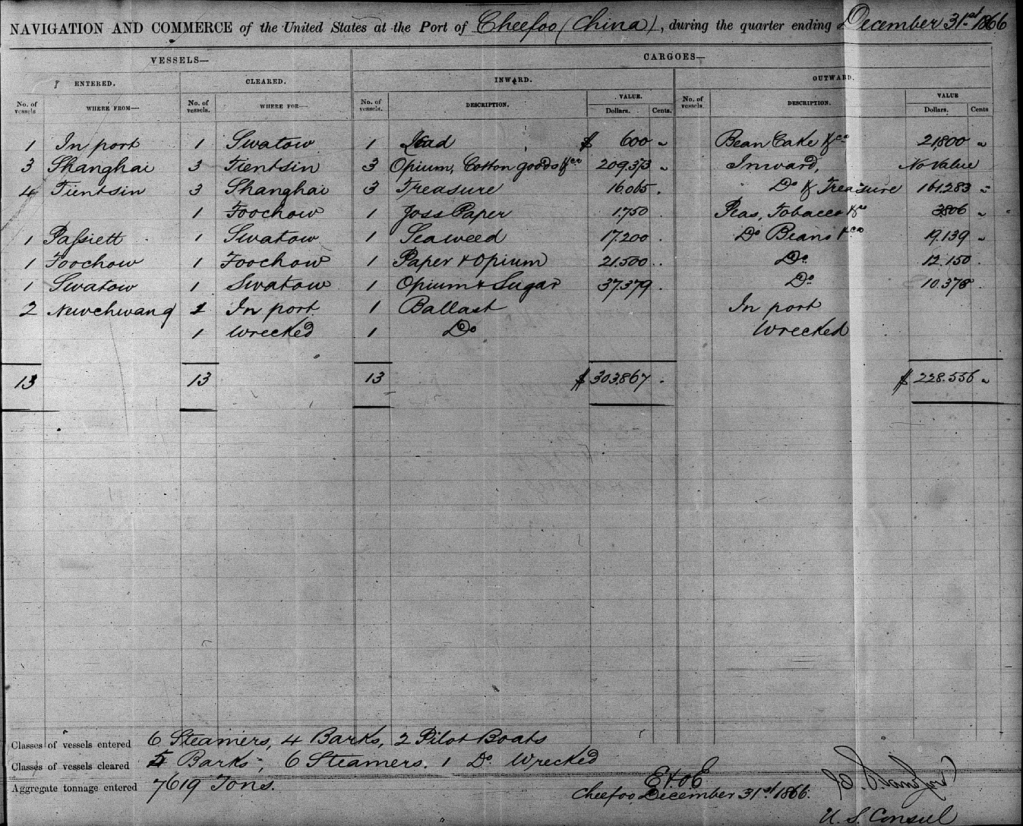
Edward’s submission of his annual report for the fourth quarter of 1866, submitted on January 1, 1867 provides examples of his day-to-day duties.
Cover letter for Edward’s 1866 year-end report, including a list of attachments.List of American vessels arriving and departing CheeFoo in 1866 (left half), submitted with Edward’s year-end report.List of American vessels arriving and departing CheeFoo in 1866 (right half), submitted with Edward’s year-end report.Report on commerce in CheeFoo in 1866, submitted with Edward’s year-end report.
Not all of Edward’s duties in CheeFoo were dull and routine. We will continue the stories of Edward’s adventures in China in a future post.
The Shipping News, a novel by E. Annie Proulx published in 1993, follows the life of Quoyle, a childhood immigrant from Newfoundland who falls on hard times and decides to move back to his homeland with his young children and his aunt, Agnis Hamm. On the journey, Quoyle discovers truths about his former homeland, his family, and himself. He learns of the wonders of Newfoundland as well as its dark secrets. Agnis, who has firsthand experience with some of these dark secrets, balances support of her nephew with her need to exorcize her own demons from the past.
The book was made into a movie of the same title in 2001 starring Kevin Spacey as Quoyle and Judi Dench as Agnis.
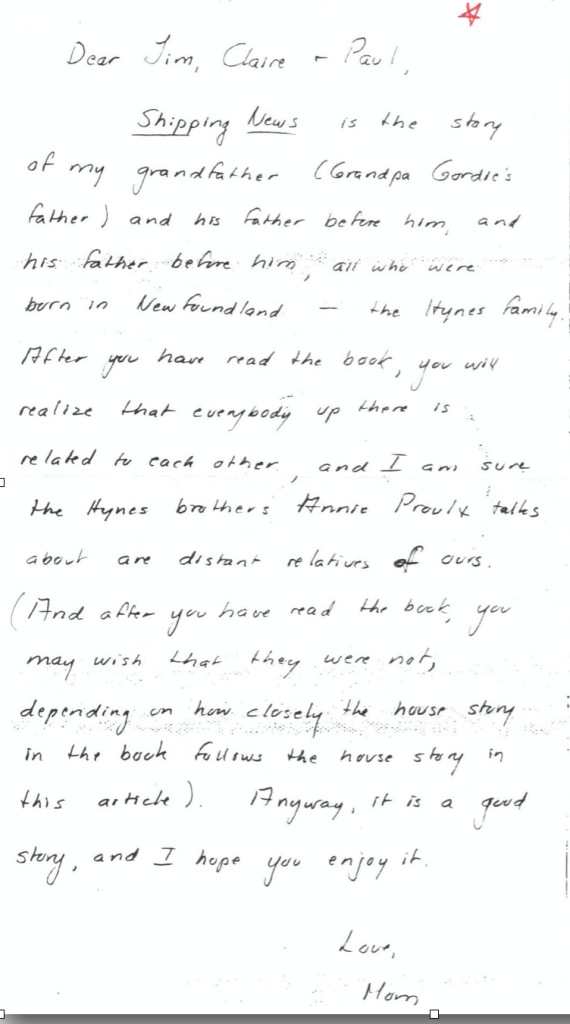
The potential relationship of the story with our ancestry first came to light in 1997 or 1998 with a note from our mother telling us about it in fairly certain terms, and giving us some warning about the dark side.
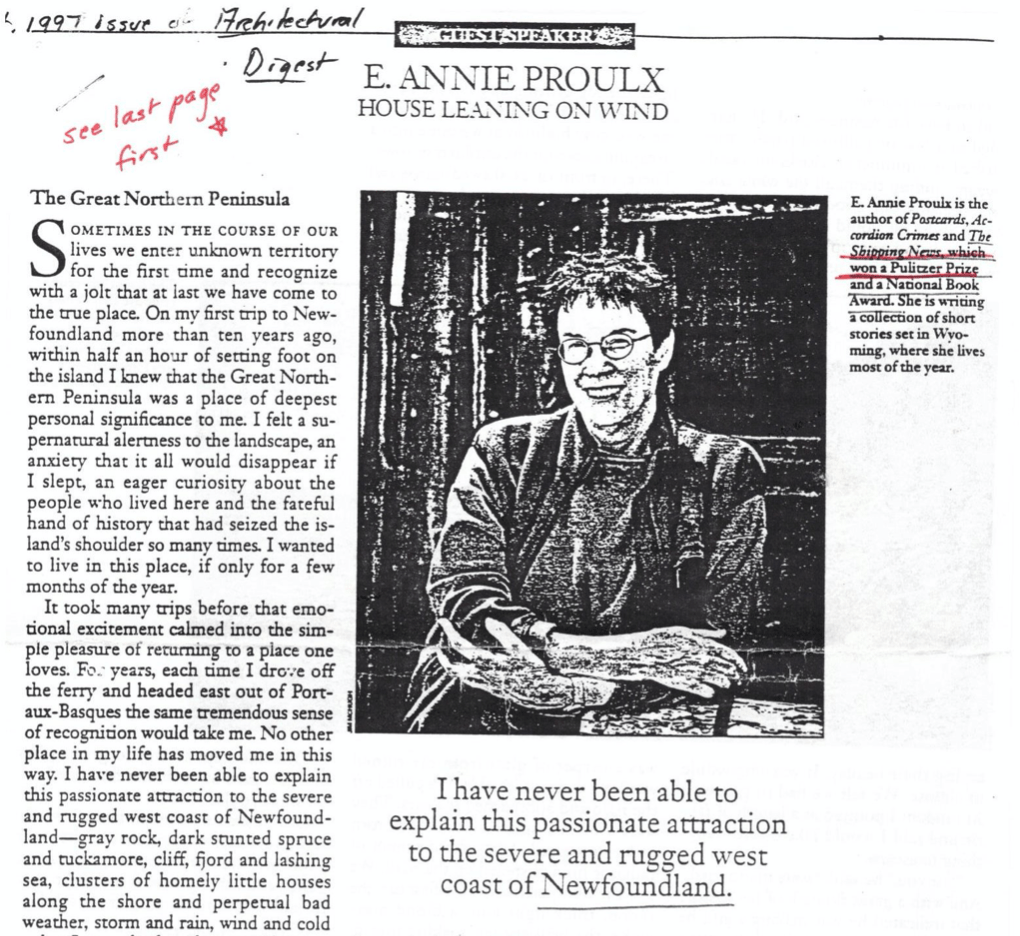
The note was attached to a copy of a 1997 non-fiction article from Architectural Digest, also written by Proulx, describing her experiences in Newfoundland leading to writing the book. The article, titled House Leaning on Wind, describes her efforts to buy and restore a house in northern Newfoundland originally built by members of the Hynes family and passed down several generations of Hynes descendants. With the information in this article, we can ask two questions: did Proulx’s inspiration for the novel include her encounters with the Hynes family? …and… is this the same Hynes family as ours?
Literary Inspiration – Did Proulx’s experiences with a Hynes family on Newfoundland help inspire the book?
House Leaning on Wind describes how Proulx’s fascination with Newfoundland took root over a series of visits, and gives clues on the origins of many of the plot elements in The Shipping News.
1997 Architectural Digest article by Annie Proulx, describing some of her inspiration in writing The Shipping News, including the northern Newfoundland Hynes house she decided to purchase and renovate.
Specifically, she explains that in the years prior to writing the book, she was drawn to Newfoundland by a series of quasi-cosmic events, fell in love with the place, and decided to buy a house there. She found an old house near Gunner’s Cove, near the extreme end of the island’s northern peninsula.
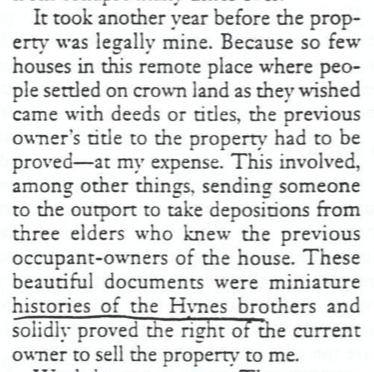
Although the price of the house was, in Proulx’s words, “less than the cost of an ordinary sofa,” there were problems with getting clear title to the property. Newfoundland is not known for its record keeping, something I have found in my own genealogical research. It only became a part of Canada in 1949, and its history is comprised of centuries of fisherman eking out a living in the harshest imaginable conditions. Informal property transfers within families were not uncommon over the generations.
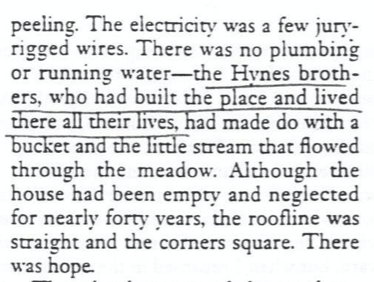
Three excerpts from Annie Proulx’s article in Architectural Digest. (1) Her description of the Hynes brothers’ as the builders and occupants of the house she intended to buy…
…(2) her description of the legal process used to obtain clear title to the property…
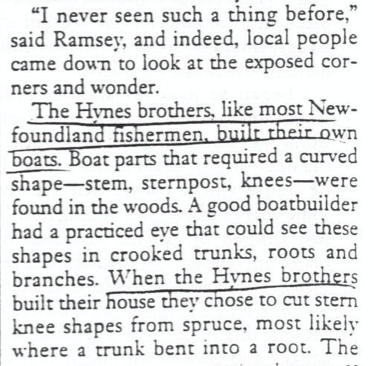
…and (3) her description of the timbers and boat building techniques found in the foundation of her house after she had acquired it.
Proulx explains that in order to establish the seller’s clear title to the property she hired Catherine Allen-Westby, a lawyer from Corner Brook (the closest thing to a large town in the vicinity of Gunner’s Cove but still 150 miles away) to research the property, conduct interviews, and piece-together a legal case for the ownership of the property. The house had been built around 1918 by brothers Lawrence and John Hynes who lived there most of their lives (they died in 1973 and 1975). Later, their niece Bridget Young and her family lived with them and built a second house on the property. The houses passed from the Hynes brothers to Bridget and finally to Bridget’s daughter Shirley Young, who wished to sell the property to Annie Proulx.
It must be noted that Proulx’s timeline in House Leaning on Wind is not completely consistent or clear–although it is a work of non-fiction, one can see that some artist’s license likely crept-in. The Shipping News was published in 1993, but her final legal claims for title of the house were filed in 1995. Despite the time delay, there is a lot about Proulx’s house buying adventure that clearly seems to have made it into the book. It could be that Proulx’s early Newfoundland experiences informed both her novel and the later magazine article. But because of the specificity of many of the references in the novel I believe it is possible that Proulx’s experiences with the house overlapped the writing of the novel. She may have bought the house informally and begun restoring and using it for a while before the need to address the legal issues of title became completely clear.
Let’s look at some of the similarities between the novel and Proulx’s experiences with the Hynes’. In House Leaning on Wind, Proulx describes her discovery of twisted timbers in the foundation of the Hynes home that are strikingly similar to boatbuilding techniques used by Newfoundlanders who build boat keels from naturally curved trees, giving the boats a great deal of added strength. Annie and her carpenters concluded that the use of similar techniques in the foundation of the Hynes house contributed to its longevity. Compare the following quotes…
With these serious underpinning defects, it was a mystery how the roofline had stayed level and the house square.
House Leaning on Wind, by Annie Proulx, Architectural Digest, 1997.
“Miracle it’s standing. That roofline is as straight as a ruler,” the aunt said. Trembling.
Aunt Agnis after her return to the family house, The Shipping News, Chapter 5, by Annie Proulx.
In the novel, Quoyle later learns the story of how his ancestors, having committed crimes too heinous even for the rough folks of Newfoundland to tolerate, are banished from the town and their house is dragged by the townspeople to its new location across the frozen ice of the bay. There is no way to prove that this dreamlike scene was inspired by the boat-like, sled-like timbers under the real-life Hynes house, but the idea is compelling.
The Hynes house, like Quoyle’s ancestral family home is indeed a substantial boat ride across the bay. Proulx describes her first encounter with the Hynes house as follows.
For a long time I watched the whales rise and dive. An outboard motor across the bay stuttered dimly. The fog thinned and lifted and then, as through an opened door a crack of brilliant light came over the ocean and illuminated the coast. A mile distant, at the foot of a sloping meadow, I saw a pale, steep-roofed hope, its windows flashing orange in the raw light, alone on the shore with the black spruce rising behind it.
House Leaning on Wind, by Annie Proulx, Architectural Digest, 1997.
Quoyle later learns of the presence of a cousin, Nolan, who still lives and lurks near his ancestral home. After mysterious sightings and finding mysterious objects around his house, Quoyle finds his hermit cousin and tends to him. Eventually Quoyle is compelled to commit Nolan to an asylum where, on a later visit, Nolan reveals to Quoyle his aunt’s dark secret, that Quoyle’s father had violated his sister, Quoyle’s aunt, in Newfoundland, when they were young.
I have no evidence of improper behavior on the part of John or Lawrence Hynes, but it is difficult not to compare cousin Nolan skulking around Quoyle’s house with the Hynes brothers living in the old house nearby his niece in the newer house in their final years in the 1970s. According to the legal depositions collected to build the case for title to the house, Lawrence Hynes became paralyzed and moved into the newer house with his niece Bridget Young and her family for the final years of his life, not unlike Quoyle caring for his aging cousin.
So as to the question of whether the family and house of Lawrence and John Hynes served as literary inspiration for The Shipping News, we have mixed indications. The similarities are compelling and hard to dismiss, but we also have to twist and turn a bit to explain discrepancies in Proulx’s time line.
The Search for a Genealogical Connection – Is the Hynes family that Proulx encountered on Newfoundland a branch of our Hynes family
To begin, we must note that Gunner’s Cove, the site of the house, is not quite in the same area of Newfoundland as our ancestors—the two areas are about 75 miles apart. Somebody would have had to have made a significant move from the mainstream of our Hynes ancestors, who predominately moved from east to west over several generations along the north shore of Newfoundland, but not on the northern peninsula. This is possible given that generations of Newfoudlanders lived off the fisheries and pursued work where they could get it.
In 2019, inspired by Proulx’s words “these beautiful documents were miniature histories of the Hynes brothers,” I wrote to both Proulx (via her publisher) and Catherine Allen-Westby to ask if there was any way to obtain copies of the 1995 paperwork. Mom recently told me that she once also tried writing to Proulx. Neither of us got a response from Proulx, who had long since moved-on to Wyoming and writing Brokeback Mountain. But I did get a response from Allen-Westby. She had long been a judge in the Newfoundland Provincial Courts, in fact she let me know that she was on the verge of retirement. She graciously found the public record legal documents that she had submitted in 1995 on behalf of Proulx, and sent me a copy.
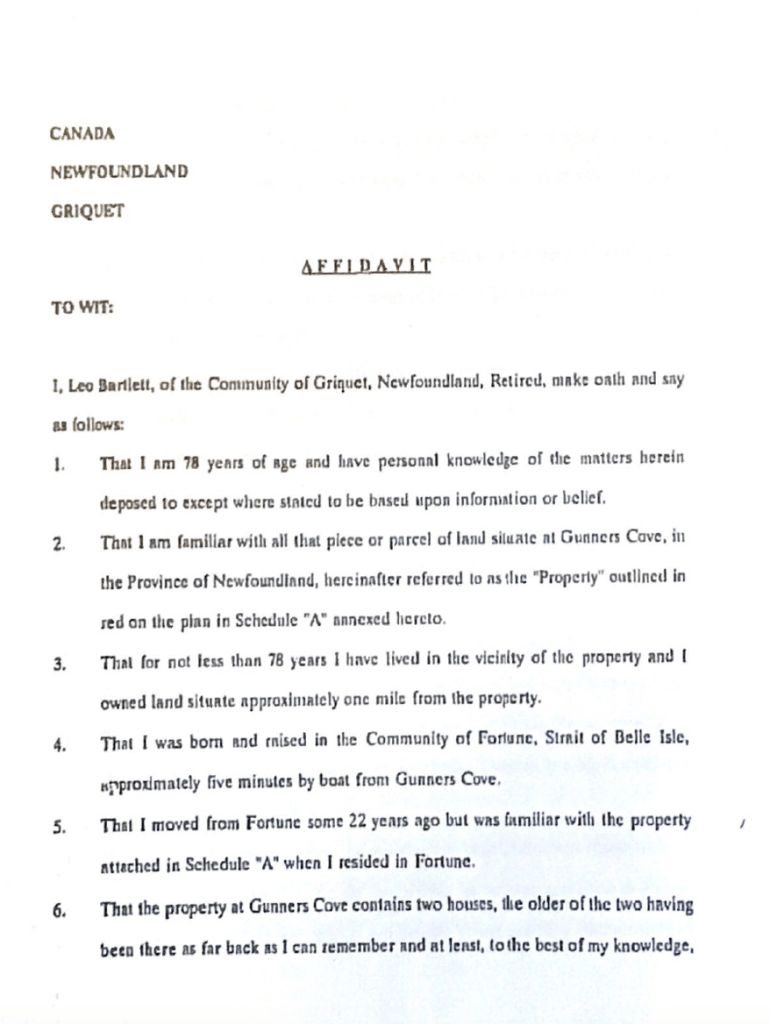
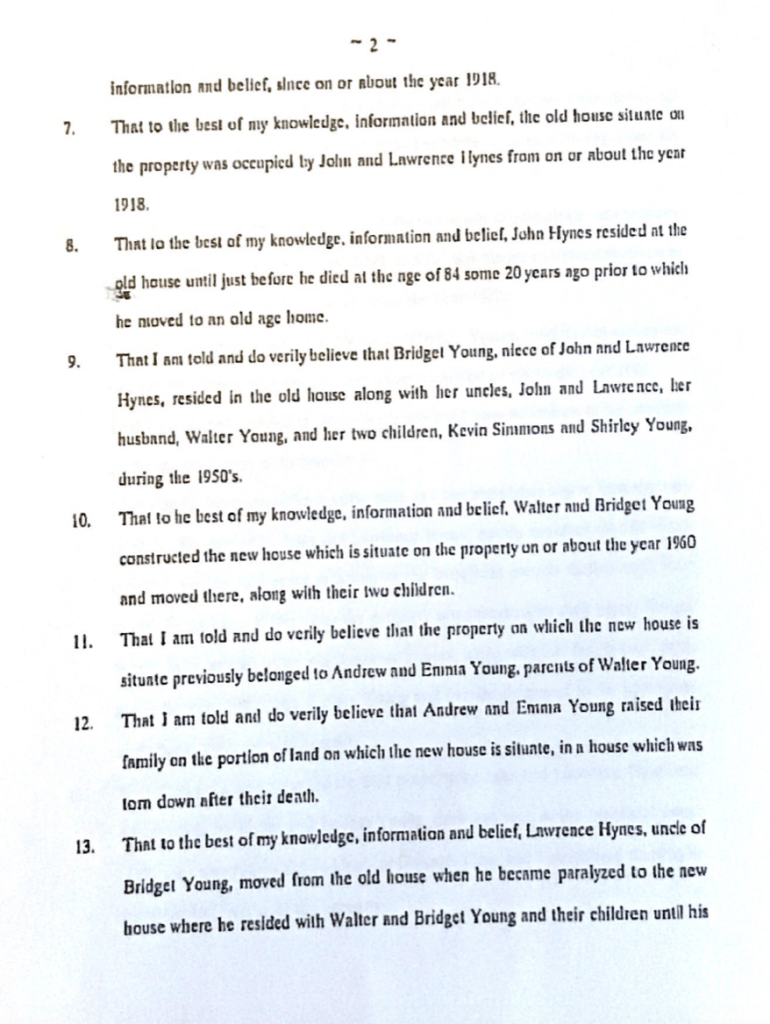
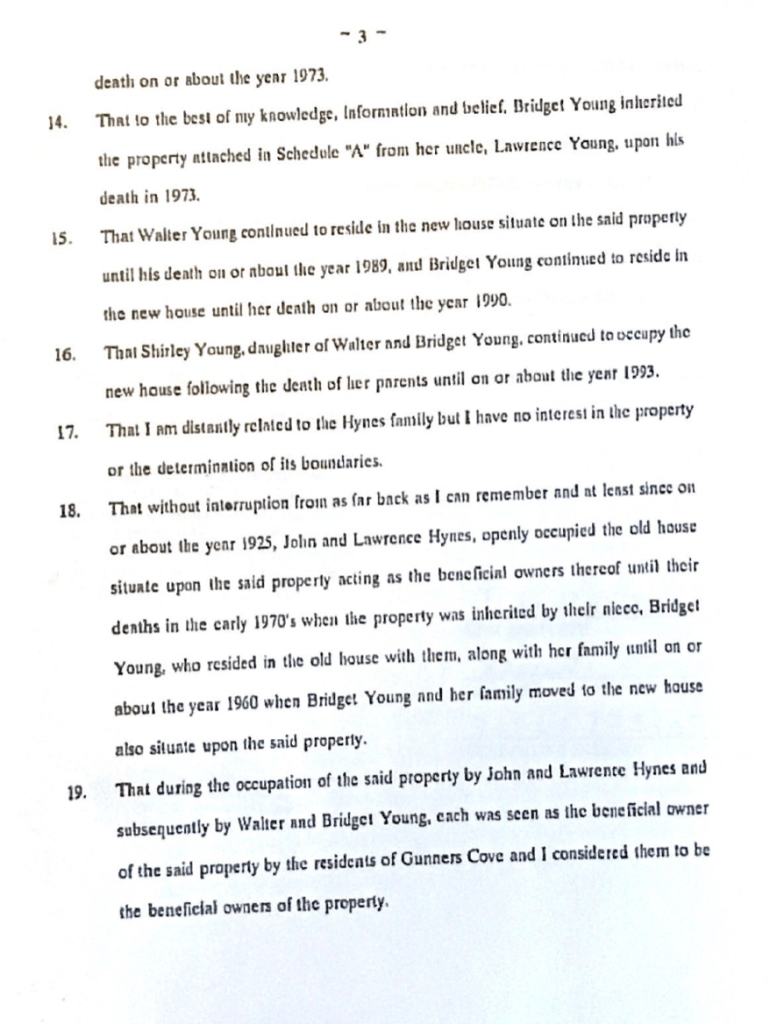
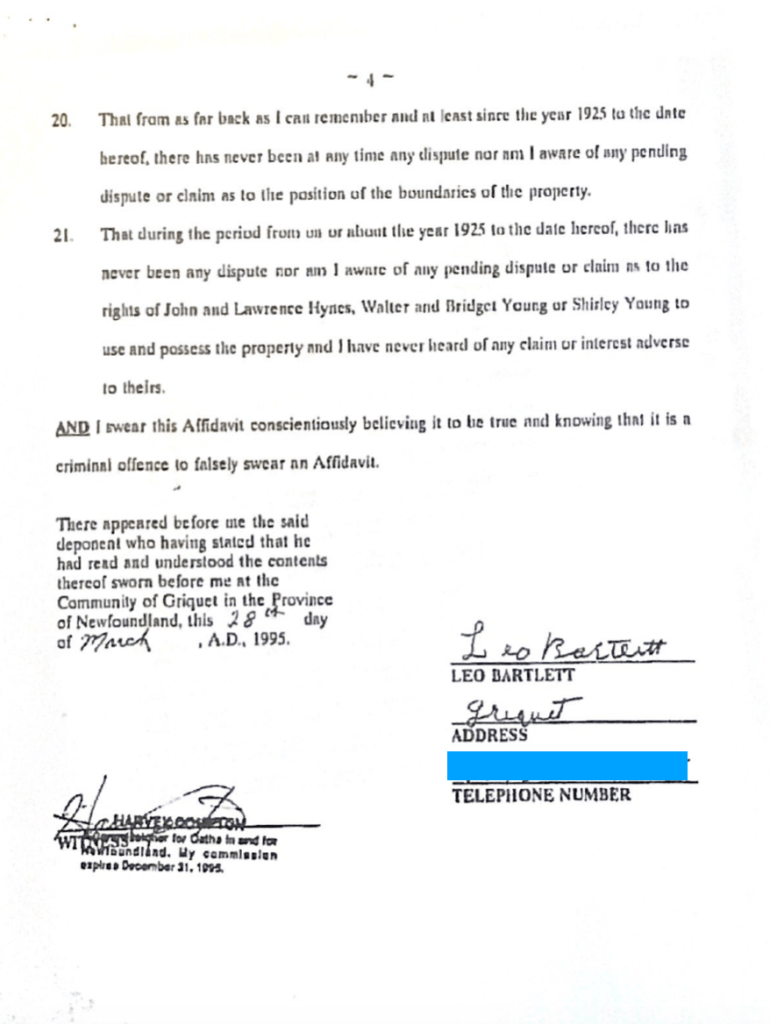
The package is 23 pages long. It primarily consists of three similar depositions, one from Shirley Young, the owner and prospective seller of the house and two other members of the community of sufficient age and standing to be credible witnesses as to the historical ownership of the property, Leo Bartlett and Lewis Elms.
1995 affidavit submitted in support of obtaining clear title to the Hynes house being sold by Shirley Young to Annie Proulx. This document makes it possible to construct a genealogy of this Hynes family to try to link it to our Hynes family.
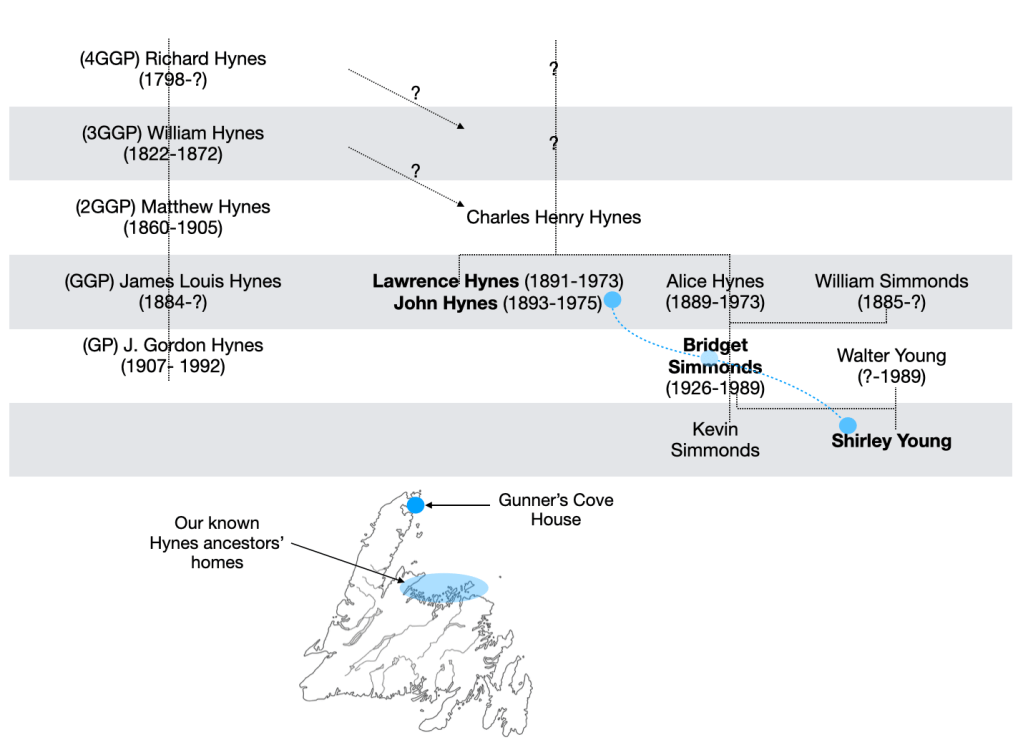
The information in the affidavits is sufficient to piece together the ancestry of Shirley Young back to her great grandfather Charles Henry Hynes. Two of his sons, John and Lawrence Hynes lived in the house since about 1918, and eventually the title passed down to Shirley Young.
Comparison of the two Hynes families trying to link them together. If Charles Henry Hynes were the son of William Hynes then James Louis Hynes would be a cousin of Lawrence and John Hynes.. If Charles Henry were the son of Richard Hynes then James Louis Hynes would be a second cousin of Lawrence and John Hynes, etc. Ownership of the house purchased by Annie Proulx is denoted by the blue dots.
Unfortunately, this is as far as the records take us in trying to connect the two Hynes families. Just as we previously pushed our own family ancestry back as far as we could to Richard Hynes, I found no record of the ancestry of Charles Henry Hynes. But neither can we disprove the link—the diagram indicates that there are possible ways that the families could have separated in Newfoundland, or possibly earlier in Britain.
In terms of comparing generations between the two Hynes families, John and Lawrence Hynes were roughly the same age as our great grandfather James Louis Hynes. James Louis was born in 1884, Lawrence in 1891 and John in 1893. James Louis had siblings the same age as Lawrence and John. James Louis and Lawrence/John are not brothers since we are confident we know all of James Louis’ family. Similarly, they are probably not cousins, since we are pretty sure we know everyone in William Hynes’ family. But a second cousin or higher relationship is possible because we don’t know very much about our ancestor Richard Hynes, and we don’t know who Charles Henry Hynes father was.
A note on the time shift between fiction and reality. Like Quoyle, James Louis was brought to the United States with his family when he was a boy, but a half century earlier. So some of the Newfoundland historical background in The Shipping News, such as the large scale importation of workers to work in Canada under near slave-like conditions, does not pertain to our family’s ancestors but occurred after they had already immigrated to New Jersey and New York.
So we cannot prove the two Hynes families are linked. But recall that in the earlier post we said that the resident population of Newfoundland grew from an estimated five thousand in 1765 to ten thousand in 1785 to forty thousand in 1815. Richard Hynes was born around 1798 when the population was maybe twenty thousand, the size of a small town, and the population of the remote far north of Newfoundland would be a fraction of this. With such small numbers, Mom’s statement about everyone up there being related to each other does not seem unreasonable, particularly between two families with the same last name living within 75 miles of each other.
So, is The Shipping News about our ancestors?
Approaching the question logically, dividing it into two smaller questions and examining all the available evidence resulted in a firm maybe for both questions. There may be more genealogical evidence out there–I will continue to look–or the answer may be lost to history.
I have gradually realized that there is something deeper fueling my interest (or obsession) with The Shipping News. Whether it is the same Hynes family or not, whether Proulx wrote the book directly based on the Hynes brothers and their house or the similarities are just coincidental and rooted in the general character and history of Newfoundland, the book captures insights about our family that feel important.
The similarities noted previously between Quoyle’s fictional ancestors and Shirley Young’s real ancestors, between the fictional house and the real house are part of it. But there is more, and to fully understand it we have to go back to the story of the secret of Aunt Agnis, the apogee of Proulx’s story line.
I said earlier that I have no evidence that Agnis’ secret about her brother (revealed to Quoyle by his cousin Nolan) was mirrored in any real-life behavior of Lawrence or John Hynes. But I also know that Agnis’s story is very similar to events that took place among our own Hynes ancestors. It is known in our family history that great grandfather James Louis Hynes violated his sister Blanche. As we will see in future posts, his transgressions did not stop there. Agnis’ fictional demons were more than matched by the direct and collateral damages inflicted on several members of our real-life Hynes family. It is this, combined with all the other similarities in The Shipping News, which leads me to conclude that even if the similarities between the novel and our ancestors’ stories are completely coincidental, the novel cannot be seen as anything less than a profound look into the soul of the Hynes branch of our family and their Newfoundland homeland.
The acknowledgement of the parallels between these fictional and real-life dark family secrets seems sufficient grounds for a declaration of truce with my unease with the uncanny similarities between our Hynes ancestry and the Proulx novel. I should mention that I considered other explanations which might best be classified as conspiracy theories, none of which led to anything credible. I looked at the possibility that we have a family link with Proulx–I found none and I now don’t believe one exists. I also asked Mom several times whether the subject of the book ever came up in our extended family when it was published, wondering how it could be that the whole family was not talking about it. The consistent, repeated answer was no, Mom really did just stumble on the article in Architectural Digest–it does make sense that she would have and a subscription to it in the 1990s–and her thoughts either were not shared with the extended family or the family’s secrecy gene kicked-in and quickly suppressed any wider discussion.
Each time I visit the stories of our Newfoundland ancestors and their American descendants I rediscover the same recurring patterns–dates and facts which don’t quite match up vs. coincidences that are so compelling they seem to comport important truths; the contrast between Newfoudland’s geographical beauty and its extreme human toil, suffering and darkness; the conflict between wanting to understand our Hynes family and facing it’s deeply ingrained family secrecy. I expect this to continue through the remainder of the saga of our Hynes ancestors.
I chose the name Bridging the Silences because I wanted to tell stories of our ancestors the only way I felt possible, by bridging known, sometimes scant, facts across large gaps with reason and informed speculation. New variations on the meaning of the phrase keep coming up. Silences can also be the result of deep distrust of government efforts to collect information, as we saw with the early Calderwood family. Silences can come from mistakes in the genealogical record, as we saw with Josephine Sandford Ware’s mistake in identifying the father of Captain Thomas Sandford from several candidates on Long Island.
And silences can be the result of deep-seated family secrecy surrounding the darker chapters of its history.
In all this, we should not forget that The Shipping News is, on the whole, an inspirational story that sheds light on an amazing place with amazing people. Our ancestors, despite their problems, were part of this for more than three generations–very tough people making their livelihoods under conditions that today we can barely imagine. I like The Shipping News because it tells, and emphasizes, this side of the story.
I also like The Shipping News because it gives me cover in confronting the stories of what is certainly our most uncomfortable family branch—trees on the barren landscape to run between and hide behind as I prepare to storm the next hill of truth.
Finally, in the overall patchwork of our family genealogy, the very existence of The Shipping News is an astonishing thing. Our Hynes branch is by far the least researchable of all our family branches, this compounded by the secrecy that surrounds it. Yet, out of nowhere, there is this novel, written by a stranger, looking into the soul of the family as if to say “sorry about the poor state of the genealogical record, but, here is a book to help fill in the gaps and make some sense out of everything.” And, to go with it, a magazine article which says “in case you missed the messages in the book, here is a Rosetta Stone you can use to help decode the messages.” Thank you, Ms. Proulx, for helping to bridge the gaps, even if unintentionally.
Is The Shipping News about our Hynes ancestors? Absolutely.
We earlier discussed third great grandparents Jacob Sechler (1800-1869) and Elizabeth Mensch (1804-1850). Elizabeth’s parents were our fourth great grandparents Abraham Mensch (1774-1861) and Elizabeth Miller (1780-1804; who may have died in childbirth with Elizabeth). Abraham’s grandparents all came from Germany in the early-mid 18th century.
A search of Mensch family trees found this historical society index card.
Mifflinburg is 20 miles west of Danville. A simple online search reveals this pamphlet with text and images from the Union County Historical Society. (The spelling of Abraham’s last name varies between sources.)
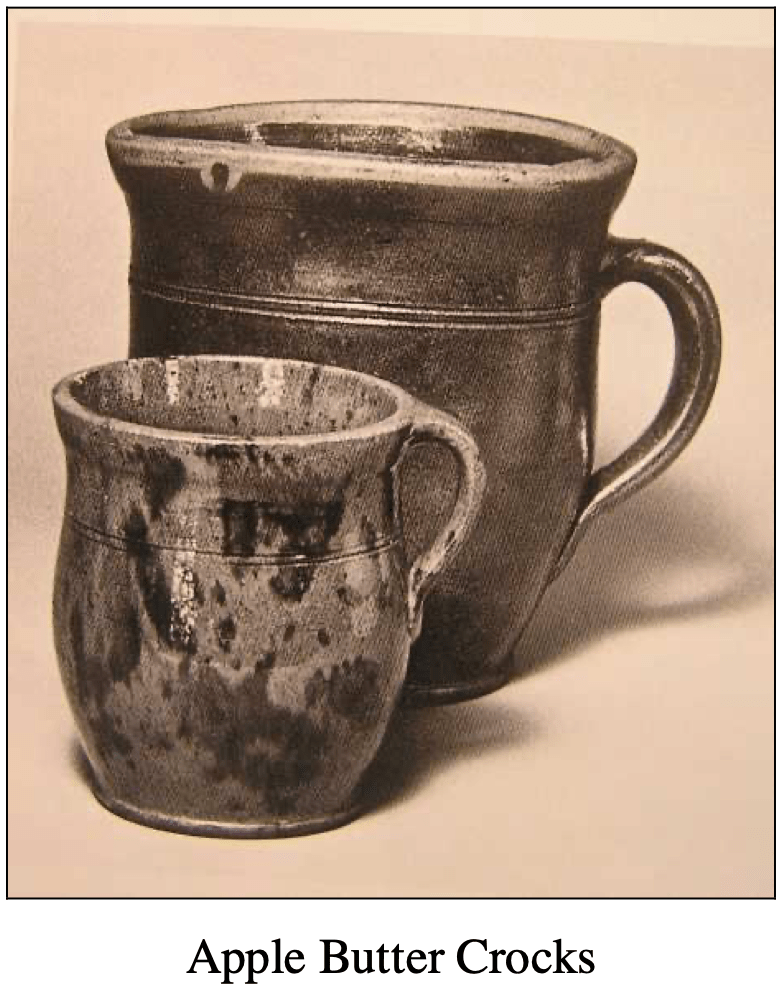
Redware Potters in Union County
Redware potters were responsible for making many of the containers used in every household in central PA for storage and serving food from the late 1700s throughout the 1800s.
Red clay is abundant in Pennsylvania, with each source having particular properties that gave the clay its color: from yellow to orange, red and brown. The clay would be worked into various forms, glazed, sometimes decorated, and fired in kilns. Most of the pottery made locally was sold locally to households in the potter’s town.
The first known potter in Mifflinburg was Christian Brown, who came from Berks County in 1794. His shop, at Market and 5th Street, was in operation until some time after 1816. Besides Brown, potters Jacob and Joseph Kimple, and Abraham Mench worked at the shop.
James Eilert set up a pottery shop at Market and 4th Street in 1826. Eilert’s pottery employed James Neiman, Henry Mathias and John Gotshall, and operated until the 1860s.
John Wolf started his shop on Chestnut Street, between 5th and 6th in 1842, and sold the business to Samuel Getgan in 1849 who continued to make pottery until 1863.
In Lewisburg, in 1796, John Leisinring opened a pottery shop on South Second and St. George streets. Philip Lester of Berks County briefly took over in 1814, after which the kiln remained inactive until John Snyder took over in 1835, the Hugh, Robert and Montgomery Hunter from 1849-1855.
Redware pottery production in New Berlin began in 1799. Peter Berger was the first potter on record, then Adam Maize and his sons Jacob, John, William and Emmanuel. Also in New Berlin were Philip Seebold and Adam Specht. In 1868, Jacob Maize’s shop was at Front and Hazel streets, and James Neiman had a shop on Front Street between Cherry and Hazel streets. Neiman’s pottery operated until 1887.
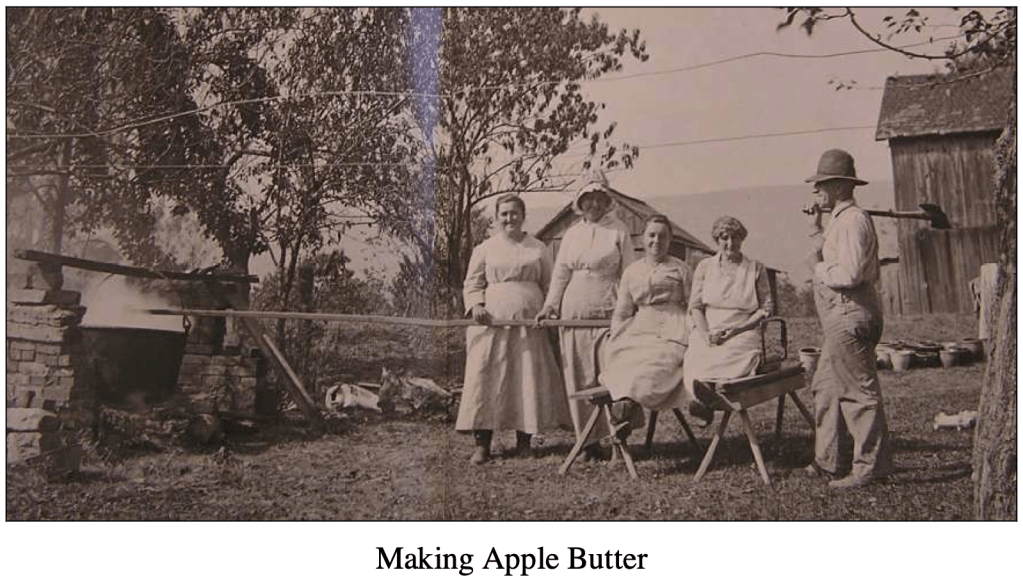
Among the many products that potters made were storage jars, apple butter and sausage crocks, and large sauerkraut crocks. Muffin, cake and pudding molds – fluted and plain – and casseroles were used to bake food. Porringers – over-large cups for serving porridge and stews – egg cups and small salt bowls, milk and syrup pitchers, cups, and plates graced the tables of our ancestors. Utilitarian objects such as roof tiles, door knobs, banks, flower pots and birdhouses, candle holders and oil lamps were also made of red clay.
Examples of early redware can sometimes be found at local farm auctions and antiques shops, and represent a great way to remember the past.
Union County Historical Society
As someone who has made pottery for 40 years, this is a wonderful discovery.
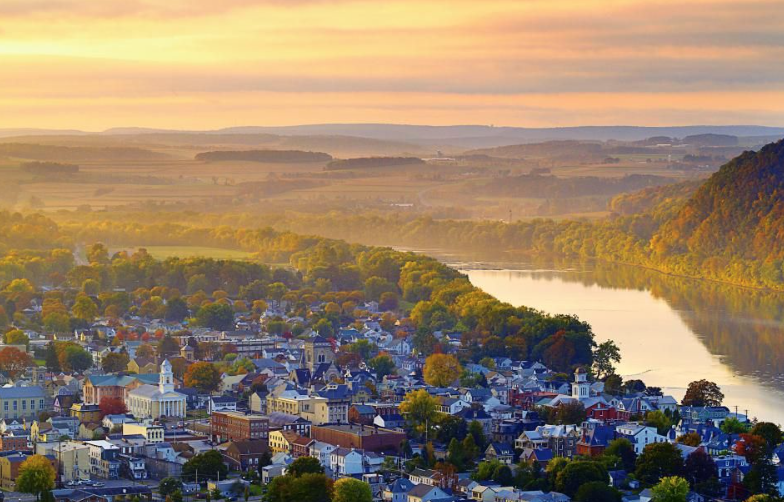
Danville is in central Pennsylvania on the north shore of the Susquehanna River, about 50 miles southwest of Scranton, 150 miles west of New York City.
Danville, Pennsylvania
In 1768, the Treaty of Fort Stanwix ceded a swath of Iroquois land to the expanding British colonies. In 1774 William Montgomery–soon to be patriot, statesman, and Revolutionary War General–purchased a plot of land on the river and established a trading post called Montgomery’s Landing. In 1792 he constructed a stone house there, which remains today as a local museum. In the same year, his son Daniel plotted the central section of the town which now bears his name.
Danville became a transportation center in the 19th century, served by several railroads and the river. Coal and iron mines fueled the local economy, and by mid-century Danville was an important iron mill town. Many of the rails of the nation’s expanding railroad system were made in Danville. However, by the end of the century many of the region’s mines and mills fell into decline as they were replaced by the modern methods and materials of the steel industry as it developed further west in Pennsylvania.
In 1869, the Danville State Hospital was built as a state institution for the treatment and care of the mentally ill. Today Danville is known as the home of the first-rate Geisinger Medical Center, founded in 1915.
John, Jacob and Joseph Sechler, sons of immigrants Johannes and Anna Sechler, came to central Pennsylvania in the 1780s. We have already discussed fifth great uncle John’s contribution to the Revolutionary War during the winter of Valley Forge. In 1789, John purchased a large section of land just east of the what would become downtown Danville, and the Sechlers are sometimes recognized as the other family involved in establishing the town. The state hospital was later built on the east boundary of the Sechler property. Some of the Sechler land is only now being developed, providing a prime location for new schools, libraries, and other modern city services.
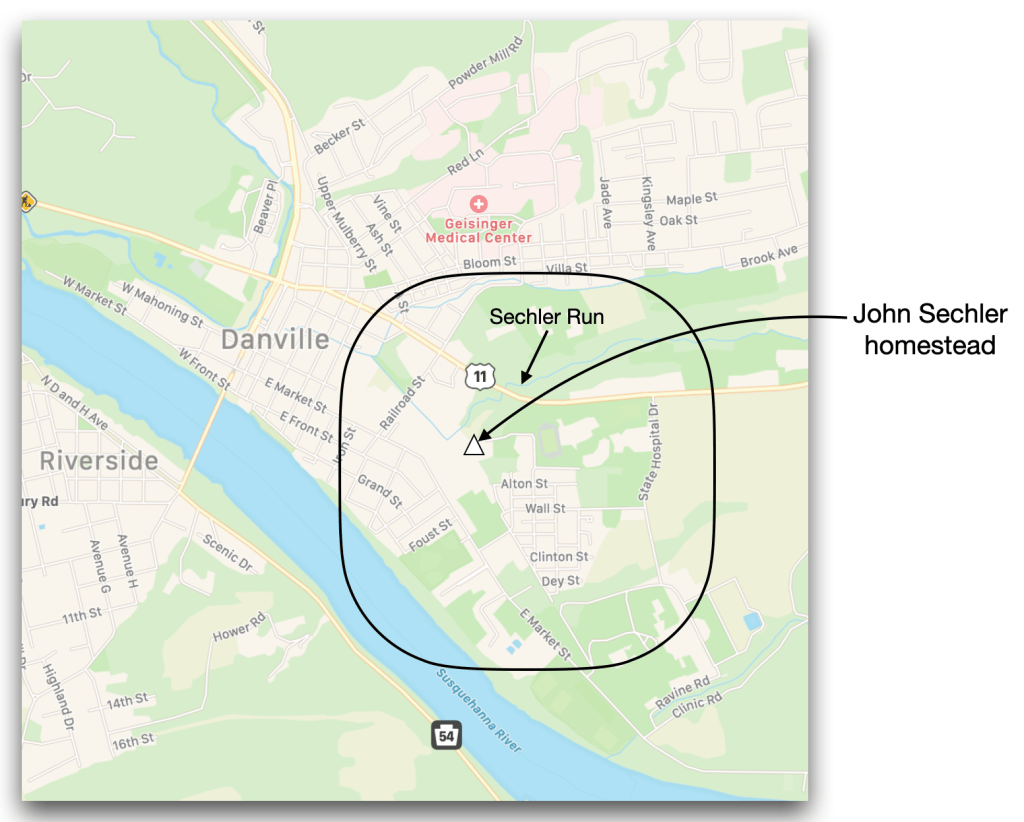
Approximate scope of John Sechler’s original land
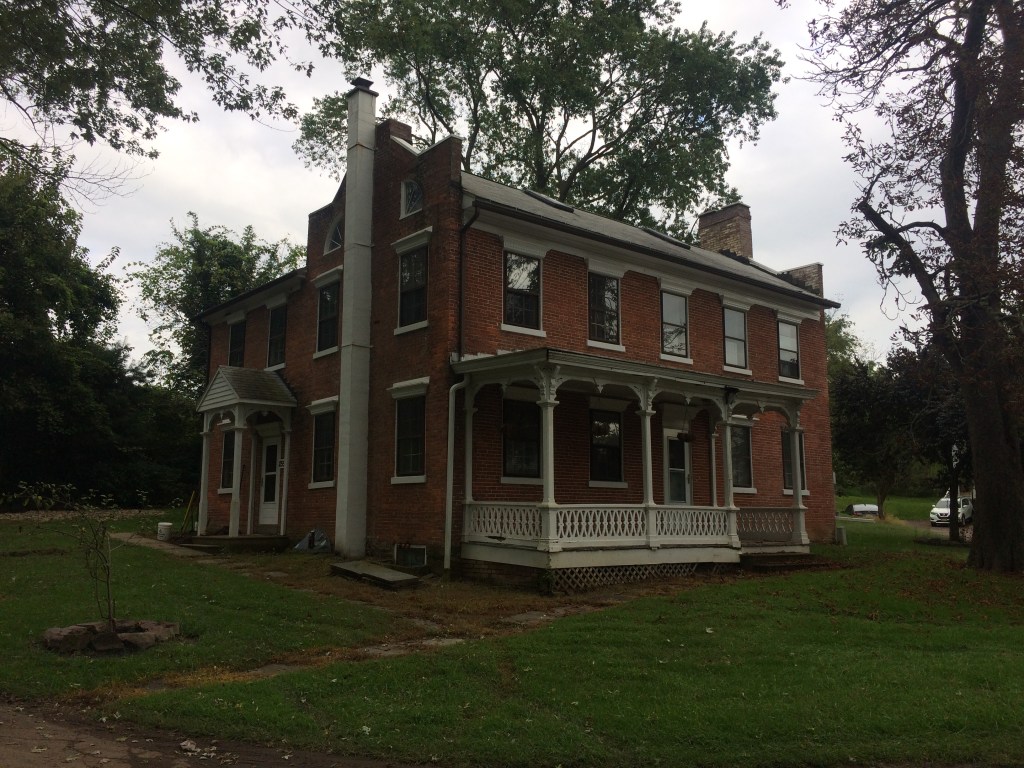
John Sechler’s homestead, built after the family had outgrown its original log cabin, still stands. A 2016 story in the Danville Morning News described its history.
John Secher’s homestead as it exists today.
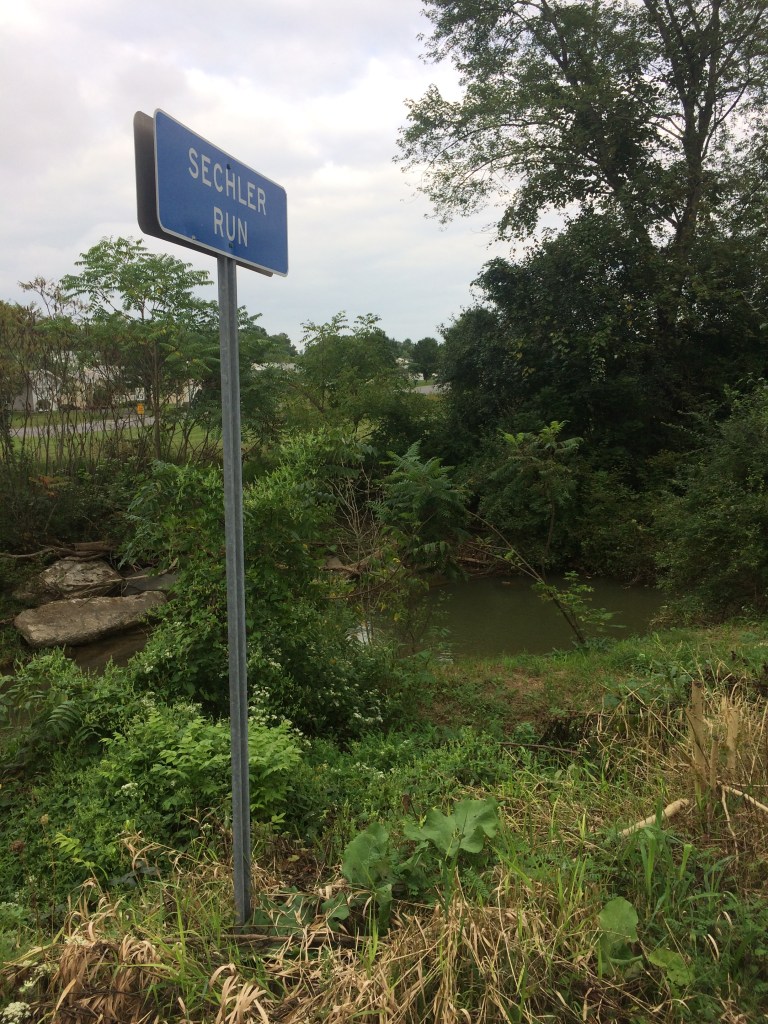
Sechler Run still winds through the town, flowing into the Mahoning and Susquehanna Rivers
Other Danville designer’s home still stands
Everyone knows about William and Daniel Montgomery, Danville’s founders. Their stone home, built in 1792 around their original modest log cabin, is the oldest house in Danville and now hosts the Montgomery House Museum and the Montour County Historical Society. It is located at the corner of Bloom and Mill Streets. Few know as much about the Sechler House, however, built by the other family involved in laying out the town of Danville in the 1790s. Sechler Run passes nearby, through a wetland area.
John Sechler bought the land in 1789, but it is not known exactly when the present brick home was constructed. It seems likely that Sechler, too, began with a log home and then moved up before too long to the large brick structure that stands today.
Claire Lawrence and Michael Hardin bought the Sechler house in 1999, when they came to the area for Lawrence to begin work as an English professor at Bloomsburg University.
In the 1790s, Daniel Montgomery set up his part of town from Mahoning Creek to Church Street, spanning the strip of land between Montour Ridge and the Susquehanna River.
John Sechler’s territory began at Church Street and extended past the present Danville State Hospital grounds, bounded on the north by Bloom Road and on the south by the river.
The original property, settled by four Sechler brothers who arrived in Danville at the close of the Revolutionary War in the 1780s, was about 500 acres. Much of the land was wilderness when they started. John Sechler purchased one parcel of that land from John Lynn and his wife Mary, according to a 1789 deed. D.H.B. Brower’s “History of Danville” credits John Sechler as the person who laid out the part of town that lies above Church Street.
About John Sechler
John Sechler was an officer on George Washington’s staff and survived the famous winter at Valley Forge. His son Jacob, born in 1790, fought in the “Danville Blues” in the War of 1812. His brother Rudy, the second postmaster of Danville and later a Justice of the Peace, was famous for his honesty. Another of the Sechler sons, Abraham, organized the first band in Danville.
Their father John was primarily a farmer, and the Sechler barn was still standing in 2008, on an adjoining piece of woodland owned by the Danville School District, until it was taken down to make room for a practice field. The house, though, and the Sechler name live on in the historical record of early Danville.
Mary Bernath for The Danville News, May 4, 2016
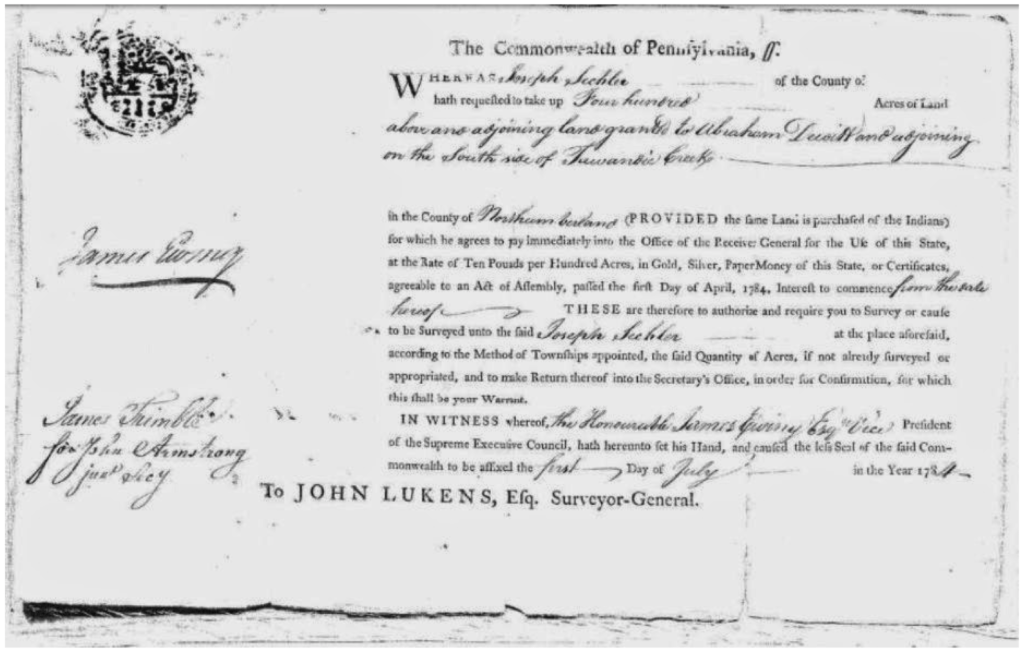
Fifth great uncle Jacob Sechler and fourth great grandfather Joseph Sechler also purchased land near Danville. They bought land adjacent to each other, the exact location of which is unclear. Joseph’s 1784 deed provides a location bounded by something like “Towarndia” Creek–neither this nor any similar spellings appear on current maps. Based on various historical geographic descriptions, it seems likely that this is an original name for Sechler Run and that Jacob and Joseph’s properties were located east of John’s, south of the creek.
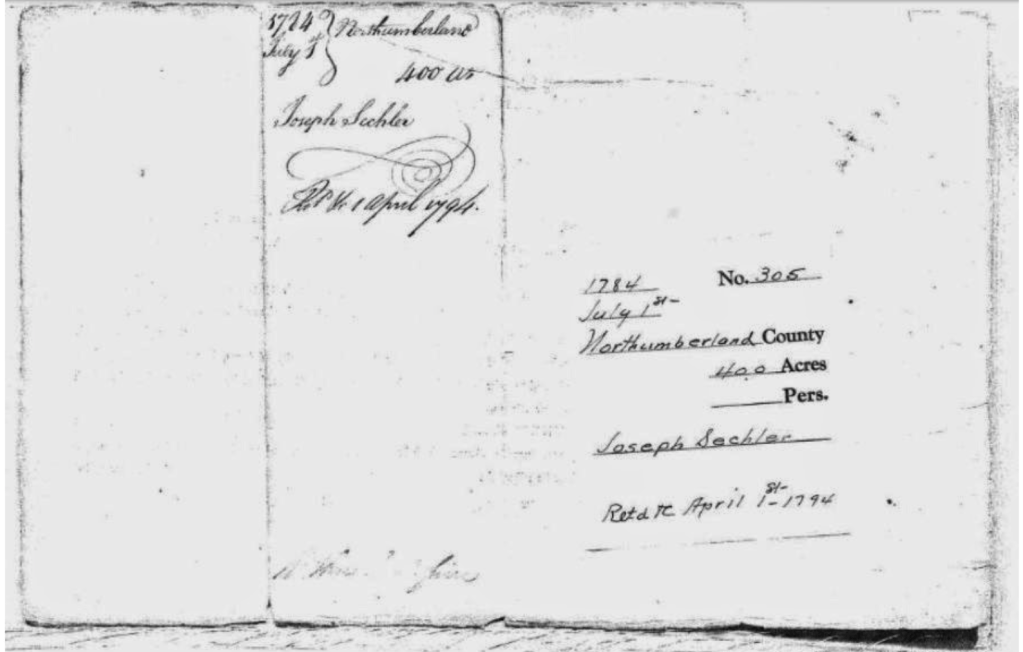
1784 title of Joseph Sechler’s property near the future Danville, Pennsylvania. Joseph’s property was adjacent to that of his brother Jacob and nearby to that of their brother John.
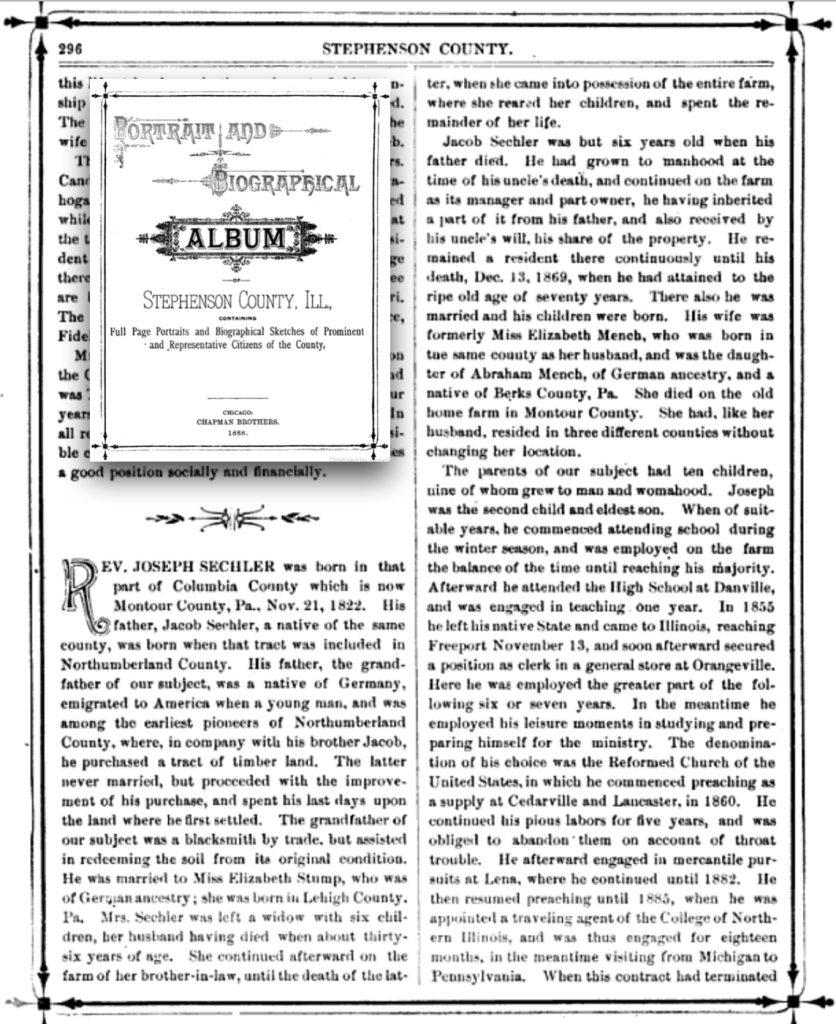
Of course it is the Joseph Sechler branch, our direct ancestral line, in which we are most interested. For this, there is a source in an obscure 1888 book, Portrait and Biographical Album of Stephenson County, Illinois. Stephenson County is the home of distant cousins who’s genealogy intersects ours. A profile of Reverend Joseph Sechler provides information we are looking for. Reverend Joseph was our third great uncle, a brother of our second great grandfather Aaron Sechler. Reverend Joseph’s ancestors are our ancestors, and the profile tells us about them.
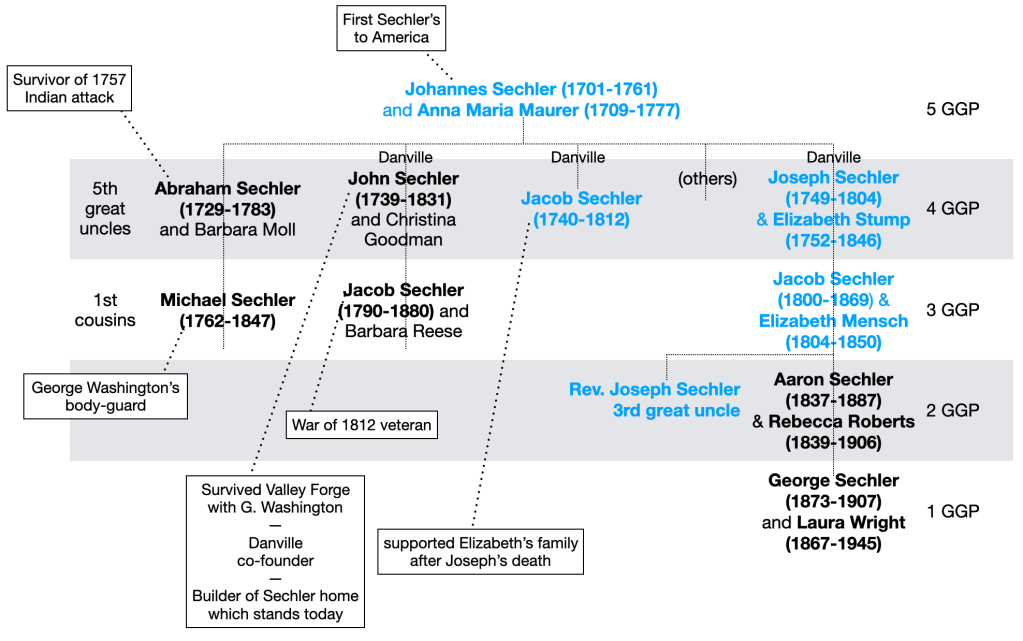
To support the discussion which follows, here is a summary of the early Sechler family we have looked at so far. The names in blue are key to the discussion. The existence of the two Jacob Sechlers (uncle and nephew) and the two Joseph Sechler’s (grandfather and grandson) are sources of confusion with which the diagram is intended to help.
A summary of the early Sechler family. The names in blue are profiled in Portrait and Biographical Album of Stephenson County Illinois. The profile of Reverend Joseph Sechler describes his immediate ancestors, who are also our ancestors.
The profile of Reverend Joseph Sechler follows.
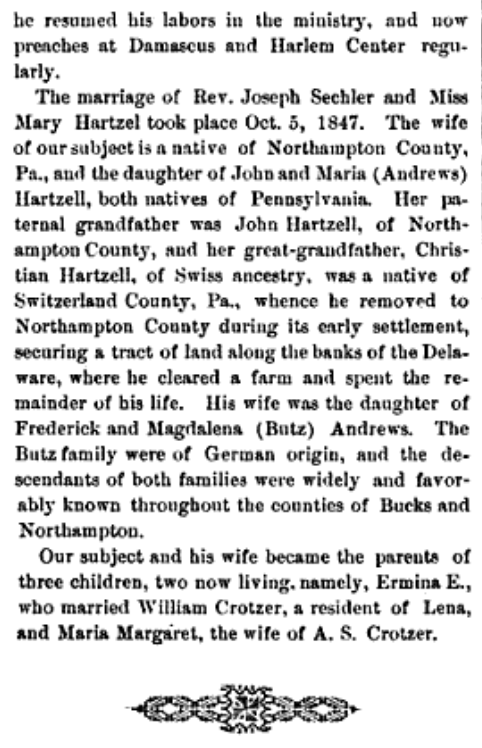
This profile of Reverend Joseph Sechler includes information about his immediate ancestors, who are also our ancestors.
The note about changing counties three times without moving refers to the fact that Danville originated in Northumberland County which was later divided to form Columbia County which was later renamed to today’s Montour County.
There are a couple of problems with the Stephenson County account. Joseph Sechler was not a native of Germany, (his parents Johannes and Anna were). Also, most sources disagree with Joseph being 36 years old when he died–he was older, as evidenced by his name appearing in later tax rolls. But there is good agreement among sources of the rest of the timeline.
Despite these discrepancies, thanks to this account written by the descendants of Reverend Joseph Sechler, we know some things about our line of Sechler great grandparents. Our 4th great grandfather Joseph Sechler was married to Elizabeth Stump. He was a blacksmith. He and his brother Jacob bought land together. When Joseph died Elizabeth carried on, collaborating with Jacob to live on their adjoining lands. After Jacob’s death eight years later, Elizabeth took possession of the entire farm.
Our third great grandfather, the younger Jacob, lost his father when he was young, but his uncle Jacob continued to support Elizabeth and her family, perhaps serving as a surrogate father in some sense. The younger Jacob married our third great grandmother Elizabeth Mensch, the daughter of another fourth great grandfather, Abraham Mensch, a son of German immigrants. Jacob and Elizabeth had ten children including Reverend Joseph and our 2nd great grandfather Aaron Sechler, whose story will be continued in a future post.
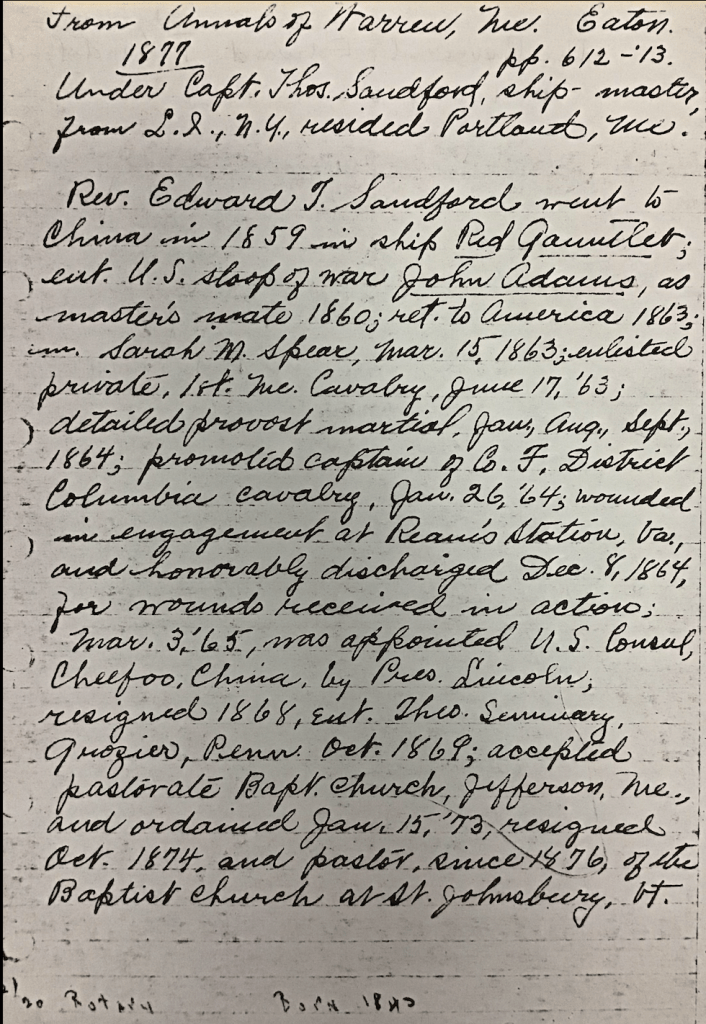
After publishing the previous entry on this subject, I rediscovered an item that Claire and I found last summer in the Ontario Model Colony History Room, a page of handwritten notes which it appears to be notes taken by grandfather Joe for one of the speeches he liked to give about his father. A notation at the bottom 2/20 Rotary suggests a Rotary Club meeting speech.
Handwritten notes, probably taken by Joe Sandford, on the life of Edward Thomas Sandford. These notes resulted in finding The Annals of Warren, in Knox County, Maine,
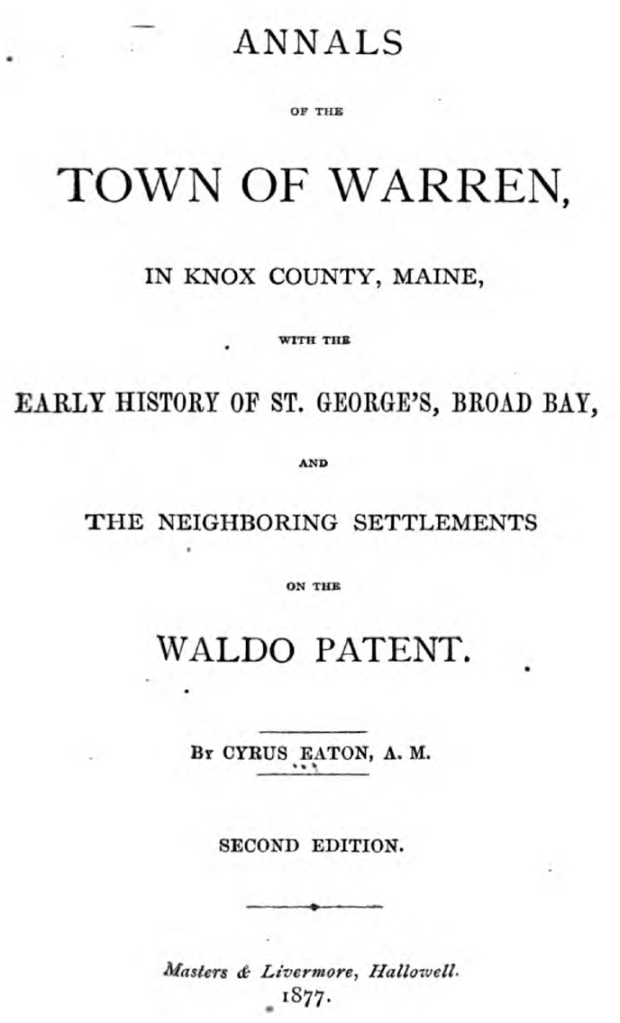
The notes in the first paragraph point to a reference The Annals of Warren, in Knox County, Maine, by Cyrus Eaton, published in 1877, which was easy to find online as a digitized book.
The book is an exhaustive history of the town of Warren Maine, combining many historical sources down to the level of decades of records of detailed town council meetings. There is enough detail to keep a local historian busy for years. Since Edward spent relatively little time in Warren, I’ll leave that task to others. But the book does contain a few pages of references to Edward and other Sandford ancestors. Since the book was published in 1877, it can be viewed as a reliable source for details on things that were, at the time, relatively recent history.
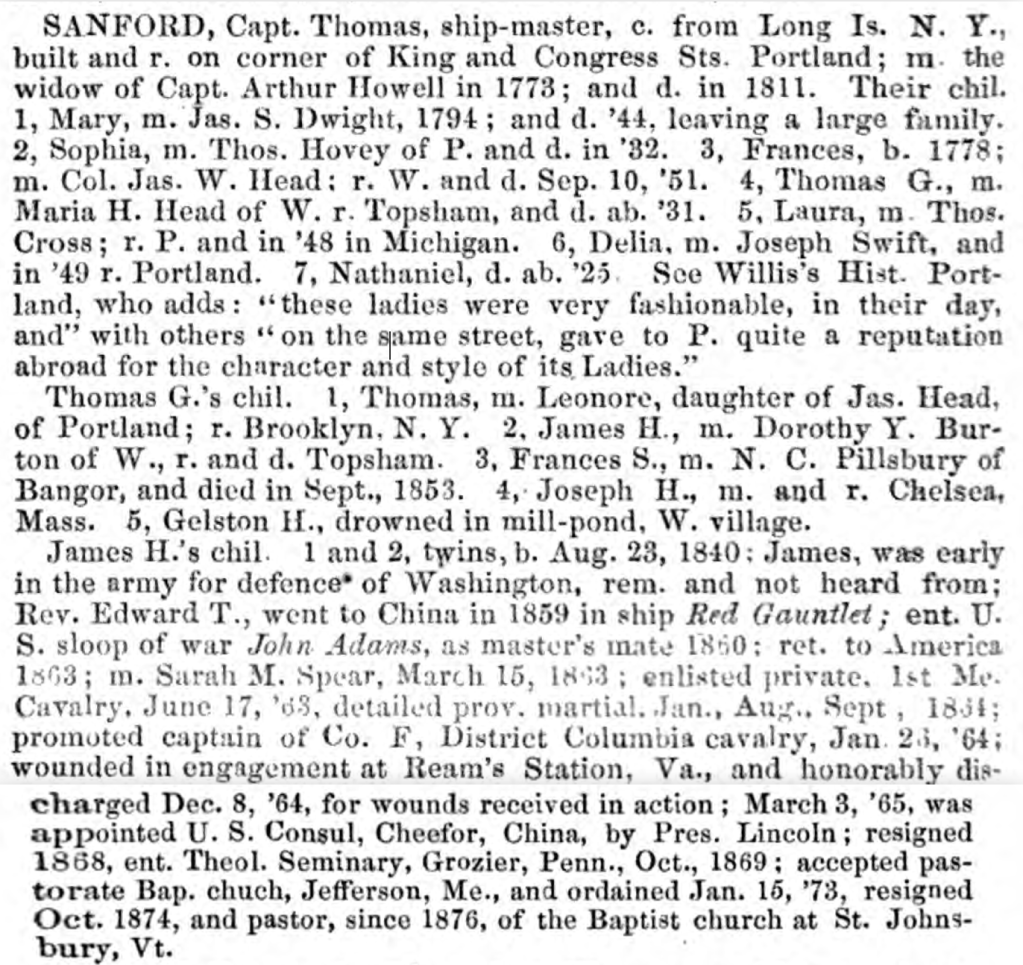
Details of the ancestry of Edward Thomas Sandford as documented in The Annals of Warren, Maine. In addition to the standard misspelling of Sandford, Cheefor should be Cheefoo, and Grozier should be Crozier.
Eaton confirms our Sandford (with the customary misspelling) ancestry as we previously understood it back through Topsham and Portland. He also affirms that the Sandfords came from Long Island, although he sheds no new light on the mystery of Captain Thomas Sandford’s father from Long Island.
I searched in the Willis book, which I already knew from my research, for the odd line about the fashionable women in Captain Thomas Sandford’s family contributing to Portland’s international reputation. I could not find it, so perhaps there is another Willis edition or Eaton confused it with another reference.
Eaton provides new detail on Edward Sandford’s maritime adventures prior to the Civil war. Edward’s first sea voyage began in 1859 when he was 18 years old. His uncle’s ship was named the Red Gauntlet. To return to America he sighed-on with the U.S.S. John Adams as a Master’s Mate in 1860, joining the ship in Siam, returning to America in early 1862. Edward then had about a year to get his affairs in order, marry Sarah Spear, and enlist in the army.
Both ships have interesting stories. The Red Gauntlet was built in Richmond, Maine and commissioned in 1853. There have been several ships by that name, which came from an 1824 novel by Sir Walter Scott entitled Redgauntlet. The ship had been to China prior to Edward’s voyage–a manuscript written by voyage’s Ship’s Carpenter describes the tribulations of that voyage, summarized here in an online sale notice of a rare manuscripts seller.
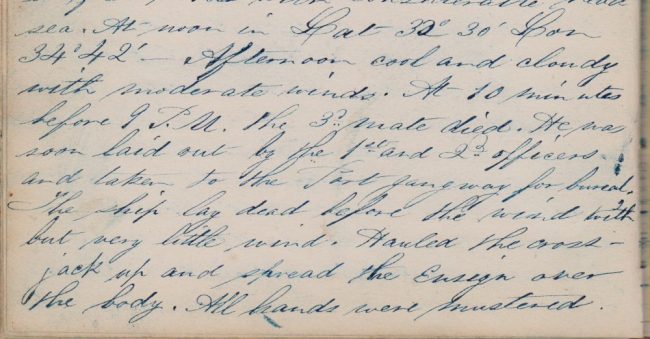
Journal of the Clipper Ship Red Gauntlet, Andrews, Master. Kept by Ship’s Carpenter William F. Harden. August 18, 1855 – December 14, 1856. New York, San Francisco, Sandwich Islands, Canton, Philippines, St. Helena.
Manuscript. Small 4to, Unpaginated. (167) pages of manuscript entries. Price: $5500
This is a remarkable journal, documenting the murder of an American seaman by a gang of Chinese in Canton. It was kept by ship’s carpenter William F. Harden of Chelsea, Mass. Journals kept by men before the mast are scarce, and tend to have a different perspective on events than journals and logs kept by officers. Such is the case with this manuscript. For example, as they were fighting their way around Cape Horn, Harden wrote, “A Ghost was seen last night twixt the hours of 11 & 12… in the shape of a man sitting on the rail.” The “Red Gauntlet” was a 1038 ton clipper ship built in Maine and launched in 1853. She was active until 1863, when she was captured and burned by the Confederate raider “Florida.” This was her second voyage. She departed New York for San Francisco, Hawaii, and Canton in August 18. In November, 1855, the ship nearly sank rounding the Horn, and had to put into Valparaiso for repairs. On their departure they discovered that a boy had stowed away in a bag of potatoes. It was a mostly happy ship, with occasional notations of “splicing the main brace” and such amusements as “A lecture on Woman’s Rights was delivered at the booby hatch… by Miss Jemima Snowflake.” Or, later in their voyage, on an evening when they were caught in a dead calm under a full moon, a boat was lowered. “Captain & Lady and two gentlemen passengers took a pull around the ship to look at her. When they returned, all hands had something to drink just for the fun of the thing.” King Neptune put in the obligatory visit when they crossed the line, and occasional sing-alongs were held. They reached San Francisco at the end of February, 1856 and promptly got stuck in a mud bank off Broadway Wharf. “Went with Johnny Loring to Rowe’s Cricus, which was a beautiful entertainment.” (Much detail about people and activities in San Francisco and Vallejo ensues.) They took on cargo for the Sandwich Islands and reached “Owyhee” on April 16, 1856. There they tied up at Market St. Wharf and Harden and his shipmates went on liberty in Honolulu. Predictably, 5 men deserted. A bounty of $25 was placed on each. Another man swam ashore. The 2nd and 3rd mates “assaulted” one of the crewmen and were discharged from the ship. (It is unlikely that an official account would have been as straightforward.) Similarly, at Canton, where they took on a cargo of tea and silk, Harden gave detailed and factual reports documenting the tensions that existed between foreign traders and the Chinese. On June 12 “a boat came alongside with 4 Chinamen to sell liquor.” They were put in irons and the liquor was confiscated. On June 14 the Chinese longshormen went on strike because of “hard usage.” On August 2 another “Chinaman” was severely beaten and thrown overboard. Four days after that the 3rd mate was set upon by a gang of 200 Chinese and severely beaten, barely escaping with his life. Two months later, at sea, the mate, George F. Wellman died. This potential international scandal was never reported or acted upon, but by this time American naval forces and marines had come into Canton to protect American interests. Harden’s journal goes on in this vein, reporting in considerable detail events on board and adventures ashore in the various ports at which the “Red Gauntlet” put in. In Canton a schooner was launched from “Mr. Cooper’s yard.” A ship’s boy named Bill was found guilty of stealing, given a dozen lashes, and sent off the ship to fend for himself. The Captain’s youngest son got sick and died. The old cook served rotten food. He was forced to eat it, was given 12 lashes, and subsequently was beaten by the Captain for minor offenses. He died a month later, and his possessions were sold at auction to the crew. In November 1856, after leaving St. Helena on the final leg of their circumnavigation, two ship’s boys, Mike and Harry, were made to have a “Prize Fight” for the amusement of the crew. The bout was called a draw after 35 minutes. Harden’s journal ends on December 14, in the mid-Atlantic, as the “Red Gauntlet” approached North America. The journal is bound in fabric over marbled boards. End sheets contain miscellaneous notes regarding money loaned and owed, items purchased, and the names of crewmen and several officers. The writing is clean and legible throughout.
Description of manuscript written by Ship’s Carpenter William harden, 1855 on the Red Gauntlet on its voyage to China prior to that of Edward Sandford. Manuscript sale notice by the Ten Pound Island Book Company.
It seems likely that the ship’s next voyage would have had its own set of adventures and tribulations. At the very least, Edward heard a lot of stories about the ship on his subsequent voyage to China.
Note that this manuscript answers the question about which route Edward would have taken to China–most likely around Cape Horn of South America, following the route taken by the ship on its previous voyage.
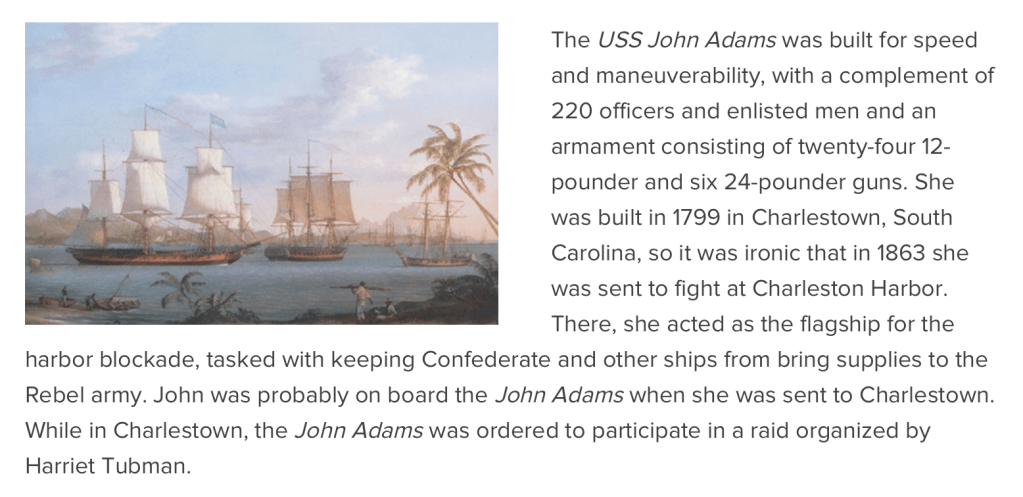
The U.S.S. John Adams, Edward’s transportation back to America, has an important history. Commissioned in 1799, it fought in numerous wars including the War of 1812 and the Mexican-American War. Historical documentation of it’s 1860-1862 voyage from Siam to New York is consistent with Edward’s story. It was later in the Civil War that Harriet Tubman led a convoy of ships led by the John Adams on the famous raid into South Carolina that freed over 750 slaves.
southamptonhistory.org
We see also from Eaton’s book that Edward originally joined the Civil War as a private but was promoted to Captain about the time he transferred to the District of Columbia Cavalry. Somewhere along the line he must have quickly convinced someone that he was worthy of the higher rank.
Regarding Sarah Spear, Edward’s first wife, Eaton devotes six pages to the Spear family. Sarah was from a five generation Warren family, originally from Scotland and Londonderry Ireland. Her ancestors fought in the Revolutionary War and the War of 1812.
Information in Eaton’s book on the later phases of Edward’s life will be incorporated into future posts.
One final note. Edward Sandford had a twin brother, James Head Sandford (named after their father; not to be confused with Edward and James’ younger half brother George who established a Sandford family branch in southern California parallel to that of Edward.) Eaton shows James in the Army, “early” ( in the war or early in his life or both) defending Washington. The two battles of Manassas (1861 and 1862), near Washington, suit this description, but I have no other evidence to support this theory. James’ early entry into the war might have been additional motivation for Edward to rush home to get involved.
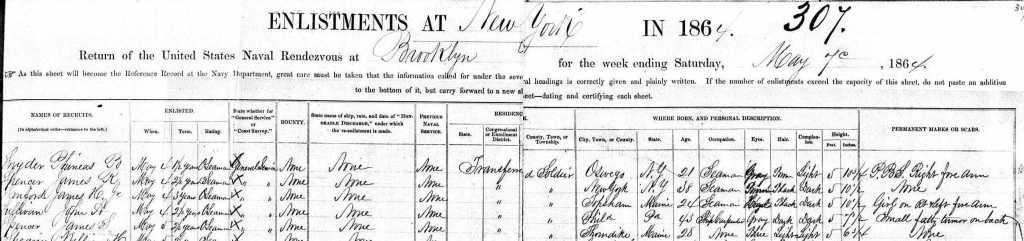
Eaton does not mention it, which suggests that perhaps the family (who would have been Eaton’s primary source) did not know about it, but there is a record of James’ enlistment in the Navy in Brooklyn in 1864.
Record of James Head Sandford (twin brother of Edward) enlistment in the Navy, May 1864
Aside from this, the modern record is in agreement with Eaton that James was not heard from after the War.
The Chaffey brothers George (1848-1932) and William (1856-1926) were engineers and entrepreneurs born in Brockville, Ontario, Canada. They followed their father to California in the late 1870s and in 1881 bought the land and water rights for the region that would become the cities of Ontario and Upland. They built the irrigation system that transformed the desert into fertile land, built city infrastructure including schools and Euclid Avenue, subdivided the land and attracted investors and residents.
Ontario, California historical marker commemorating city founder George Chaffey
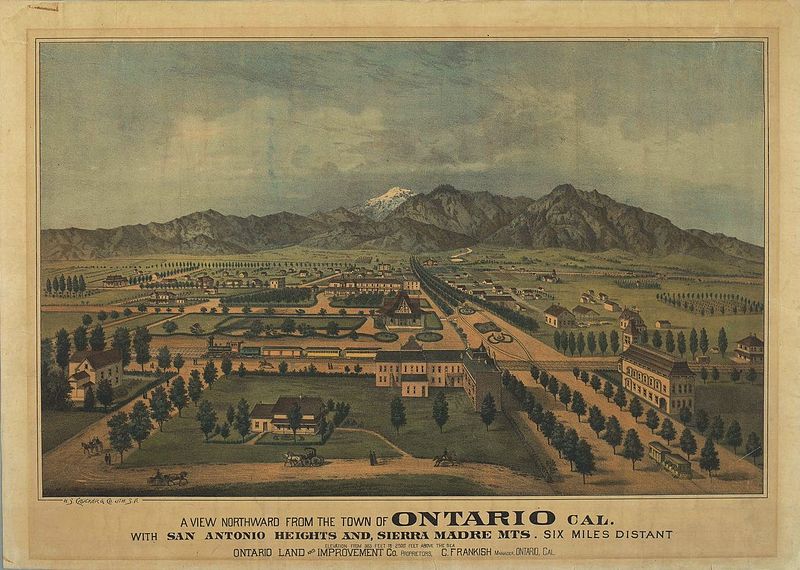
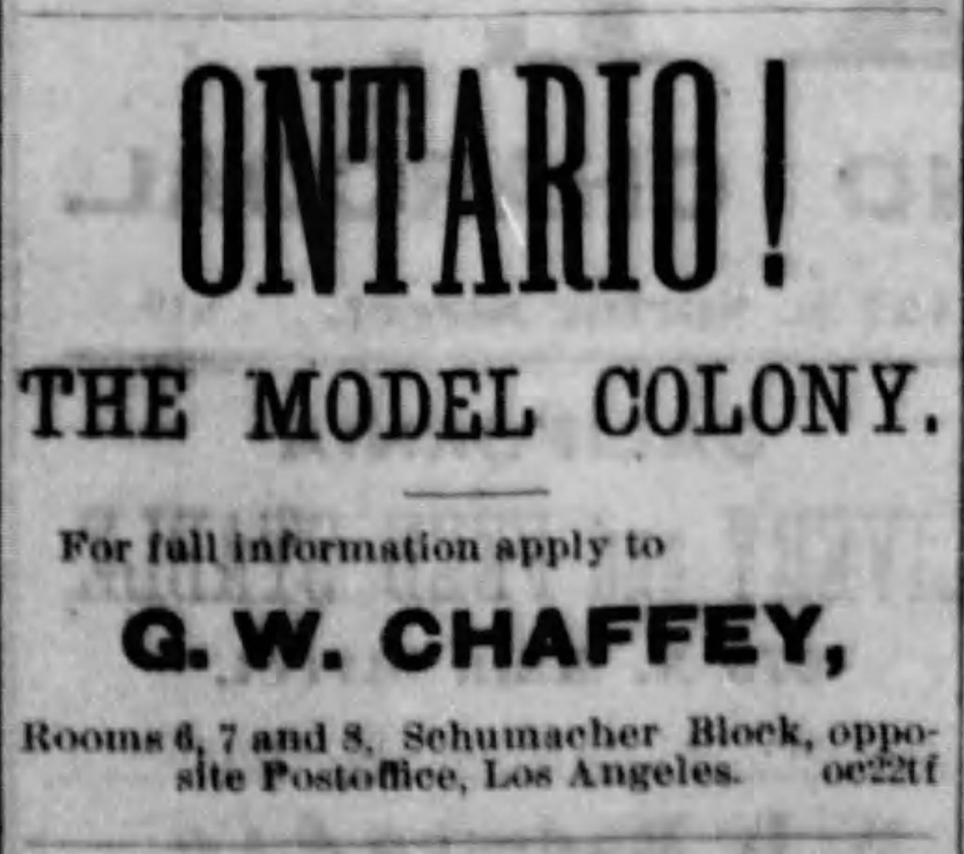
They termed their new settlement “The Model Colony”, expressing their vision for a town with an ideal balance between agricultural interests and city comforts. They chose the name Ontario in honor of their homeland.
Ontario, California circa 1890. Euclid Avenue ascends from lower right to horizon, with Mount Baldy in the background. Note the ornate gardens and train station, designed to entice Los Angeles-bound travelers to remain.
October 22, 1884 promotion of the Model Colony, in the Los Angeles Herald
By 1886, the brothers had moved on to Australia where they built similar irrigation projects. Their efforts there ran into some legal and financial troubles requiring intervention of the government. William stayed to oversee the project’s eventual success, but by 1897 George had returned to California, where he would remain. With his son Andrew Chaffey (born 1874), George founded the American Savings Bank. Our grandfather Joe, although 18 years younger, knew Andrew well and his name comes up in many of Joe’s stories.
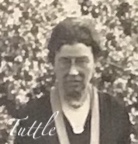
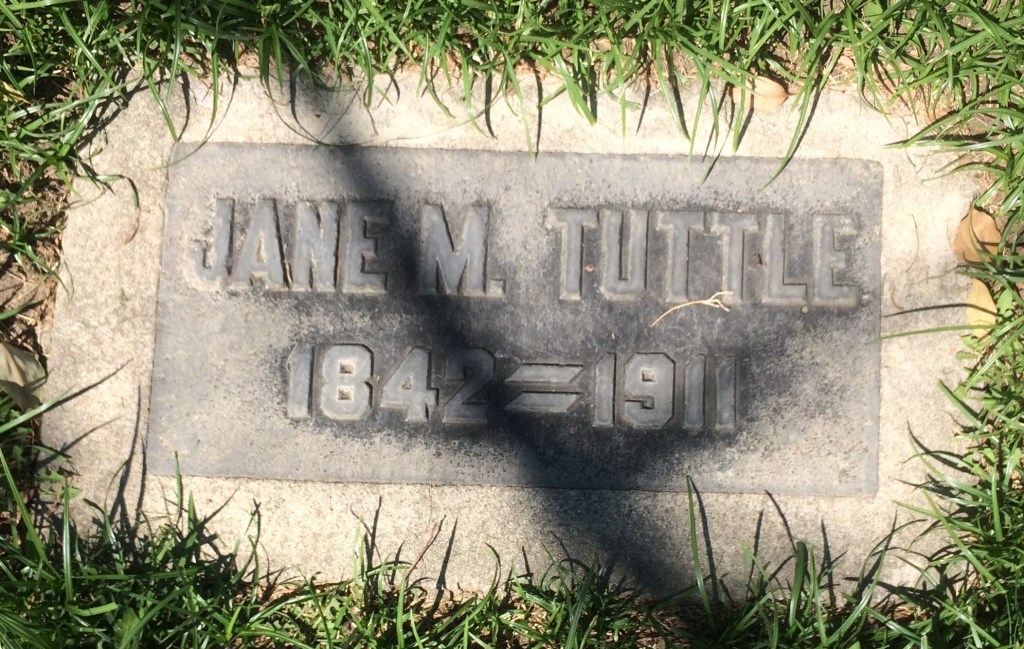
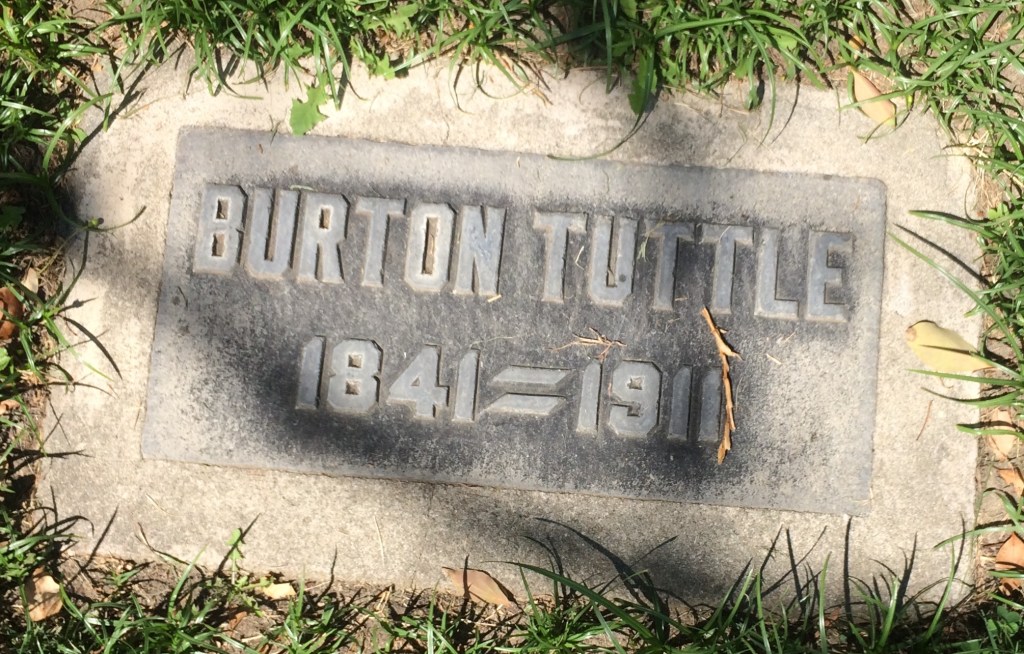
Second great grandfather Burton Tuttle (1842-1911) was born in New York state, his farmer parents having left New Haven after multiple generations living there. Burton moved on to Illinois where he met second great grandmother Jane Thompson (1843-1911). They were married in Illinois in 1862 and their only child, our great grandmother Mabel Tuttle, was born there in 1866. By 1870 the United States Census shows the family of three living in Mankato, probably drawn there by the same migratory forces and rivers that brought the Swan family there a few years earlier from Ohio. The 1870 Census lists Burton as a hardware retailer.
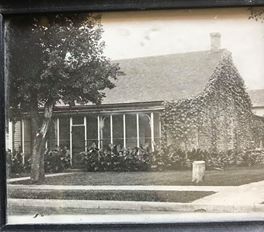
Burton Tuttle home in Mankato, Minn
Burton and Jane Tuttle came to Ontario from Mankato Minnesota sometime between 1892, when they still appear in the Mankato directory, and 1894, when they appear in the San Bernardino voter listings as Ontario residents.
Interestingly, grandma Margaret was born in 1895 in Mankato. a year or two after her grandparents had already moved to Ontario. So when, as the story goes, Henry Swan and Mabel Tuttle decided to move to California for the health of their young daughter, they simply followed Mabel’s parents there.
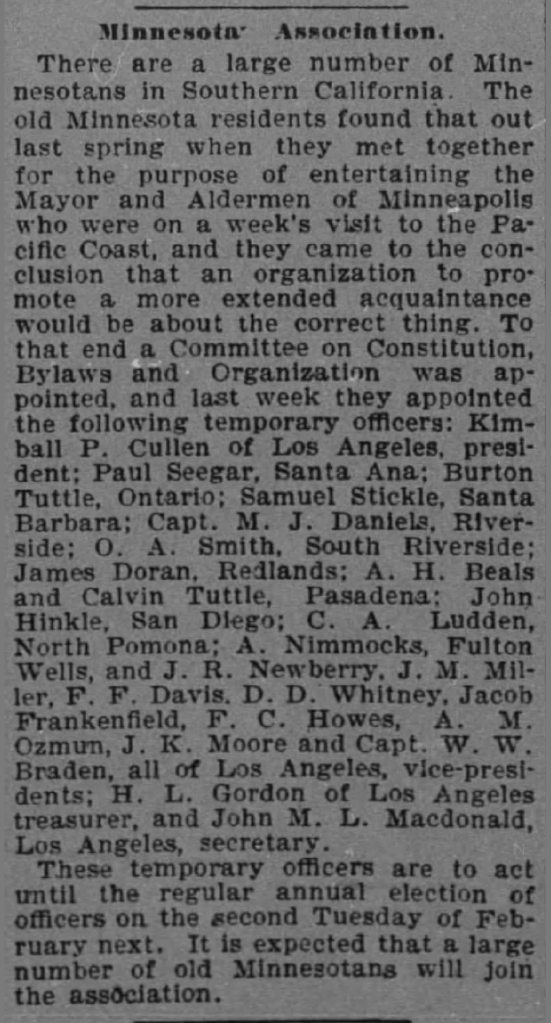
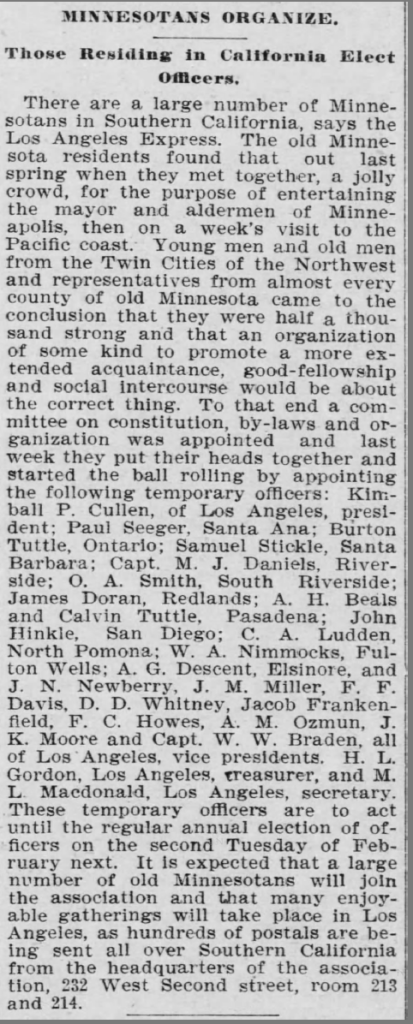
There was a steady migratory flow from Minnesota to California during these years. They kept in communication with each other and with family and friends who stayed behind. An 1896 Los Angeles Times article, reprinted a week later in Saint Paul, gives a list of prominent Minnesotans who had settled in Southern California.
Minnesotans in California–Nov 15, 1896 Los Angeles Times. The identity of Calvin Tuttle is a mystery for the future.
A version of the same article appeared in the Nov 22, 1896 Saint Paul Globe a week later.
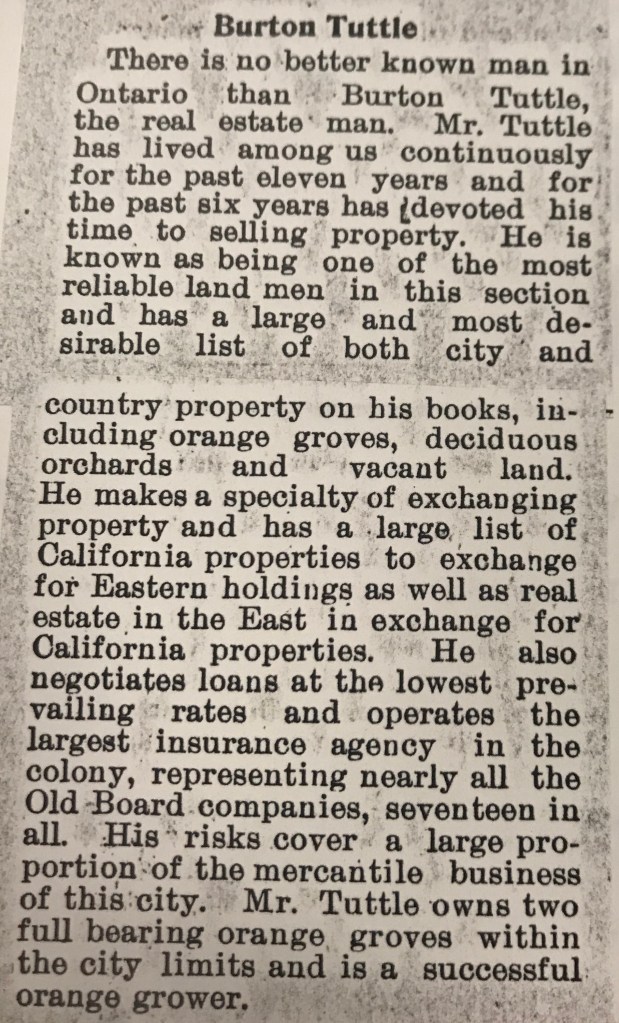
Burton and Jane Tuttle thrived in Ontario. Burton became an orange grower but also established a thriving real estate business, both occupations at the epicenter of life in the Model Colony.
This living tribute to Burton must have been published around 1905, although the date and source are unknown.
Found in file in Model Colony History Room–date and source unknown
When George Chaffey returned to Ontario from Australia, the two became friends and business associates (Burton six years older than George.)
By the time daughter Maybe Tuttle Swan and son-in-law Henry Swan settled in Ontario for the second and last time in 1902, the Tuttle family were already leading citizens of Ontario, and Henry, a successful banker in his own right, fit right in.
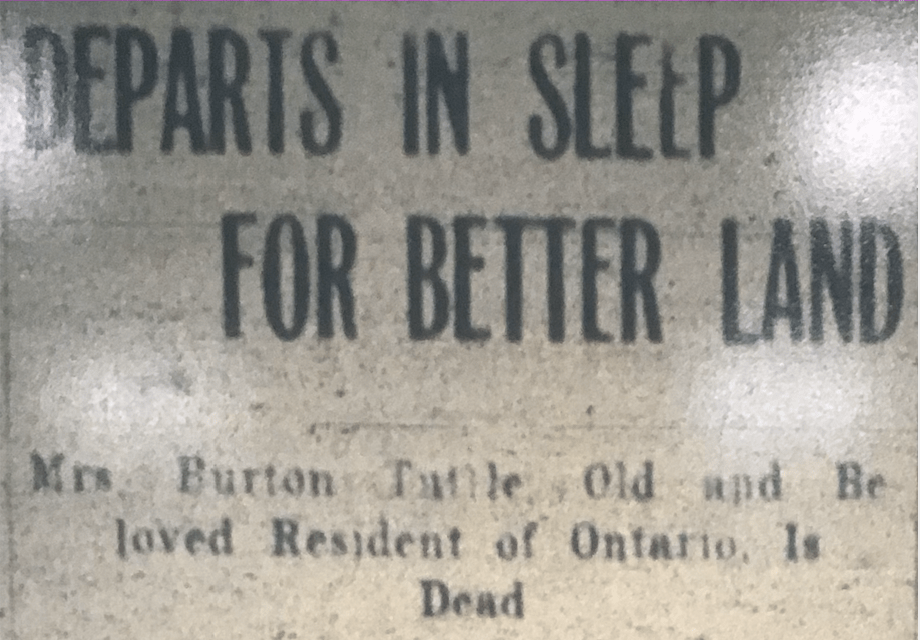
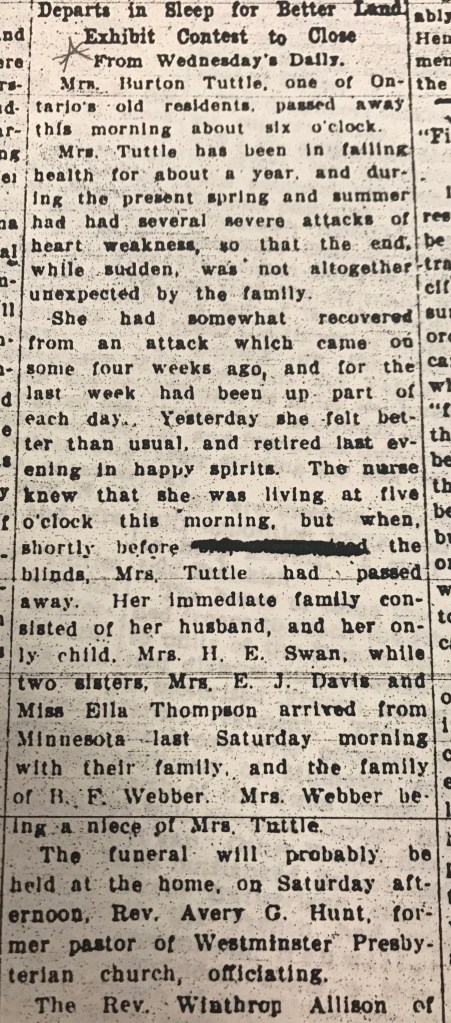
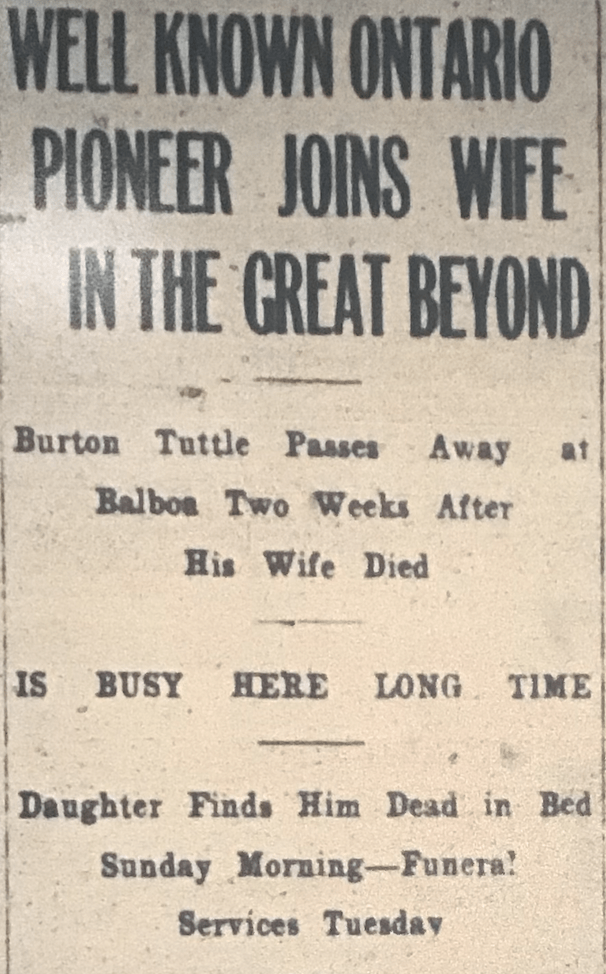
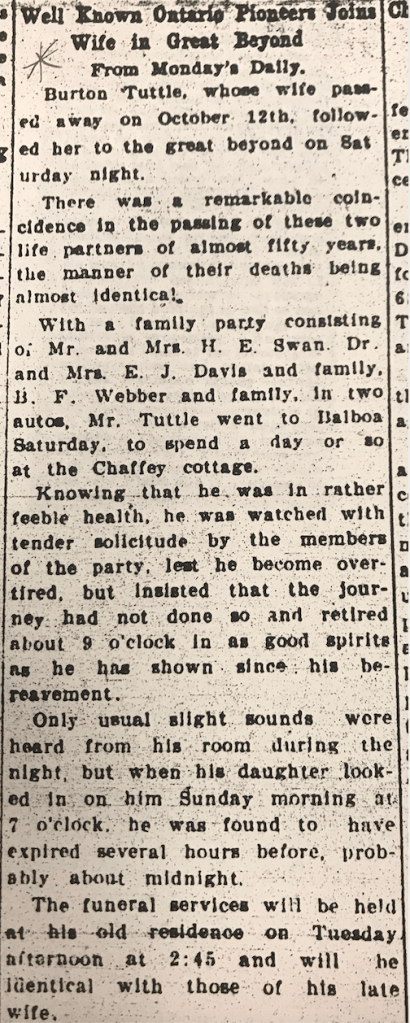
Burton and Jane Tuttle died in October 1911, two weeks apart. Burton died at the Chaffey Cottage in Balboa on the coast south of Los Angeles.
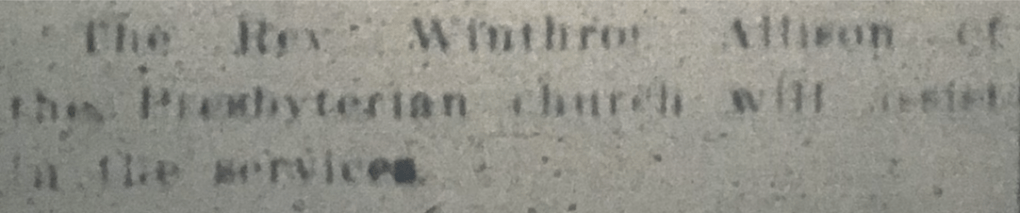
October 12, 1911 obituary of Jane Tuttle
The deal of Burton Tuttle occurred 16 days later at the Chaffey Cottage in Balboa, as reported in the October 30, 1911 Ontario Daily Report.
Jane and Burton are buried in the family plot at Bellvue Cemetery in Ontario.
Great grandfather Edward Thomas Sandford was 20 years old, at sea near China, when the Civil War broke out. We continue to follow his story as told by his son, our grandfather Joe Sandford, in his 1966 talk to the First Baptist Church of Corona, CA, where Edward would later preach.
His Uncle Thomas Sandford owned a fleet of Clipper Ships that sailed the Seven Seas.The opening of the Civil War in the United States found father in Chinese waters on one of these ships serving as First Officer. He was anxious to share a part in this War and became an officer on one of our Naval ships serving for one year.
Since the 1820 Missouri compromise, which resulted in statehood for Maine and Missouri on opposite sides of the slavery debate, Maine has always been proud of its anti-slavery roots. Edward would have been raised in this environment, and this may help explain his enthusiasm for joining the war.
The specific details of Edward’s return to America are unknown. He must have struck some sort of deal in a distant port to leave his uncle’s merchant ship and return serving on a Navy ship that was heading in the right direction. China was about as far from Maine as it was possible to go in 1861–from the far Pacific the trip would have taken the better part of a year, sailing either around Africa or South America.
By early 1863 Edward was back in Maine, and on March 12 at age 22 he married Sarah Spear of Warren, Maine. Sarah was 21 years old, the daughter of a farmer, the third of four children. Warren is 40 miles northeast of Topsham. Since 1851, the railroad had connected Topsham with Warren and other cities between Portland and Augusta. It seems likely, but is not clear, that Edward knew Sarah before his long first voyage to China.
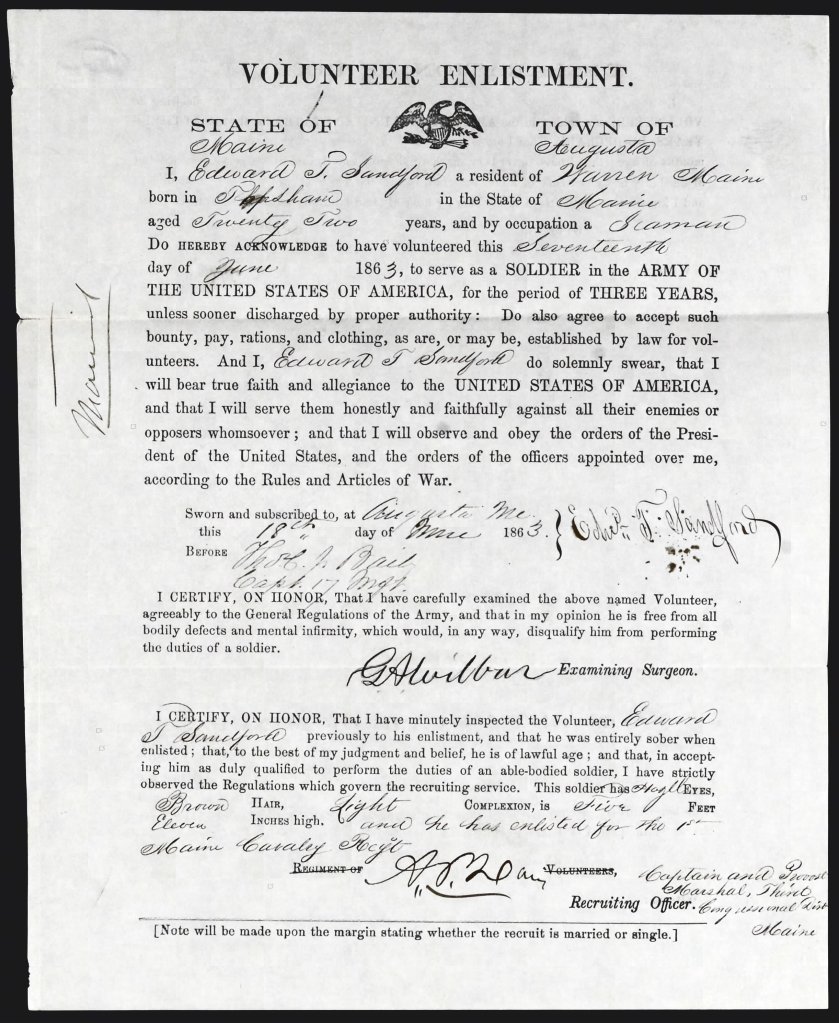
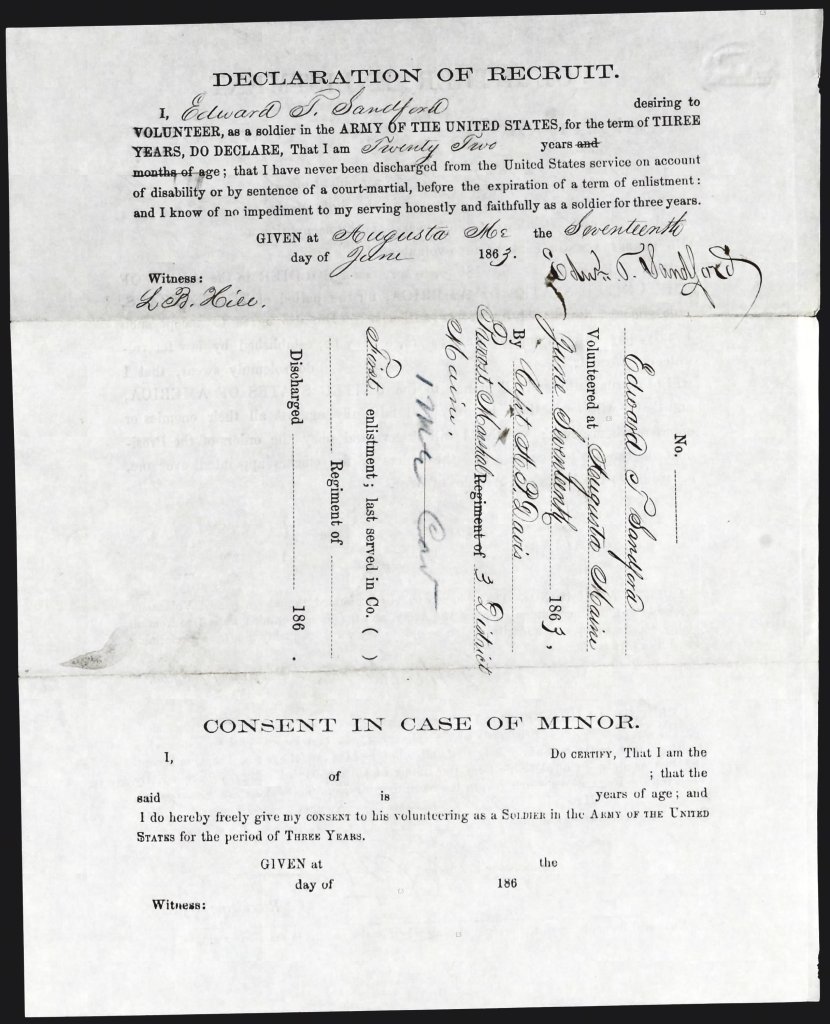
It was June 1863 before Edward was able to enlist in the Army, doing so in Augusta Maine at the age of 22. Edward’s enlistment papers list Warren as his place of residence.
Edward Thomas Sandford’s enlistment in the Army, June 17, 1863.
Most military records of the era were designed to be folded in three sections and kept in a narrow file with the center section visible to file clerks.
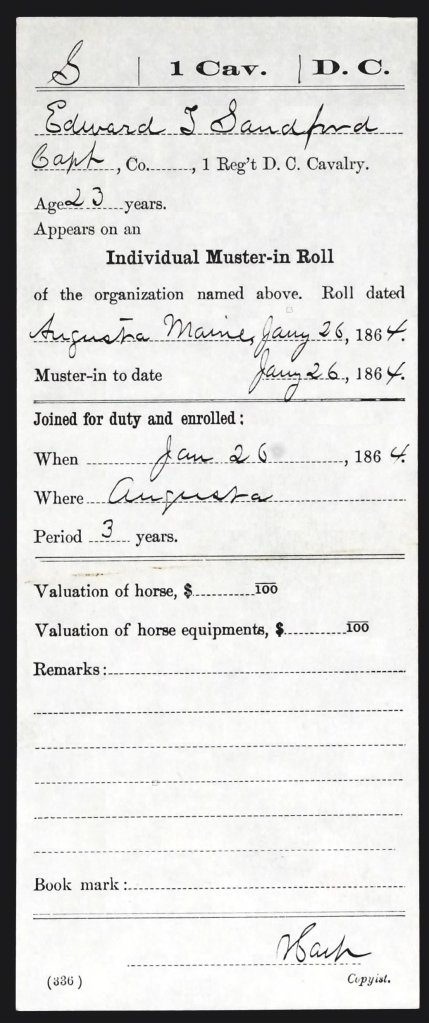
Returning to Maine he became Captain of the First Maine Cavalry. Soon his Regiment was transferred to Washington, D. C. and became the First District of Columbia Cavalry.
By January 1864, Edward, or his entire unit, had changed to the 1st Cavalry of the District of Columbia, for unknown reasons.
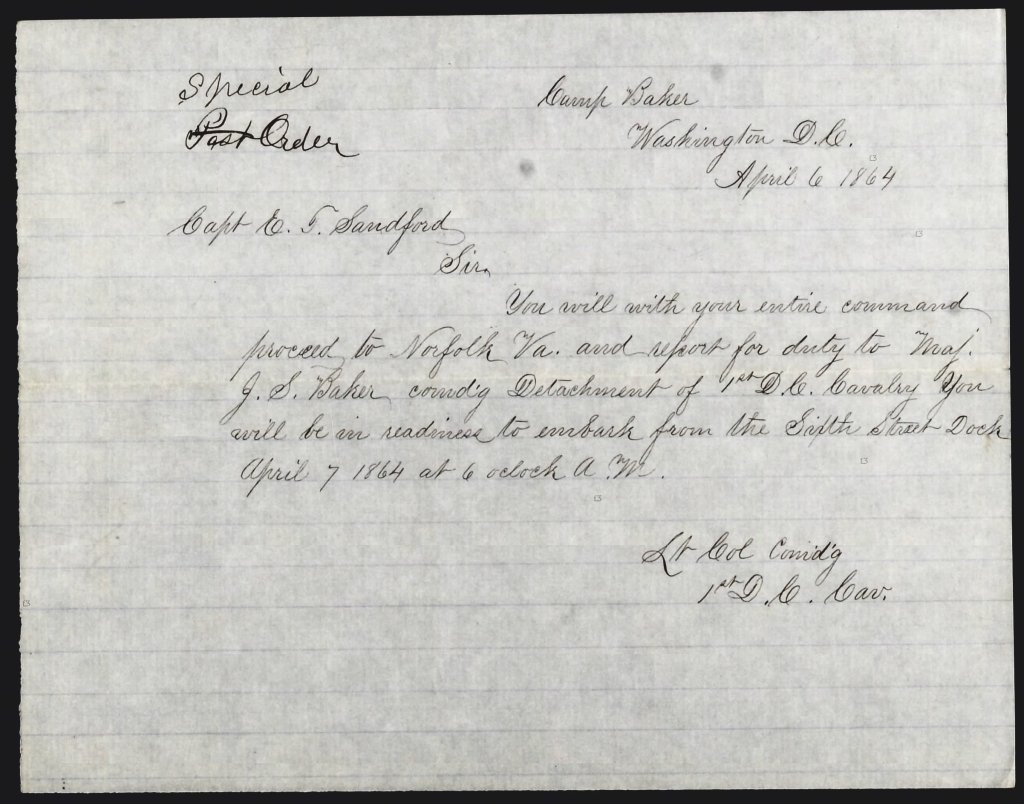
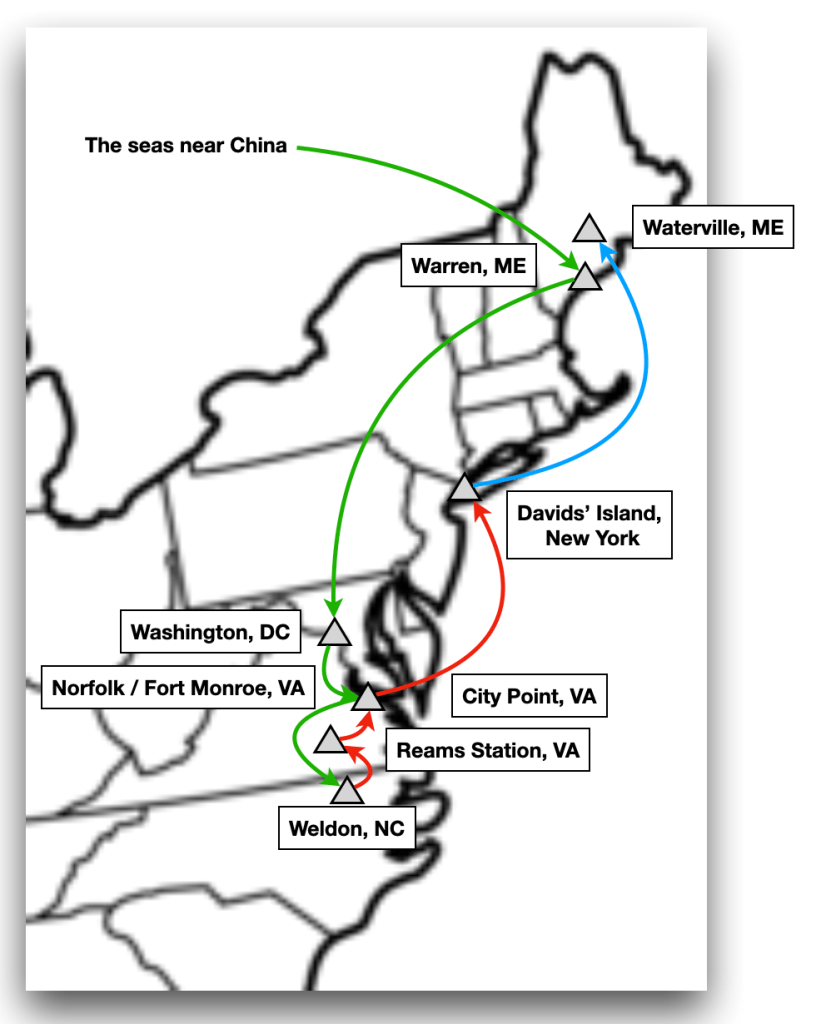
Edward and his command were ordered from Washington, DC to Norfolk, Virginia on April 6, 1864.
Edward’s orders to proceed to Norfolk Virginia, dated April 6, 1864. Camp “Baker” is probably Camp Barker in NE Washington. There are two Sixth Streets in Washington, but this note probably refers to Sixth Street SW, which today is the newly renovated Washington Waterfront.
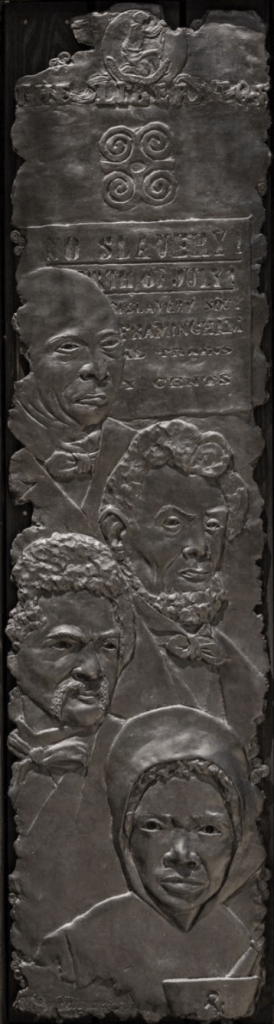
I believe the “Camp Baker” cited in the letter is really Camp Barker, located in Northeast Washington DC near what today is the trendy U Street neighborhood. The camp was originally build to house Union soldiers but later in the war was converted to house escaped and freed slaves, giving root to one of Washington’s most historic original black neighborhoods. Howard University, founded in 1867, is a few blocks away. Today, a monument to the camp stands at the entrance to the playground of nearby Garrison Elementary School.
The Camp Barker Memorial in the U Street neighborhood of Washington, DC NE
He saw much action to the South of the Capitol (sic). We have many letters that he wrote to his wife from the battle fields and they are very personal, historic and valuable.
These letters remain the biggest missing piece in the puzzle of the Civil War story of Edward Sandford. I have no idea if they still exist–even a copy of the letters would indeed be valuable and it would be wonderful to find them. They would probably shed light on the specific actions undertaken by Edward and his command upon reaching Virginia.
By May, 1864 Edward was in Fort Monroe, Virginia, near Norfolk. Norfolk is about 50 miles from Richmond, and there were several battles around Richmond in May–in New Market, Drewry’s Bluff, and the North Anna River.
His regiment was one of the first to use the repeating rifle. His men could fire sixteen times without reloading and his writings state that, ‘The Rebs could not understand how this was possible’.
His first hear (? sic) wound was through his coat sleeve and in letter informing his wife of the experience he mentions a fellow townsman that was yellow on the field of battle.
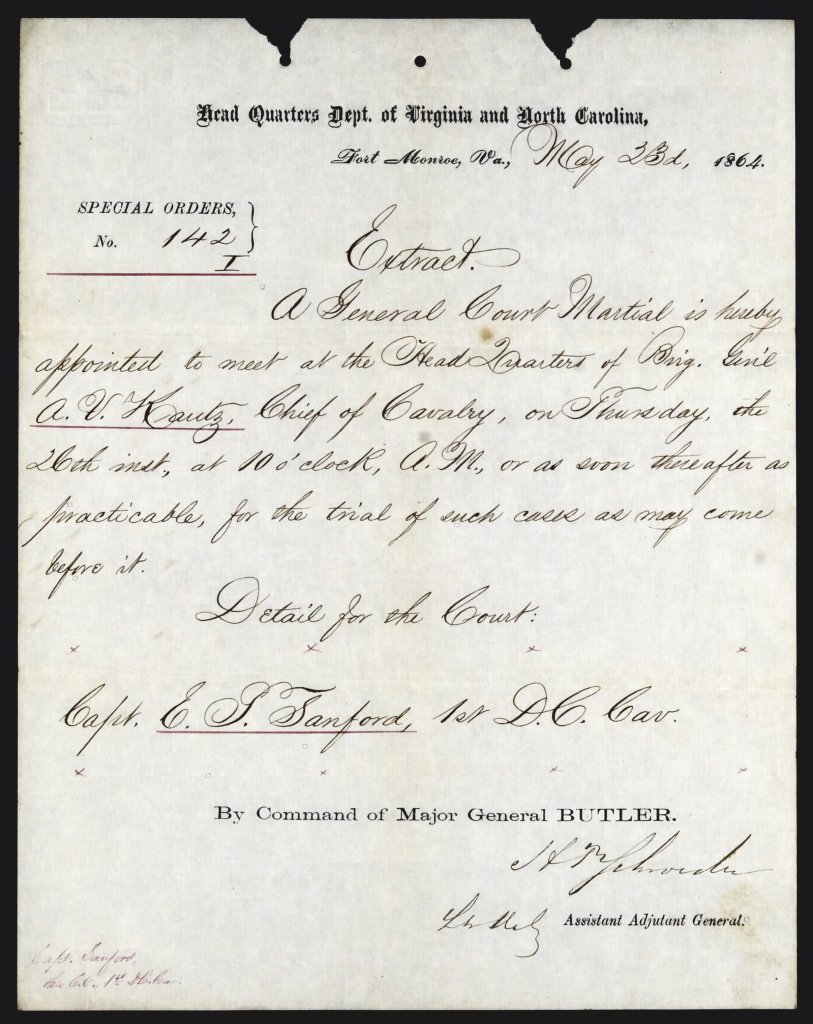
Another indication that Edward faced reckoning with fellow soldiers who struggled in the face of battle comes in this May 23 communication, ordering Edward back from his unit to serve on Court Martial duty…
During the Spring of 1864 his Regiment was active on the Wilson Raids into the South. On one of these two week Raids they were successful in getting through the Reb Lines and rode day and night as far South as Weldon, N. C. destroying telegraph lines, depots, bridges and rail equipment.
The Wilson Raids reference does not seem completely accurate from today’s point of view. It specifically refer to actions taking place a little farther south (Georgia and Alabama). It seems that the term “Wilson Raids” has been generalized a bit to encompass a number of actions pushing toward Atlanta, and that Edward’s involvement fits within this larger context. The burning of Atlanta took place in July 1864, perhaps 4-6 weeks after Edward’s role in the war came to an abrupt end.
They found ample food in the South and he wrote his wife that she must not believe the news reports that the South was short of such.
Returning to their base camp in the North he was shot through the groin and felled from his mount. This at Reams Station, Va.
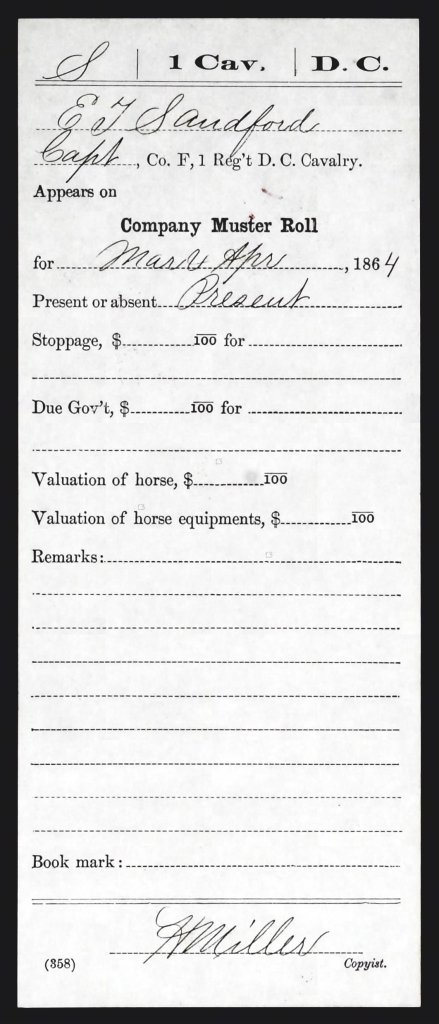
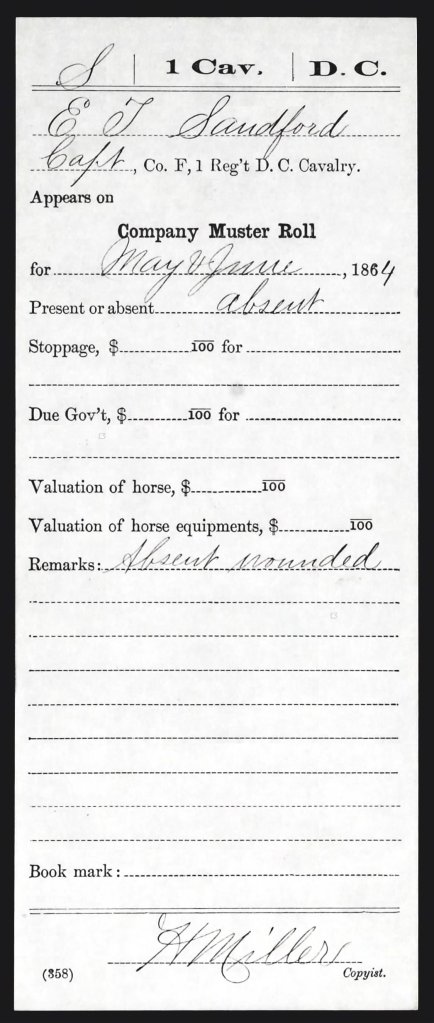
Edward’s serious wound must have taken place around mid June. The routine muster records narrow this down to May and June, and the timing of his service on the court martial would eliminate most of the month of May.
Routine bi-monthly muster records showing on-duty status March and April 1864…
…followed by notation of absent/wounded status for May and June 2864.
Upon regaining consciousness he crawled through the field, was able to join his Regiment. An order was received that they flee leaving all sick and wounded on the field. He ordered a horse and was assisted thereon and rode ‘Ten miles through swamps, jumping fences and reached field hospital.’
In letter written by the Christian Commissioner he states that ‘Dr. Jamison has been very kind to me doing all that he can for me’.
Leaving the field hospital he was transported to City Point and then via ship to hospital in New York City.
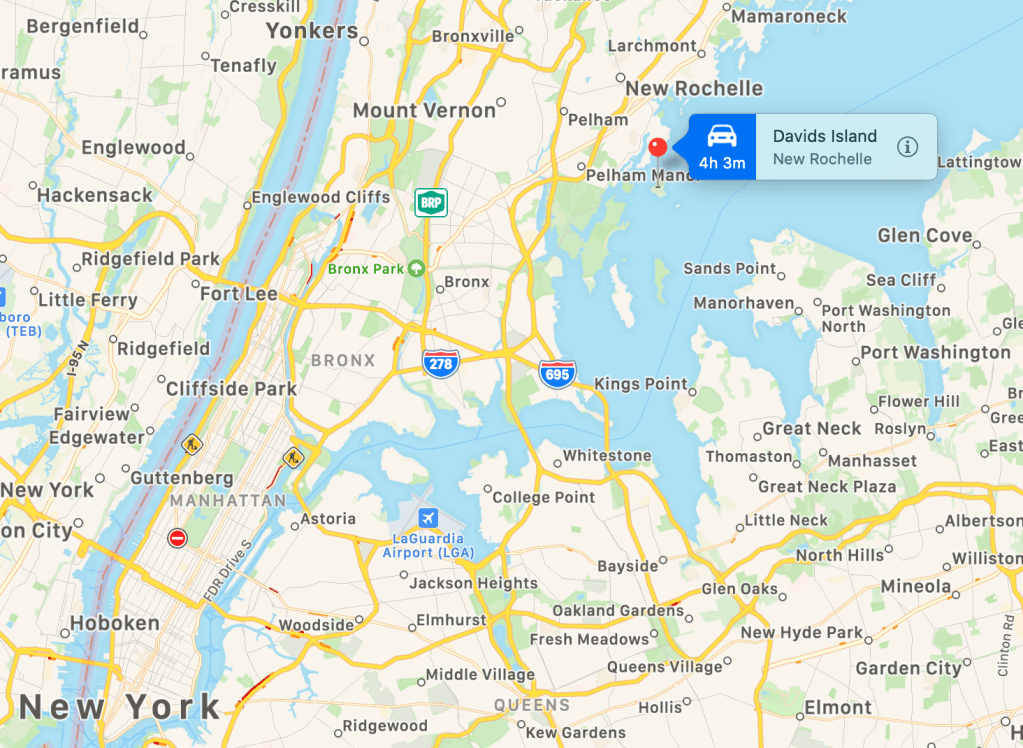
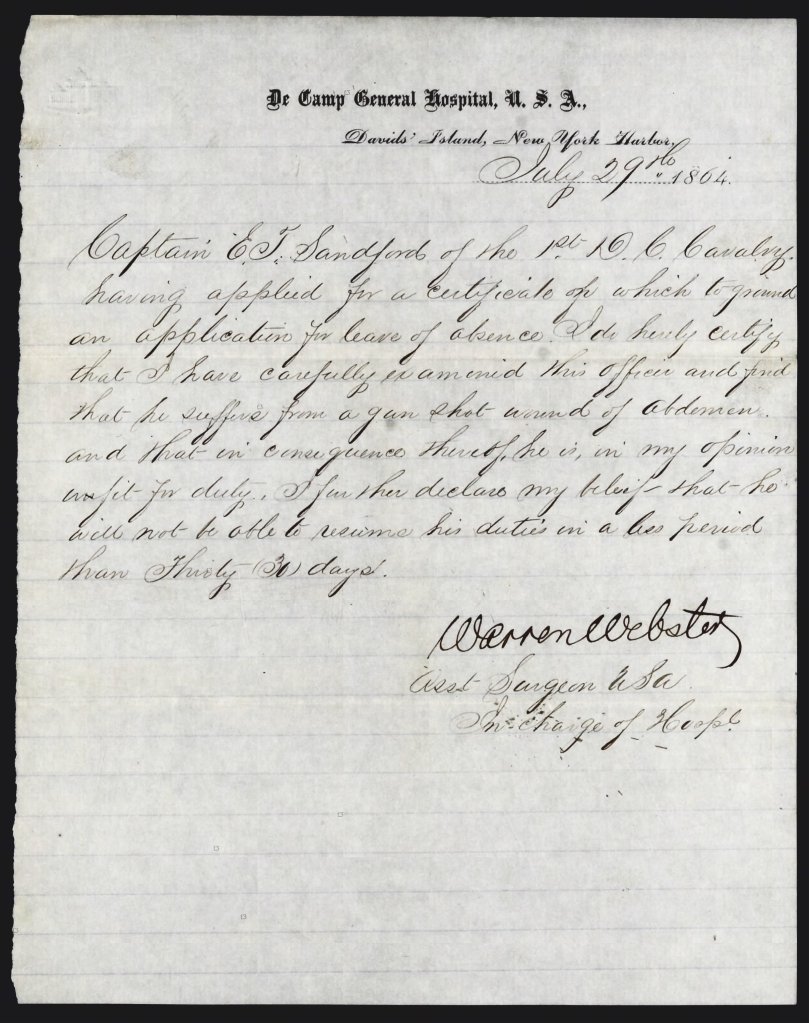
I have no documentation of Edward’s stay at the field hospital, nor his transport to New York. The trail resumes on Davids’ Island at the end of July. Davids’ Island is located at the west end of Long Island Sound, north of City Island New York, offshore from New Rochelle. During the Civil War it was the site of a hospital and POW camp. It was later a staging area for troops going to World War I. Today it is abandoned.
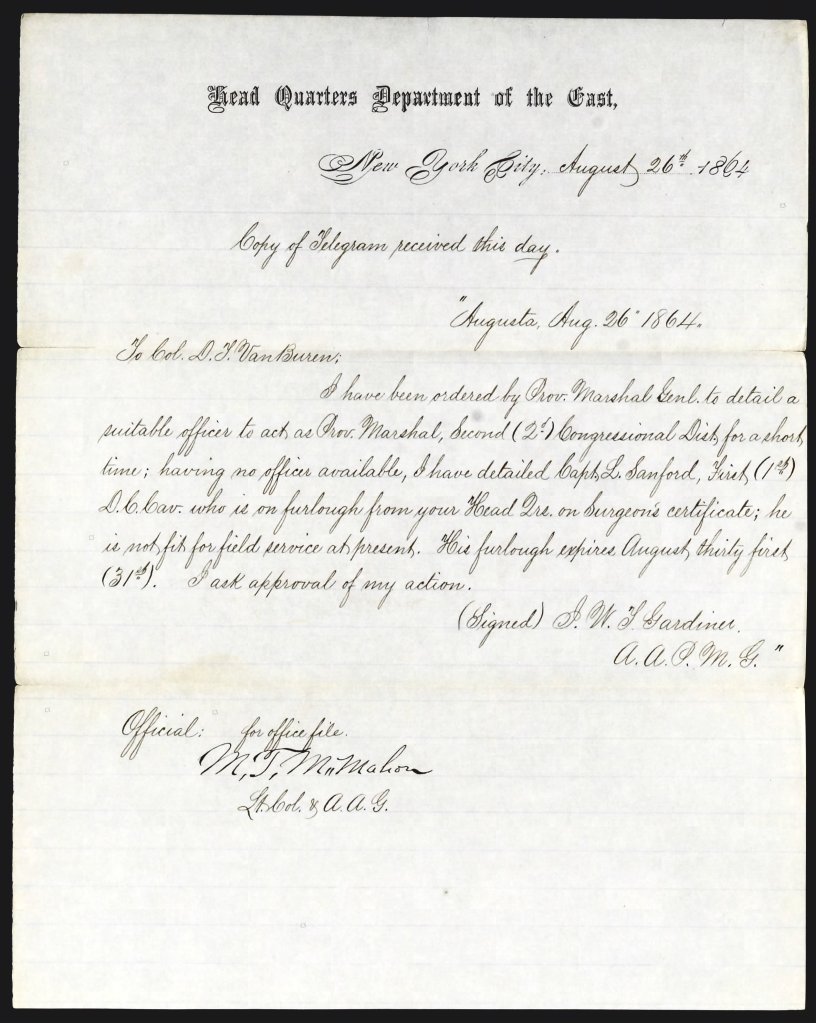
By late July, Edward was apparently out of the woods in terms of his health but beyond any possibility of returning to the war, so there was a period of bureaucratic exchanges formally requesting a leave of absence which would eventually result in his return to Maine.
We should note that the type of wound Edward received in 1864 would be serious by today’s standards, even without the escape by horseback. His survival is nothing short of miraculous.
Location of David’s Island, near New Rochelle, New York
In late July,1864, Edward began the process of formally requesting leave-of-absence from the war to complete his recovery and return to Maine,By late August, 1864, Edward was in the process of being transferred to a new assignment in Waterville, Maine. His days of fighting in the war were finished.
Upon recovery and while limping he was asked by the War Department to go to Waterville, Maine as Provost Marshal to straighten out a serious problem.
He accomplished this well and when completed his associates presented him with this Gold Headed Cane on Sept. 28 1864.
Joe Sandford, from his 1966 talk delivered to the First Baptist Church, Corona, CA
I believe the cane was left to Joe’s oldest grandson, Steve.
Edward was 24 years old when he returned to Maine. His son, our grandfather Joe, would not be born for another 28 years. There is much more to come in the story of Edward Sandford, including his return to China. His story will be continued in a future post.
The movements of Edward Thomas Sandford in the Civil War.
At least two members of the Sechler family served in the Revolutionary War: our first cousin (5x removed) Michael Sechler and our fifth great uncle John Sechler.
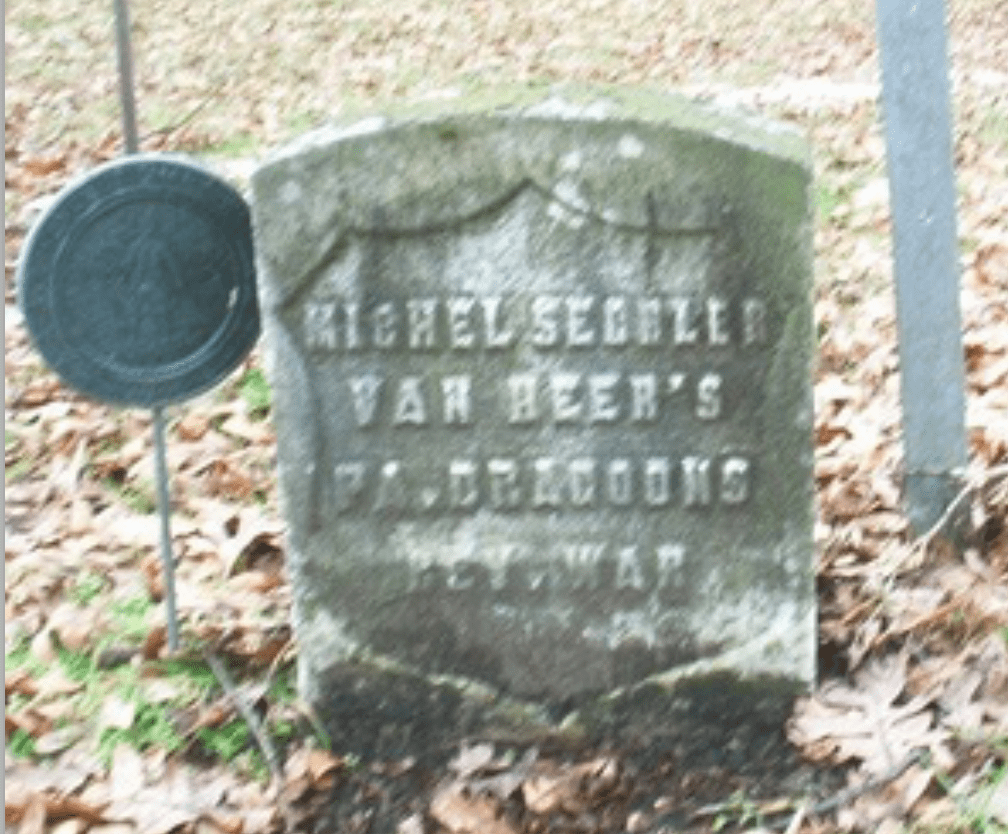
Michael Sechler (1762-1847) was the son of our fifth great uncle Abraham Sechler, whose role in the attack of 1757 was described in a previous post. A marker at Michael’s grave in Montgomery, Pennsylvania (central Pennsylvania between Danville and Williamsport; note that this is different from Montgomery County in southeastern Pennsylvania where the Sechler family lived earlier) commemorates his role as a member of Major Van Heer’s Pennsylvania Dragoons, whose duties included protection of General George Washington.
Article in the Williamsport Sun-Gazette, circa 1970, commemorating the Revolutionary War service of Michael Sechler.
A description of the Dragoons’ role follows:
The Dragoons served on horseback as George Washington’s bodyguards and were split into two units. The elite guard served Washington in close proximity to keep him from personal harm. The rear guard served as Washington’s eyes and ears and as messengers.
Sechler served in the rear guard for fourteen months near the end of the war and stayed with the unit afterwards and was serving when Washington was inaugurated as President, long after most of the other Dragoons’ service had ended.
Jade Heasley, The Luminary, 2018, describing research of Larry Stout
After the war Michael moved to central Pennsylvania where he lived the rest of his life. He was a farmer, a potter, and a Justice of the Peace.
Gravestone of Michael Sechler, Clinton Baptist Cemetery, Montgomery PA
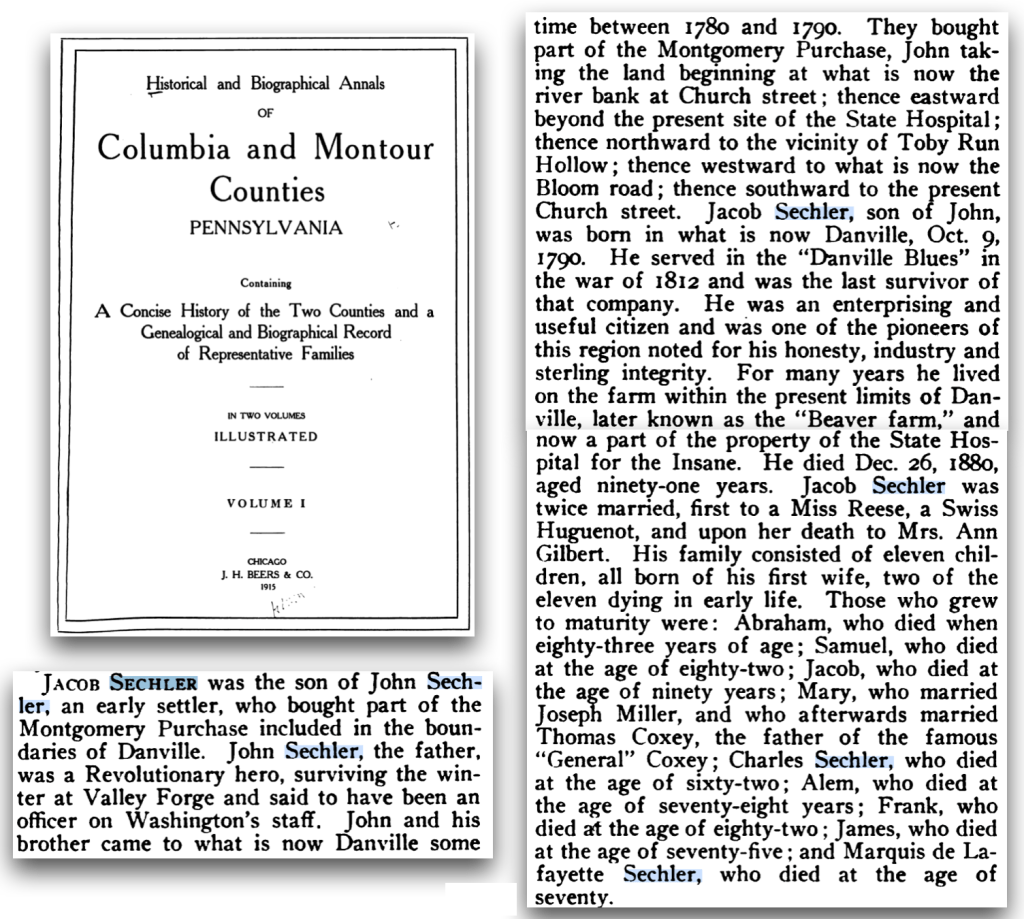
John Sechler (1739-1831) was Abraham Sechler’s (ten years younger) brother, Michael Sechler’s uncle. Several biographical sources credit John with being an officer on George Washington’s staff, such as the following, mainly about John’s son Jacob (not to be confused with John’s brother Jacob).
This 1915 biographical summary of Jacob Sechler includes information about his father (our 5th great uncle) John Sechler. Note the reference to Valley Forge and Georg Washington’s staff at the bottom of the first column.
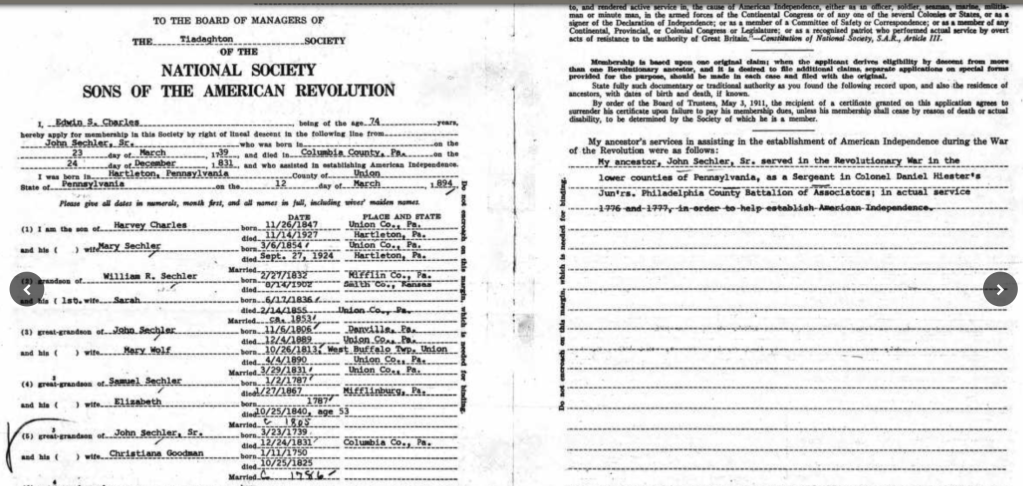
This may be a little overstated–John Sechler is a popular reference in DAR membership applications, which generally identify him as Sargent John Sechler, and don’t make any specific mention of direct service to George Washington.
John Sechler is a popular reference for DAR membership applications, such as this one for Edwin S. Charles (born in 1820 and who must have been a distant cousin of ours. Information on John Sechler’s life and military service is at the bottom of both pages, with no mention of direct service to George Washington.
After the war, John eventually joined his brothers Jacob and (fourth great grandfather) Joseph in helping to establish the new town of Danville, where three more generations of Sechlers would live until our great grandfather George moved to Groton and Brooklyn at the end of the 19th century.
I want to take a minute to point out some features of the website and blog. I am aware that in telling eight stories at the same time, each spanning centuries and containing multiple plot lines, it’s a lot to keep track of. These features may help.
If you are reading the blog through an email subscription, don’t forget that everything is available on the website sandfordhistory.news.blog, including reference features that don’t go out over email. These features are accessible by the buttons midway down the home page, and include:
The Ancestors page which has pictures and biographical summaries. By clicking on the great grandparents’ names on this page, you can access the summary genealogical ancestry listings for this family branch.
The Migrations Map which shows our ancestors’ historical movements across North America.
The By Branch page, which divides the blog entries into separate categories for each of the great grandparents. When it gets difficult to follow eight stories at the same time, you can use this to focus on a single branch.
The 36 posts published so far barely cover a third of the known material, so we’re in this for the long haul. Please encourage others who might be interested to look at the website and subscribe.
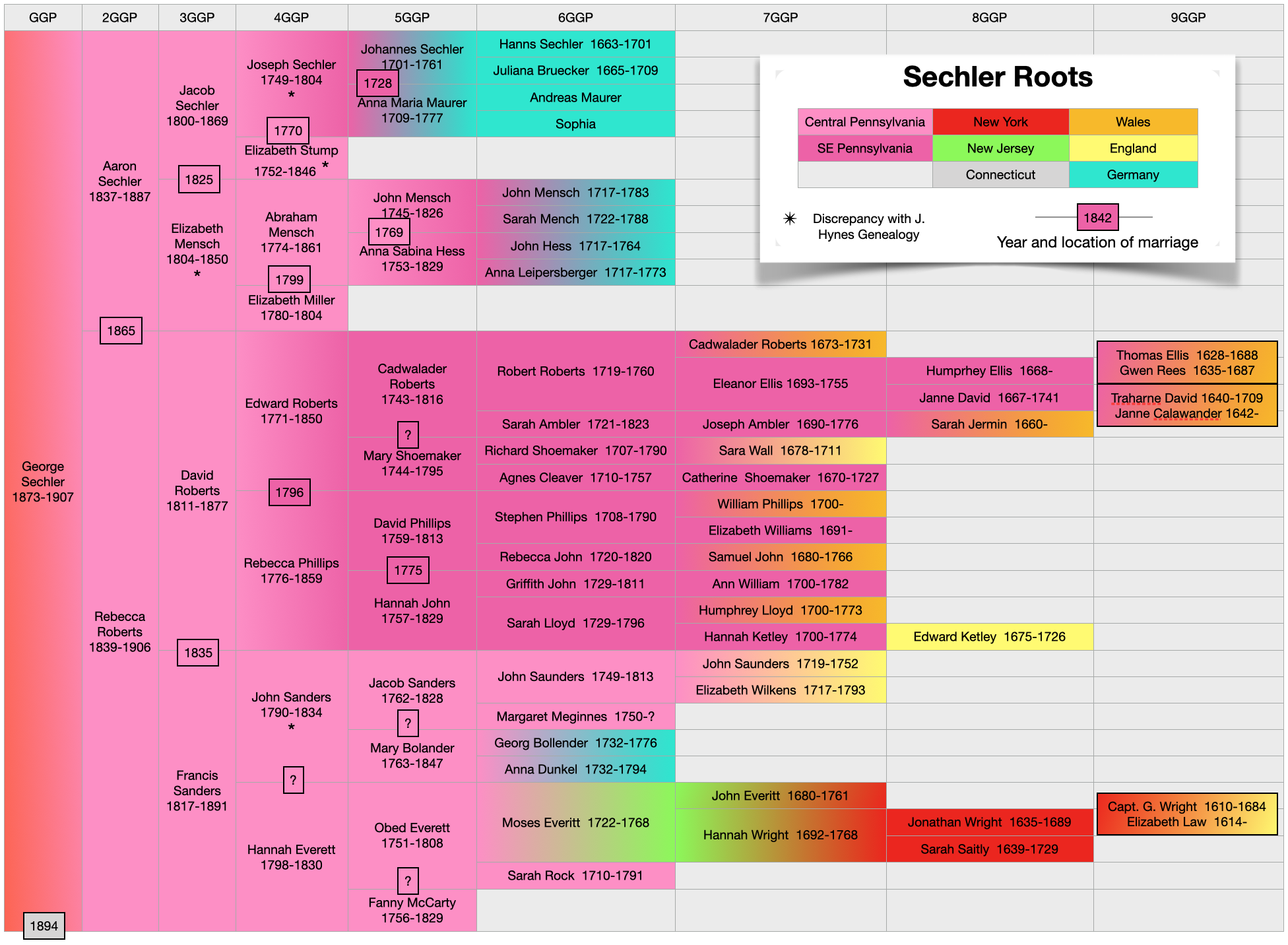
Great grandfather George Sechler had deep roots in Pennsylvania going back to the early 18th and even late 17th century. The following diagram maps George’s traceable ancestors back to their points of immigration to America.
Map of George Sechler’s ancestry in America. His father’s family came mostly from Germany. His mother’s side is mostly from Wales.
From this view, we can see that most of the ancestors of George Sechler’s father, Aaron Sechler, came from Germany. Most of the ancestors of Geoge’s mother, Rebecca Roberts, came from Wales, with a few from Germany and England. One branch of Rebecca Roberts’ family, that of Rebecca Phillips, had a large, multi-generational presence in Chester Pennsylvania, south of Philadelphia.
Recalling that Philadelphia was settled around 1682, we can see from the diagram that our earliest ancestors settling in the region were perhaps the Welsh families of Thomas Ellis and Traharne Davis and that they might have been around in the earliest days of Pennsylvania. I have no specific details about their lives.
The first of our Sechler-named ancestors to immigrate to America was our 5th great grandfather Johannes Sechler (1701-1761). Born in Lomersheim, Germany (about 30 miles from the French border), his exact immigration year is not known but he married 5th great grandmother Anna Maria Maurer (1709-1777), also a recent German immigrant, in 1728 in Philadelphia.
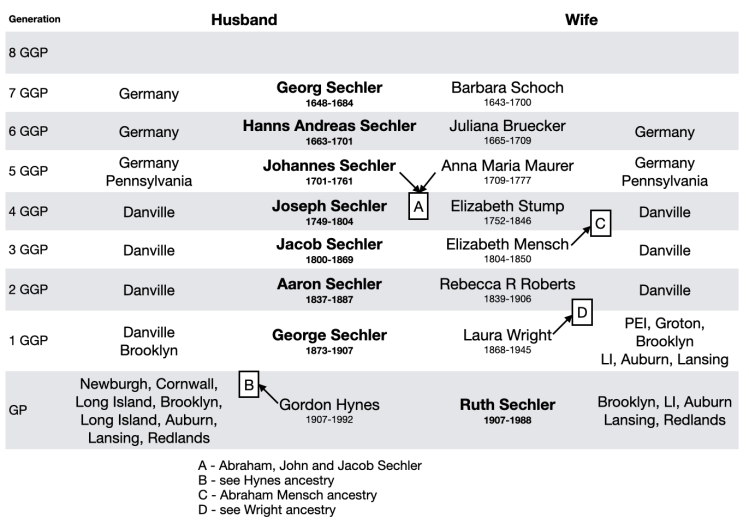
The Sechler ancestry.
Maurer was a common name in Pennsylvania at the time. There are genealogies listing dozens of Maurer families in the region north of Philadelphia, the same region where Johannes and Anna lived, although I have not been able to connect them with Anna or her parents. The branches may connect further back in Germany, suggesting the possibility that there were a lot of Maurer family branches following each other to the new world.
After marrying in 1728, Johannes and Anna remained Eastern Pennsylvania for the remainder of their lives, migrating toward what is now the Allentown region, 40-50 miles to the north of Philadelphia. Allentown was founded in 1762, just after Johannes’ death.
Johannes and Anna had nine or more children. Many lists of names can be found, not all in agreement. The following list is typical.
Abraham (1729-1783)
Samuel (?-1761)
Anna Maria (1737-?)
John (1739-1831)
Jacob (1740-1830)
Andrew (1742-1830)
Frederick (1743-1825)
Rudolph (1747-?)
Joseph (1748-1804) (our 4th great grandfather)
In this and future posts, we will focus on the lives of the four names in bold. We begin with a story that focuses on son Abraham (our 5th great uncle), but must have involved much of the family.
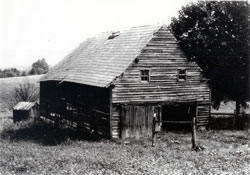
Around 1750, the Sechler family built a homestead in Lynn Township, a few miles northeast of what is today Allentown. (Today’s Appalachian Trail passes within a few miles of this location.) Johannes was 49, Anna 41, and oldest child Abraham was 21, so it seems likely that most or all of the family moved into the new homestead together.
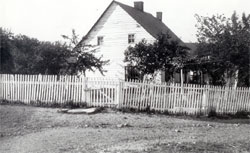
Sechler homestead, built about 1750, Lynn Township, PA. Photo likely published 1914.
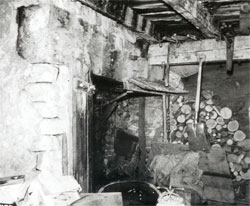
Interior of the Sechler homestead.
Former Sechler homestead as it appeared 1n 1948. It was abandoned in 1919 and demolished around 1976.
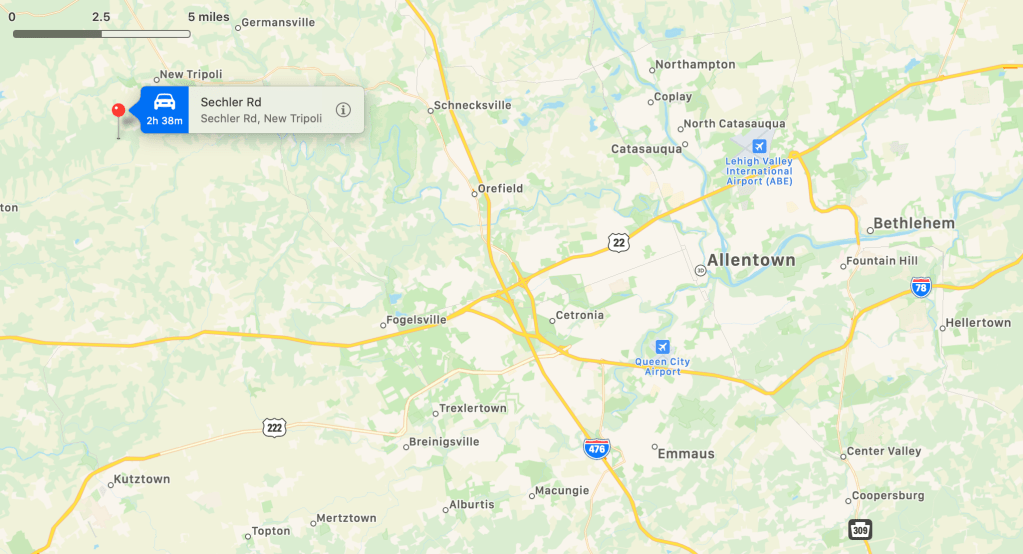
Location of Sechler homestead and 1757 incident (Sechler Road, upper left)
At the time, this was the wild American frontier. By 1757 Abraham was married with at least one child. In this year, a confrontation with local Indians left several dead, including Abraham’s wife and one of their children. The incident is documented in the following report, filed by the barely-literate Lieutenant Jacob Wetherhold to his superiors.
Honored Sir: These are to acquaint you of a murder happened this day at the house of Adam Clauce, in said Township of Lynn, were three or four neighbors was cutting said man’s corn: as they was eating their dinner, they waire fell one by a party of savages, Indians, and five of the Whits took to there heals, two men, two women, and one girl, and got saf out of their hands. Was killed and scalped, Martin Yager and his wife, and John Croushores wife and one child, and the wife of Abraham Secler was sculpt and is yet alive. But badly wounded, one sho thro the sid and the other in the thy, and two children killed belonging to said Croushere, and one to said Secler, and one belonging to Philip Antone not scullpt, and this was don at least three miles within the out side settlers, and 4 miles from John Everett’s and Philip Antone’s wife was one that took her tilit and came home and acquainted her husband, and he came and acquainted me and I went immediately to the place with seven men besides myself and saw the murder. But the Indians was gon and I derectly purs’ed them about 4 miles and cam up with them in the thick groves weaire wee met with nine Indians, and one sprung behind a tree and took site at me and I run direct at him, and another one the sid flast at me, and then both took to there heals, and I shot one as i goge thro the body, as he fell on his face. But I loaded and after another that was leding a maire, and ye meane time he got up and run away and I fired on the other, and I think I shot him in ye Buttux, and my soldiers had oppertunity to shot three times, and then they got out of oure site in the thick groves, and wee cold not find them no more, but I got from them one maire and two saddels, one bridel and halter, and one bag with a cag of stil licker in it, and cloths and one brace cittel and four Indian Cake baked in the ashes of wheat meal and to aquat you further, that I have several new soldiers that has no guns, and were little powder and led, and I have sent this express to you hoping that you wold help me with arms and ammenishan, and so I remaine yours friend and humble servent.
Lieut. Jacob Wetherhold to Major Parsons at Easton. Documented in History of Lehigh County, PA. pub. 1914. Vol. I, pp 90 and 91. on 9 July 1757 at Lynn Twp., Northampton County, Pennsylvania.
About 15 years later, three Sechler sons–John, Jacob and Joseph–moved to central Pennsylvania to help found the town of Danville. We will pick up their stories in a future post.
Johannes died in 1761, Anna lived to 1777. Abraham Sechler remained in the region. He remarried to Barbara Moll, had a large family and lived until 1783. He did not go to Danville, although some of his descendants later did.
 The Shipping News, a novel by E. Annie Proulx published in 1993, follows the life of Quoyle, a childhood immigrant from Newfoundland who falls on hard times and decides to move back to his homeland with his young children and his aunt, Agnis Hamm. On the journey, Quoyle discovers truths about his former homeland, his family, and himself. He learns of the wonders of Newfoundland as well as its dark secrets. Agnis, who has firsthand experience with some of these dark secrets, balances support of her nephew with her need to exorcize her own demons from the past.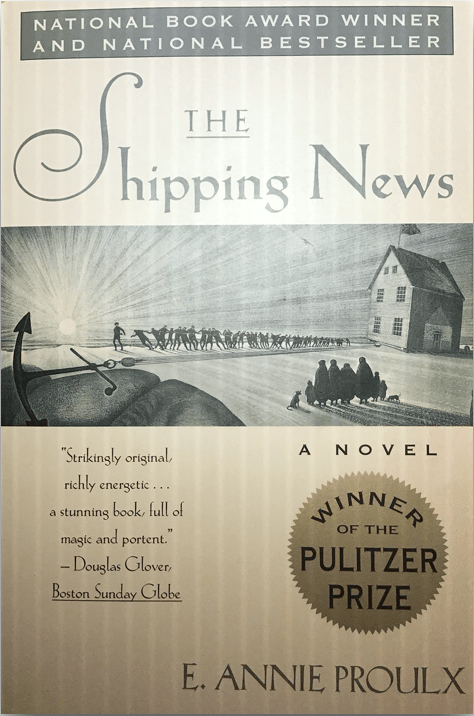
 We earlier discussed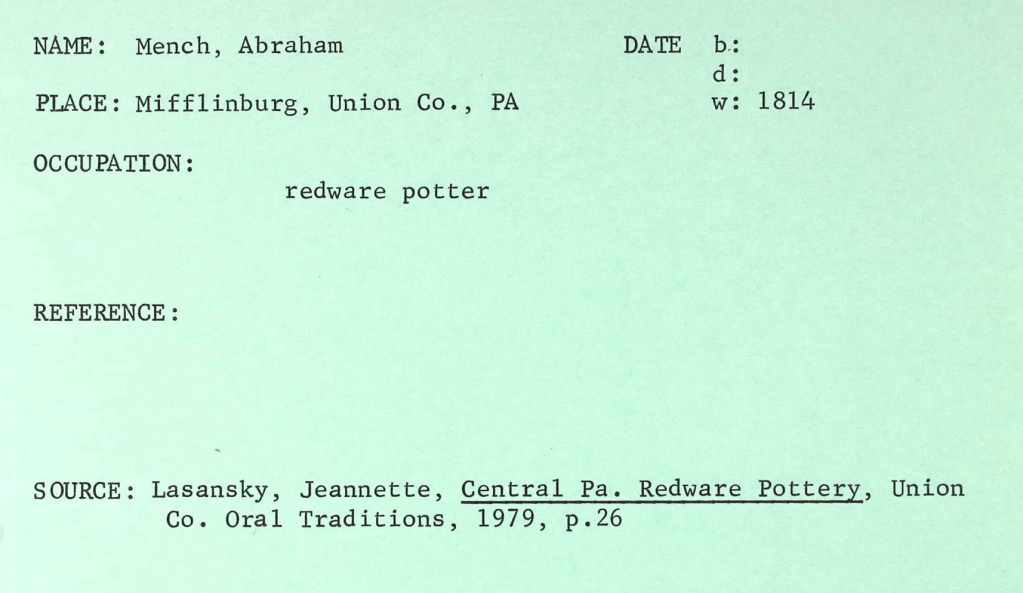
 The Chaffey brothers George (1848-1932) and William (1856-1926) were engineers and entrepreneurs born in Brockville, Ontario, Canada. They followed their father to California in the late 1870s and in 1881 bought the land and water rights for the region that would become the cities of Ontario and Upland. They built the irrigation system that transformed the desert into fertile land, built city infrastructure including schools and Euclid Avenue, subdivided the land and attracted investors and residents.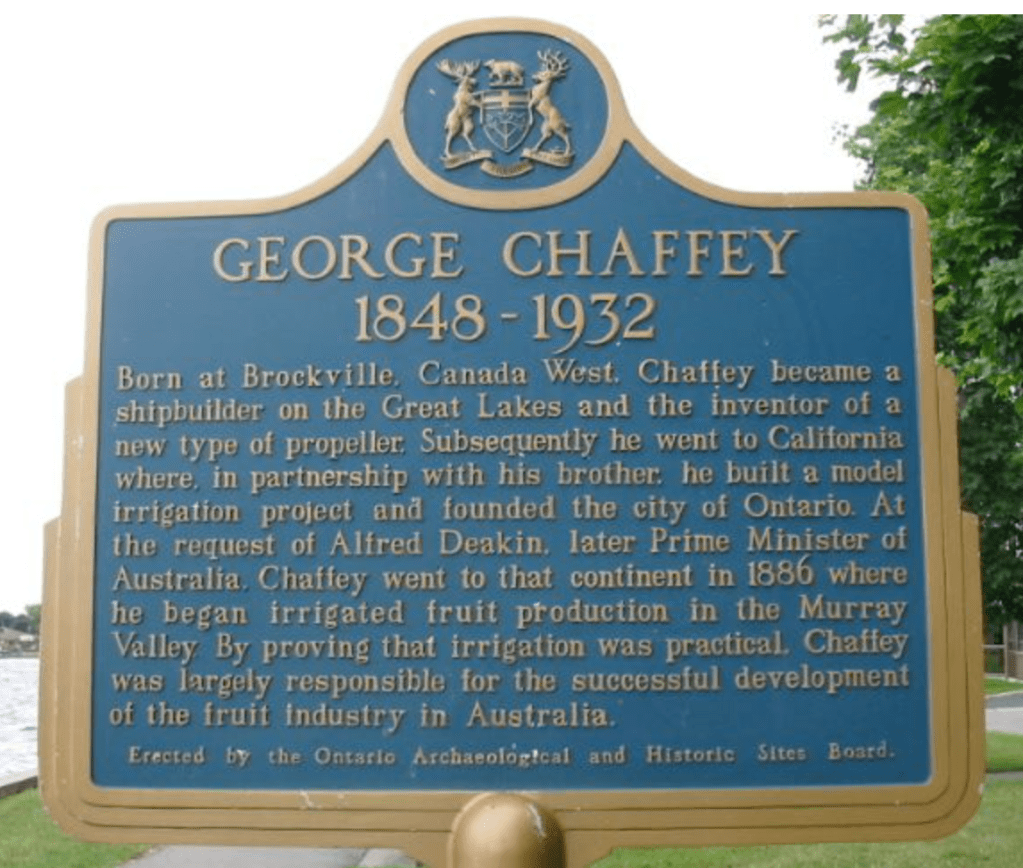

 At least two members of the Sechler family served in the Revolutionary War: our first cousin (5x removed) Michael Sechler and our fifth great uncle John Sechler.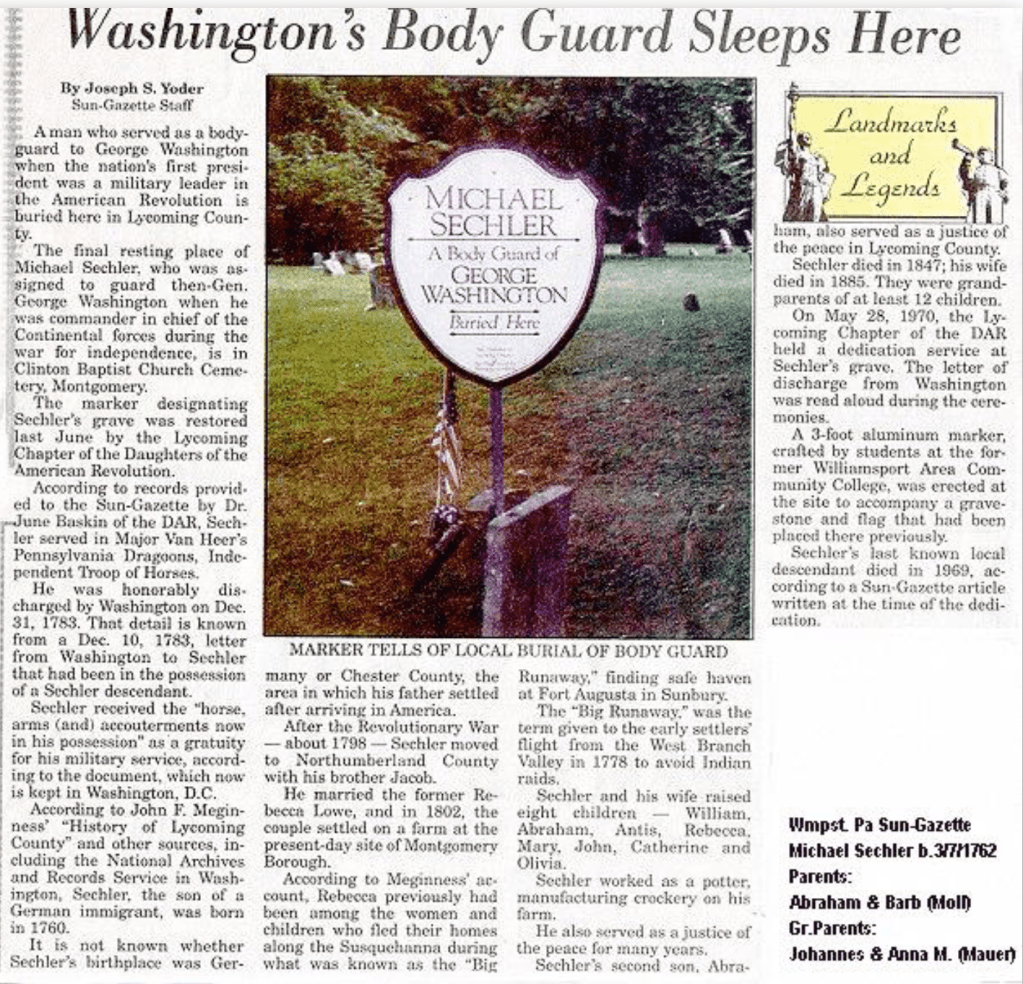
 Bridging the Silences