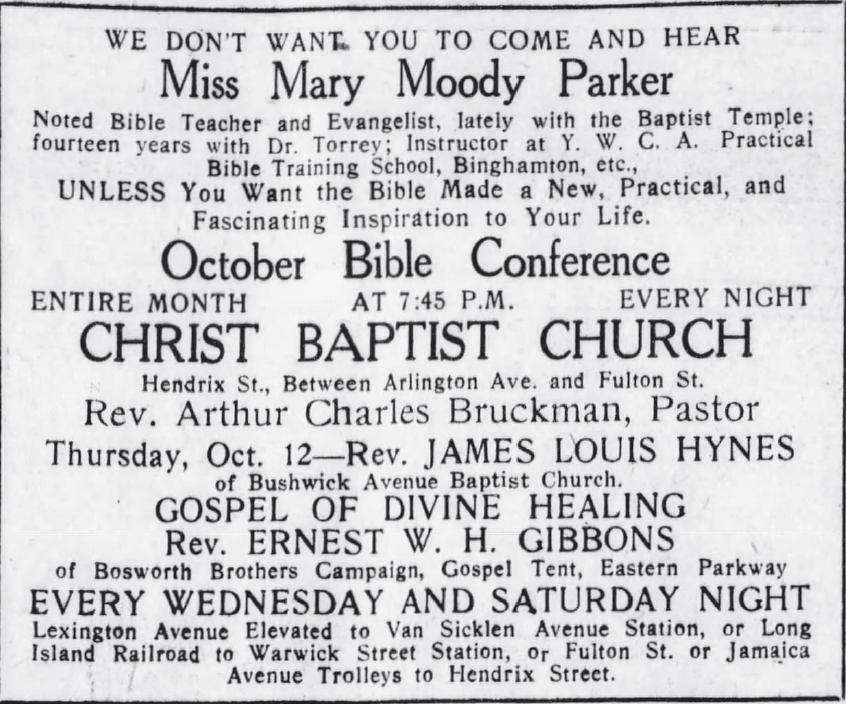
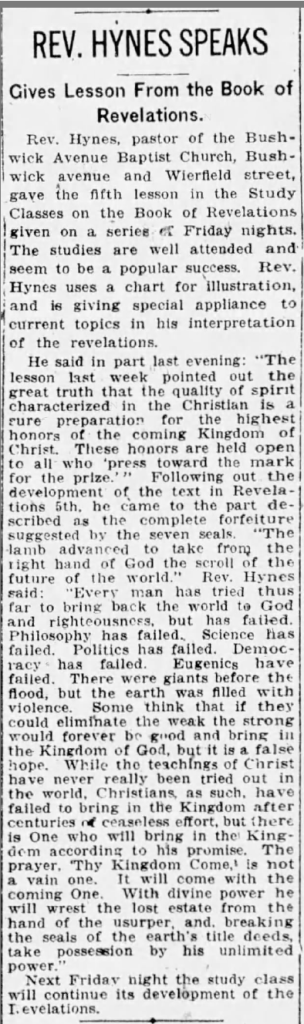
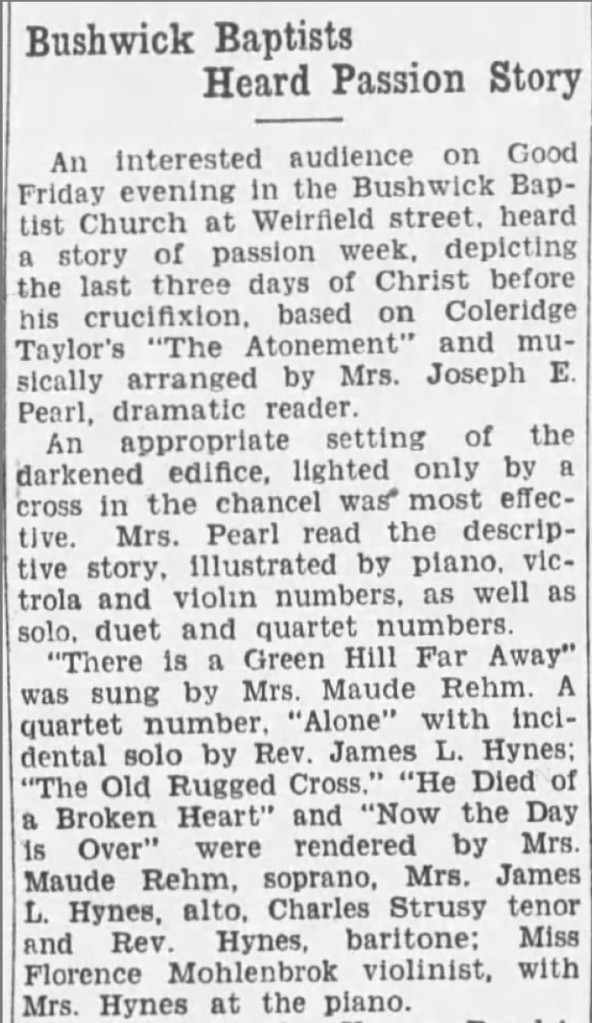
By Jan 1919 great grandfather James Louis Hynes had been in the Baptist ministry for a decade, having worked his way up through churches in Cornwall and Freeport. The Bushwick Avenue Baptist Church was a thriving operation in the 1920s, part of a vibrant network of churches in the city. Newspaper articles and notices throughout the decade show the church to have been a venue of many religious services, classes, and social activities with Reverend Hynes at the center of everything.
The Chat, Brooklyn NY, October 22, 1921Brooklyn Daily Eagle, October 7, 1922
Brooklyn Times Union, November 11, 1922
The 1920s were a time of post-war optimism and relative prosperity which spurred ideological movements, including those of the church. It was the era of prohibition, perhaps the most evident symptom of the emboldened religious doctrines of the times.
Absent from all the newspaper accounts of the Bushwick Avenue Baptist Church of the 1920s is any hint of the turmoil inflicted upon his family by the Reverend Hynes, James–any hint of the double life he led and the care he must have taken to keep the two parts separate from each other.
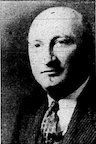
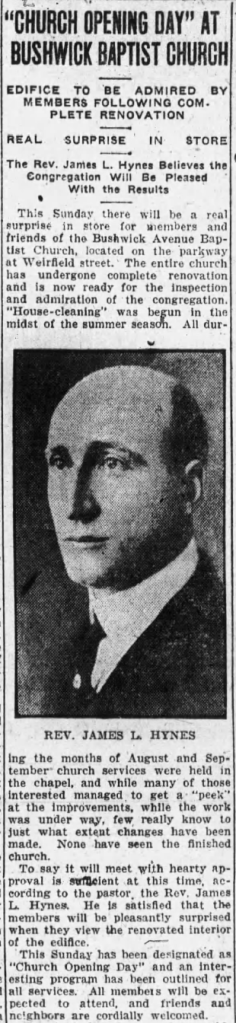
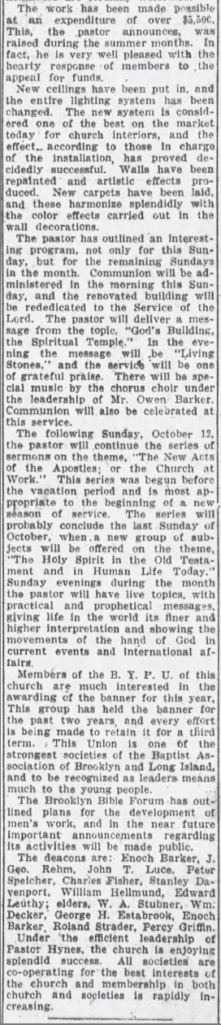
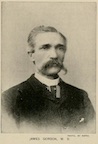
Regardless, the church thrived throughout the era, even underwent a major renovation in 1924. A newspaper announcement of the completion of the renovation gives us our second photograph of James Hynes.
Photo of James Louis Hynes at age 40
The Chat, Brooklyn NY, October 4, 1924
Some newspaper accounts give new insights into James and his family…
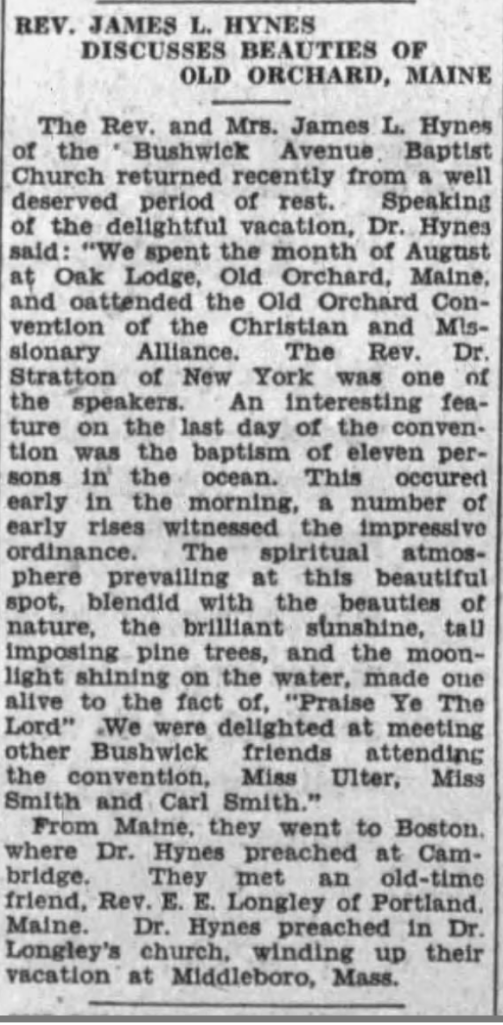
Old Orchard, Maine, is frequently mentioned as the site of a Baptist camp and retreat, and a favorite vacation spot of James and his family. Our mother and her brothers remember vacationing there in the late 1930s or early 1940s, one of a relatively small number of times they saw their grandfather.
Grandfather Gordon Hynes is mentioned with increasing frequency throughout the decade, as he moved toward his own career as a Baptist minister.
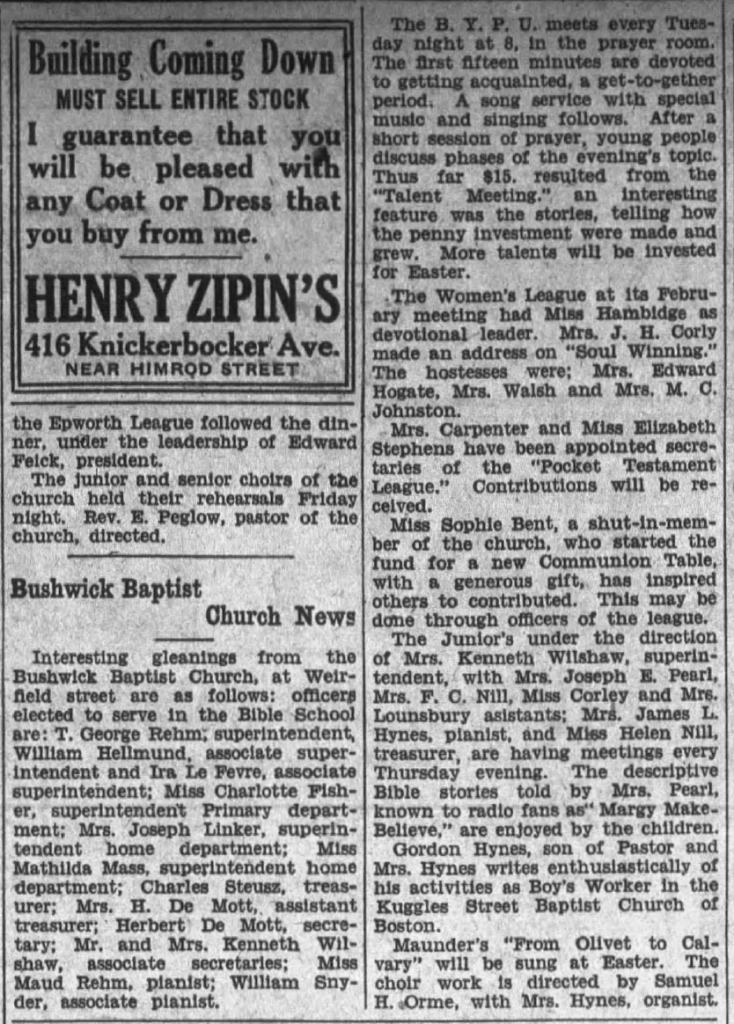
Music played a significant role in the family. Bessie played the piano and both James and Bessie sang. (We will see later that Son Gilbert was an accomplished musician throughout his life.)
The Chat, Brooklyn NY, October 1, 1927. Old Orchard was a favorite vacation spot over many years.
The Chat, Brooklyn NY, March 3, 1928. In his youth, Grandfather Gordon Hynes was active in the church.
The Chat, Brooklyn NY, April 14, 1928. James and Bessie were both musicians.
It is interesting to note that James’ double life did not just apply him–it applied to his family as well. Bessie was fully involved in and committed to the activities of her husband’s church, her name appearing often in church notices. Their children, including their daughters, would continue in the traditions of the church throughout their lives, despite their first-hand knowledge of the depravities of their father, the Reverend Hynes.
The questions and contradictions are overwhelming.
One of these questions is whether James could possibly have kept his secrets from his congregation over a decade? It is inconceivable that there would not at least have been whispers. Everyone would have known that James’ daughters were not living at home. Would there not have been some fear on the part of parishioners for the safety of their own daughters?
I have to conclude that there was awareness in the church, but that it was accompanied by an extraordinary willingness to look the other way. The imperatives and doctrines of the church somehow took precedence over matters of mere human moral failings (in 2020, this sounds familiar). The result was collective silence in the church and in the family.
A century later this silence continues to reverberate in the family.
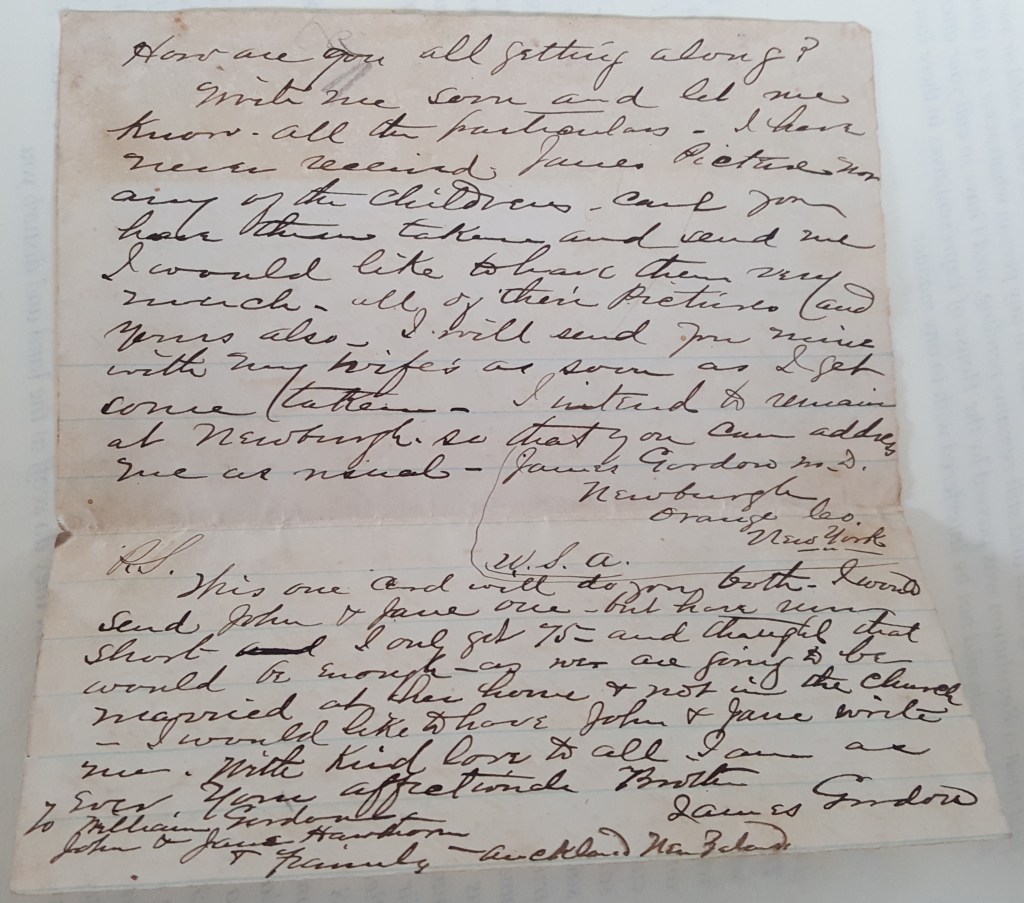
I have one more short letter from second great grandfather Dr. James Gordon to his brother William and sister Jane in New Zealand, provided by our distant cousin Claire. The images below are followed by a transcription. James announces his engagement to Nettie Johnston of New Jersey, although I don’t have the “enclosed” card which would have the details.
Newburgh, November 28th 1872
Dear brother,
How do you get along? It is quite a while since I have heard from any of you. You will see by the enclosed card that I am about to get married on the 4th of next month. The young lady that I am going to marry I have been engaged to for the past five years or more. I am boarding yet but expect to go to housekeeping about the 1st of May. I have been in good health since I last heard from you and hope that you are all enjoying the same blessing. How are you all getting along?
Write me soon and let me know all the particulars. I have never received James’ picture nor any of the children’s—Can you have them taken and send me. I would like to have them very much—all of their pictures (and yours also). I will send you mine with my wife’s as soon as I get some taken. I intend to remain at Newburgh so that you can address me as usual.
James Gordon M.D.
Newburgh, Orange Co, New York, U.S.A.
P.S. This one card will do you both. I would send John and Jane one, but have run short. I only get 75— and thought that would be enough as we are going to be married at their home and not in the church. I would like to have John and Jane write me. With kind love to all, I am as ever your affectionate brother.
James Gordon
To William Gordon and John and Jane Hawthorn and family,
Auckland, New Zealand
James Gordon letter to his brother and sister in New Zealand, November 28, 1872
James and Nettie were married in Washington, New Jersey on December 4, 1872 and lived in Newburgh, NY shortly thereafter.
After a dozen years in Corona, great grandfather Edward Sandford stepped down from his post as pastor of the Corona Baptist Church. The family moved to Chino around 1908. I don’t think Edward took easily to the idea of retirement, but he was 68 years old and his health remained an issue. This was likely a semi-retirement move, trading the Corona church for the smaller First Baptist Church of Chino.
The 1910 U.S. Census shows the family, Edward, Annie, chidden Saada, Joe, and Helen, and Annie’s mother living in Chino.
Grandfather Joe Sandford was able to continue building his banking career in Chino, based on his previous experience in Corona. He continues his family’s story in the living history interview recordings he left us.
But anyway, eventually father resigned over there [Corona] and moved to over Chino, he was elderly, you see. And, they found that I’d had a little banking…old Chino State Bank.
And they…I had to get certain credits from the high school that they couldn’t get me at Chino, so I rode a bicycle along the railroad tracks from Chino to Pomona every day. Well Mr. Rhodes, the head of the bank, asked me to do the same for them [as he had in Corona]. So I worked before and after school.
Joe Sandford from 1974 Living History Interview conducted by the Upland Public Library
Joe has dozens of stories from the early frontier days of banking.
I’ll tell you about one of the early day burglar alarms. In the bank at Chino, things were primitive in those days. When we would get ready to lock the vault door, it was a fire door. We’d close half the fire door, then we’d go around and we had a great big bottle of ammonia with a cord tied around the neck. We’d take that bottle and put it clear in the back of the vault on the shelf. The cord was taut. You could see if anybody got in there and pulled that door open, they couldn’t work, because the ammonia bottle would break, and you couldn’t breathe. True story.
Joe Sandford from 1976 Living History Interview with Bryce Denton
Chino, Pomona, and Ontario form a triangle, each about 5 miles from the other two. Not long distance bike riding by today’s standards, but hard to imagine on 1910 dirt roads, on a 1910 one-speed bicycle, wearing whatever 1910 clothes Joe had to wear. (I recall a day as a child visiting Ontario when we had to find a bicycle shop to repair a flat on my bike, Grandpa’s banter with the bike shop people revealing his substantial familiarity with the subject.) When the family moved to Ontario, Joe’s daily bike ride from Chino to Pomona turned into a daily bike ride from Ontario to Chino…
Ontario, when I arrived here in 1910, was a lovely community, and I’ve mentioned the trains that we have here. There was a stopover; father spent a couple of years in Chino before coming here [Ontario] to retire, and while there, Mr. Rhodes put me to work in the bank and I rode a bicycle every day from Chino to Pomona on the railroad track, for the balance of the year. That was fun, and different and interesting. When we moved up here, Mr. Rhodes was bound [?] that I had to ride the bicycle down and work there anyway. I did. If I did that it was a long ways to pump back, and I found out that I could ride the Southern Pacific train which came from Los Angeles to Pomona down through Chino, check my bicycle for fifteen cents. That beat pumping up here. Frequently, I’d ride on the back with the conductor. In the rainy season, we had to stop for the Union Pacific track. Then we had to pull that long train going to Salt Lake City around the bend. He always wanted to bet as to whether we’d make it or not. Sometimes we had to back up and get a little momentum to go around there. Of course that track is all removed today.
Joe Sandford from 1976 Living History Interview with Bryce Denton
The railroads were an important part of life in Ontario in the 1910s, and especially so for our grandfather who took full advantage of them. They come up again and again in his stories.
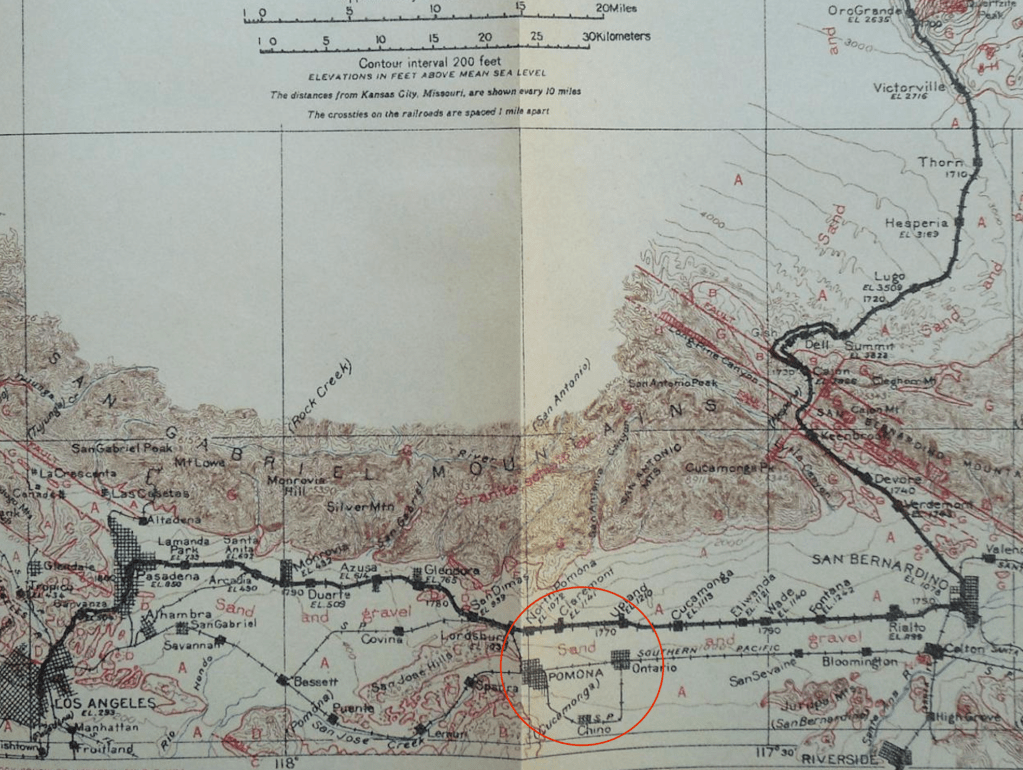
Built in the later 1800’s, by 1910 there were two major railroad lines running east-west through Ontario. The Southern Pacific went directly through Ontario and Pomona with a spur looping to the south through Chino. The Atlantic and Pacific (a.k.a. the Santa Fe) followed the foothills to the north through Upland (about the route we know as the Foothills Highway). A north-south electric trolley connected Ontario and Upland. An intersecting trolley line followed followed the foothills route into Los Angeles. (Today the Los Angeles Red Line light rail follows the same route, and has made it about halfway to Ontario–perhaps in another 25 years the system can catch up with where it was in 1910.)
1915 railroad map of lines leading to Los Angeles. The Southern Pacific went directly through Ontario and Pomona with a spur looping to the south through Chino (see circled area). The Atlantic and Pacific (a.k.a. the Santa Fe) followed the foothills to the north through Upland. A north-south electric trolley connected Ontario and Upland. Electric trolleys also followed the foothills route into Los Angeles. (Corona is another 5 miles below this map, south of Ontario)
The family remained in Chino for about two years before settling in Ontario, I think by the end of 1910. At age 70, Edward fully retired and the family moved into the house at 541 East D Street.
And then, the folks retired and moved up here. And I’d ride a bicycle down and it was all uphill coming back.
(Interviewer) Your parents moved to Ontario…
…to retire…
(Interviewer) …and you’d ride down to Chino?
Yes, and perhaps take a little lunch along. And incidentally when I didn’t take a little lunch along I’d go into a little restaurant and you’d get a bountiful meal for a quarter, all you wanted you know, and so forth. Well, father Swan, Margaret’s father, learned that I was doing that, and he sent word to me by his cashier, he said tell Joe he doesn’t need to do that, we can use him here. And so, oh yes, I got,… coming up the hill on a bicycle is a long way…
(Interviewer) From Chino, it sure is.
…and the trains, certain trains, used to go down from Los Angeles to Pomona, made the loop down around Chino to Ontario, and on to Chicago. And there was a train came through there about five o’clock. And for fifteen cents, I could come up on that train, check the bicycle. Now you’d say that was impossible but it’s pretty good history.
Joe Sandford from 1974 Living History Interview conducted by the Upland Public Library
Joe turned 18 in 1910. Margaret was 15, not quite in the picture yet. The first contact between the Sandford and Swan families was on a professional level, a job offer to save Joe the daily trip from Ontario to Chino to continue working his job at the bank.
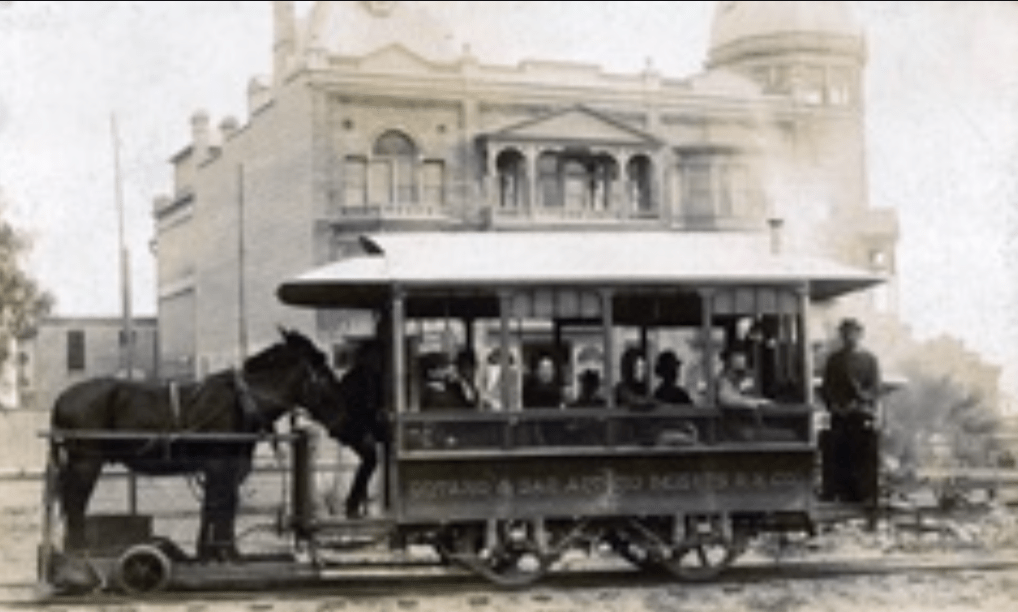
On Euclid Ave, as I’ve probably told you, there was a streetcar here at that time, an electric car. It used to start down at the Southern Pacific tracks, as I recall, the Union Pacific. It went up to Upland and clear on up to the Heights. That was our medium for going to the mountains. It would connect with a “through” electric car running from San Bernardino to Los Angeles. We’d go in there and shop, do business, whatever we had in mind. As you’ve probably been told, before that there was a mule car. Margaret and I never saw the mule car; we’ve seen a replica of it. But the mules would pull the car clear up to the Heights. Then they’d climb on a platform at the rear and coast down. They got a free ride. There are many lovely stories connected with that.
Joe Sandford from 1973 Living History Interview with Esther Boulton Black
Everyone discussing Ontario history, including Grandpa, loves to talk about the mule car. It predated the Sandford’s in Ontario, as well as the Swans, although Mabel is said to have seen it in operation once when there was an electrical outage affecting the trolley.
The Ontario Mule Car was in operation between 1887 and 1895, when it was replaced by an electric trolley.
Then I went to work with father Swan. I was with him a few months, but there were men in there that were very smart, they were older, and they used to pile a lot of work on me, cause I had little experience, and so forth.
(Interviewer) This is in the First National Bank in Ontario?
…in Ontario, um hm. And I couldn’t see any future for myself. And at that time, the First National of Ontario merged, a little savings bank with it. And I’d had to do with that, and so forth. Uh…to make a long story short, I had to combine the books from one bank to the other, alphabetically, half of the ledger. And I did, got all through it at six o’clock and went home. The next morning when I went back to the bank one of the officers said Joe, why didn’t you come back last night. I said what do you mean? He said well we worked till midnight, getting the other half straightened out. Well I’d never even thought of that, it wasn’t my job.
But, anyway, ahh, one day I read in the papers that a man was out here from North Dakota, wanted to start a bank. So, I made a point about meeting him. He said, “Joe, you’re just the man that I needed.” Well, there were just two of us next to the top, you see the point. We were very successful and the experiences were most unusual, and so forth.
Joe Sandford from 1974 Living History Interview conducted by the Upland Public Library
So Joe’s initial employment with Henry Swan lasted only a few months before he ventured into new opportunities on his own. I believe the man from North Dakota was George McCrae, of whom we will hear more in future posts.
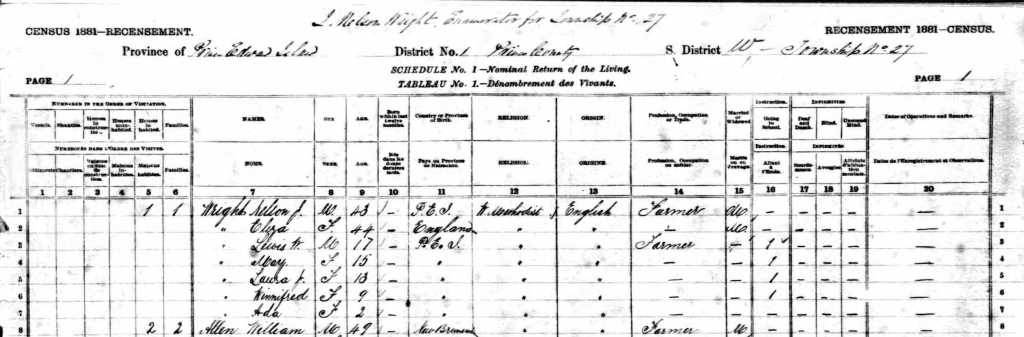
Second great grandparents John Nelson Wright and Eliza Marshall Wright had a son and four daughters, all born on Prince Edward Island between 1864 and 1878. A fifth daughter, Lucy, did not survive her first six months. The 1881 Canadian Census shows the family of seven living on the island.
The Wright family in the 1881 Canadian Census
The Wrights came to the United states between 1882 and 1884, John probably arriving first to get established before sending for the family. They settled in Groton, Connecticut. John was a ship’s carpenter, working in the Groton shipyards.
Laura’s Sister Winnie is of particular interest in our story. She married Fred Johnson in Groton in 1890.
Laura’s sister Winnifred Wright was married to Fred Johnson in Groton in 1890
Fred was from Groton, but had already lived in Brooklyn at the time of the marriage. He may have known Winnie before setting off for New York and later returned to marry her and bring her to the city. Since Johnson is such a common name, it is difficult to track his early movements.
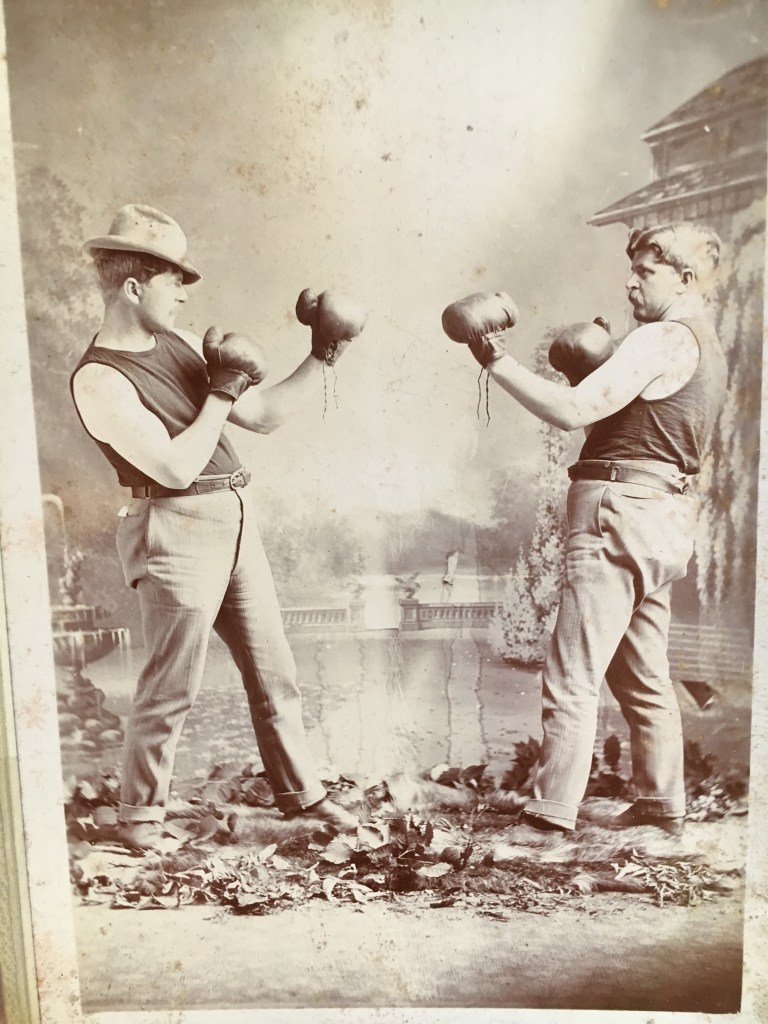
I have only one odd picture of Fred in his younger days, boxing with another young man. Someone in an intersecting family tree has been active posting pictures on Ancestry, giving us this picture and those that follow. (It has occurred to me that the man on the left could be George, but I have no way of identifying him.)
Fred Johnson on the right.
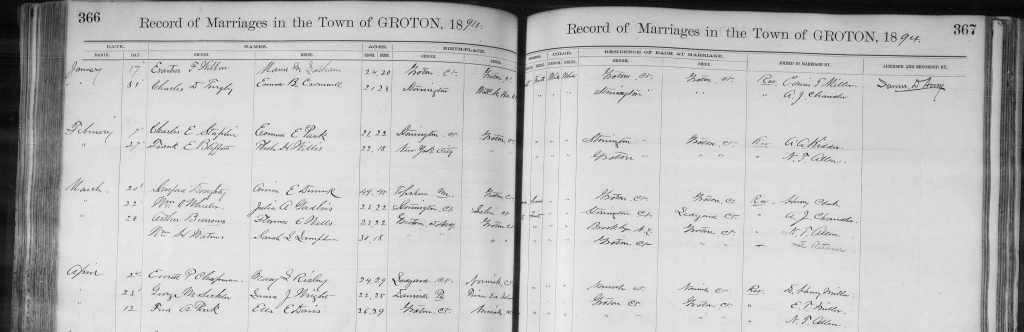
However George made his way to Groton, he met Laura there and they were married in 1894.
Laura was married to George Sechler in Groton in 1894 (second row from the bottom).
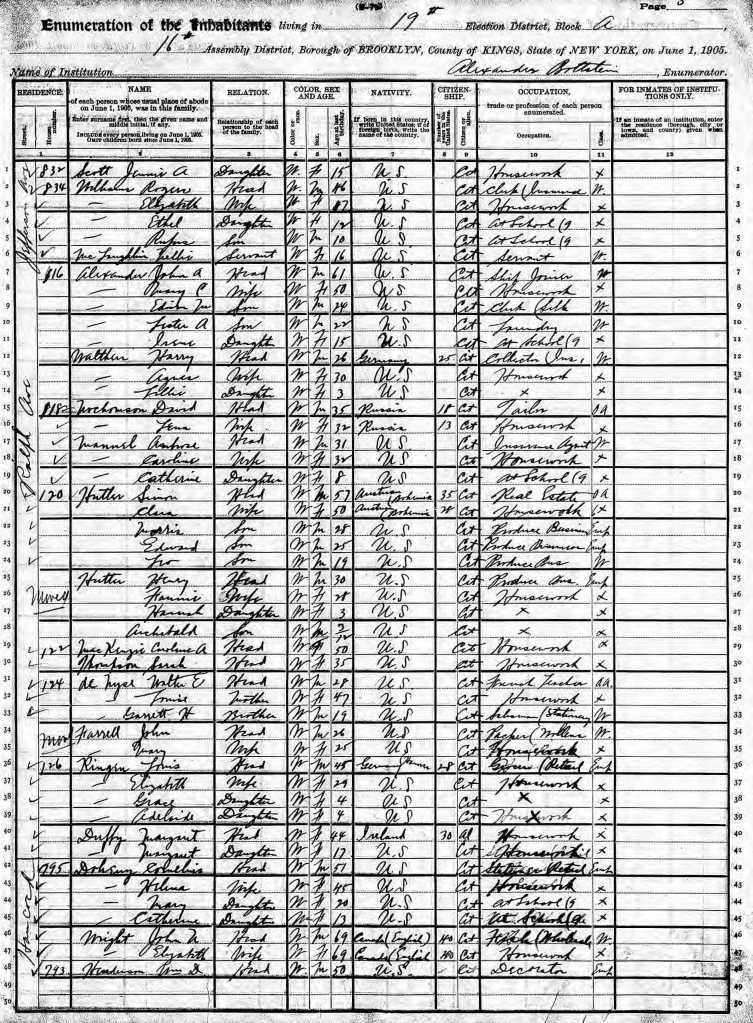
By 1900 all three families were living in Brooklyn. Around that time there were rail lines linking John’s Stuyvesant Heights neighborhood directly to the Brooklyn Navy Yards, leading me to believe he worked there for a time. The 1905 Census, however, lists John (at age 69) as a fish wholesaler, which would be the family business for at least three generations. (Later records still identify John as a carpenter, so he must have done both kinds of work at various times.)
The 1905 New York State Census lists John Nelson Wright as a fish wholesaler (third row from the bottom).
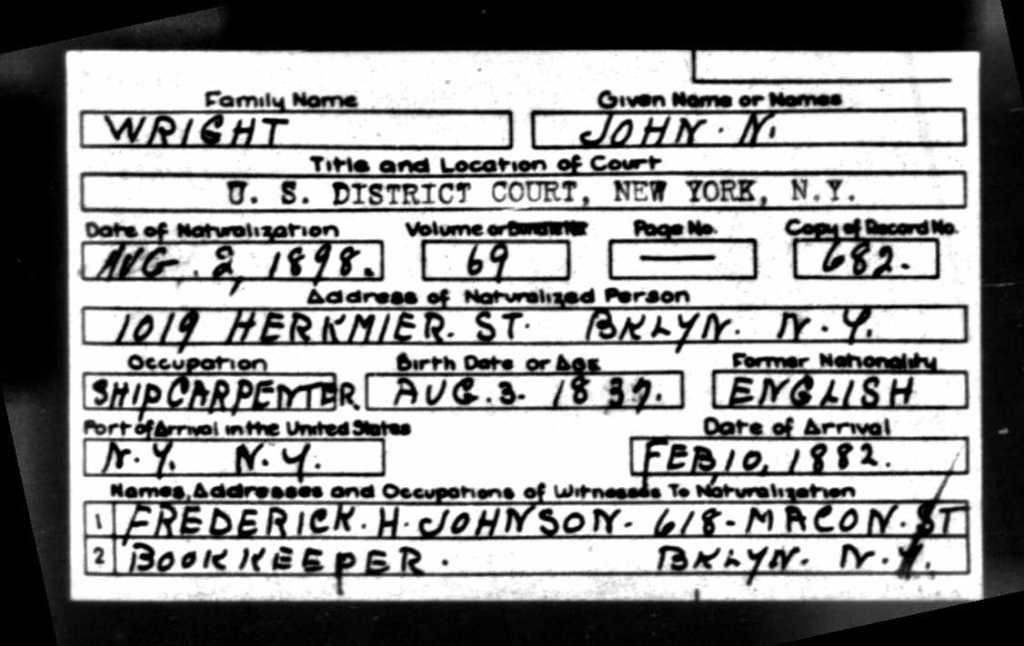
Fred Johnson is related to us only by marriage, but he wins the award for best supporting family member. He appears at several critical times in the family history. He helped sponsor the citizenship of his father in law in 1898.
John Nelson Wright’s U.S. Citizenship paperwork lists son-in-law Fred Johnson as a sponsor.
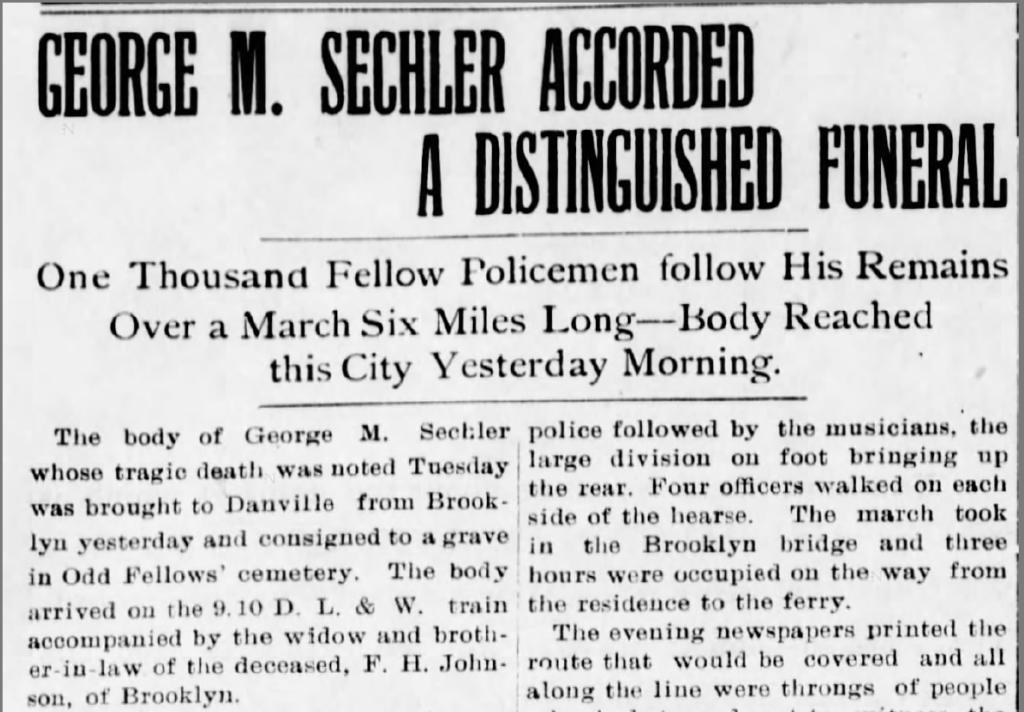
It was Fred and Winnie Johnson’s house at 618 Macon Street in Brooklyn where brother-in-Law George’s funeral procession began in April 1907. Fred accompanied Laura on the night train to Danville brining George to his final resting place…
Brother-in-law Fred Johnson accompanied Laura and the body of George Sechler to the funeral in Danville. (Danville Morning News, April 19, 1907)
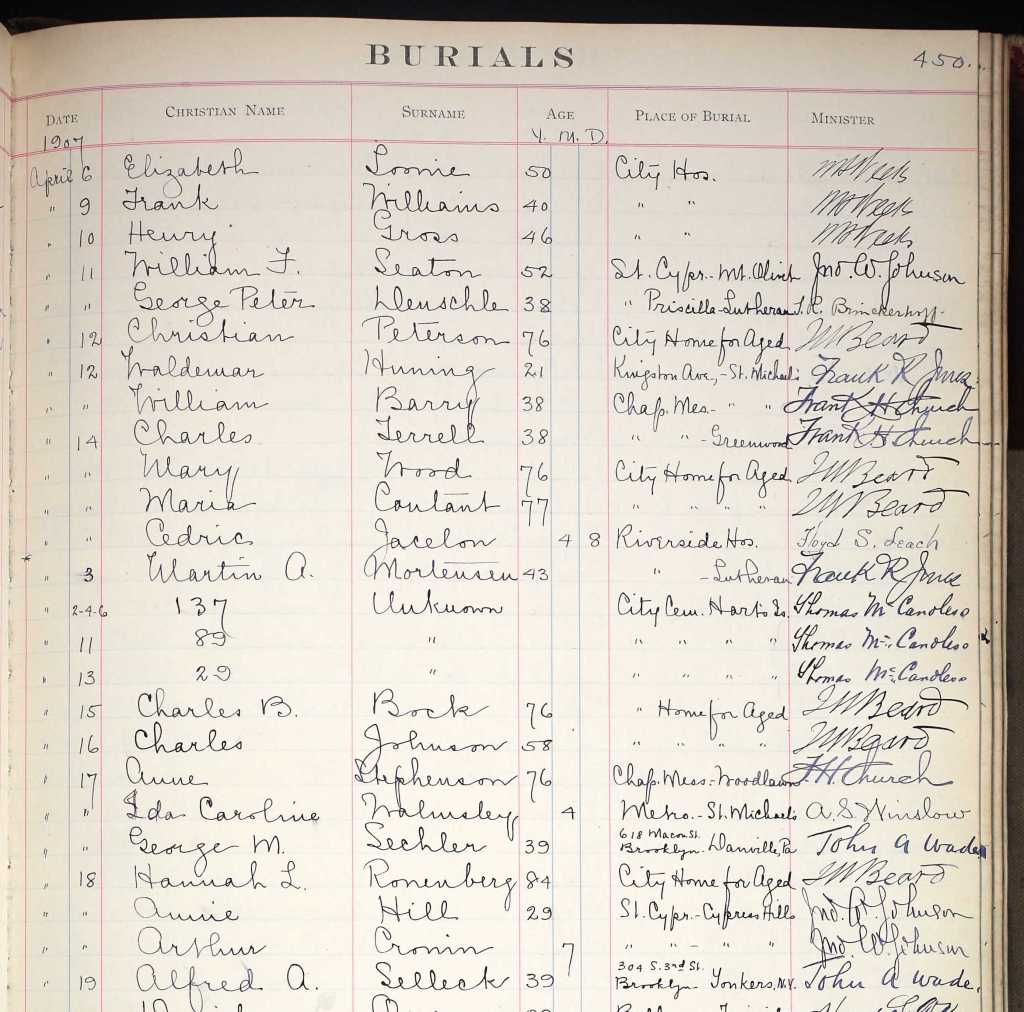
Fred’s home is also listed as a waypoint to Danville in George’s burial record of the New York Episcopal Diocese.
New York Episcopal Diocese Burial Records. The Macon tree address is the home of Fred and Winnifred Johnson (5th row from the bottom). Note that fellow officer Alfred Selleck is also listed in this record (bottom row).
As we have noted, Laura and Ruth moved back home with John and Eliza in 1910 following George’s death.
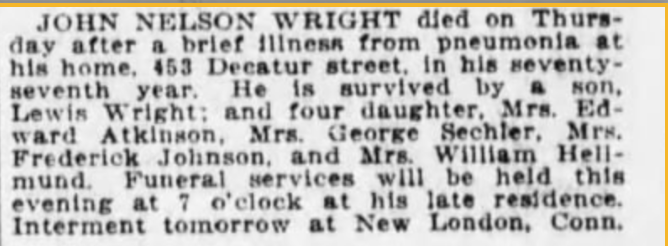
John Nelson Wright died in May 1914 at age 76 in Brooklyn. His obituary leaves a clear record of the whereabouts of his family…
Brooklyn Daily Eagle, May 23, 1914
Son Lewis Wright had moved to Shawangunk, New York, not far from Newburgh. Daughters Laura and Winnie, of course, lived in Brooklyn. Daughter May had married Edward Atkinson, and would live near Groton for the rest of her life.
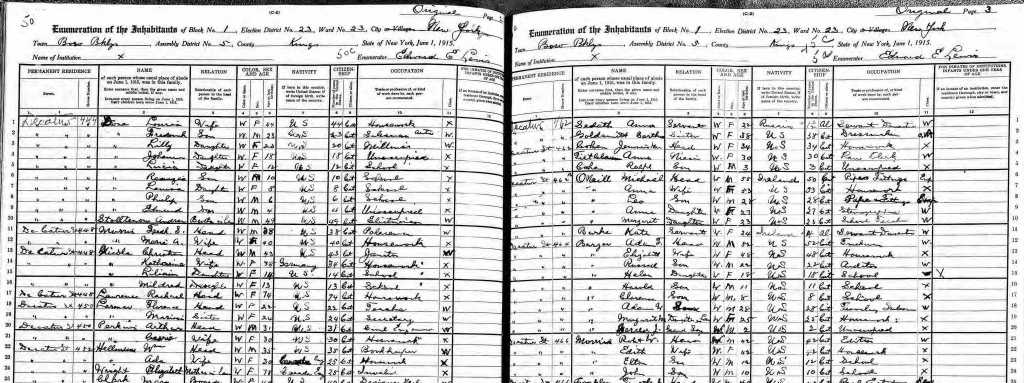
Daughter Ada had married William Hellmund and also lived in Brooklyn. The 1915 New York Census shows that she lived with Ada in the years after John’s death.
1915 New York State Census showing that Eliza Wright lived with her daughter Ada and son-in-law William Hellmund after John Nelson Wright’s death in 1914.
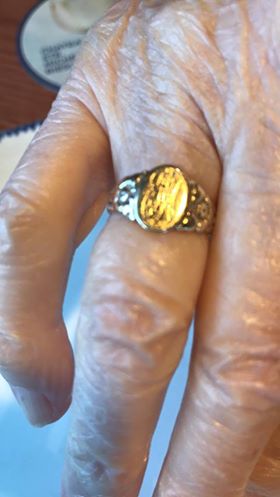
Eliza died Dec 12, 1918 in Brooklyn. Today, our mother still wears the ring of Eliza Marshall…
Eliza Marshall’s ring, inscribed “E.M.”
Fred Johnson must have served as a surrogate father for our grandmother Ruth. There is a series of memories our mother has of childhood events in and around Brooklyn while they lived in nearby Freeport, Long Island. Since she was born in 1932 and the family moved away by 1945, the range of these memories must be the late 1930s and early 1940s.
Mom remembers Uncle Fred, and having holiday dinners with his family in Brooklyn. (I discovered Fred Johnson working through archival records from 1890, so it’s gratifying to be able to connect him with living memory on the other end of things.)
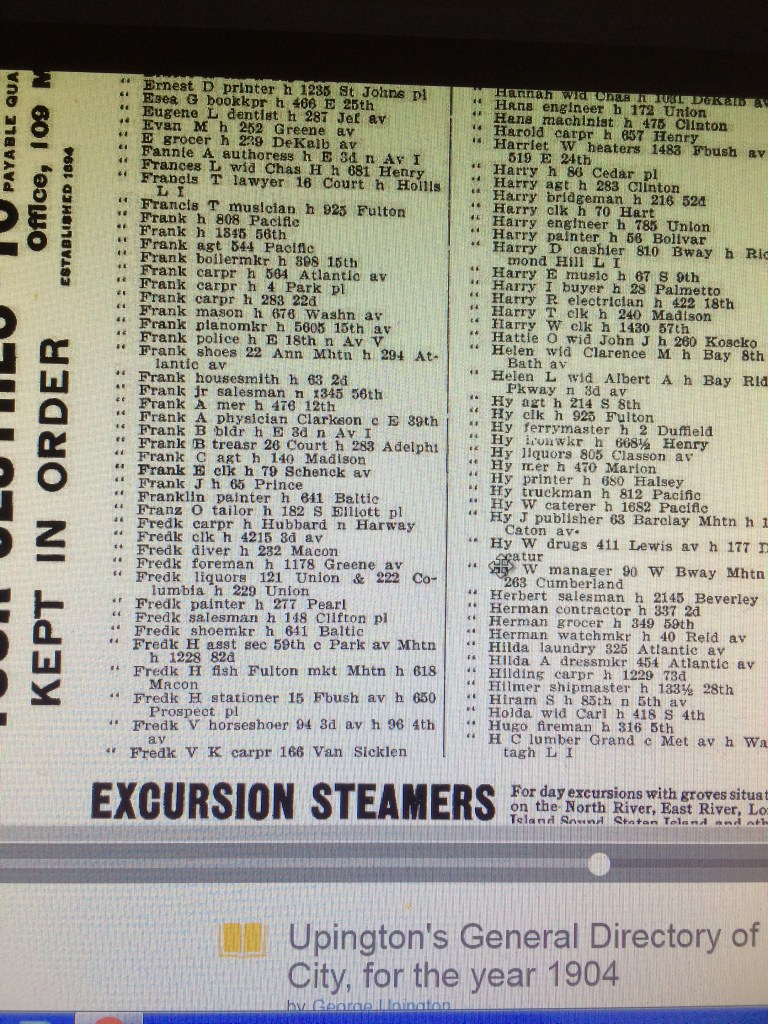
Mom remembers that Uncle Fred was a fish merchant at the Fulton Market in Manhattan. For years, the Brooklyn telephone directories include the terse notation “fish” next to his name.
Fred Johnson’s listing in the 1904 Brooklyn telephone directory (left column, 4th from the bottom), also listing his fish business in the Fulton market in Manhattan.
Mom remembers that Uncle Fred sent a barrel of fish to their family when they were living in Auburn, NY after moving there from Freeport, around 1945. (Fred and Winnie had moved to Virginia by this time, but the family remained in the fish business.)
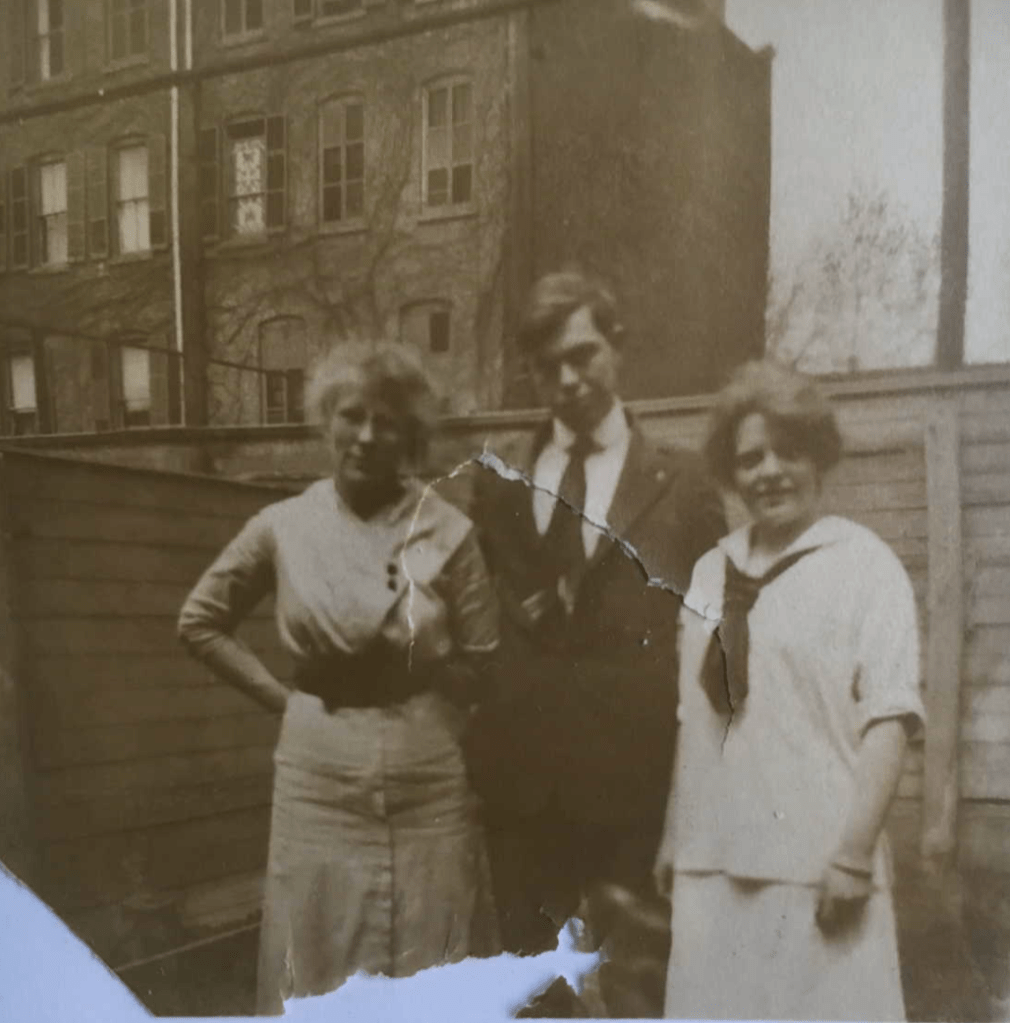
I have one picture of Laura’s sister Winnie, with her daughter Marjorie and her son-in-law Dan Elliot. If Fred Johnson was a surrogate father for Ruth, it seems likely that Marjorie was a surrogate sister. (There is a resemblance between the cousins.)
Winnifred Wright Johnson, Dan Elliot and Marjorie Johnson Elliot in the 1920sThe 1930 U.S. Census shows Daniel and Marjorie Elliott, their infant son Daniel, vive year old daughter Shirley, and parents Fred and Winnie Johnson living together in Brooklyn.
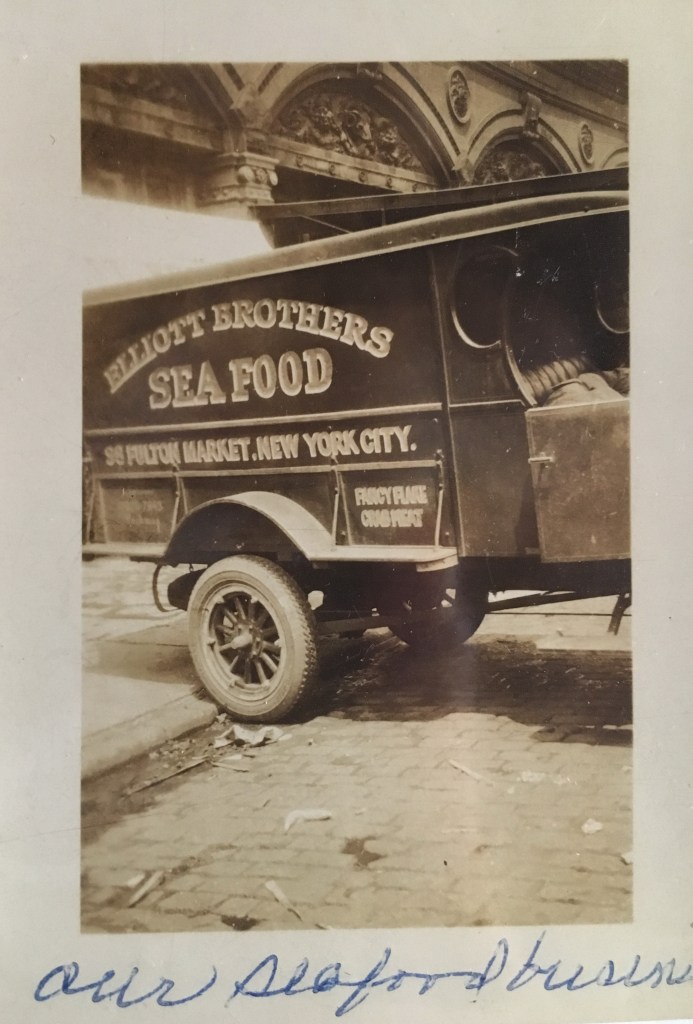
Fred’s fish business got passed-down to the next generation to his son-in-law Dan Elliot.
A photo from the fish business that was passed from Fred Johnson to his son-in-law Dan Elliot.
This photo of the fish business, from an intersecting family tree in Ancestry, comes with a caption that the business was closed during the depression because of threats from the mafia. This matches a family story that our mother recalls.
Dan Elliot was from Virginia, and after closing the fish business in New York, Dan and Shirley moved to Hampton Virginia, sometime between 1935 and 1940, bringing Fred and Winnie with them. They started a new fish business there.
Fred and Winnie died in Hampton, in 1948 and 1959, respectively.
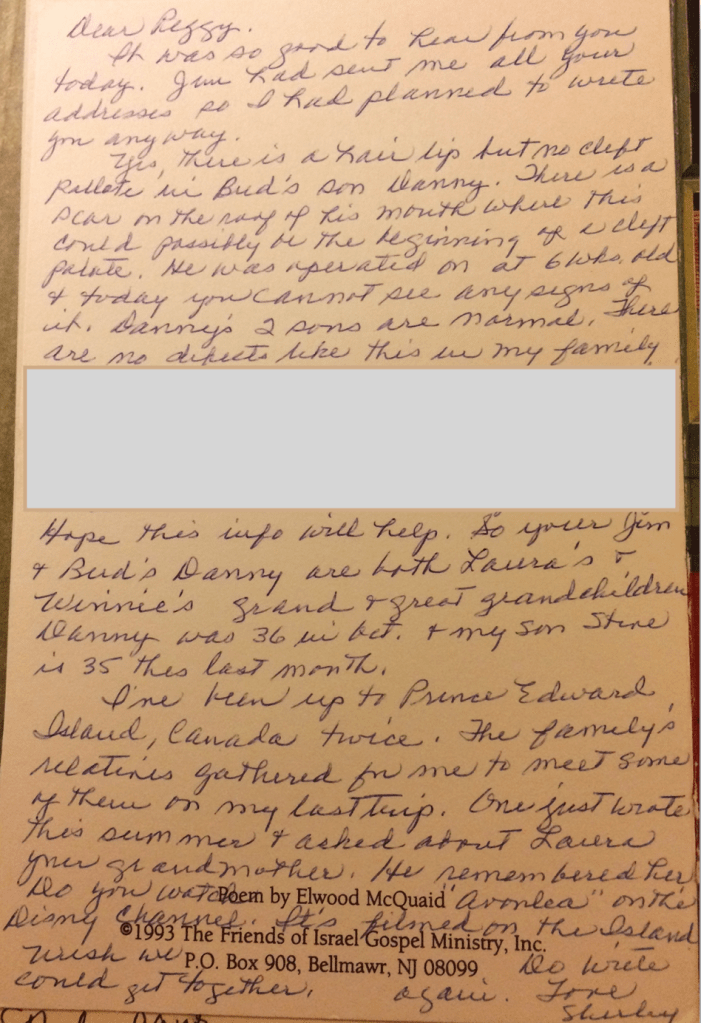
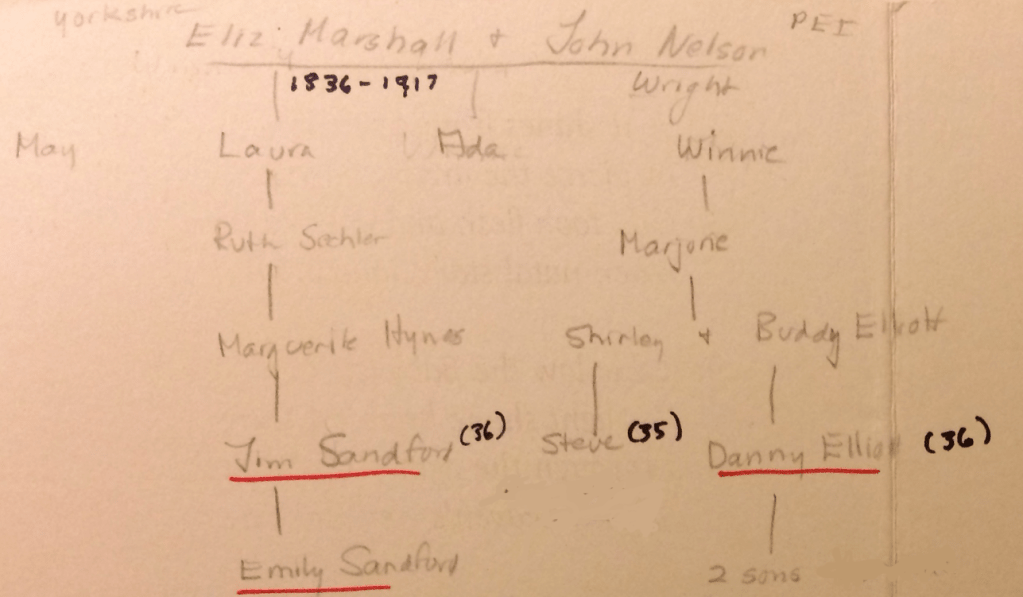
Dan and Marjorie had daughter Shirley in 1925 in Brooklyn, who was the same generation as our mother. Mom and Shirley stayed in contact with each other through at least 1992. The following letter from Shirley to Mom was apparently a reply to Mom’s inquiry into possible genetic links in the family for cleft lip/palate, spurred by my passing this to daughter Emily, who was born in 1992. If there is such a genetic link between the two branches of the family (which seems unlikely) the common ancestors would be John and Eliza Wright from PEI.
Shirley Elliott Moberg wrote this note to our mother in late 1992 or early 1993. (Unrelated personal details redacted.)Mom sketched this family tree on the back side of the note. Red lines apparently signify cleft lips.
Laura and Ruth stayed in contact with other members of the Wright family through the years. Mom remembers that Laura and Ruth had a serious crash on the Merritt Parkway when returning from a visit in Connecticut, presumably to May’s family. (The Merritt Parkway was built around 1934.)
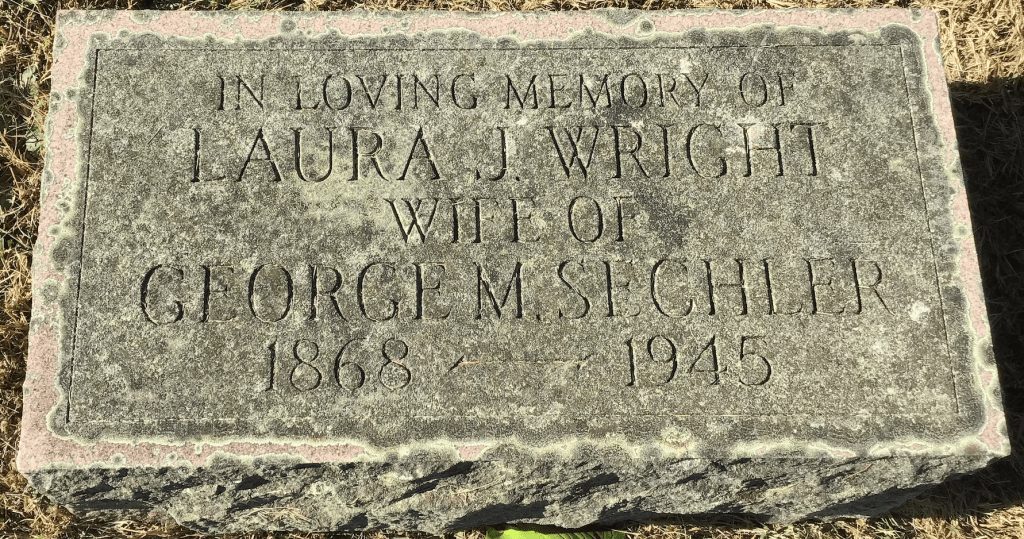
When Laura died in Michigan in 1945, our grandmother Ruth had a plan for her burial. Husband George Sechler had, of course, been buried in his family plot in Danville in 1907. Laura was sent back to her sister May in Connecticut to be buried in the family plot. Her gravestone acknowledges her as the wife of George Sechler. May herself died four years later.
Laura Sechler’s gravestone in the family plot in Waterbury, CT. She is buried next to her parents John and Eliza, her brother Lewis, and her sister May.
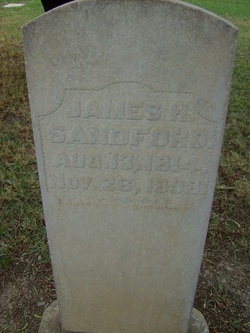
Before we move on from great grandfather Edward Sandford’s time in Corona, California, there is a loose thread to deal with. Edward’s father, James Head Sandford (our grandfather’s grandfather) died on November 26, 1898 and is buried in Corona. From Edward’s story as we have told it so far, it is not clear that he has seen his father since the 1850s in Maine, so how did James come to rejoin his son in Corona, at the end of his life?
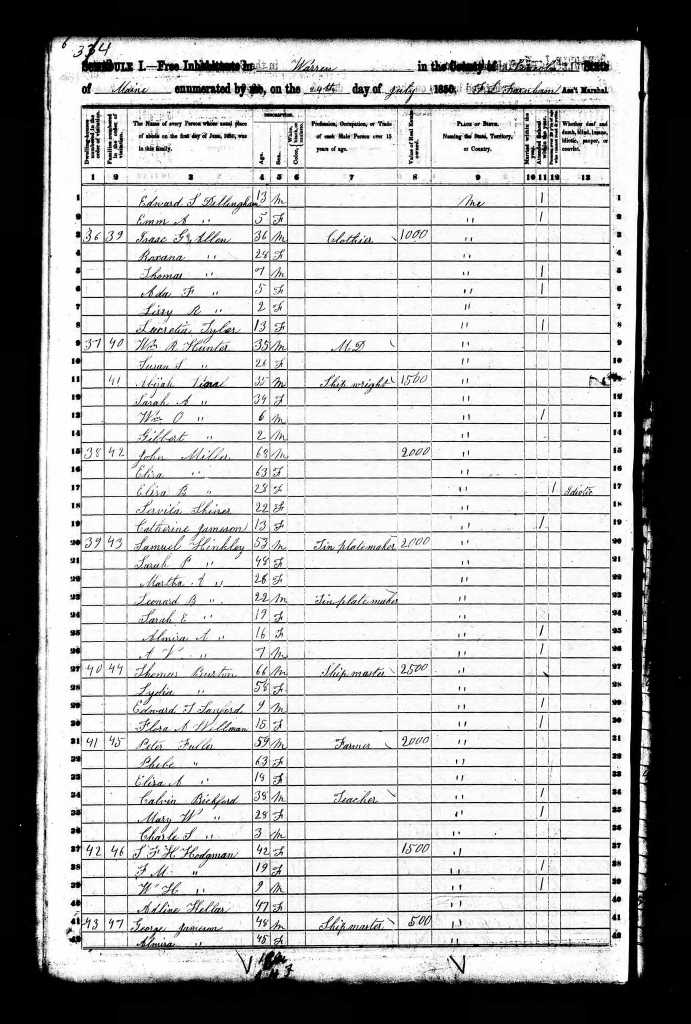
The 1850 Census indicates that Edward went to live with his grandparents, Thomas and Lydia Burton, when his mother Dorothy died.
In 1850, three years after the death of his mother Dorothy, Edward Sandford is living with his grandparents, Thomas and Lydia Burton. Edward’s twin brother, James (Jr.) is listed in a separate Census record as living with his father James and his second wife Arabella.
Another record of the 1850 Census which is not legibly printable shows that James Jr. remained with his father and new wife, Arabella. It seems that the twins were separated after the death of their mother, although the families may have lived in close proximity. Half brother George was born in 1850, not quite in time to be recorded by the 1850 Census.
By 1860, when Edward was already on his first trip to China aboard his uncle’s merchant ship, James (Sr.), Arabella, and 10 year old George had moved to Mazeppa Minnesota, in Wabasha County, 40 miles southeast of St. Paul, about 15 miles from the Mississippi River. (This has nothing to do with our Swan ancestors from Mankato, Minnesota, 60 miles to the west, except that that region at that time was an outpost of western migration because of its proximity to the Ohio and Mississippi Rivers.)
As we have seen in other towns of that era, a local history was published containing biographies of its prominent citizens. History of Wabasha County was compiled by Dr. L.H. Bunnell and published in Chicago by H.H. Hill, Publishers, in 1884. It was later republished by Higginson Books.
It contains biographies for father James Head Sandford and son (half brother to Edward) George D. Sandford.
Sandford, Jas. H., (page 968), retired farmer, was born in Topsham, Maine, August 14, 1814. He was kept at school until fifteen years of age, when, shortly after, his father died, when he went to sea, entering the foreign merchant trade. For about twenty-seven years his principal occupation was that of a sailor. Occasionally, however, he would stop at home for a time, and on these occasions he would make a trip or two in some coasting-vessel. He also made several trips into the western wilds in the employ of the fur traders. In 1856 he immigrated to Minnesota, and settled in the town of Mazeppa, where he pre-empted one hundred and sixty acres of land in section 29, on which he continued to reside up to 1882, when he rented his farm and removed into the village of Mazeppa. Mr. Sandford is full of amusing and interesting reminiscences of the early days.
He saw much of the Indians, as his place was near the Zumbro, which afforded fine camping-grounds for them, and who frequently called at his house for the purpose of begging. In those days he had to carry his supplies on his back some four miles, and the idea that the lazy Indians had the face to beg of him, when they knew how he had to pack his provisions, was too much for him, so he told his wife, in the hearing of several of them, that he would not give them anything more, whereupon they, seeming to understand, at once left.
Shaska, one of the Indians hung for the massacre of settlers, at New Ulm, came to his house one day and said he was sick so Mrs. Sandford offered him a bottling containing No. 6, composed of gum myrrh, brandy and capsicum, a very hot, powerful medicine; but Shaska would not take ti till Mrs. Sandford assured him by appearing to take some herself, where upon he raised the bottle to his mouth and gulped down a good dose, before he was aware of how hot it was; it was down, though, and he had to stand it; but his grimaces and antics were amusing for a few moments. It seems the Indian had faith in Mrs. Sandford’s ability as a doctor, for he repeated the dose for several days, till finally one day he came and said he was all right.
On one occasion in the winter, when Mr. Sandford was away, a lot of Indians called at his house to warm themselves, leaving their guns outside; finally, when they left, Mrs. Sandford went to the door with her son George, a small boy, when they suddenly drew up their guns and aimed at Mrs. Sandford, who, instead of darting into the house with fear, stood and laughed at them, believing they meant no harm, while her little boy thought it meant business, and was considerably alarmed.
Mr. Sandford is now in his decling years, enjoying the fruits of an industrious life as he justly deserves, being the owner of several farms; his means are ample. He has been twice married, and had two sons by his first marriage, one of whom is living. His second wife was Miss Arabella Pierce, of Bath, Maine, by whom he had one son, George, who is postmaster of Mazeppa.
History of Wabasha County, compiled by Dr. L.H. Bunnell, 1884
Sandford, George D., (page 994), merchant, is a son of J. H. Sandford, elsewhere mentioned in this work, and was born in Topsham, Maine, June 14, 1850. He was brought to Mazeppa with his father’s family in the fall of 1855, and has dwelt here ever since.
His life was passed on a farm till twenty-one years old, and his education was furnished by the common schools, of whose advantages he made the best use. His natural abilities and energies have made him a successful business man.
In 1871 he went to Lake City, where he spent three years in learning and following the wagonmaker’s trade. In 1874 he built a wagon-shop near the mill in Mazeppa, which he operated five years and then sold, the advent of the railroad spoiling the location. He has dealt considerable in real estate, and is now the owner of a farm near the village, which he rents.
On April 25, 1881, he was deputized as postmaster, and has kept the postoffice ever since. The following year he opened a stock of groceries and boots and shoes in the postoffice building, and does considerable trade in those commodities. He was elected town clerk in 1882, and is now fulfilling the duties of the same office.
He is a republican, and a member of the masonic order. He has been twice married, and was robbed of his first mate by death in July, 1875. Jennie Dickey was the lady’s name before her marriage to Mr. Sandford, which occurred October 22, 1874. On Christmas day, 1879, he was united in marriage with Miss Alice, daughter of J. B. Miller. They have a son, born December 5, 1880, and christened Frank Burnett.
History of Wabasha County, compiled by Dr. L.H. Bunnell, 1884
James Head owned land in Minnesota at least through 1885. In 1885 he was 70 and George was 35. It’s not clear if they moved to California at the same time, but the families must have left Minnesota some time after 1885. James (Sr.)’s second wife, Arabella, died in Mazeppa (year unknown), so she was not part of the westward expedition.
George first appears in Southern California on voter registration rolls in 1896, when he was 46 years old. Edward brought his family to Corona (from Santa Cruz) in 1897 or 1898. So he may have made the move partly on a recommendation from his half brother and/or his father. Recalling the quote from grandfather Joe Sandford…
… father they told us if we would move to Corona that we could have all the oranges we wanted…
Joe Sandford from 1974 Living History Interview conducted by the Upland Public Library
…perhaps is was James or George that put the orange trees into Edward’s mind.
Since James Sr. moved to Minnesota in 1856, about the time Edward was thinking of sailing to China on his uncle’s ship, it is possible that father and son were not reunited for 40 years, until Edward moved to Corona. A vacation to Minnesota from Vermont seems far fetched, and even stopping in Minnesota on his way west to would have been quite a detour for Edward in 1891-1892. Edward lived in Northern California for 5-6 years before coming to Corona, but a trip from Northern to Southern California during this time still would have been a major undertaking.
But the proof that Edward was finally reunited with his father a year or two before James’ death in Corona can be found in the Sunnyside Cemetery there.
James Head Sandford’s grave in the Corona Sunnyslope Cemetery, Corona, California
After the marriage of great grandparents James Louis Hynes and Bessie Gordon in 1905, the Gordon and Hynes branches of our family tree remained entangled in the 1910s and 1920s in surprising ways. These entanglements give us the opportunity to discover things about each of the branches that we would not otherwise have been able to learn.
1900 US Census, showing the family of James and Nettie Gordon in Newburgh, New York
Addie, our second-great-aunt, was the third child, born in 1877. She was 28 years old when her sister, Bessie, married James Hynes in 1905. Addie never married but, in 1908 at the age of 31, she left home to go to Nashville, Tennessee, where she remained for 8 years.
The 1910 U.S. Census shows James and Nettie, ages 72 and 62, living in the Newburgh house alone. Son Edward Gordon was in medical school during this time. Daughter Bessie Gordon Hynes then lived with her husband and four children nearby, soon to move to Cornwall.
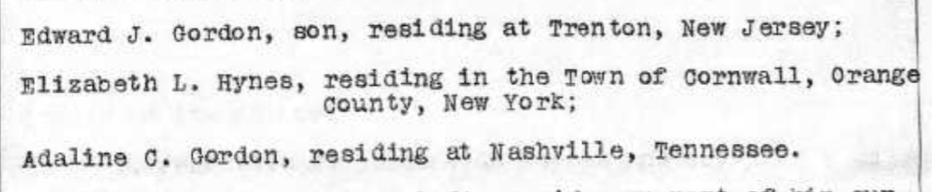
In 1912 James Gordon died at age 74. According to legal documents pertaining to his estate, Addie still lived in Nashville at that time.
Excerpt from the 1912 petition Nettie Gordon for the disposition of James Gordon’s estate, detailing the whereabouts of three of their four children. It is unclear why daughter Jennie is not listed.
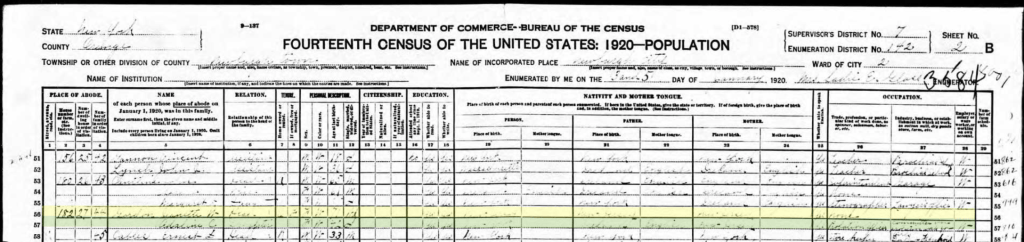
According to the Newburgh City Directory, Nettie lived in the house alone until 1916, when Addie returned. Nettie and Addie were still living there in 1920, according to the U.S. Census.
1920 Census showing that Nettie Gordon lived with her daughter Addie in the Newburgh house
I have no information of what Addie was doing in Nashville for 8 years. She appears to have been left out of the 1910 Census, which would have provided useful information, including an occupation. My guess is that she was teaching and perhaps a student. The guess is based on her father’s life in New Jersey and Philadelphia at a similar age. Recall that her sister, Bessie, was also a teacher, until her marriage.
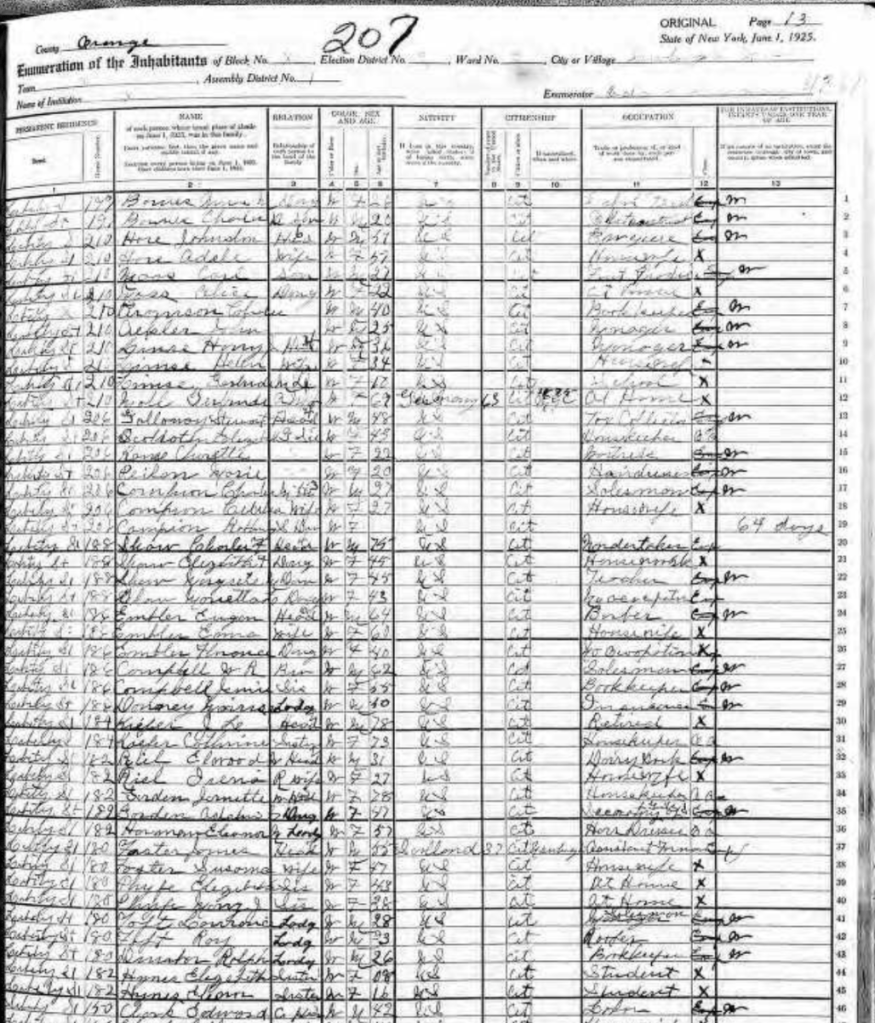
The 1925 New York Census continues to show Addie continuing to live with her mother in the house.
1925 New York State Census showing that Nettie Gordon continued to live with her daughter Addie in the Newburgh house (lines 34 and 35). The document also indicates that Addie’s nieces Elizabeth and Eleanor Hynes lived in the house with them (lines 44 and 45).
A closer look at the 1925 New York Census reveals something very unexpected. Nine rows below the entries for Addie and Nettie are two additional entries for 182 Liberty Street. The entries are separated as if the census taker got interrupted and came back a little later. In 1925 Elizabeth and Eleanor Hynes, ages 18 and 16, lived in the house at 182 Liberty Street with their aunt Addie and great aunt Nettie, 50 miles away from their family home in Brooklyn.
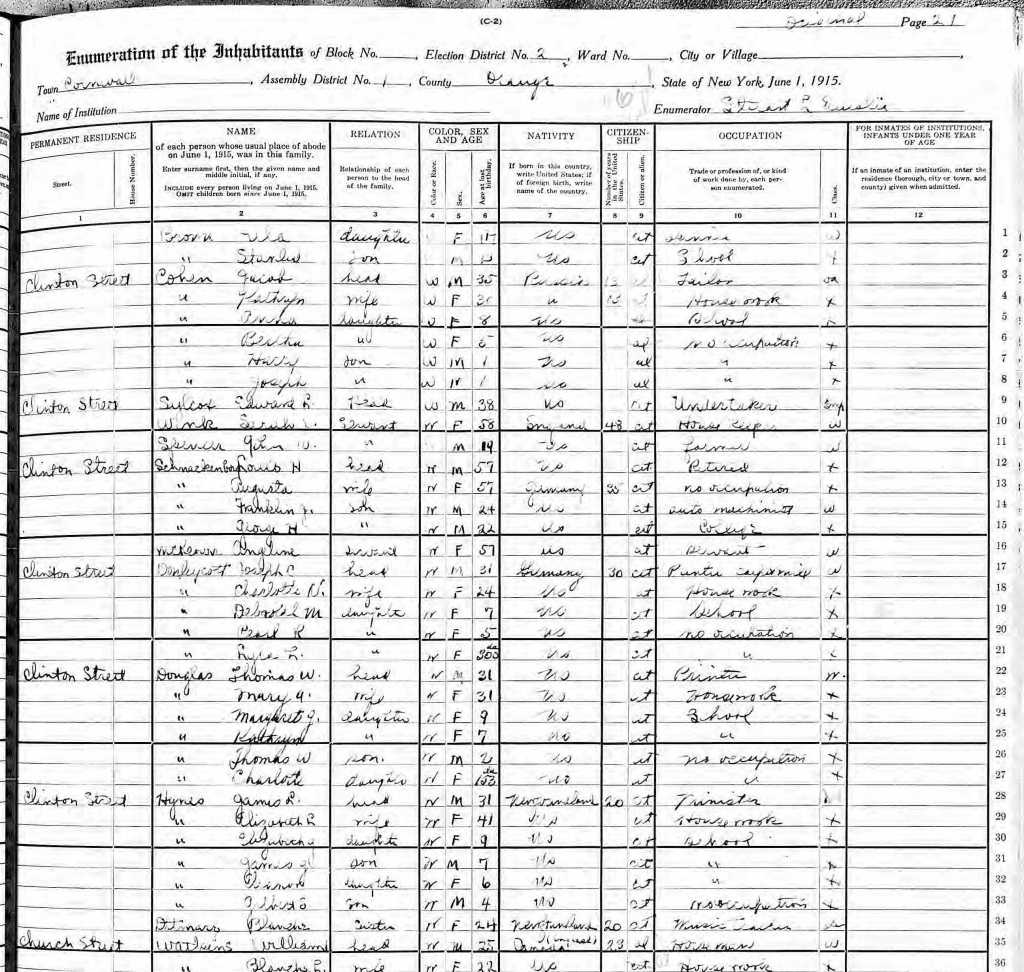
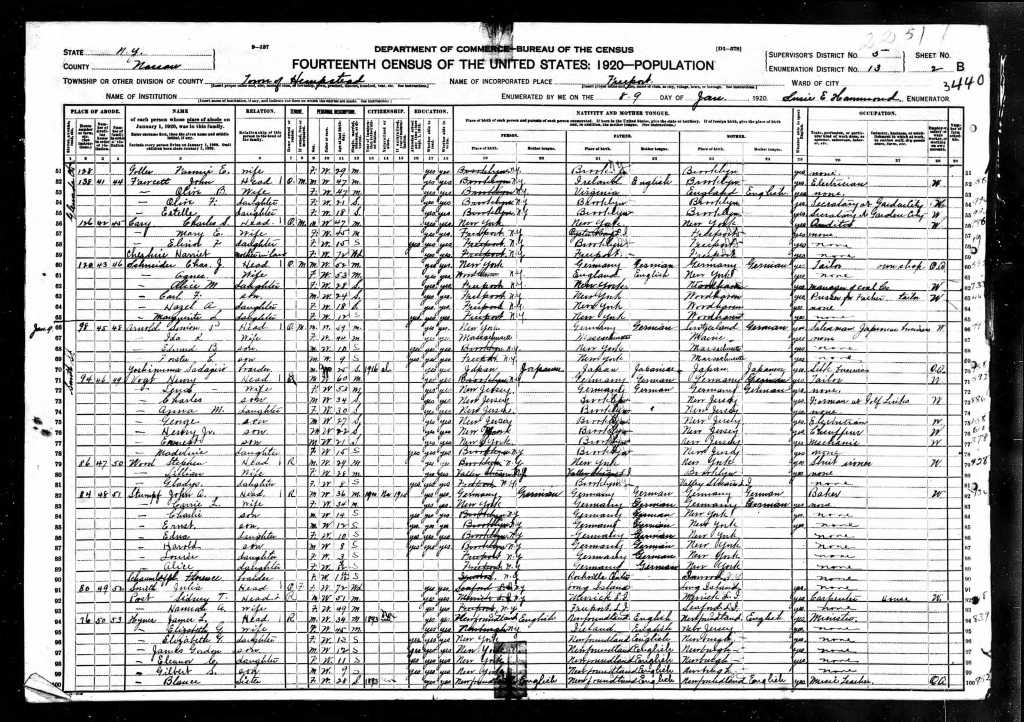
Blanche is of interest in our story, but is difficult to find information about. She was 19 in 2010. By the 2015 New York State Census she has returned to live with her brother’s family in Cornwall. Strangely, she appears as Blanche Detmar or Ditmarr. If she was married after 1910 it does not seem to have lasted. There is a December 1910 record of a marriage to a Lester Ditmas, but no other records of Lester can be found. Later information on Blanche is also difficult to find. In 1920 she still lived with her brother’s family, now in Freeport, Long Island. After 1920 there is one additional Social Security record in which Blanche appears as Blanche McAllister, so it seems that she remarried. Second great grandmother Hannah is nowhere to be found after 1910 except that she appears to have eventually gone back to Newfoundland where she died in 1950.
The 1915 New York State Census shows that Blanche lived with her brother James’s family in Cornwall. She is listed with a different last name (line 34) suggesting that she was married for a short time.
James moved his family to Freeport sometime after 1915 to become pastor of the Freeport Baptist Church. In 1919 he took a position as pastor of the Bushwick Avenue Baptist Church in Brooklyn. He must have commuted to Brooklyn from Freeport for a while since he still lived in Freeport at the time of the 1920 Census. The 1925 New York State Census seems to have missed James and his family, but they probably lived in Brooklyn by that time. As we have seen, James’ and Bessie’s daughters lived in Newburgh in 1925, with their Aunt Addie.
1920 US Census showing the Hynes family living in Freeport including children Elizabeth (13), J. Gordon (12), Eleanor (11), and Gilbert (9). Blanche, age 28, still lives with her brother’s family.
Aside from census reports, direct information about James in Cornwall and Freeport is pretty scarce–just a few church notices in local papers. Even if there were more published, it would certainly not reveal the true nature of what was going on. Family oral history also says that our grandfather, Gordon Hynes, who was 8-18 years old between 1915 and 1925 had to spend parts of his childhood defending his sisters from the advances of their father. The situation culminated with James fathering a child with younger daughter Eleanor around 1922. It is clear that Elizabeth and Eleanor were removed from the household, by family intervention, in the years leading up to 1925, sent to live with their Aunt Addie in Newburgh.
Consistent with the theory that she shared her father’s penchant for learning and was a student in Nashville, Addie established a professional career after her 1916 return to Newburgh that continued for at least 36 years. The Newburgh City Directories provide an outline and timeline for the development of this career:
In 1918 she is listed as the Assistant Secretary of the YWCA
In 1919 she is listed as a Protective Officer for the City of Newburgh.
In 1920 she is listed as a Probation Officer. The 1920 Census also lists this as her occupation.
Between 1924 and 1960 (ages 46-83), she is listed in various executive positions with the Newburgh Girls Services League
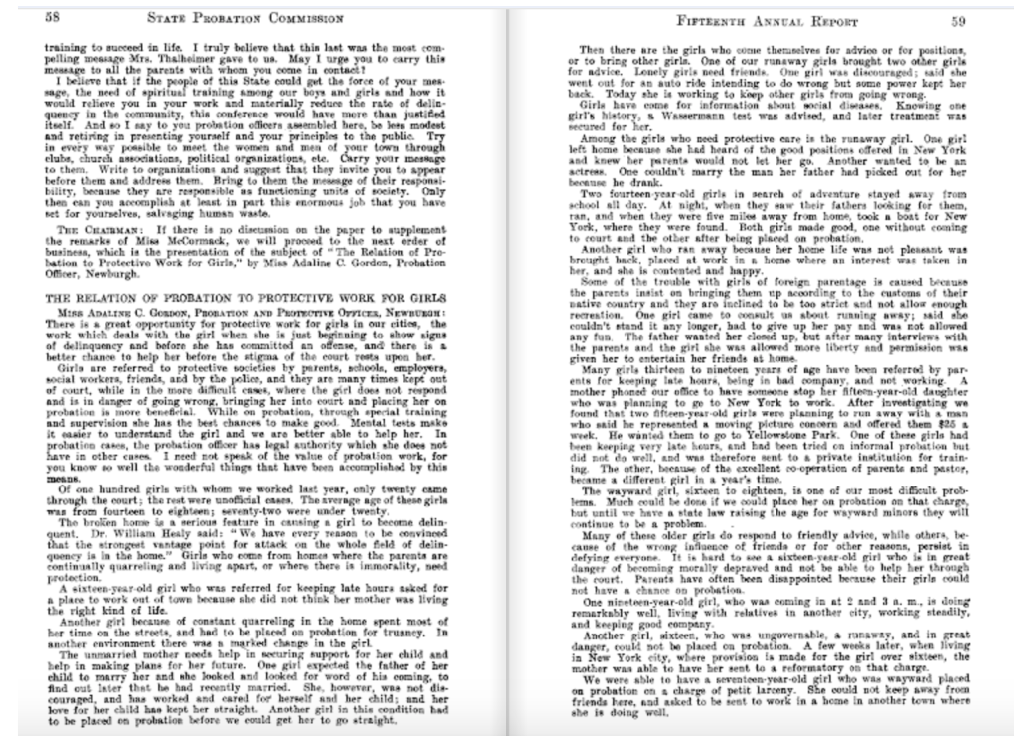
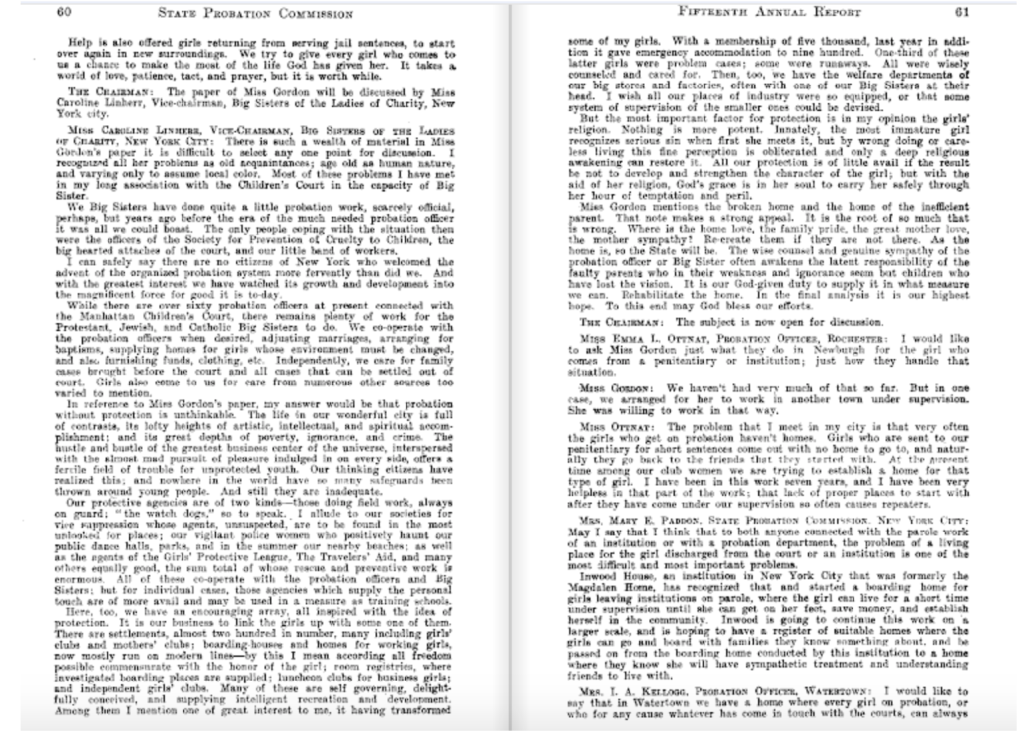
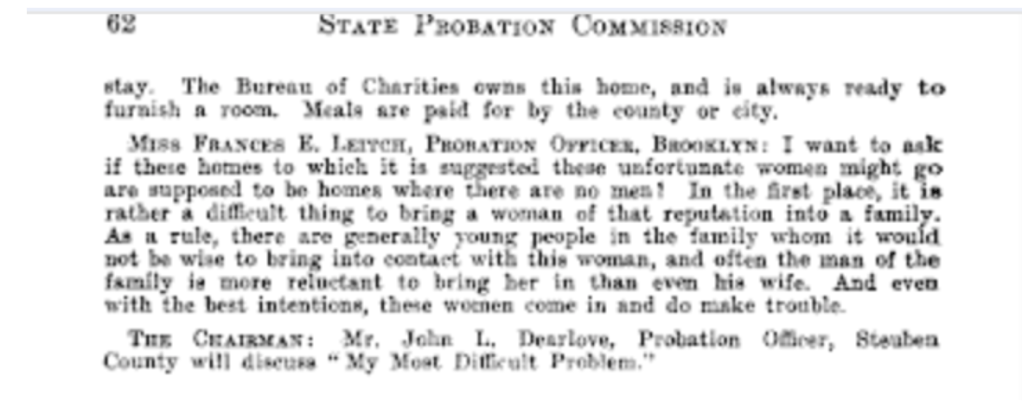
A 1921 publication of a transcript of a presentation Addie gave to the New York State Probation commission summarizes a paper she wrote on some of her findings in the field, and gives insights into her work.
1921 Transcript of presentation given by Addie Gordon to the New York State Probation Commission, summarizing her findings and beliefs in supporting young women with troubled backgrounds.
Since we don’t know what Addie did in Nashville, we can’t tell whether her earlier studies led to this career or it is something that came about after 1916. But it is difficult to believe that the similarity between Addie’s lifelong work in support of young women and the circumstances of her sister’s marriage to James Hynes could be a coincidence. Addie must have been aware of Bessie’s problems from the time of her marriage to James in 1905. It is possible that, in addition to needing to take care of her widowed mother, Addie’s return to Newburgh had something to do with her sister’s problems. At the very least, Bessie would have had too many problems of her own to be able to attend to their mother, so the responsibility must have fallen to Addie.
At the time of Addie’s return to Newburgh, James and Bessie had Blanche living with them (after something went wrong with her marriage), their daughters were entering their teenage years, and their son was learning to protect his sisters from their father. With all this going on, Addie would have been looking for ways to help her sister and nieces, making contacts and asking questions, which may have sparked her career interests. Between Newburgh and Freeport is New York, so I can imagine that Addie’s entanglements with her family problems led to the development of contacts and sources in the big city.
By the time the illegitimate baby came in 1922, Addie must have been the one in the family with professional knowledge about how such things were dealt with. She must have played a role in putting the baby up for adoption or whatever the solution would have been. And she must have been the one to set in motion the plans for removal of her nieces from their home in Brooklyn for the remainder of their teenage years.
I have summarized the purpose of this forum as “exploring the lives of eight great grandparents who led astonishing or extraordinary lives”. The definitions of the words “astonishing” and “extraordinary” do not necessarily imply “virtuous” or “agreeable”. James Hynes did not lead a virtuous life despite outward appearances, nor could much of Bessie Gordon Hynes’ life have been considered agreeable. Addie’s life, on the other hand was astonishing and extraordinary in all of the good ways. She was an educated career woman in an era when that was not common. She gave a life of service to her family and community.
Leaving Vermont, great grandparents Edward and Annie Calderwood Sandford, with infant daughter Saada, made their way west. They passed through Cheyenne, Wyoming in the Spring of 1981, where Edward had found a temporary engagement with the Baptist Church, and settled in Northern California later that year.
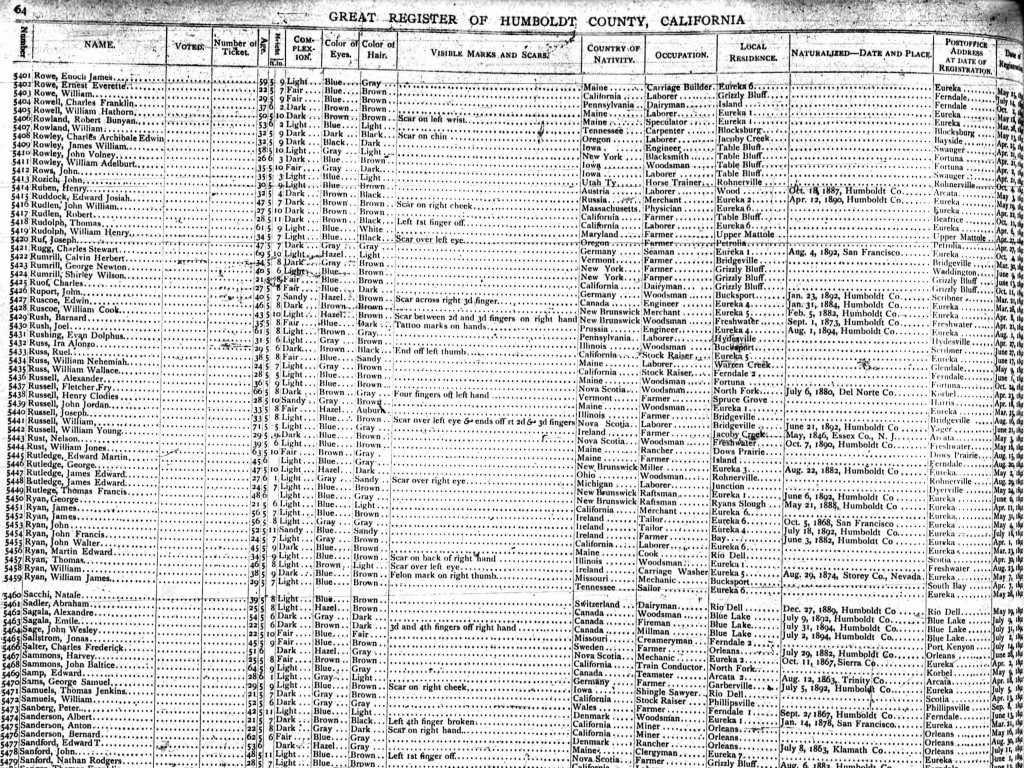
Edward became pastor of the Baptist Church in Eureka, California between 1891 and 1894. Voter registration records show the family living in Eureka in Humboldt County in far northern California in 1892.
Humboldt County voter registration records show Edward Sandford living in Eureka in 1892 (entry near the bottom of the page). The record also tells us that Edward was six feet tall.
Grandfather Joe Sandford was born in Twin Lakes, near Santa Cruz in May 1892, so there must have been some juggling between Eureka and Santa Cruz (which are about 200 miles apart) during this time, the details of which are not clear. The family would have arrived in California in 1891 by the transcontinental railroad to San Francisco, so they may have waited there for the baby to be born before proceeding to Edward’s new job in Eureka. The railroad did not reach Eureka until early in the 20th century, so it must have been a boat trip up the coast.
After living in Eureka, the family returned to Santa Cruz for a two year engagement with the Baptist Church there, somewhere between 1894 and 1897.
In 1897 or 1898 they moved to Corona in southern California, 45 miles east of Los Angeles, where Edward preached at the Corona Baptist Church.
Their third and last child, Helen (“Honey”), was born in Corona in 1898. The family stayed in Corona for about 10 years.
The motivations for Edward’s westward migration make themselves clearer in looking at his life in California. Edward had entered the ministry after his diplomatic tour of duty in China with the specific ambition to become a missionary in China. However, his family life, specifically the ill heath of his first wife Sarah, precluded that for the next two decades. He remained in Vermont but, following Sarah’s death and his remarriage to Annie, he had another chance to pursue his vision, although by this time his age and health made a return (third) trip to China unrealistic. He took what was perhaps the next most ambitious path, following the expanding frontier of the United States to its extreme in California. Indeed, the work he did in Corona appears to have taken on more of a missionary flavor than his work in Vermont. Edward’s obituary, still decades in the future, would later summarize this period in his life as follows:
While in Corona he became well-known and loved in the community through his earnest desire to help anyone who was afflicted with suffering or sorrow, making it a custom to visit the sick and afflicted throughout all the country round about.
Saint Johnsbury Caledonian Record, October 25, 1922
Around this time in our story, the source of the narrative shifts to our grandfather Joe, who left many detailed notes and remembrances in his later years, beginning with his recollections from Corona, where he lived between ages 5 and 15.
Joe loved to tell stories. He recorded at least three sets of living history interviews years in the 1970s, sponsored by local historical societies and libraries. The three sets of interviews have a lot of repetition between the stories, which makes it possible to correlate and select between versions. Some of the stories are somewhat familiar to me–I have vague recollections of having heard them from him.
And my father and family moved out to Corona, California, a little community across the valley, about 1897. I was a little boy then. We lived in Corona for some ten years, perhaps twelve years. I went to grammar school there. ……. Corona is a circle city—crown. You’re familiar with it probably. It was a lovely community.
Joe Sandford from 1973 Living History Interview with Esther Boulton Black
My father was a minister and pastor of the First Baptist Church in Corona. We’d moved from Santa Cruz, California to Corona in the later part of the century, about 1897. And sometime you’d love to have his history, it’s from Abraham Lincoln and so forth. And, one little story there….I’ve always worked, father they told us if we would move to Corona that we could have all the oranges we wanted. We arrived there, occupied a lovely two-story home, that’s been owned by a doctor. I can remember as a little chap I went to the house and out the back door and there was an orange tree, covered with oranges.
Joe Sandford from 1974 Living History Interview conducted by the Upland Public Library
My father was pastor of the First Baptist Church of Corona from 1897 to about 1908. Those were the horse and buggy days. They had a livery stable….in Corona. My father out of his own pocket would rent a rig, as we called it, and he would drive out into the valley, to Auburndale, to the Pioneer district, and visit the farmers there. Then he would hold services in the different schoolhouses on Sunday. Me, a little termite going with him out into this south country here, I would see smoke coming along here, and I’d say, “Dad, what’s that smoke over there?” “Joe, that must be a train.” I wondered as to whether I would ever get over where that railroad was.
Joe Sandford from 1976 Living History Interview with Bryce Denton
Joe describes in detail his early work experiences…
As a boy, my father always wanted me to work, and I always wanted to work. My father was a minister. Our funds were limited. Salaries–there weren’t salaries. You had to limit yourself. Anyway, I was asked to peddle bills [i.e., handbills–ads]. One of the merchants over there would have me peddle bills. I had to do it walking. He would give me a dollar for a half day or a day; if there weren’t enough houses for the bills, I’d stick them in the hedges. The boys today still do that.
Anyway, the day came when one of the merchants said, “Joe, you’ve been delivering these bills for us, why don’t you come in and work after and before school, and holidays? How much would you charge?” It was a grocery store. I said, “Well, you’re paying me a dollar a day for half day’s work to get these bills out, how about a dollar a day?” Well, he said he couldn’t pay me that much. But I learned a lesson.
Another man bought the store in Corona–C.W. Veach and Son. I used to hold father’s hand and go down there when he’d buy groceries, and Mr. Veach–my father asked him if he’d like to hire me. He said, “Well, how much would you ask?” Well, I’d learned that a dollar a day was too much. I wanted a job. I said, “Well, how about fifty cents a day, three dollars a week?” “You’re hired.”
Well that man, I stayed with him for years, loved him. They taught me so much.
Joe Sandford from 1973 Living History Interview with Esther Boulton Black
Joe has specific memories of adventures and mishaps during his time working for the market….
Over in Corona I was working for Veach and Sons. We bought a team of mules, and they were wild; they’d never been broken in. We had a delivery wagon with a cab to deliver our groceries and things. They would always send two men out. One man would take care of the mules while the other would go in with the groceries. They didn’t have a brake on this delivery cart. After a year, one day, they let one man go out. The mules were supposed to be trained. I can remember in Corona I went off West Sixth St., and it was contoured like this. In those days you could park on either side. Today they put you in jail if you park … And I saw this flock of sheep off toward Rincon, toward Prado. I could see the mules were a little bit restless. They saw this flock of sheep coming and the dust. I thought I had plenty of time to get in there with those groceries and get out. Well, I came out just in time to see them make a turn and head back to town. They went around so fast that they turned the cab over and the whole thing, and broke away harness and all, and ran away. The boss was awful nice and never reprimanded me.
Joe Sandford from 1973 Living History Interview with Esther Boulton Black
Another time, an older gentleman in the store had taken those mules down to have them shod. We didn’t have the cart for long, but they were all harnessed. He said, ” Joe, you stand up at the front and hold on to the bridle, and I’ll drive them. To me, that was kind of foolish; it made it so slow, you know. So I said, “Why don’t we drive them?” And he said, “You come drive them.” So he turned the reins over to me and he didn’t stay at the head. Well, they walked about two steps. Then they commenced to trot. I couldn’t keep up with them; they just ran away. He knew something I didn’t know, you see. I thought I knew it all. But the lesson I learned there. You have to learn. So it goes.
Joe Sandford from 1973 Living History Interview with Esther Boulton Black
Joe’s path to becoming a banker began early in his life, in Corona, directly resulting from his work in the market…
And, I worked before and after school as a little fellow, and one day one of the directors of two banks over there, the Citizens Bank and the First National Bank of Corona, came down to the bank and he said “Joe,” he said, “that Mr. Kinney, the president of the bank, wants to see you.” I was probably about 14 years old.
Well, you didn’t need to tell me anything twice, so pretty soon I went up to see Mr. Kinney. And he said, “Joe we’ve been watching you, you’ve been sweeping out down at the store working there before you went to school and coming back after you went to school and so forth, working weekends, the holidays. We’d like to have you do that in the bank.” I did that.
Interviewer: That’s how you got started?
That’s the way I got started, in the bank. Just think of it, the director of the bank.
Joe Sandford from 1974 Living History Interview conducted by the Upland Public Library
Joe carried his work ethic from the store to his new job at the bank…
And it was fun. And I did just as he said–go down in the morning and sweep up, in the afternoon I’d go down and do the bookkeeping and some of those things. One morning he came in where I was working and he said “Joe, come over here.” And he pulled out a drawer in a desk and he taught me the combination to the vault. He said “Joe, you can have this, and you can have this open for me tomorrow.” Well after he left, I said “well why’d he pull out that drawer?” Well the numbers he’d given me were written on the margin. Well, he came in, probably at 9:30, and he pulled out another drawer, and he went and opened up the time lock. Well after he left, I went and looked at the other drawer, and the numbers were there. Well, it didn’t take me long to prove–they were the ones–so the next day I had the money out for him. He came in and said “well, Joe, who taught you to do this?” Well, I told him the story. Well he was (?) and he had confidence in me and said “Joe, don’t tell anybody, you can have it out after this..” Well, he could have fired me. But I’ve always tried to do that, to anticipate and do things.
Joe Sandford from 1974 Living History Interview conducted by the Upland Public Library
Joe got his work ethic from his father, but also his moral compass, even as he moved further into a line of work much different from that of his father….
My folks, father having been and was a Baptist minister at that time, and my mother, they were always against saloons and liquors. We had two saloons in Corona at that time. And each saloon paid $300 a month license fee. And so, I was kind of prejudiced against the employees of saloons. One day one of the men from the saloon came in and he wanted 50 pennies, along with some other things. And I gave him what though was–they were rolls, you know–and I gave him a roll. Pretty soon he came back. He said “Joe, didn’t you make a mistake? You gave me 50 dimes.” Five dollars. I said “gee there must be some good in these saloon keepers.” I learned a lesson, there’s good in everybody, he was honest in other words. And the saloon keepers all loved my father because he said “I admire you, I don’t like your business, but you have wives, you have children, you want them to be in church and Sunday school, and anything I can do for you, I want to.” He didn’t kick ’em out of town, but he rendered a service to them.
Joe Sandford from 1974 Living History Interview conducted by the Upland Public Library
Joe became an astute banker. Even in the 1970s he was able to recall details about the workings of the banks, the financial world, and many of his clients over his long career….
One day in the bank, in 1906 we had a depression, and they called in all the gold. The Los Angeles banks were issuing certificates, and so forth. Well one day a sheepherder came in–they used to have a lot of sheep in the hills, southwest of Pomona and down in the Corona hills–one day a sheepherder came in with a can of $20 gold pieces. There was something about gold, the feel and the ring of it and all that I loved. I used to keep those as part of our reserve in the little bank. I never sent it in to Los Angeles.
Joe Sandford from 1974 Living History Interview conducted by the Upland Public Library
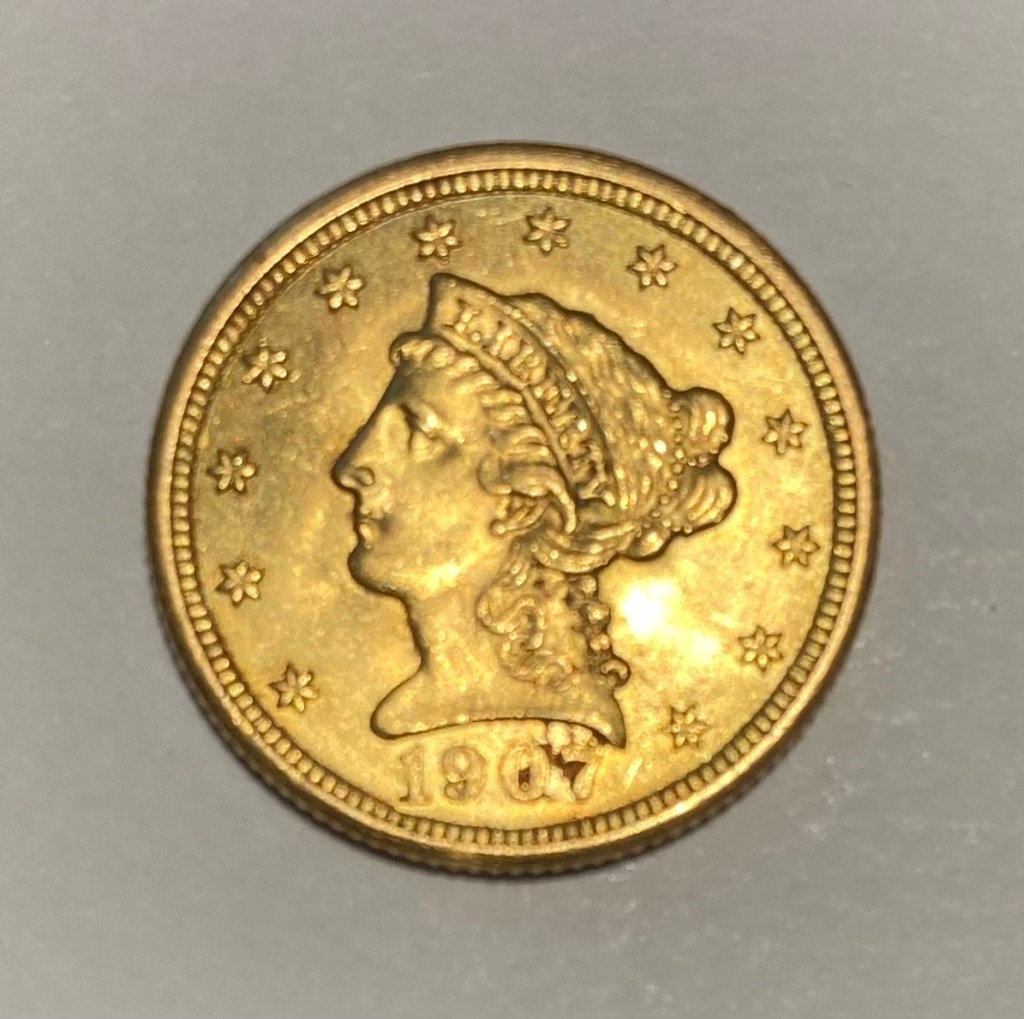
A $2.50 gold piece was maybe a little bigger than a dime. We used to have some, but we gave them to one of our boys for souvenirs.
Joe Sandford from 1973 Living History Interview with Esther Boulton Black
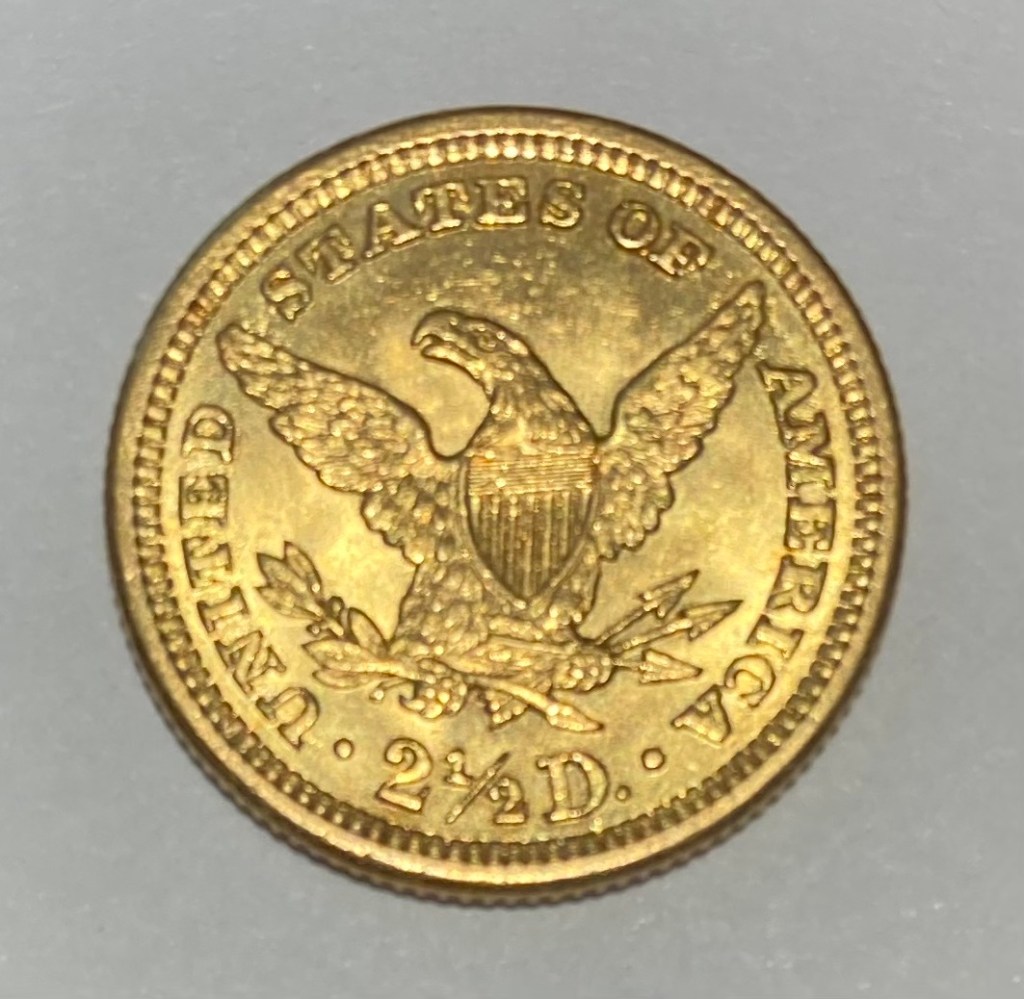
It may be one of these $2.50 gold pieces that was given to me by my grandfather as a child and which I still have today.
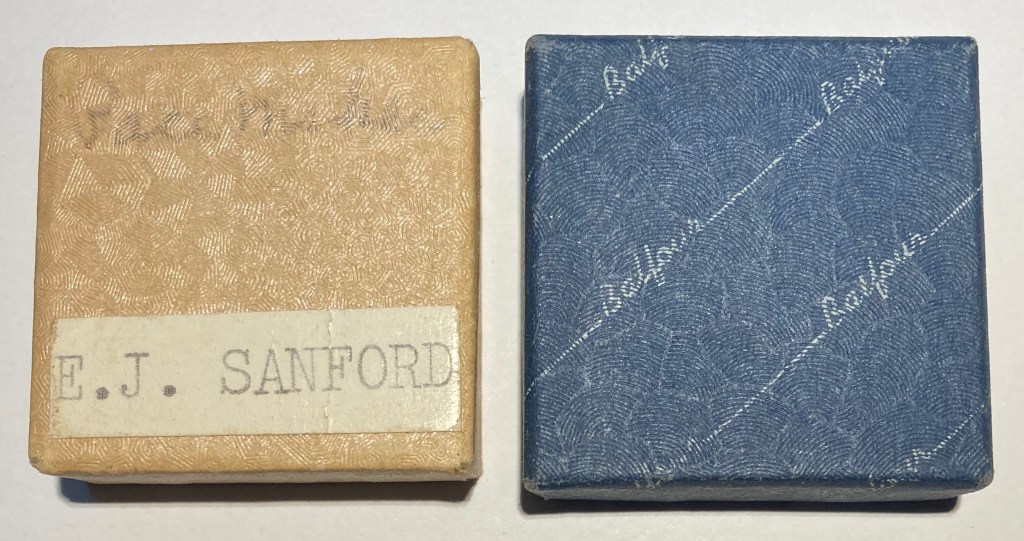
1907 United States $2.50 gold coin, given to me as a young child in the 1960s, which seems to match the description in Joe’s story. The coin is about the size of a dime. It has remained in this box since the gift was made. I do not know who labeled the box with the misspelled name.
I will close this chapter on the Corona years with the following words which Joe used to end one of his Corona stories and which captures the spirit with which he recalls of these early days in Corona and the nearby towns that were to come next.
In the early days, the pioneering people of the valley were very proud. They came out here very interested in improving the valley–what could be grown here in the way of fruit, grain and stoop labor products? Our largest product in this area up here in Upland were oranges and lemons at that time. Then south of the railroad, the Southern Pacific Railroad, we had deciduous trees: peaches, apricots. And we grew alfalfa and some of those products. It was a lovely period for everybody. Horse and buggy days. The automobiles were just beginning to come in. These people that came here, perhaps they would have ten acres of oranges, lemons or what have you. It seemed to me at that time, they would cultivate the groves one day, and then once a month they would irrigate, and they would furrow out [??] to receive the water and irrigate the trees. Another day they would close the furrows. The rest of the time it seemed like they were visiting each other with their horses, and going to church. It was a lovely class of people. Each man was a king, you might say.
Joe Sandford from 1973 Living History Interview with Esther Boulton Black
By the time his family left Corona, Joe was a young man, 15 or 16 years old, with a firm set of ethics inherited from his parents, and a firm foothold in the banking business where he would work for the next half century.
We continue our discussion of second great grandfather James Gordon’s correspondence with his brother William and sister Jane Hawthorn. Recall that James left Northern Ireland for Newburgh, New York in 1857, while William and Jane later established themselves in New Zealand, where their branches of the family remain today.
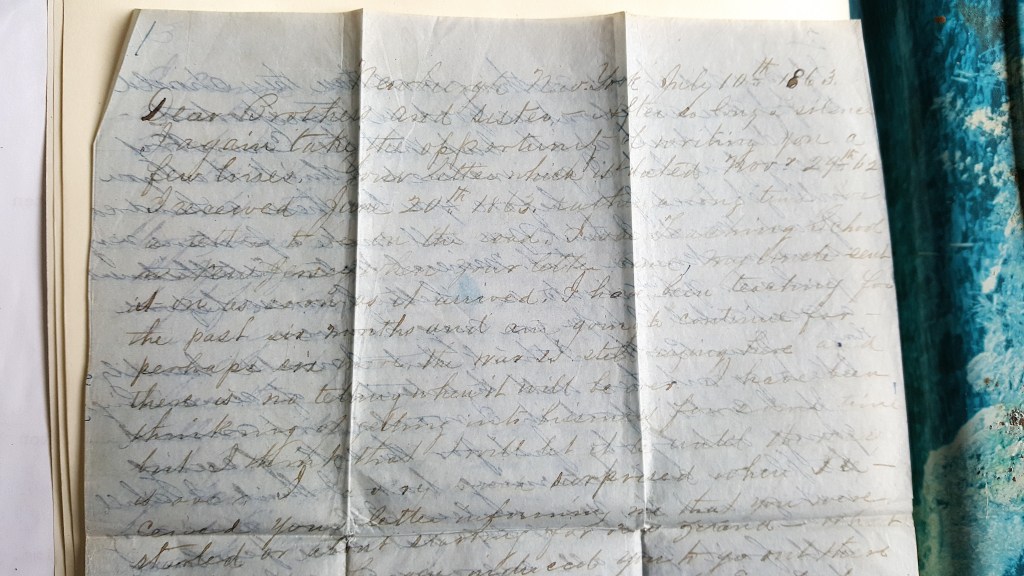
The following letter, again courtesy of our (genealogically and geographically) distant cousin Claire, was written in the summer of 1863, two years earlier than the previously posted letter. James had been teaching in New Jersey but had not yet started his study of medicine.
A transcript of the letter follows. The original is difficult to read because it is written on both sides of the thin paper, the diagonal lettering on the back side bleeding through, crosshatching the lettering on the front side. The total letter is seven and a half handwritten pages. Pay particular attention to the section in bold type in the transcript.
Newburgh New York July 10th 1863
Dear brother and sister—After so long a silence I again take the opportunity of writing you a few lines. Your letter which is dated Nov 29th ’62 I received June 20th 1863. Such a long time for a letter to be on the road(?). I was teaching school in New Jersey when your letter came, my Uncle sent it on as soon as it arrived. I have been teaching for the past six months and am going to continue for perhaps six more. The war is still raging here and there is no telling when it will be over. I have been thinking of getting into business for some time but I think that I will let it be until the waris over. I was? very much surprised when I received your letter informing me that you were started or about starting off for New Zealand—what (?) induced you to go out there is more than I can tell. Did the English Governor offer inducements? and if so what were they? There must certainly be sone inducements or you would not transport yourselves to an island inhabited by a lot of savages or worse. If the English Government want their savage islands populated by a whole race would let them go and settle down there themselves. You are now further off then where they used to transport people to —you know that they used to transport those convicted of crimes to Botany Bay and give them a (?) for passage. I suppose they hardly gave (?). If they did it was nothing more than they should do for you are about as good as transported.
I don’t doubt at all but that the country is very fine but I am inclined to think that you will get tired of it before you live there a hundred years. Nor do I think you will make a fortune very soon working in that mineral water establishment perhaps you will get into a better business before a great while. I hope you may, however long.
Dear brother I think that I would hardly likely to go out there with the intention of remaining. If I could afford it I would not mind going out by and by, just for the sake of seeing the place and returning but I think I shall not go out this year unless I have some very good inducements. I hope that these few lines will find you all enjoying good health, as it leaves me. You must try and write to me every three months and I will do the same. I hope that you may like the place and do well. It seems to me that you will not have much trouble to get to the salt water. You can go to New Castle every day. I think you will enjoy it very much. Have you seen any of original inhabitants of the island? And if so what do you think of them (?) a fine (?) of boys and girls? I think you had better quit working at the soda water and see if you can’t convert them to Christianity or are you converted yourselves?
I came to Newburgh yesterday. I have vacation of two weeks then I shall go back to New Jersey and take my school exam.
My Uncle, Aunt and family are all in good health (the family consists of two children, boys) one named Joseph aged 4 years 8 months, the younger named William George aged 14 months, both fine children and lively as crickets. By the way I would like to see Jane’s children very much, perhaps I will come out by the by and see them. James McClughan and William Henry are both here now. They came out from the old country in the month of May. They landed on the 8th of May in Canada and came from there here. They are both at work. William Henry is working in a store and James is on a farm, or something of that sort. I have not seen James yet. It is strange that I did not get your letter sooner for my Uncle Alexander had received a letter from you before they left and they brought word here of your arrival before I received your letter. In your next letter you must give me a history of the country and tell me whether you think I had better go out and see(?) those Hottentots [crude reference usually used for African natives] or not.
I suppose you have received a letter from my Uncle Alexander before this time. I understand that they are all in good health. Joseph Burrows is out here yet he talks some of going home.
The rest of the Burrows family are in good health except Sarah and she has been unwell for some time with chronic res(?). I think you have heard that she is married. She got married some 18 months ago to a Wm Wallace, a bookkeeper. She has had a young son some time ago. The rest of the family are in good health. Samuel and Alexander are in the (?) business and the manufacture soda water and sassaparilla(?) besides and send it all over so they are doing quite a business in Newburgh. Alexander had a family of three children. Samuel is not married yet but expects to be soon. Jane Burrows is living in Newburgh and boarding with Alexander. She is not married yet. Elizabeth is living with Sarah, her husband died some time ago. Her health is not quite as good as it used to be. Helen (or Mrs. Mahood) is living about two or three miles from Newburgh. They James bought a farm. They are getting along as well as possible. I think I have given you a pretty good account of the Burrows family.
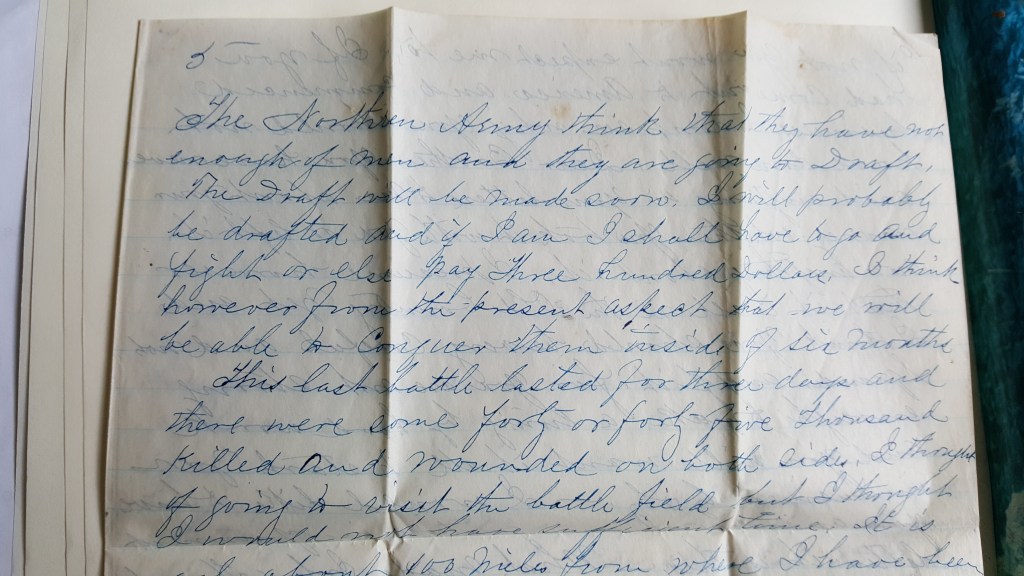
James Harrison’s family have left Harrisons Close and gone out to Pittsburgh in the state of Pennsylvania. I live in the state of New Jersey where I have been teaching school. In this same state there has been great battle fought last week the North were victorious. The Northern Army thin that they have not enough of men and they are going to draft. The draft will be made soon. I will probably be drafted and if I am I shall have to go and fight or else play three hundred dollars. I think however from the present aspect that we will be able to conquer them inside of six months. [it took 21 months]
This last battle lasted for three days and there were some forty or forty five thousand killed and wounded on both sides. I thought of going to visit the battle field but I thought I would not have sufficient time. It is only about 100 miles from where I have been teaching. I could go in about 4 hours ride on the railroad. I think from your accounts that Saboners(?) are pretty well paid for their work. What was your intention before your went there? Did you intend to go at storekeeping or at farming or what? Will it pay to keep a store there? If it does why don’t you go at storekeeping? Or if you don’t like it will you come back to Ireland or America? Give me all the particulars in your next. As I have said before, I would like to have you write every three months at least, and if I am on the land of the living I will reply. If not, you won’t expect me to. If you had come out to America and commenced business, I don’t see why you should not have done well. Dear brother you have never said anything in your letters to me about your money, whether you took it with you or left it, nor anything about it. I presume however that it is all in the old country yet and I think you should be very careful and not squander any of it, for you are not strong enough to make a living by hand work and you will want it all to start you in business by and by. I would like to have you answer me one question in your next letter—it is this. What made John Thornton, Jane and you leave and go to New Zealand? Was John not making a living in Belfast? That he left there and if he was doing well as I suppose he was, if he attended to his business, what made him leave? These are things I would like to understand.
I do not want to know these things from mere curiosity. The reason I want to know is because I take an interest in the welfare of you all.
Sunday July 12th 1863. James McClughan is in from the country. He and William Henry are both here. James says that he promised you to go with him to New Zealand if you sent him good word. He says that he did not then think of coming out to America. James McClughan the widow’s son intended going out to [too?] but when he was at Belfast he had his pocket picked of all his money, returned back and would not start again. I suppose you are aware that Joseph Burrows came out here some time ago. Since he came out his father died. He thought of going home but has not gone yet and will not go before the fall of the year. He is working out in the country now in haying and harvest. Joseph Burrows had a letter from his mother last night. They are all in good health. They state that the English Government are giving a free passage to all who choose to go to New Zealand. James McClughan, William Henry, My Uncle and Aunt and all the folks send their kind regards to you all. I do not think of anything more that I can write you at present. If there is anything that you wish to know regarding anyone or anything, just let me know in your next letter and I will try and give you the desired information. Hoping to hear from you soon and often. I remain as ever your affectionate brother James Gordon, New Hampton N.J.
To William Gordon, John and Jane Hawthorn, Auckland, New Zealand
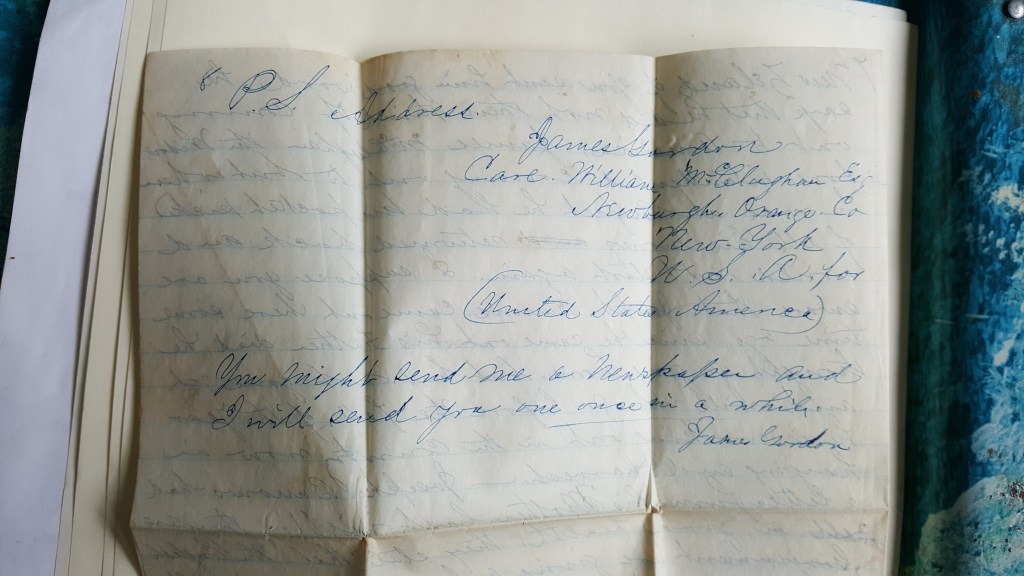
P.S. Address
James Gordon
Care William McClughan, Esq.
Newburgh, Orange County, New York, U.S.A. (for United States America)
You might send me a newspaper and I will send you one once in a while.
James Gordon
Letter from James Gordon of Newburgh to brother William Gordon and sister Jane Hawthorn of New Zealand, July 10, 1863
Interspersed with family talk, the bolded section refers, of course, to the Civil War Battle of Gettysburg which had ended a week earlier on July 3, 1863. (I wish I could shake James by the shoulders and say “yes, please spend the $20 to take the train and visit the town, you will never get closer to the main flow of history!”)
Aside from the flow of history, I imagine that William and Jane got a little tired of James going on and on about how they could possibly want to settle in New Zealand and wouldn’t they be better off somewhere/anywhere else? James’ 100 years prediction was incorrect, the family is still there, happily, after 157 years. (Had history shifted just a little, we could all be New Zealanders now!) After 157 years we can probably forgive James’ derogatory remarks about the natives–it might be difficult to find any ancestors who didn’t say similar things during their lives.
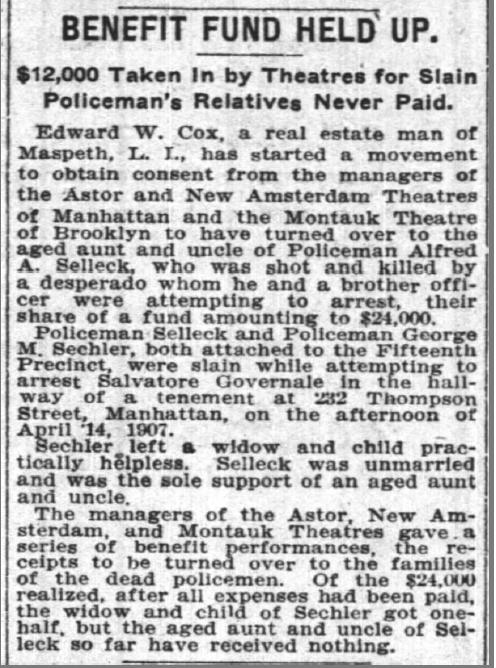
Great grandmother Laura Sechler was forty years old with seven week-old daughter Ruth when they lost husband/father George in April 1907. In the years to follow, chaos and public spectacle would give way to a new everyday life as the pair adapted to their situation.
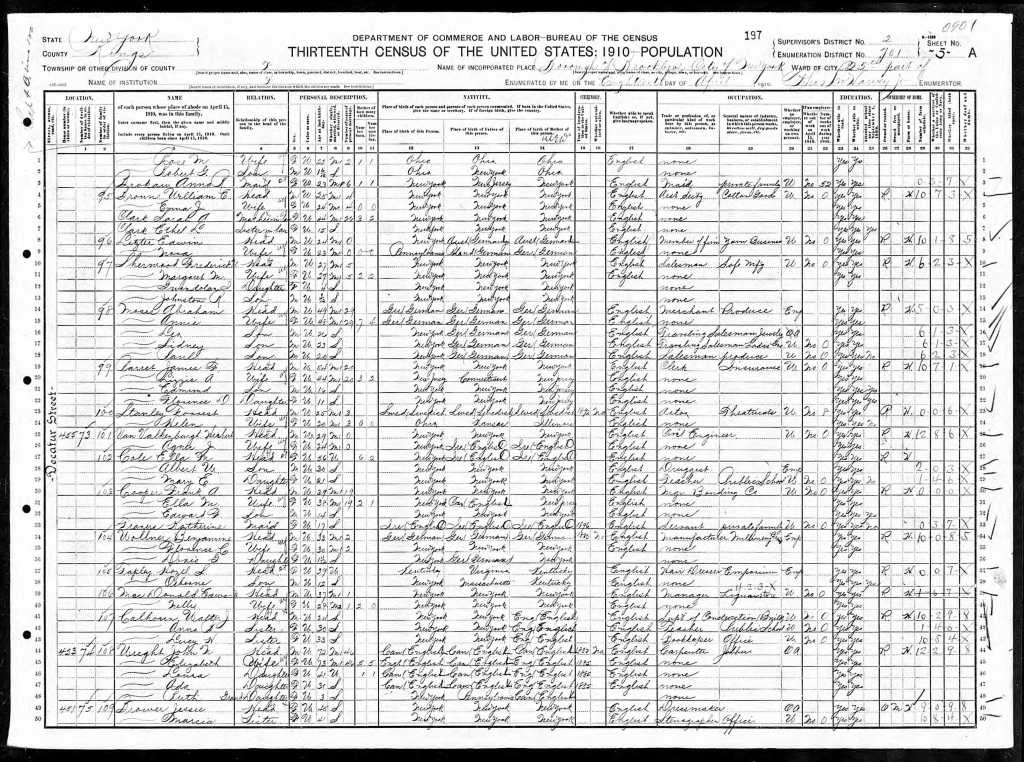
The 1910 Census shows that Laura moved back to her family home in Bushwick / Stuyvesant Heights, Brooklyn, giving up the home she had shared with George in downtown Brooklyn. The census names Laura and daughter Ruth living in the home with parents John and Eliza Wright, as well as Laura’s 31 year old sister, Ada.
1910 Census showing Laura and Ruth living with Laura’s parents John and Eliza Wright and Laura’s sister Ada (near the bottom of the page)
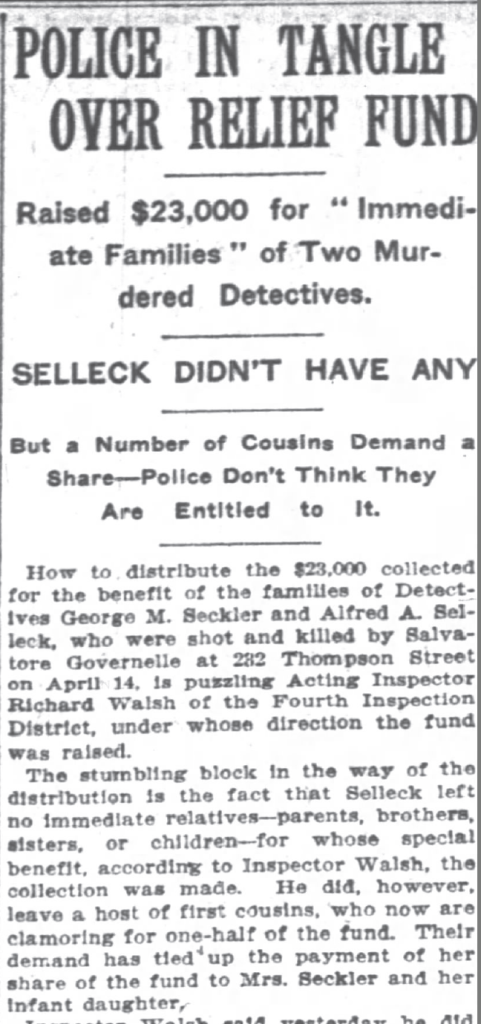
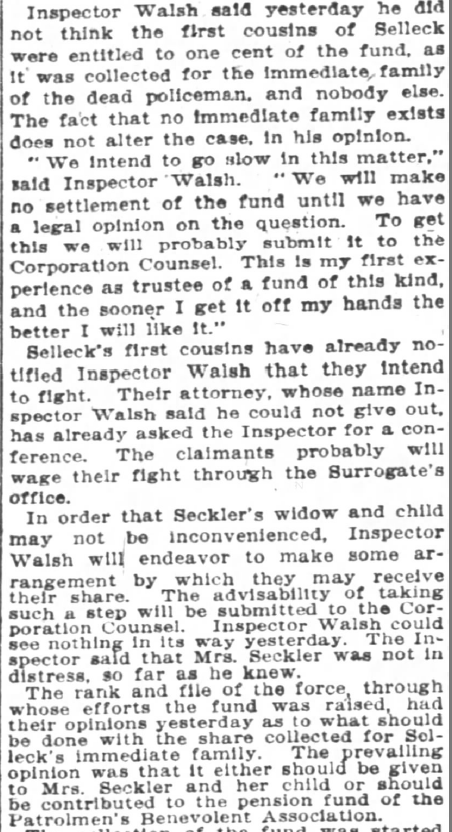
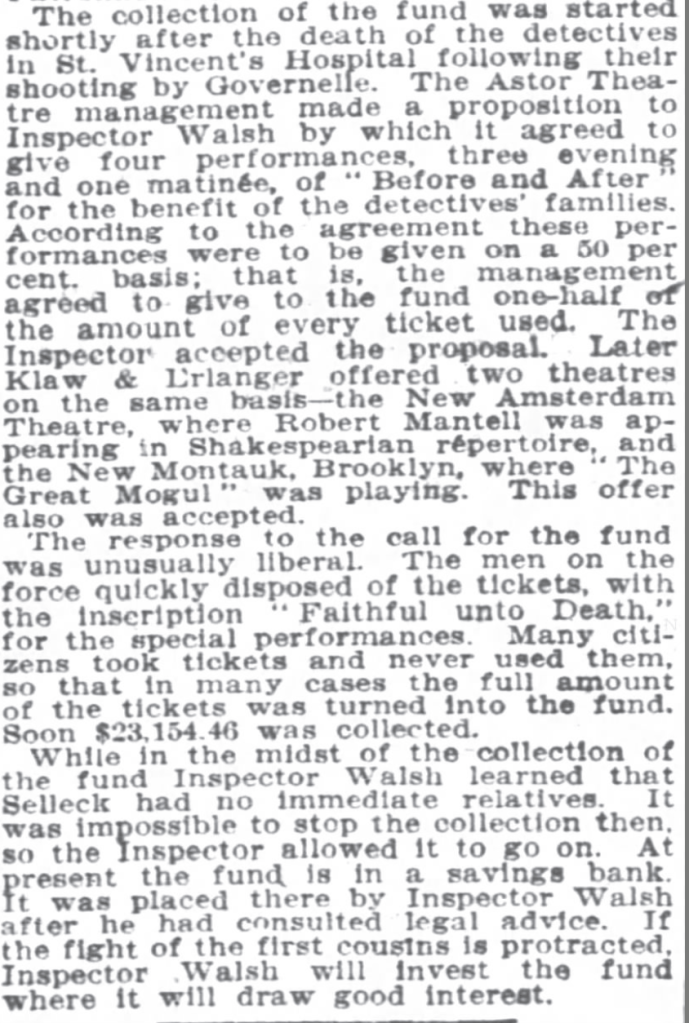
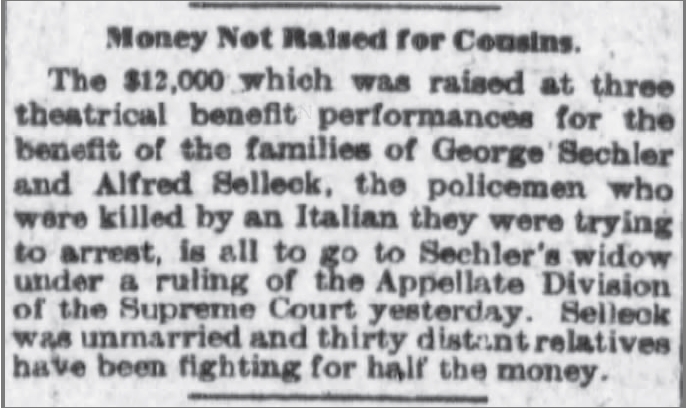
New York Times, June 4, 1907New York Times, October 4, 1908New York Sun, February 6, 1910
$23,000 in 1907 would be worth about $600,000 today. It was a significant amount of money but, divided over a 20 year period, would need to be supplemented to sustain the pair through Ruth’s childhood. Records show that they lived in at least four places through the late 1920’s, all in the same neighborhood. Census records generally list Laura as a “housekeeper” which may mean that she worked for other families, but it may just reflect the way to which women’s occupations were usually referred during that era.
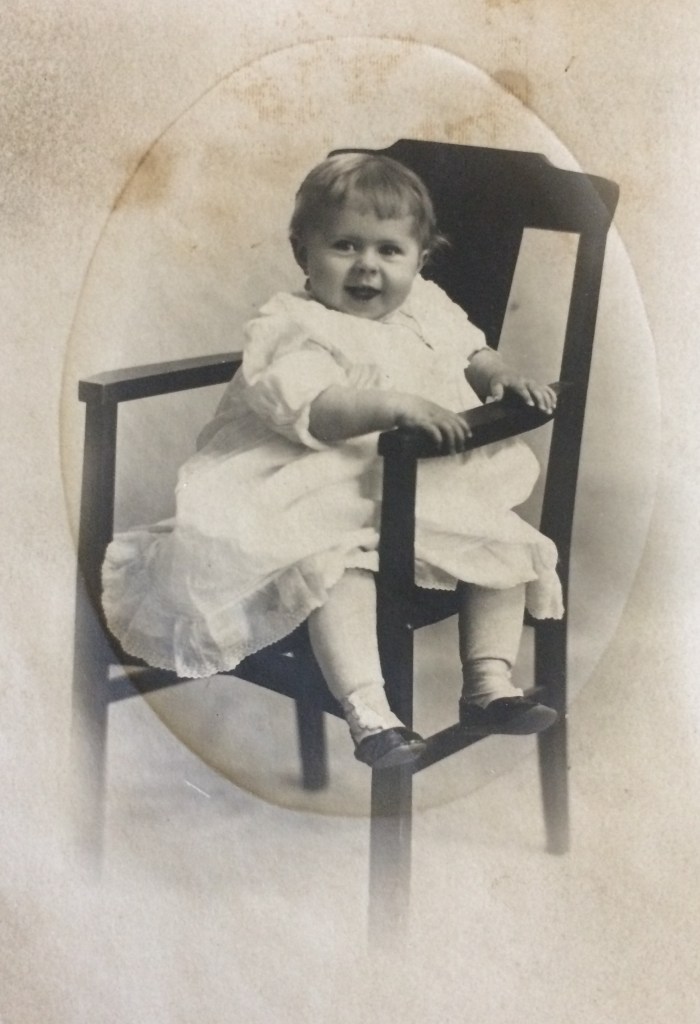
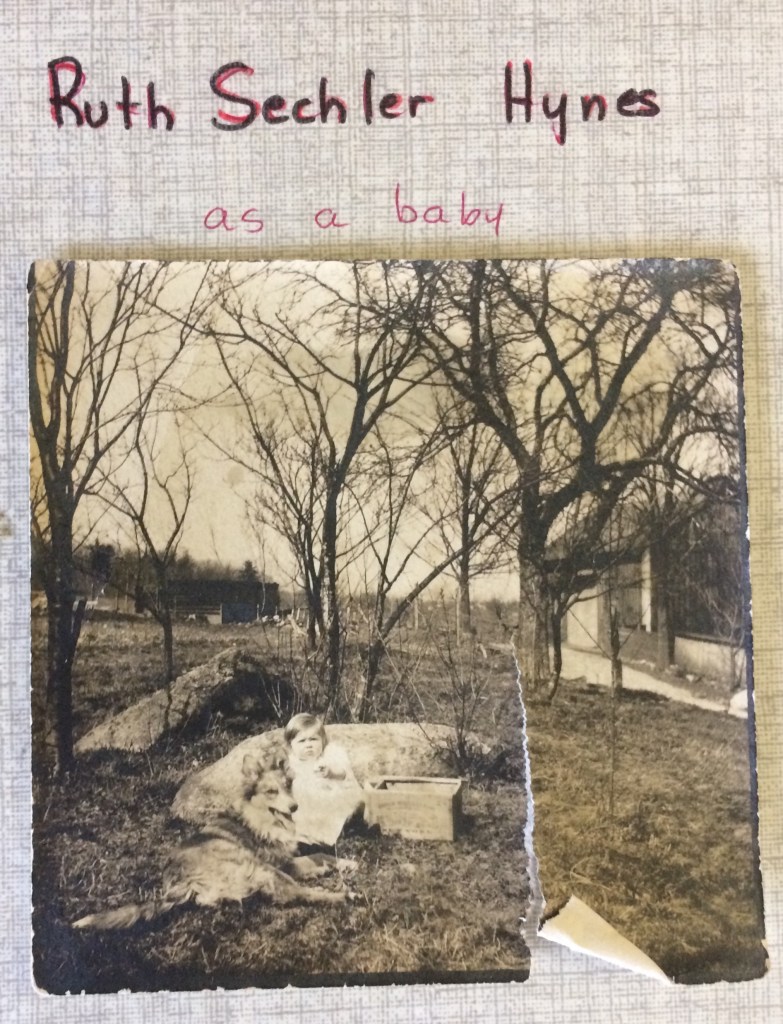
Photography was just becoming accessible to the mass market around 1910, and Laura took advantage of the new technology, leaving us several photographs of Ruth as a toddler.
A photo of Ruth on a picnic with an unknown dog is particularly intriguing. From the estimated age of the baby and the leafless state of the trees, the picture must have been taken in early Spring 1908 (possibly 1909), one year (or two) after Georgeʼs death. It may be in a park in Brooklyn, or in Connecticut (where Laura still had family) or perhaps in Danville on a return visit to the family.
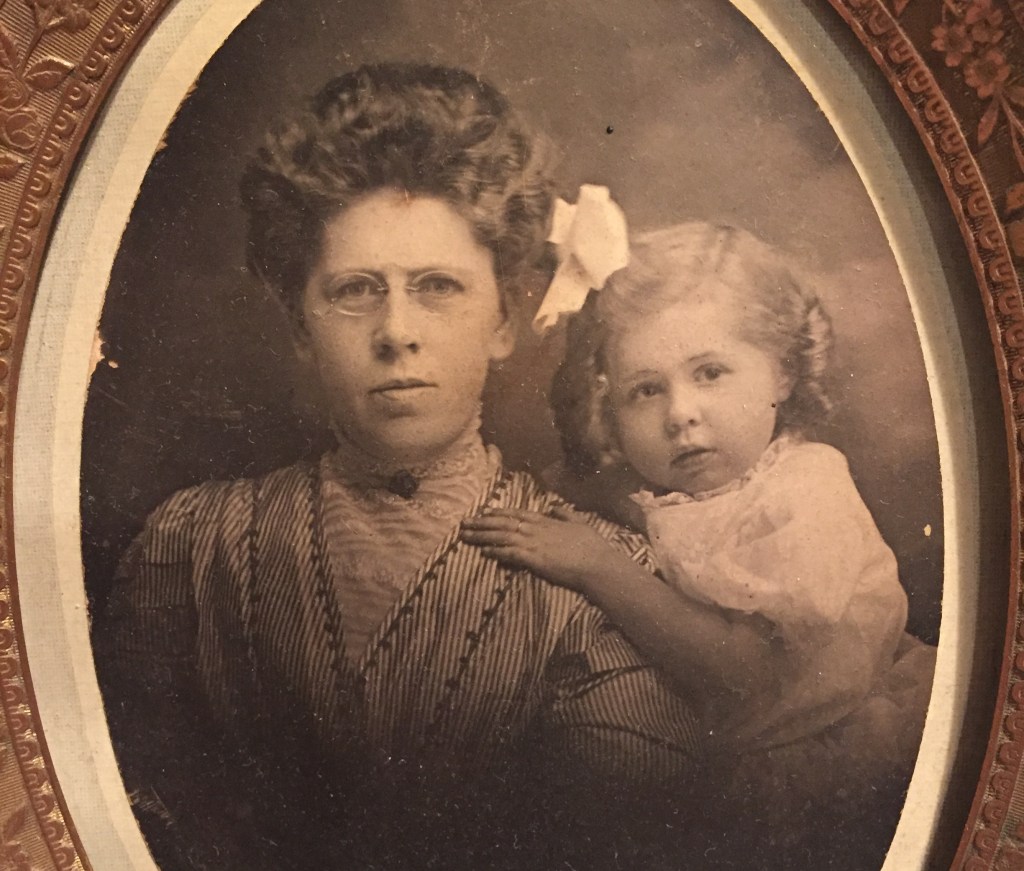
One photo of Laura and Ruth together captures their situation perfectly. The photo was found in the family home in Redlands, which is still owned by our cousin Chris. A professional portrait (as indicated by the fade effect at the bottom), it must have been taken around 1910, judging from the age of Ruth. This would have been about the time that legal processes had drawn to a close and New York was moving-on, leaving the family to resume normal life.
A lot of preparation went into this pose, down to the ring on Ruth’s middle finger. It speaks to mother and daughter being ready to face the world together, the bond between them unbreakable. Laura and Ruth would remain inseparable for the next 35 years, their caretaking roles eventually switching. According to Mom, Laura never spoke of the events of 1907.
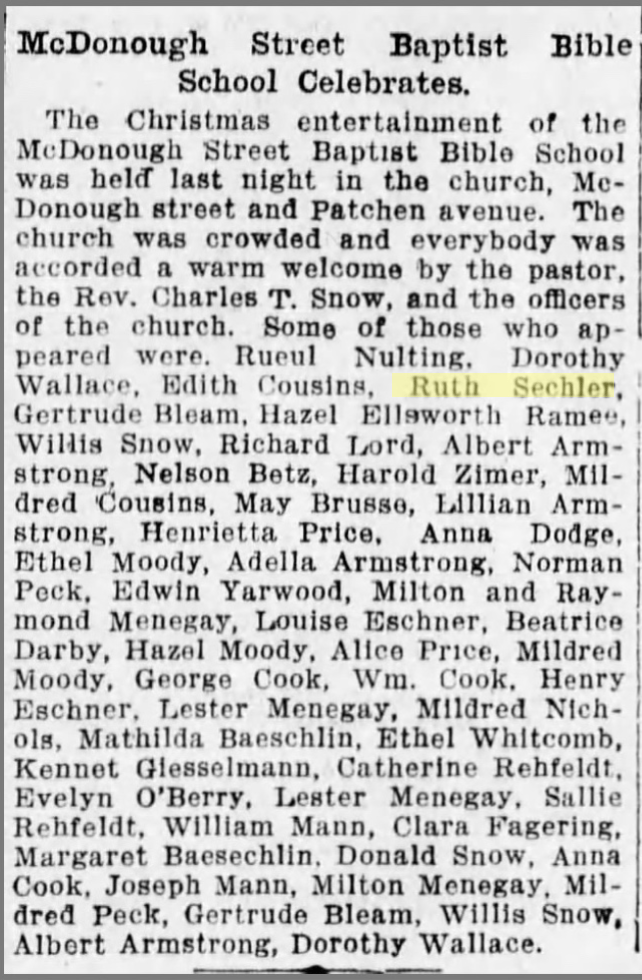
Over the next decade, Laura and Ruth faded into routine life, their days of newspaper headlines behind them. A 1911 note in the Brooklyn Daily Eagle lists Ruth participating in her preschool Christmas pageant.
Brooklyn Daily Eagle, December 29, 1911
By 1915 Laura and Ruth lived alone, according to the New York State Census. Laura’s father, John Wright, had died in 1914. Her mother Eliza had moved in with her daughter Ada and her husband William Hellmund.
Laura must have had to deal with the flu epidemic of 1918-1919, although less serious in New York than in Philadelphia and Boston.
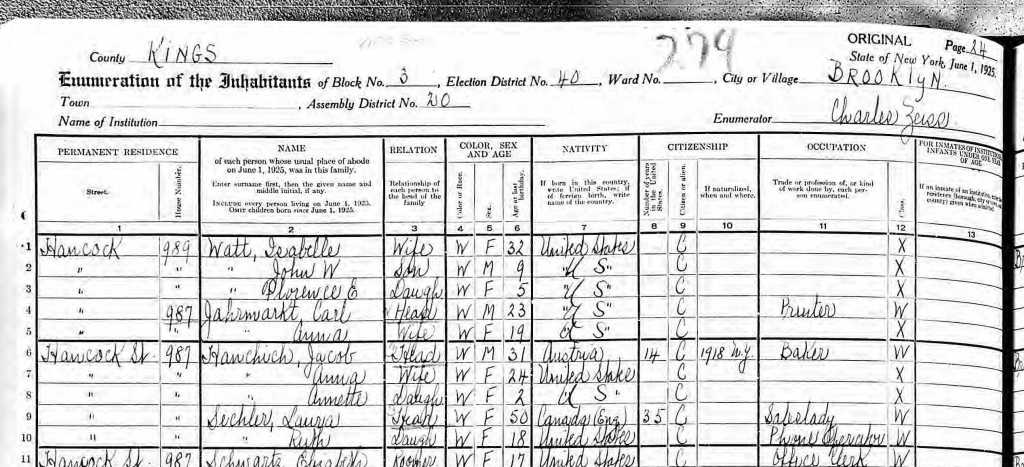
By 1925 Ruth, at age 18, was working as a telephone operator the (family story being that she was an international telephone operator, able to deal with calls in multiple languages).
1925 New York State Census showing Ruth, age 18, working as a telephone operator
In 1925 the two lived at 987 Hancock Street, one block southwest of the Bushwick Avenue Baptist Church, the next convergence point in this branch of our family history. We will continue this part of the story in a future post.
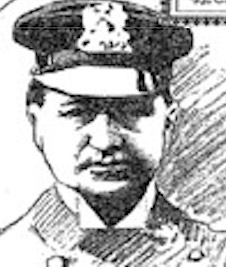
A final note: Laura’s affinity for photography may be related to the drawing of George Sechler, the only image I have of him. I do not know the source of the drawing, only that it appears in the NYPD officers’ memorial web pages. There are no similar sketches for other officers of the era, so this was not something that was normally done. Newspaper photos were not common either, during the early 1900s–big newspapers had photo sections perhaps once a week and were almost exclusively devoted to high society.
My theory is that when George became a police officer in 1905, photography not quite yet being accessible to the middle class, Laura arranged for a sketch to be made of him in his new uniform, perhaps enlisting a paid artist or an artistic friend or family member. The corner of some kind of wall hanging appearing in the upper right suggests that he was sitting at home.
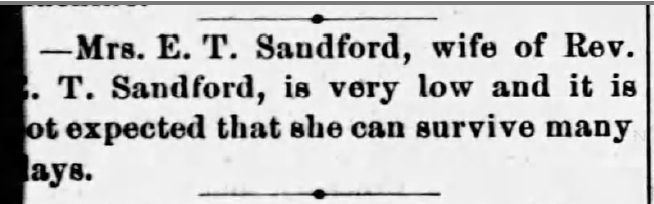
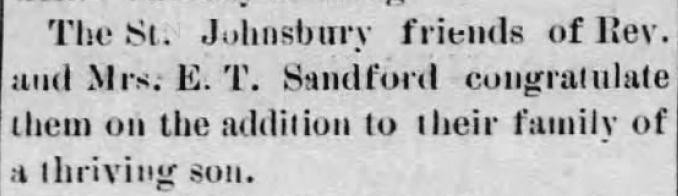
A June 14, 1888 newspaper notice portends the changes to come.
June 14, 1888 Saint Johnsbury Caledonian
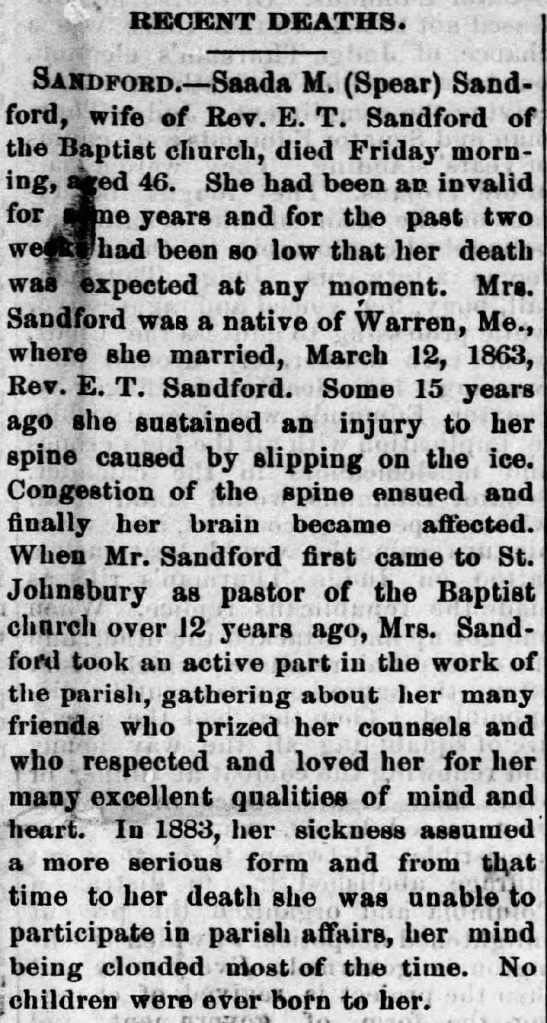
Edward’s wife Saada (Sarah) Spear Sandford died the following day. According to her obituary she had been in decline for 15 years after falling on ice and injuring her spine. There are indications that she had been prone to illnesses for much of her life–In 1866 Edward had almost declined the position of Consul to China because of her illness, and his 1869 resignation was, at least in part, due to the need to care for her.
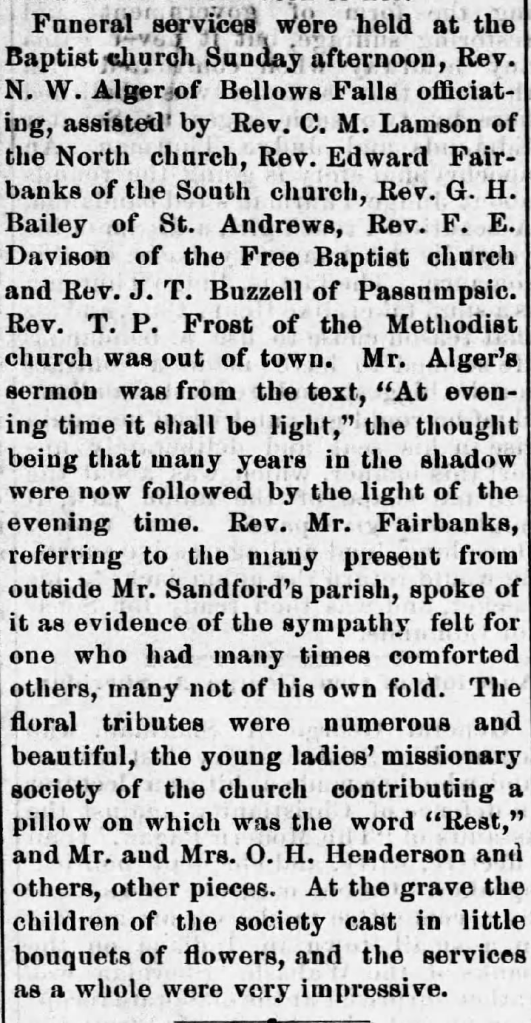
June 21, 1888, Saint Johnsbury Caledonian
It is not completely clear why Saada and Edward never had children. They were married for 25 years. The first 5 years Edward was away most of the time, first in the war, and then in China. There might have been a chance for children between Edward’s return in 1869 and Saada’s accident in 1873, but nothing happened and her overall health seems the most likely explanation.
A side note on Saada–a part of the 1880 Census listing farm assets shows that she held substantial assets in her own name, including more than 100 acres of land in Maine, probably inherited through her prominent family.
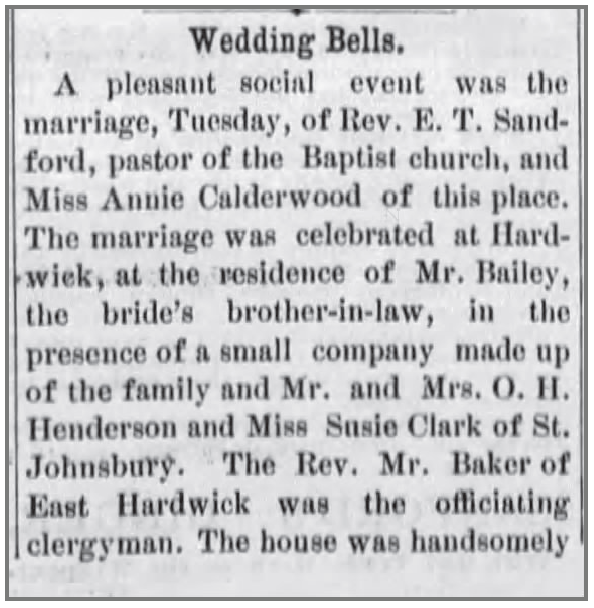
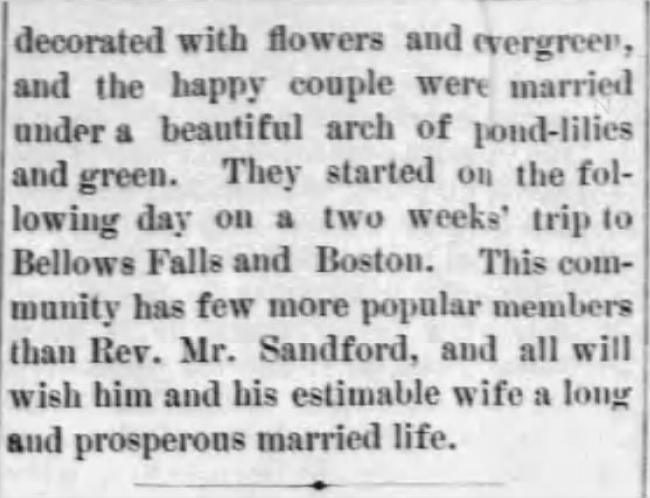
13 months after Saada’s death, Edward was remarried to Annie Calderwood, whose ancestry we have previously explored.
St. Johnsbury Republican, July 18, 1889
St. Johnsbury Caledonian, August 8, 1889
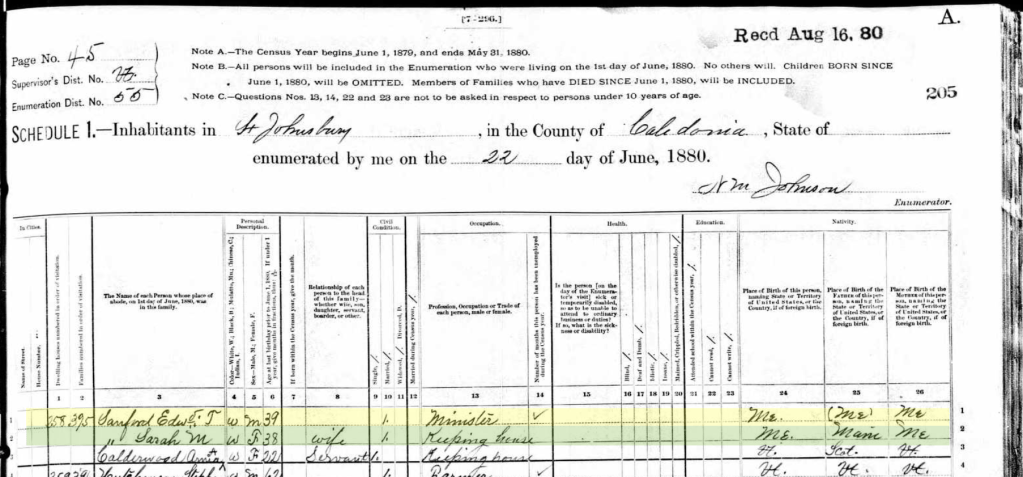
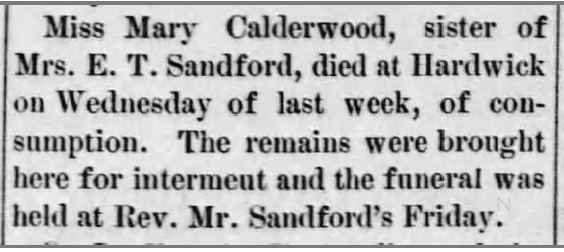
Annie, our great grandmother, shows up in the historical record at least 8 years prior to the marriage. The 1880 census shows that she was employed by Edward and Saada as a housekeeper, and probably a caretaker for Saada as her health declined.
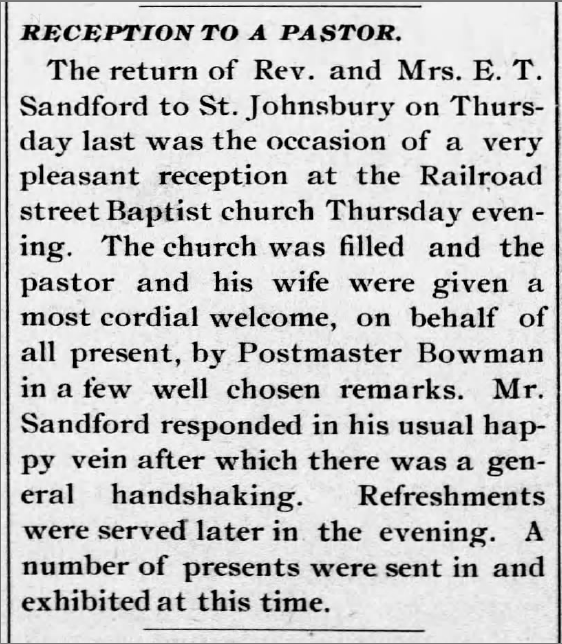
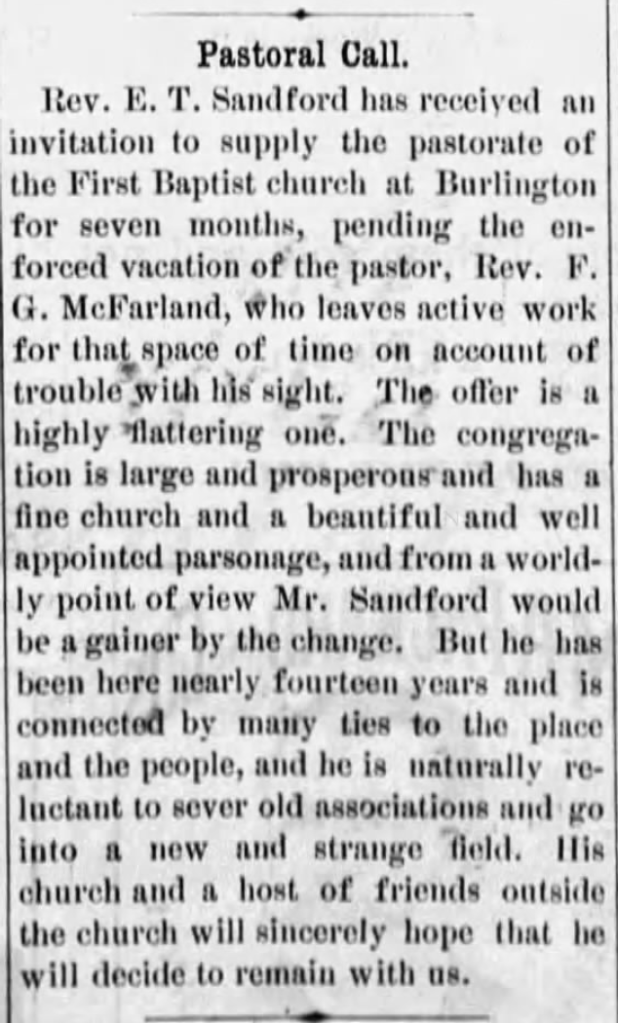
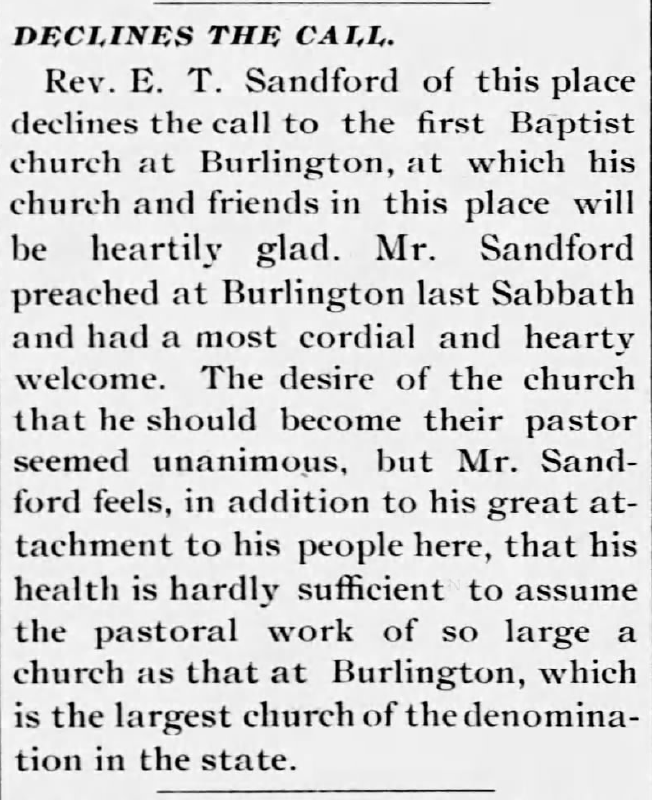
That Edward and Annie might someday leave Saint Johnsbury is foreshadowed in the fall of 1889, when Edward receives, and ultimately rejects a job offer from a larger pastorate in nearby Burlington, VT. Edward’s health also starts coming up as an issue during this time, as cited in his explanation for declining the position.
St. Johnsbury Republican, Sept. 26, 1889
St. Johnsbury Caledonian, Oct. 3, 1889
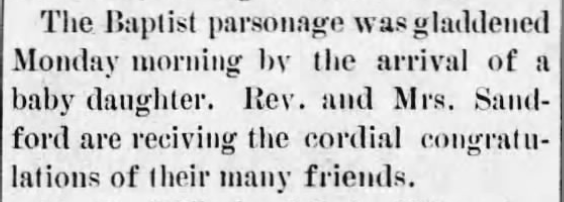
Nine months after their marriage, Edward and Annie had their first child, Saada, our great aunt. We can’t be sure that she was named in honor of Edward’s first wife, but it seems likely given that both Edward and Annie cared for her for many years.
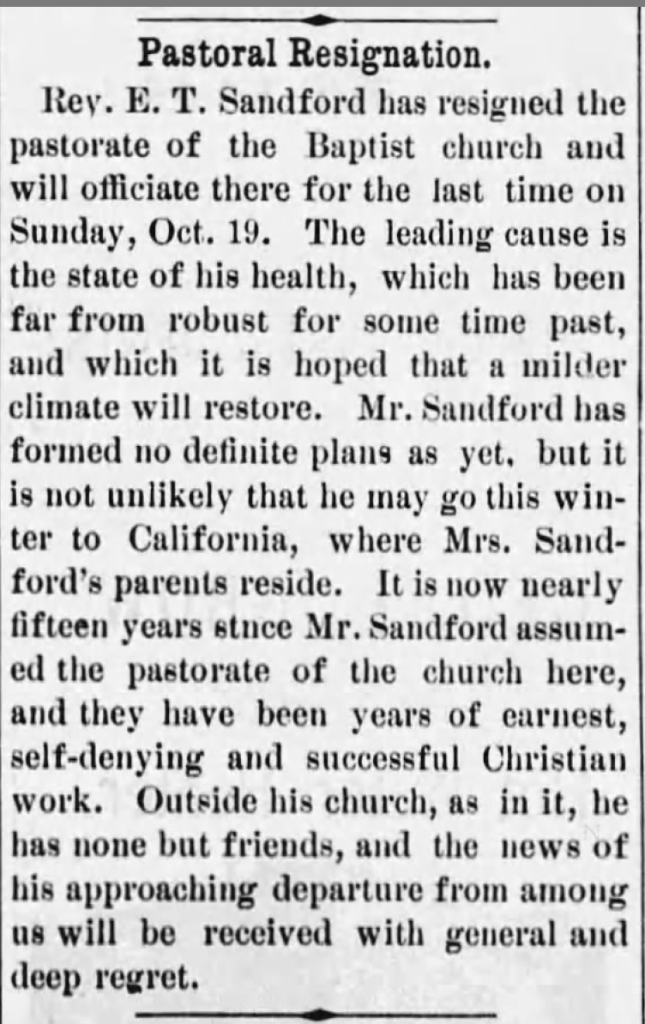
In the fall of 1890 Edward submitted his resignation to the Baptist church where he had been Pastor for 18 years. The explanation given in the newspapers was that he was looking for a milder climate because of ill health.
St. Johnsbury Republican, Oct 9, 1890
St. Johnsbury Republican, Oct. 23, 1890St. Johnsbury Republican, Jan 29, 1891
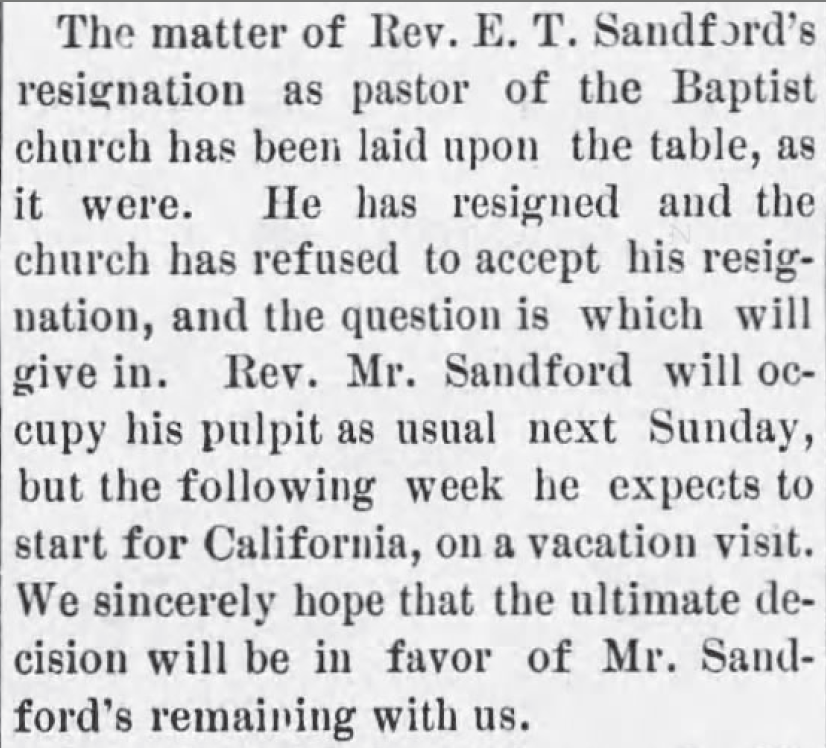
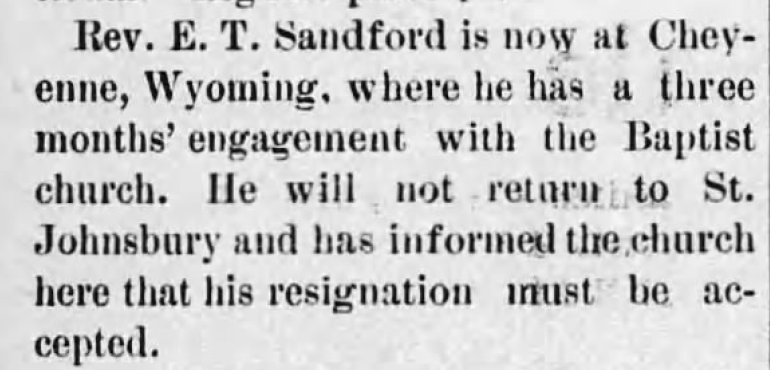
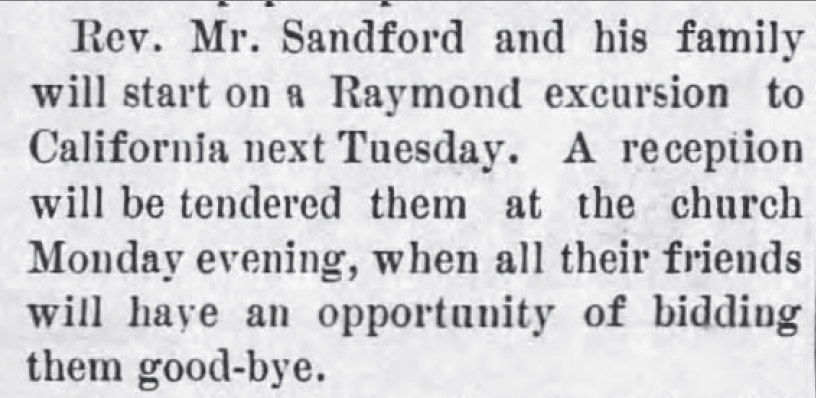
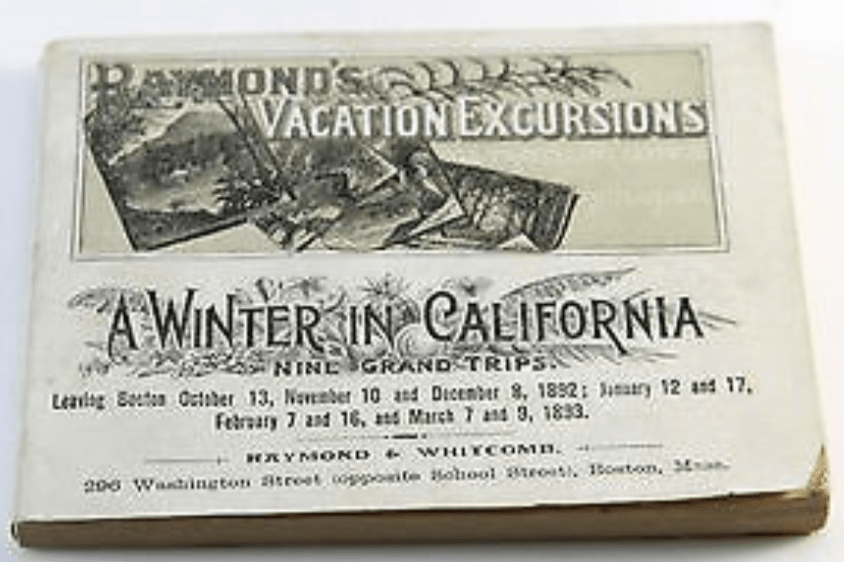
The church did not let Edward slip away easily. For a time, they declined to accept his resignation. Edward went anyway, signing up for a vacation excursion with the Raymond and Whitcomb company that specialized in showing people the wonders of the west. It is not clear whether Edward and Annie returned from the vacation and then left Vermont for good, or perhaps never returned from the vacation, but by January 1891 he had accepted a temporary ministerial post in Cheyenne Wyoming, and it was clear that he would not be returning to Vermont.
St. Johnsbury Republican, Oct. 30, 1890
A travel brochure for Raymond’s Vacation Excursions
Edward and Annie continued to make their way west, next settling in the Bay Area. Edward had probably been to San Francisco early in his life, twice coming and going from China, and must have enjoyed seeing it again, this time arriving by land, and showing it to Annie.
Our grandfather Joe Sandford was born in Twin Lakes, California, near Santa Cruz, in May 1892, the second child of Edward and Annie.
St. Johnsbury Republican, May 19, 1892. The town kept tabs on its former Minister.
The family will make one more move to southern California before settling down for good. We will continue their story in Corona in a future post.
 By Jan 1919 great grandfather James Louis Hynes had been in the Baptist ministry for a decade, having worked his way up through churches in Cornwall and Freeport. The Bushwick Avenue Baptist Church was a thriving operation in the 1920s, part of a vibrant network of churches in the city. Newspaper articles and notices throughout the decade show the church to have been a venue of many religious services, classes, and social activities with Reverend Hynes at the center of everything.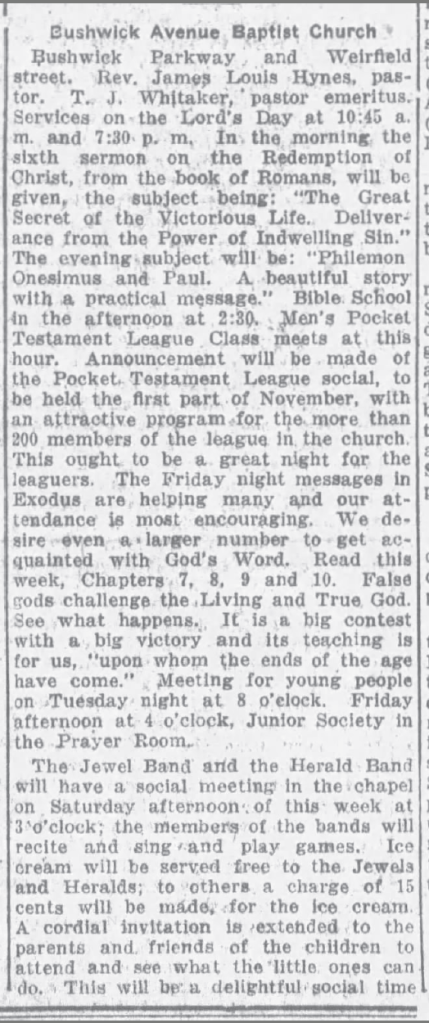
 I have one more short letter from second great grandfather Dr. James Gordon to his brother William and sister Jane in New Zealand, provided by our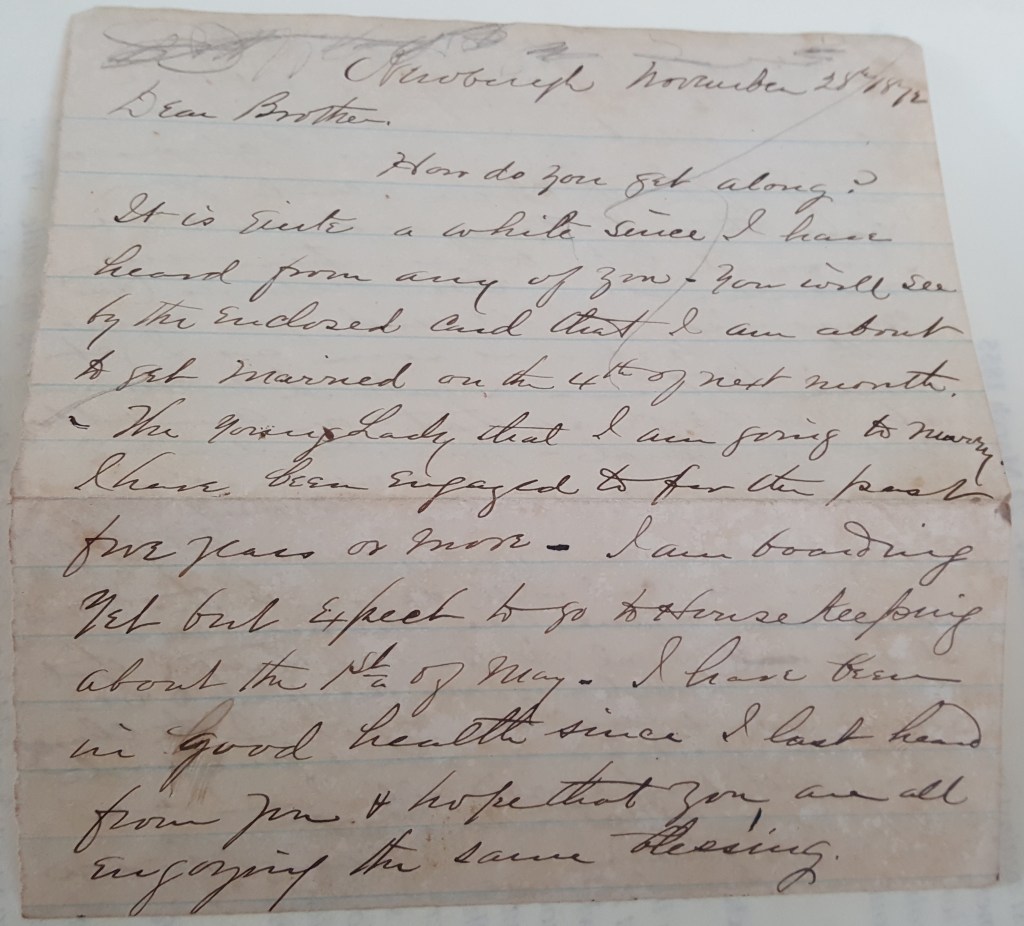
 After a dozen years in Corona, great grandfather Edward Sandford stepped down from his post as pastor of the Corona Baptist Church. The family moved to Chino around 1908. I don’t think Edward took easily to the idea of retirement, but he was 68 years old and his health remained an issue. This was likely a semi-retirement move, trading the Corona church for the smaller First Baptist Church of Chino.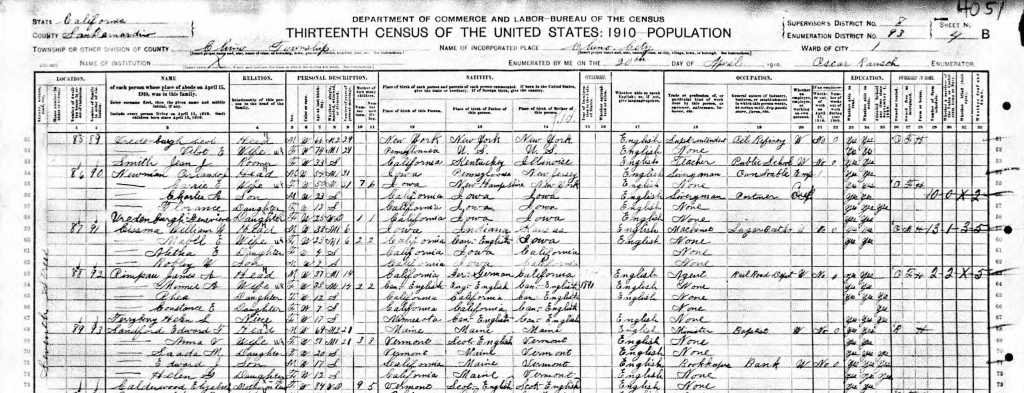




 Bridging the Silences