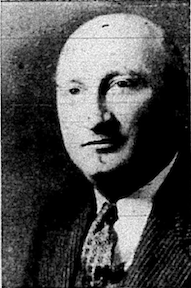
The recent public release of 1950 census records provides an additional data point from the lives of great-grandparents James Louis Hynes and Bessie Gordon Hynes. In 1950 they lived at 107-29 134th street in Queens, New York.
1950 U.S. Census entries for james and Elizabeth Hynes
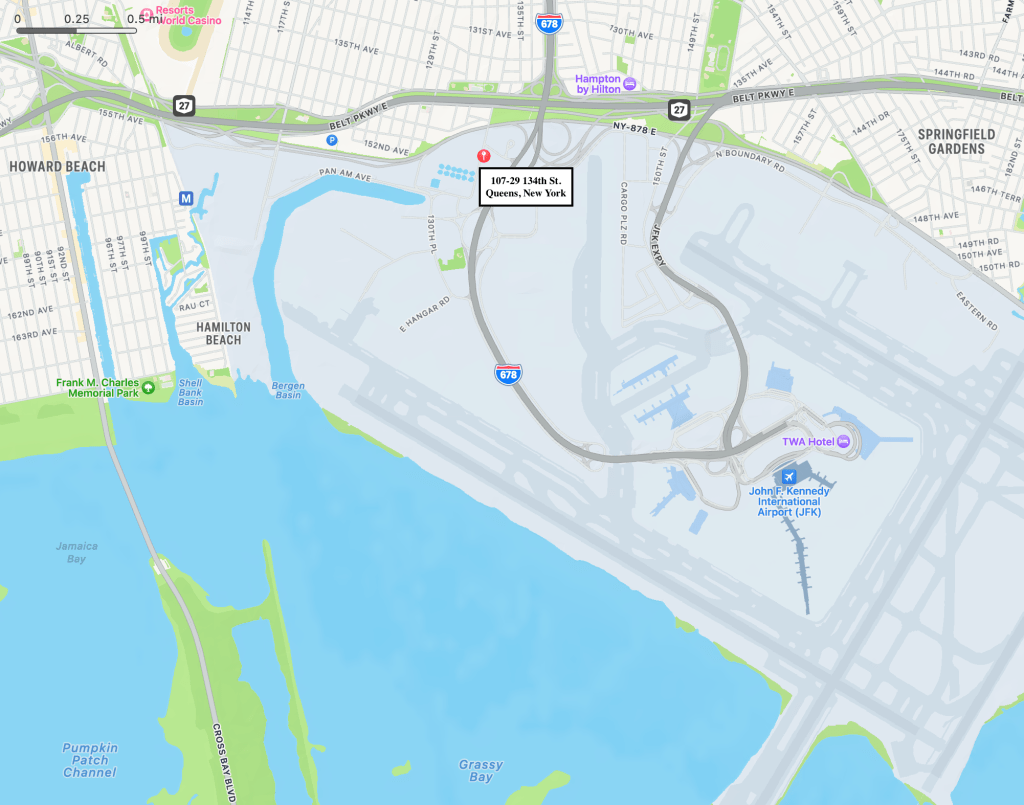
A search of today’s maps places this location in the industrial periphery of JFK airport, near the intersection of the Belt Parkway and the Van Wyck Expressway.
Between 1950 and today, 107-29 134th Street has been absorbed into the industrial periphery of JFK Airport
There is no question that the 1950 census record is for our ancestors, James and Bessie Hynes–all details match, including James’ profession and country of birth. There is also no question that the address on the census record is the former Queens neighborhood suggested by the current-day map search–adjacent records on the census form consistently reference other nearby streets and landmarks.
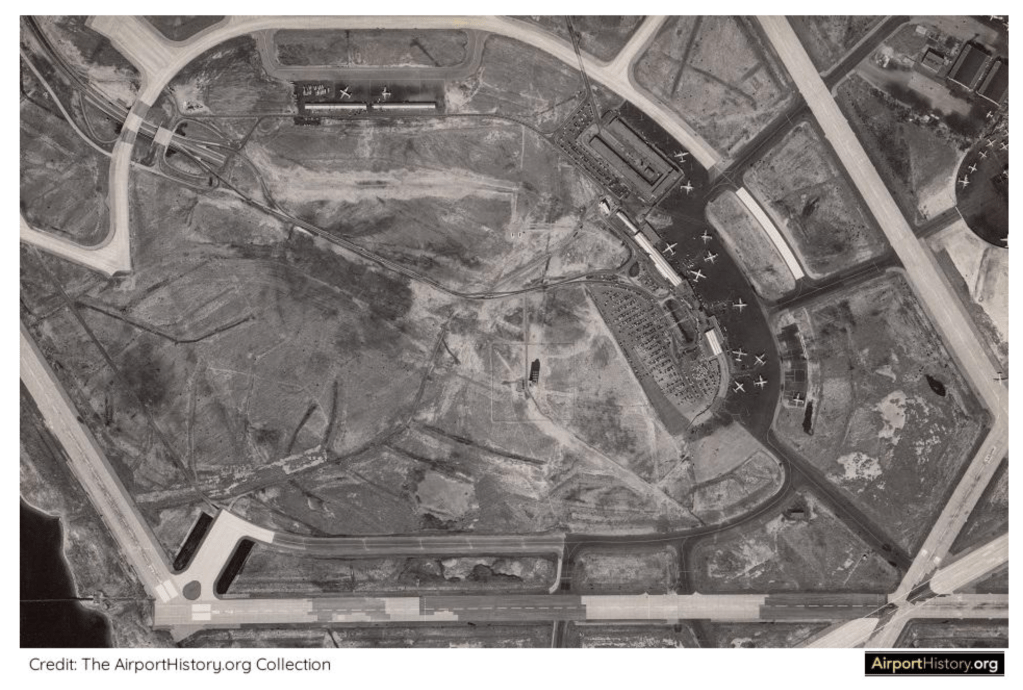
Idlewild Airport, named after the golf course it displaced, opened in 1948. At that time it was a small operational airfield and terminal surrounded by future terminal early construction sites in accordance with an ambitious master plan that would eventually grow into the futuristic JFK airport of the 1960s and the densely-packed mess that exists today.
A 1954 aerial photograph of the Idelwild Airport site. The site of James and Bessie’s 1950 home is to the upper left of the frame this photo, at an additional distance of about half the width of this photo.
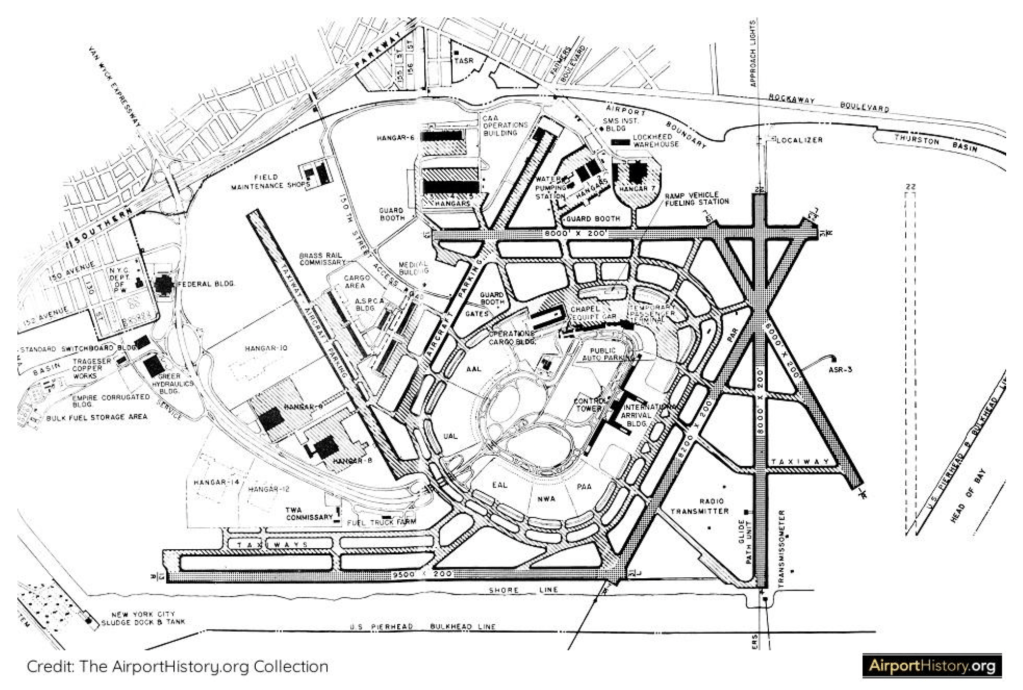
Early versions of the airport master plan show the 134th street neighborhood barely surviving, adjacent to airport maintenance shops and earlier versions of city expressways.
Original master master plan of the Idlewild Airport. James and Bessie Hynes’ 1950 home is in the neighborhood shown in the upper left of this plan.
It’s hard to put a positive spin on this information about the late lives of James and Bessie Hynes, just as it was difficult to find positive ways to read James’ abrupt 1945 resignation and sparse 1953 death notices. It’s also hard to imagine that south Queens was what James had in mind when, in his 1945 resignation letter, he expressed his desire to move “somewhere in the south” after spending some time in his hometown of Newburgh NY.
This queens neighborhood was about 5 miles southeast of the Bushwick neighborhood where the family lived in the 1920s, and about 10 miles west of the Freeport neighborhood where the family lived before and after living in Bushwick. In 1950, James’ and Bessie’s son and his family were already living in California, having long since lived in upstate New York and Michigan. Their other surviving children remained in Massachussets. James’ sister Addie’s Newburgh home was more than a two hour journey away. There were no family reasons to move to this Queens neighborhood. At best, it would have been a familiar region for James and Bessie, perhaps with a few old friends living nearby, but nothing more.
The 1950 Census shows James and Bessie’s son, James Gordon Hynes living with his family in Redlands, California, long since moved from the New York region.
A New York death record, previously disregarded because there was no reason to believe he lived in New York at the time, shows that a James Hynes, born in 1875, died on July 16, 1953. No note of James’ passing has been found in New York newspapers. The timing and circumstances of Bessie’s death remain unknown.
As a final note, the 1950 census shows James’ age as 65 and Bessie’s as 70. James’ reported age, over the years, has been pretty consistent with this figure, including his Shoal Arm NL birth certificate showing his October 1884 birth. Estimates of Bessie’s age, on the other hand, have been all over the map. The 1880 Census, for example, lists her as 6 years old at the time, consistent with the 1873-1874 birth year range which seems to be most trusted by various sources. We have previously noted the couple’s age difference at the time of their 1905 marriage–James 20 and Bessie as old as 32 at the time. Under these awkward circumstances, it is perhaps easy to understand how under-reporting of her age could have become a persistent habit over the years.
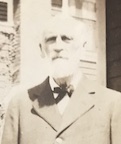
An open question has been how our great grandfather Edward Sandford, who was born, raised, and enlisted in Maine, came to serve in the First Cavalry Regiment of the District of Columbia during the Civil War? I had presumed that it had something to do with his arriving late to the party, having been on the other side of the world when the war broke out, and perhaps he had to look around for an available unit that needed him in 1863 when he was able to enlist.
The real reason turns out to be much more complex and interesting, leading us to the story of the life of Lafayette Curry Baker, the man credited with founding the DC First Cavalry. Born in 1826 and raised in upstate New York and Michigan, Baker pursued a life of adventure and intrigue, usually in support of law and order causes of one form or another. At age 30, he spent several years in San Francisco as a “vigilante” (with details left to the imagination). When the war broke out in 1861, he went to Washington DC and offered his services to the cause as an independent agent.
Baker tells his story in his autobiographical The Secret Service in the Civil War, published in 1867. He worked for the Union in many capacities during the war including as a spy, head of the Secret Service, and Colonel in the Union army leading the First DC Cavalry. Baker led the team that tracked down John Wilkes Booth and other conspirators after the Lincoln assassination. He made many enemies during his life, and often tested the line between fervent supporter of Union causes and purveyor of conspiracy theories. He died as General Baker in 1868 at the early age of 42 under circumstances that led some to believe he was poisoned.
It is likely that Edward Sandford (and later son Joe) knew about this book. Edward stayed involved in veterans affairs through his life, would have heard about such a book written by his former commander, and would known of Baker’s early death. It is not clear how many of the following details our grandfather Joe would have known of.
Returning to the story of Baker’s life, in 1861 after a lengthy process to convince the Generals and Washington authorities of his credentials and sincere intentions, he was asked to go to Richmond as a spy. He readily agreed, despite being told that of his five predecessors, two had been killed and the others were likely in prison.
Baker was caught several times on the way to Richmond but proved to be very good at thinking on his feet and smooth-talking his way out of bad situations. On one occasion he bought drinks for his captors en route to their camp and escaped when they eventually fell asleep.
Ultimately, though, he was captured, taken to Richmond, and subjected to repeated interrogations by a cast of characters, eventually including Confederacy president Jefferson Davis. Baker was extremely shrewd in interrogations, relying on a well-developed cover story and usually giving answers that were 95% true, enabling him to be consistent from one interview to the next.
For example, When Jefferson Davis eventually summoned a man from Knoxville who was part of Baker’s cover story (but Baker had never met), he cooly handed the situation…
The next morning brought Mr. Brock to my loft, evidently sent to satisfy himself fully that I was Sam Munson. A delicate and difficult task was before me, and the result to my own mind very doubtful. Brock, however, was talkative, willing to carry on the conversation, and evidently quite sure that he was not mistaken in his man. I knew something of the Munsons, and localities in Knoxville, and, by the aid of imagination, could till any pauses in Brock’s conversation; eight years of absence excusing failures inmemory. Brock asked leading questions, saying, for illustration, “You know so-and-so.” “Oh, yes,” I responded, though I had not the remotest knowledge of the person. Then Brock would refer to something very ludicrous, and I would burst into laughter, as though at the recollection, while Brock, greatly enjoying it, would unconsciously tell the whole story, so that I could put in a fitting remark here and there, which seemed to come naturally from recollection. Brock went away entirely satisfied, and reported to Jeff. Davis. Two days later, a commissioned officer entered the room with a parole, pledging myself not to leave the city of Richmond without orders from the provost-marshal. I signed it, and was released from confinement. With the freedom of the city, I continued my observations.
Lafayette Baker, The Secret Service in the Civil War, 1867
Finally in the confidence of Jefferson Davis, Baker was given papers of introduction and travel permits consistent with his cover story. (Along the way, Baker had collected a wealth of intelligence about troop strengths and positions in Virginia, some directly from Davis.) Baker used these papers to escape back to Washington, although under harrowing conditions.
Baker stopped in Washington just long enough to debrief the Generals on the intelligence he had gathered, then immediately continued north. He used the papers supplied by Jefferson Davis to infiltrate several networks of southern sympathizers in Baltimore and Philadelphia, resulting in multiple arrests.
Throughout the war, Baker repeated the cycle of infiltrating one network of sympathizers after another (there was no shortage of these in and around Maryland), each time building his credentials with the leadership in Washington. Along the way he was named as head of the Secret Service. In this capacity he initially worked for Secretary of State William Seward, and later for War Secretary Edwin Stanton.
Baker was given more and more support as his missions increased in size and complexity. One mission to infiltrate offices of the Postal Service in southern Maryland (which were engaged in near-free exchange of correspondence with their counterparts in Virginia) required a supporting company of soldiers because of the dangers involved.
So is was a natural part if this progression that Baker was commissioned a Colonel in the Union army, and the First Cavalry Regiment of the District of Columbia was created, essentially as Baker’s personal supporting army. Initially a force of 4 hundred men, an additional 8 companies were soon added, bringing the strength of the regiment to 1,200 men.
And it so happened that most of these 8 companies were provided by Maine’s Governor Samuel Coney. Maine, with its fervent anti-slavery positions and forces far removed from potential influence of southern sympathizers, was a logical choice as a source for filling the coveted positions in the new First DC Cavalry.
The First Cavalry of DC was formed in June 1863, the same month that Edward Sandford enlisted in the Maine militia. We can now interleave the narrative of Baker with that of our grandfather, Joe Sandford in his 1966 remarks to the First Baptist Church of Corona, California.
[Edward’s] Uncle Thomas Sandford owned a fleet of Clipper Ships that sailed the Seven Seas. The opening of the Civil War in the United States found father in Chinese waters on one of these ships serving as First Officer. He was anxious to share a part in this War and became an officer on one of our Naval ships serving for one year.
Returning to Maine he became Captain of the First Maine Cavalry. Soon his Regiment was transferred to Washington, D. C. and became the First District of Columbia Cavalry.
Joe Sandford, 1966 remarks
On the 16th of February [1864], Company F was mounted, and remained at Camp Baker, engaged in daily drilling until the 7th of April. At that date it left Washington for Norfolk, and the next day joined a squadron of the old battalion on picket at Great Bridge.
Lafayette Baker, The Secret Service in the Civil War, 1867
(Recall that we have seen an image of the orders given to Edward on April 6, to report with his command to the 6th Street [SW] docks the following day for transport to Norfolk. Note that in the late 1863 time frame the command and operations of the First DC Cavalry were shifted from Washington toward the war front in Virginia. I think there were several reasons for this. First, as the war moved southward, away from Washington, the security of the Capital became less of a concern while the need to support the southward progress of the Union army became more of a concern. Also, I can’t help but think that some in authority in Washington realized that the First DC Cavalry perhaps needed a little more structure and adult supervision than perhaps the maverick Colonel Baker was able to provide on his own.)
He saw much action to the South of the Capitol [sic]. We have many letters that he wrote to his wife from the battle fields and they are very personal, historic and valuable.
His regiment was one of the first to use the repeating rifle. His men could fire sixteen times without reloading and his writings state that, ‘The Rebs could not understand how this was possible’.
Joe Sandford, 1966 remarks [I’m still wondering where these letters wound up]
This regiment was distinguished by the superiority of the carbines with which it was armed. It was the only regiment in the army of the Potomac armed with “Henry’s Repeating Rifle.” The peculiarity of this gun is, that it will fire sixteen shots without reloading. It is cocked by the same movement of the guard that opens and closes the breech—the exploded cartridge being withdrawn and a fresh one supplied at the same time and by the same movements. The copper cartridges are placed in a tube, extending the entire length of the barrel, on the underside. From this they are fed into the gun by the operation of the lever guard; meantime a spiral spring forces down the cartridges as fast as they are discharged. The whole device is of the simplest nature. The work is strong, and the whole thing is so nearly perfect, that it is difficult to conceive of any improvement. The subsequent history of this regiment proves it to be a terribly effective weapon. Fifteen shots can be given with it in ten seconds. Thus, a regiment of one thousand men would fire fifteen thousand shots in ten seconds. After having having witnessed the effectiveness of this weapon, one is not surprised at the remark, said to have been made by the guerrilla chief, Mosby, after an encounter with some of our men, that “he did not care for the common gun, or for Spencer s seven-shooter, but as for these guns, that they could wind up on Sunday and shoot all the week, it was useless to fight against them.”
Lafayette Baker, The Secret Service in the Civil War, 1867
Baker’s memoir devotes 20 pages to the activities of the First DC Cavalry in April and June, 1864 leading up to the Wilson Raids, which I will not attempt to summarize here.
During the Spring of 1864 his Regiment was active on the Wilson Raids into the South. On one of these two week Raids they were successful in getting through the Reb Lines and rode day and night as far South as Weldon, N. C. destroying telegraph lines, depots, bridges and rail equipment.
They found ample food in the South and he wrote his wife that she must not believe the news reports that the South was short of such.
Joe Sandford, 1966 remarks
At this point, Baker’s book provides us with a fascinating insight. From Joe’s description we understand that Edward Sandford and his men were operating about as far south as any unit in the Union army at the time, well beyond the official front lines. As such, there were encounters with enslaved people which our great grandfather was likely a part of.
An illustration of the interesting peculiarity of the race came under my observation during one of the well-known raids by General Kurtz, from Suffolk, on the Weldon railroad. The First District Cavalry, a regiment I had raised, and of which further mention will be made, was divided into front and rear guard. The advance of the forces was the first appearance of Union troops among these patient “servants” of the region. To be informed that we were “Yankees,” was enough, without the slightest hint of our plans or destination, to stir the most stupid toiler like a trumpet-call. The hoe was dropped, the plow and cart abandoned. Even the women, moved by the same wild impulse, deserted their cabins, and all together rushed to the rear of the army, and stepped to the music of the march for days, and sometimes for weeks. They dreaded more than death the return to their owners, or recapture by them. When it became necessary to leave several hundred at Reams’s Station, in our hurried movement backward, they lingered about instead of going forward, and their frantic agony was heart-rending.
Lafayette Baker, The Secret Service in the Civil War, 1867
This is also Baker’s first mention of the fateful Reams’ Station encounter and retreat, which would change the life of Edward Sandford. At this point, Baker’s account gives us far more detail than we have known previously…
Returning to their base camp in the North he was shot through the groin and felled from his mount. This at Reams Station, Va.
Joe Sandford, 1966 remarks
Wilson’s object was to burn the bridge, and Lieutenant Colonel Conger, of the First District of Columbia Cavalry, was detailed to do it. The regiment was composed of new recruits, with little experience, and had received less instruction than any other regiment in the command. The undertaking was a perilous one. Its wisdom the reader will be likely to question. And yet, when the final order was given to charge across the level ground, in the face of the rebel batteries, the gallant First District of Columbia moved forward in splendid style, dismounted (except the intrepid Conger, who, being lame from previous wounds, was compelled to ride). The advance squadron, commanded by Captain Benson, had not advanced far, when, from the line of the enemy’s works in front, a murderous storm of grape and canister was hurled into their ranks with terrible effect. Officers and men went down in large numbers. Still, without the least protection, in the face of that withering fire, and at too great a distance from the enemy to effect much by their own, those brave men pressed on till near the bridge. Efforts were made to burn it, but they were unsuccessful. The regiment did but little actual fighting here, for the simple reason that they could not get at the enemy, but the cannonading was’ rapid and heavy. The hills presented a line of fire and smoke, and the earth trembled with the terrific concussions. Shells screamed across the horizon, bursting into deadly iron hail—the grim forms of smoke-masked men, the gleam of burnished guns in the wheat field, where the men were not engaged, and the flashing of sabers where they were, with horsemen in the distance, sweeping to and fro, formed a scene of exciting grandeur such as few of our men had ever witnessed before.
When at length it was discovered that the object could not be accomplished but at too great a sacrifice of life, the advance was ordered back, and, as nothing else was to be done in this direction, the return march was commenced. The enemy followed all day, but made no attack. After a march of thirty-two miles directly east, through Greensborough, the column halted for the night near Oak Grove.
A march of thirty-eight miles brought them to the Iron Bridge across Stony Creek, at about ten o’clock on the morning of the 28th. Here a heavy force of cavalry and artillery was found in position to dispute the crossing. The cavalry consisted of Hampton’s command, together with that of Fitz Hugh Lee.
A severe engagement took place, in which this regiment lost about eighty men in killed, wounded, and missing. The result was indecisive. The enemy was pressed back, while our column turned to the left and crossed the creek at a point above.
General Kautz’s division had the advance, this regiment moving at the head of the column, and the Eleventh Pennsylvania next.
On approaching Reams’s Station, which had been supposed to be in our possession, General Kautz found himself confronted by the enemy, both infantry and artillery. Mahone’s whole division, and one brigade from another division, had been sent out to intercept Wilson’s command, which was now outnumbered two to one. The enemy was drawn up in strong line of battle, extending from the Notaway River, on our right, to a point far out on our left. This regiment and the Eleventh Pennsylvania charged directly through. General Wilson, however, instead of following on, fell back, abandoned his artillery, wagons, and ambulances, and, by making a wide detour, avoided the enemy, and abandoned these two regiments to their fate.
Kautz had marched but a short distance, when he found himself in a triangle, two sides of which, including his rear and left front, were held by the enemy in overwhelming numbers. Extending along his right front was the railroad, running through a cut from ten to twelve feet in depth.
Beyond it, and running nearly parallel with it, was a muddy stream of considerable depth, and beyond that, an extensive swamp, supposed to be impassable.
The enemy now thought himself sure of his prey. Under the circumstances, almost any other man would have surrendered. Not so the indomitable Kautz.
It was a wild and exciting scene to see those mounted men slide down that steep embankment to the railroad track, and scramble up the opposite bank, and dash down the next declivity into the stream, and wallow through mire and water, the horses in some instances rolling over, and the men going under, amid the thunder of artillery, and with solid shot plunging, and shells exploding, and grape and canister raining, and musket balls whistling around them, till they reached the opposite shore, and disappeared in the swamp.
Following their indefatigable commander, they pressed their way through, and reached their old camp at Jones’s Landing, the next day.
Lieutenant-Colonel Conger, Major Curtis, and Captain Sanford were severely wounded. Captains Benson and Chase, who had been wounded at Roanoke Bridge, fell into the enemy’s hands as prisoners, when the ambulances were abandoned at Stony Creek.
Lafayette Baker, The Secret Service in the Civil War, 1867
(In predictable fashion, Baker continues the family tradition of always misspelling the Sandford family name in documentation of important life events.)
At this point, the Baker and Sandford family stories diverge. Edward, following his wild escape on a commandeered horse, is transported back for recovery through City Point Virginia, New York, and Maine.
Upon regaining consciousness he crawled through the field, was able to join his Regiment. An order was received that they flee leaving all sick and wounded on the field. He ordered a horse and was assisted thereon and rode ‘Ten miles through swamps, jumping fences and reached field hospital.’
In letter written by the Christian Commissioner he states that ‘Dr. Jamison has been very kind to me doing all that he can for me’.
Leaving the field hospital he was transported to City Point and then via ship to hospital in New York City.
Joe Sandford, 1966 remarks
Baker, who’s memoir continues for another 200 pages, continues to fight for the Union through the end of the war.
General Baker was as proud of his DC Cavalry as Edward Sandford was of the role he played in it.
The regiment was a splendid body of troops, and achieved all that was anticipated from it;
Much of the service performed for the country will never be written. The detachments of men moving stealthily over the lines of encampment and battle; guarding me or my subordinates in perilous adventures; and other quiet, unheralded, and unreported duties, will have no record but the pages of memory, and, with the death of the actors in the varied scenes of such a life, be forgotten.
Lafayette Baker, The Secret Service in the Civil War, 1867
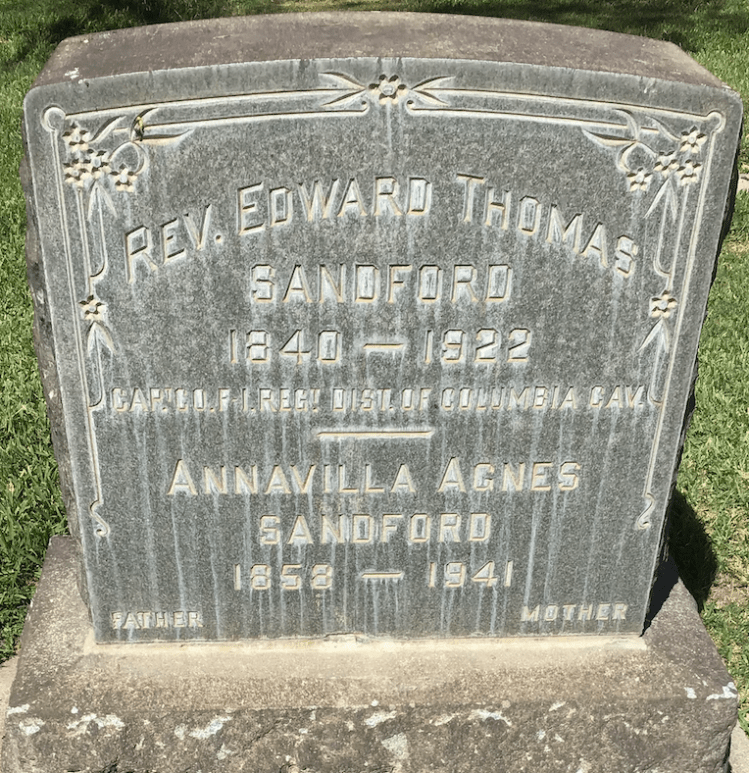
Reverend Edward Thomas Sandford, Captain Company F, 1st Regiment District of Columbia Cavalry
Died Friday October 20, 1905 (116 years ago) in New Haven, Connecticut. Matthew Hynes, 2nd great grandfather
Died Saturday October 28, 1911 (110 years ago) in Ontario, California. Burton Tuttle, 2nd great grandfather
Died Sunday October 28, 1951 (70 years ago) in Ontario, California. Mabel Tuttle Swan, great grandmother
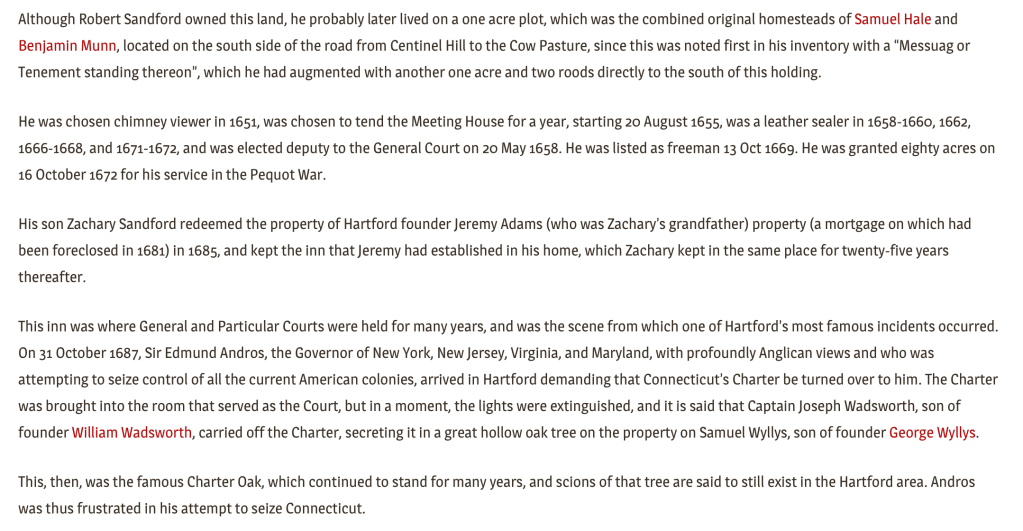
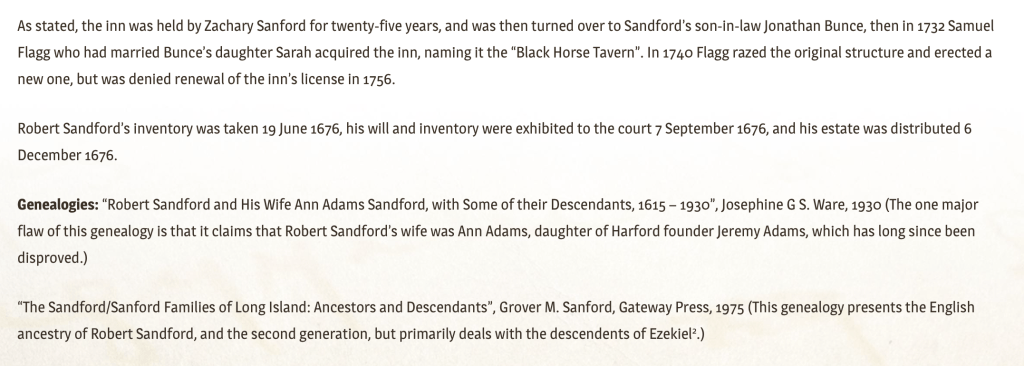
Co-conspirator in the Charter Oak Incident, Friday October 31, 1687 (334 years ago) in Hartford, Connecticut. Zachariah Sandford, brother of 7th great grandfather Ezekiel Sandford
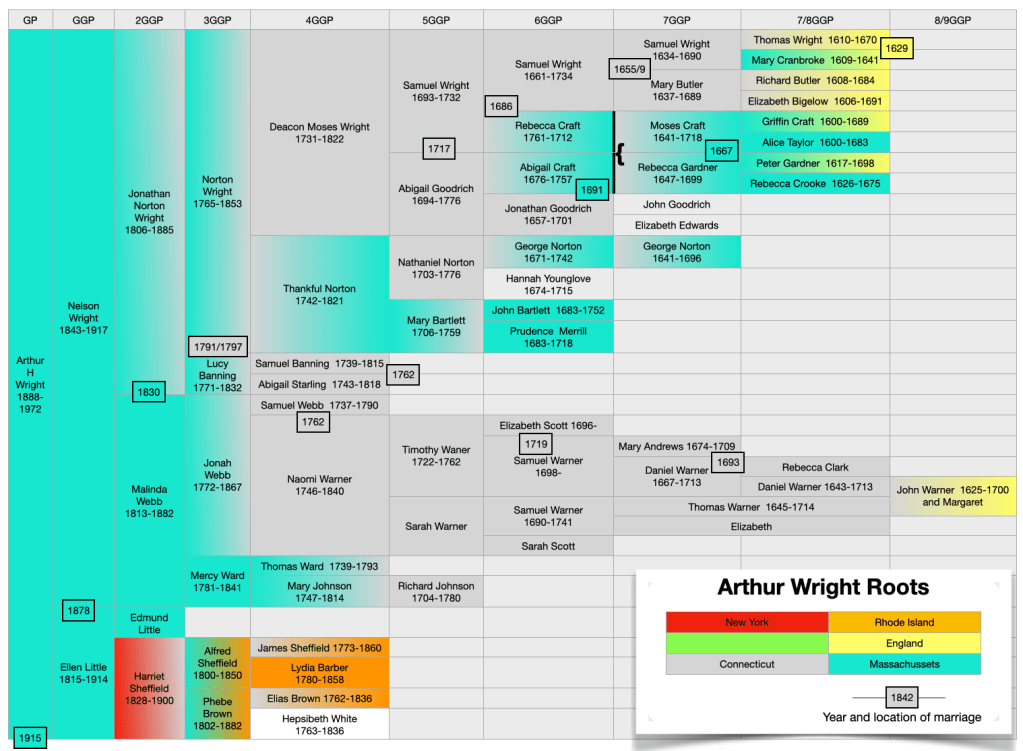
The ancestors of Janelle’s maternal grandfather Arthur Wright, have been in New England since the early 17th century, circulating between Massachusetts, Connecticut, and Rhode Island. A summary of what we can figure out about Janelle’s New England roots New England is shown below. (As a reminder, there is no known connection between these Wrights and our Wright ancestors from Prince Edward Island.)
At least two branches of Janelle’s family history reach back to the colonial origins of New England
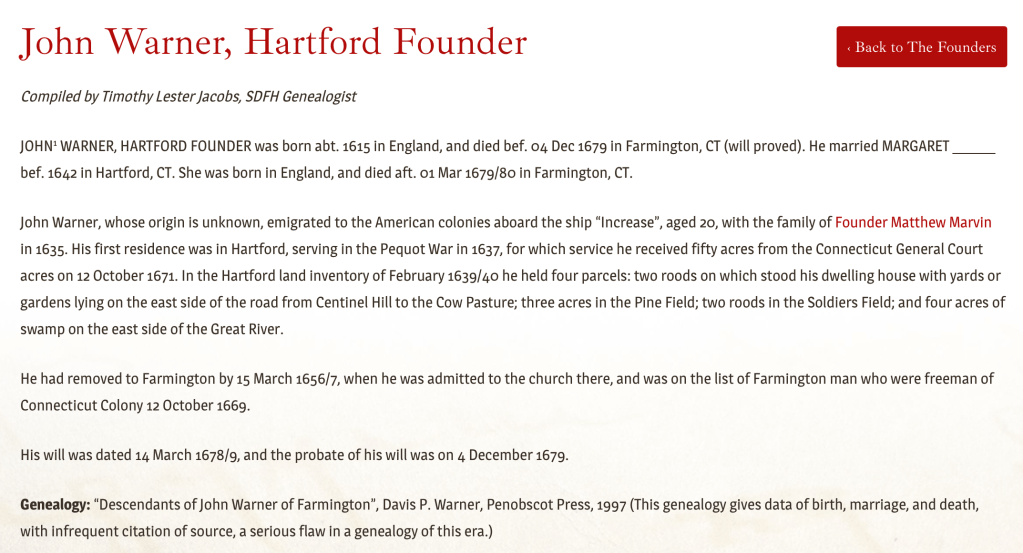
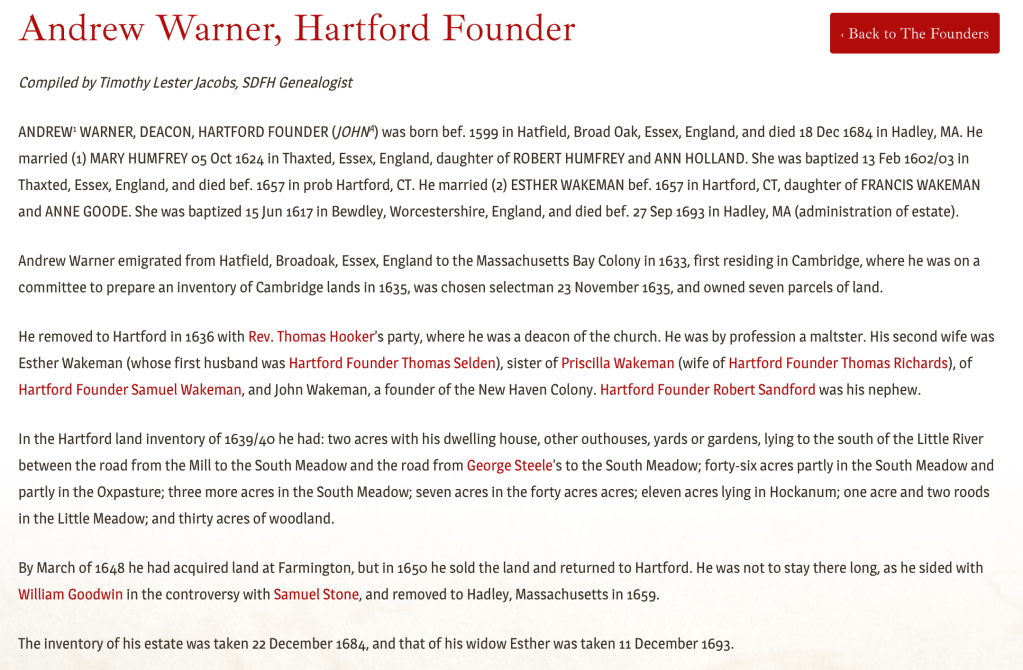
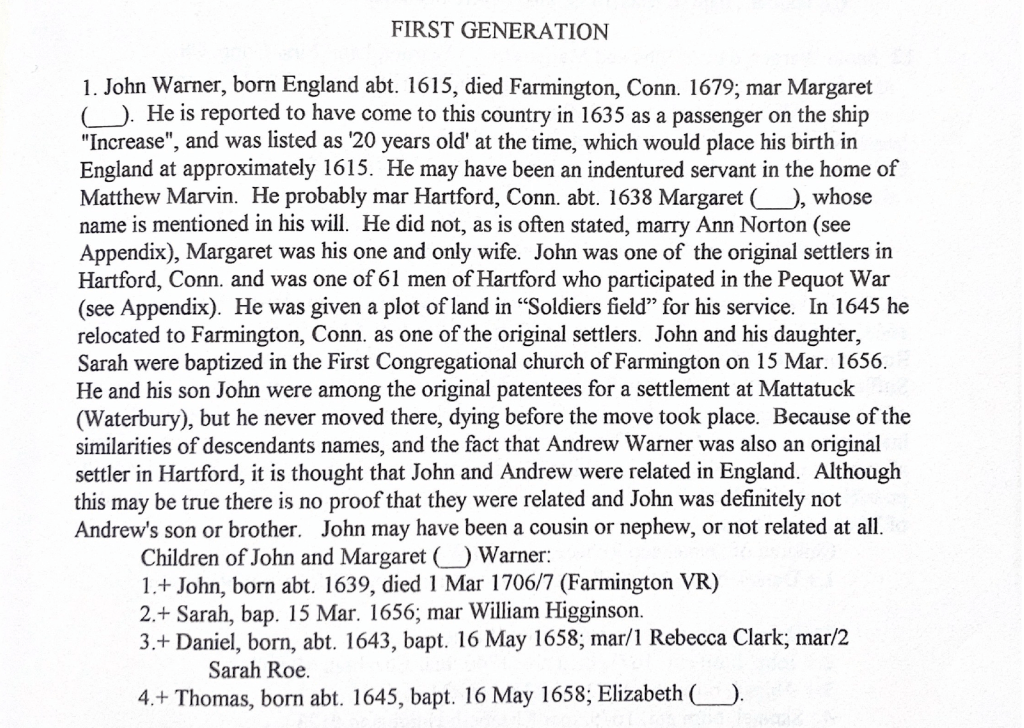
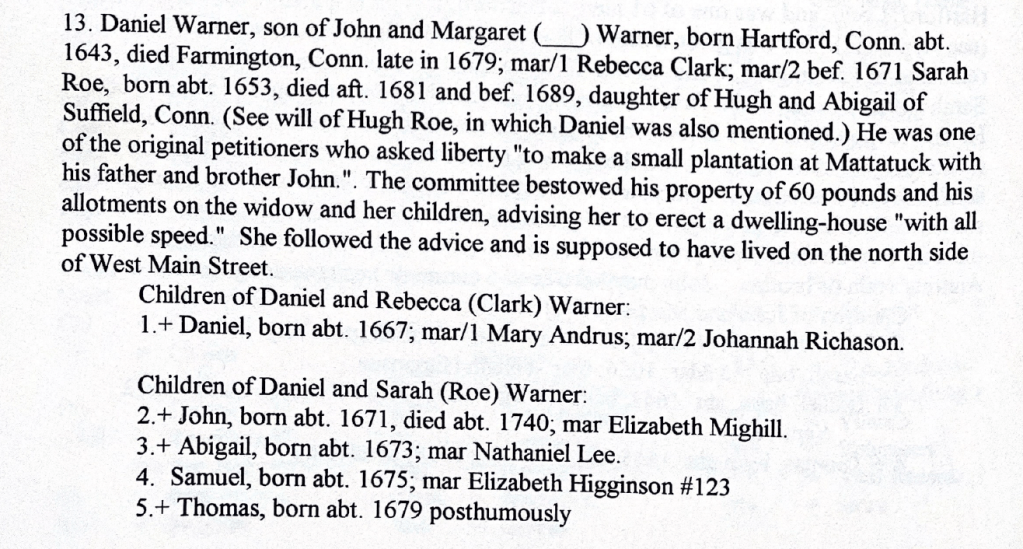
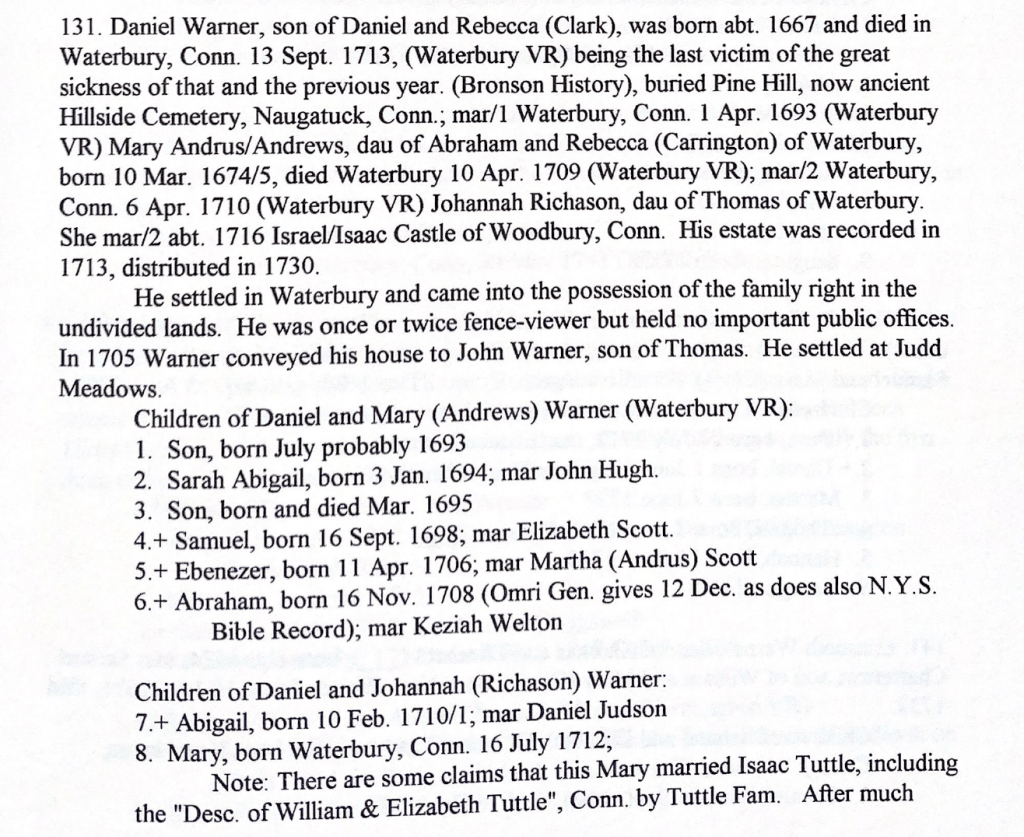
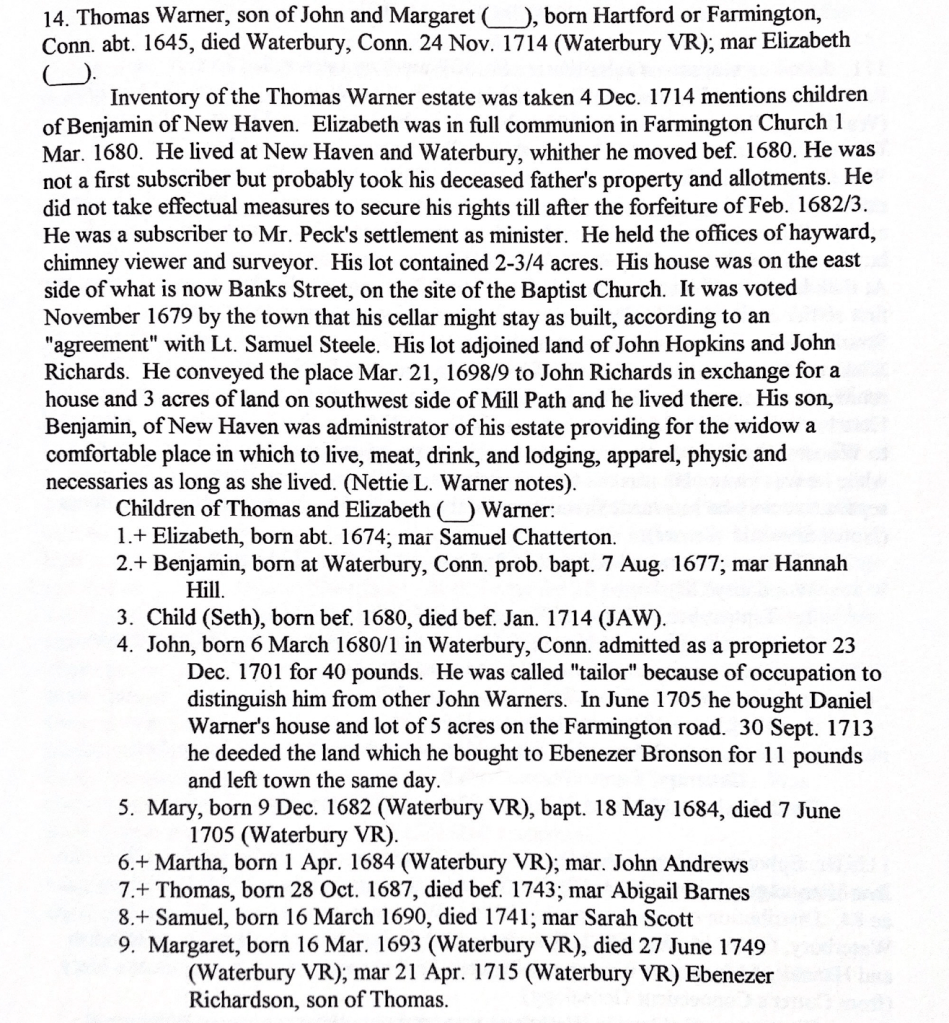
But concerns about the possibility of being very distant cousins are soon eased with a visit to the Founders of Hartford website. John Warner and Andrew Warner came to America at about the same time, but from separate origins with no known connection between the two.
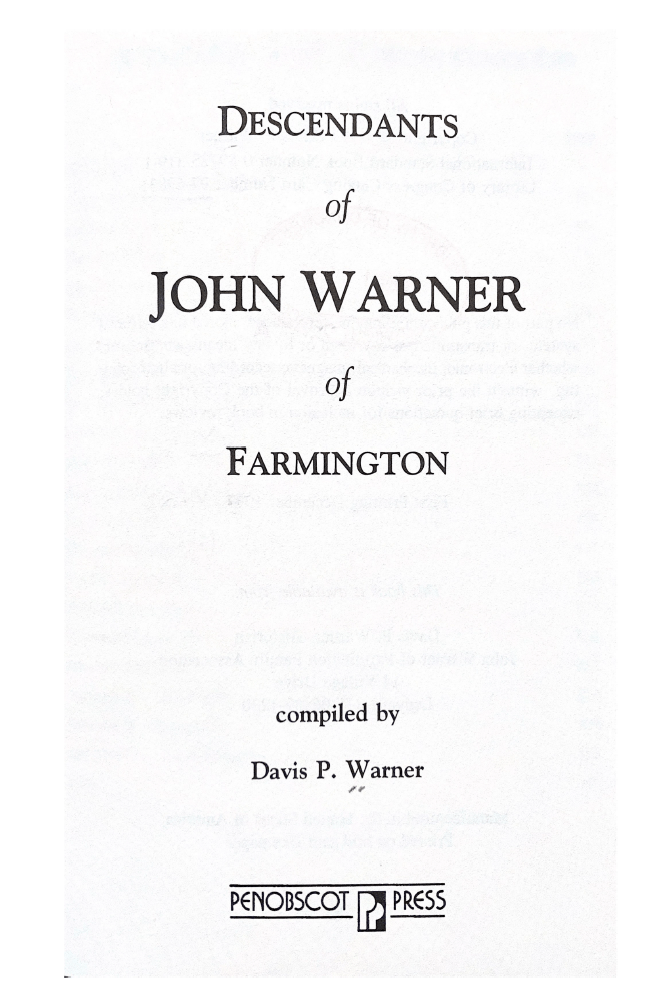
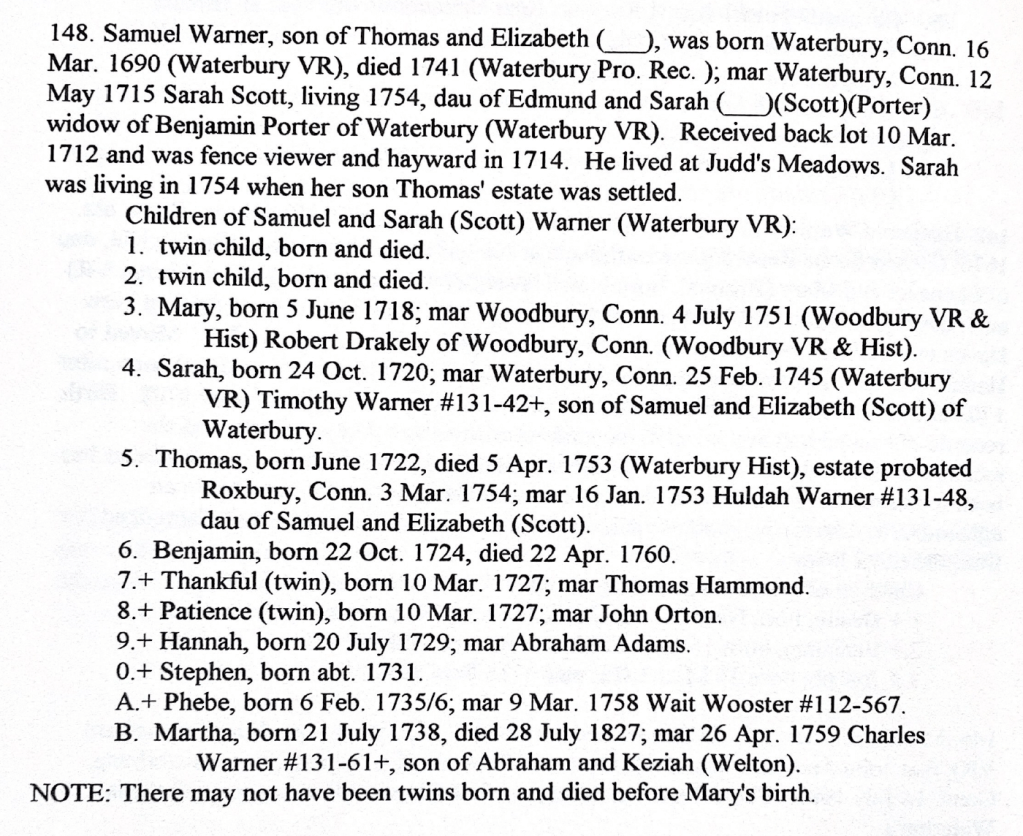
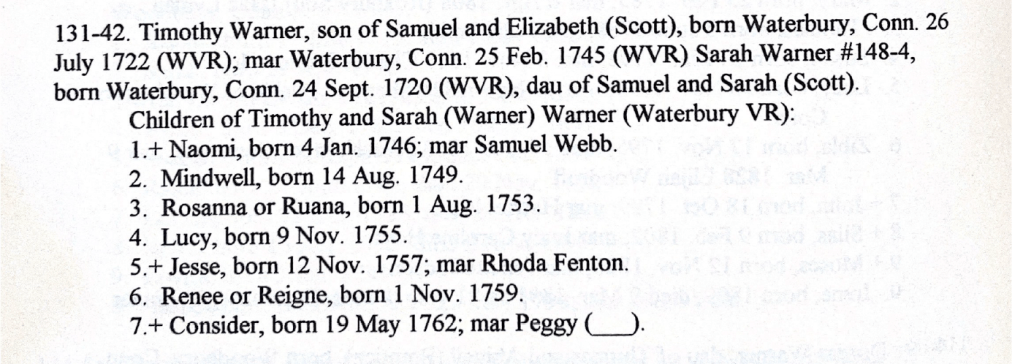
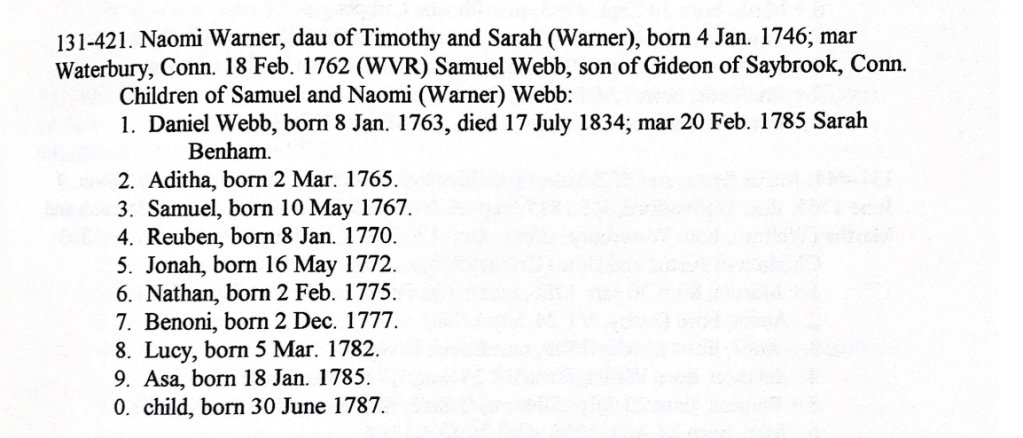
The genealogy of John Warner traces the descendants of John Warner down to Naomi Warner of Waterbury Connecticut, Janelle’s 4th great grandmother. She married Samuel Webb and their son Jonah Webb migrated to the Berkshires of Massachussets which became the new homeland of the Wright family. Naomi’s granddaughter, Melinda Webb, would marry Johnathan Norton Wright in the mid 19th century.
First of two paths from John Warner to Naomi Warner
Second of two paths from John Warner to Naomi Warner
Jonah Webb, son of Samuel Webb and Naomi Warner, was Janelle’s 3rd great grandfather
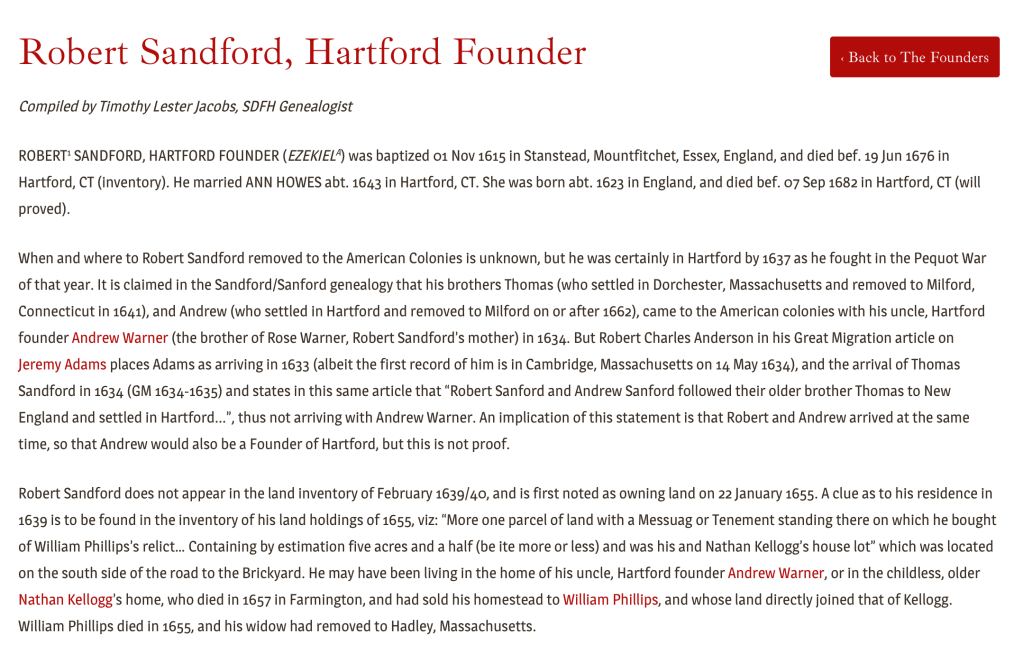
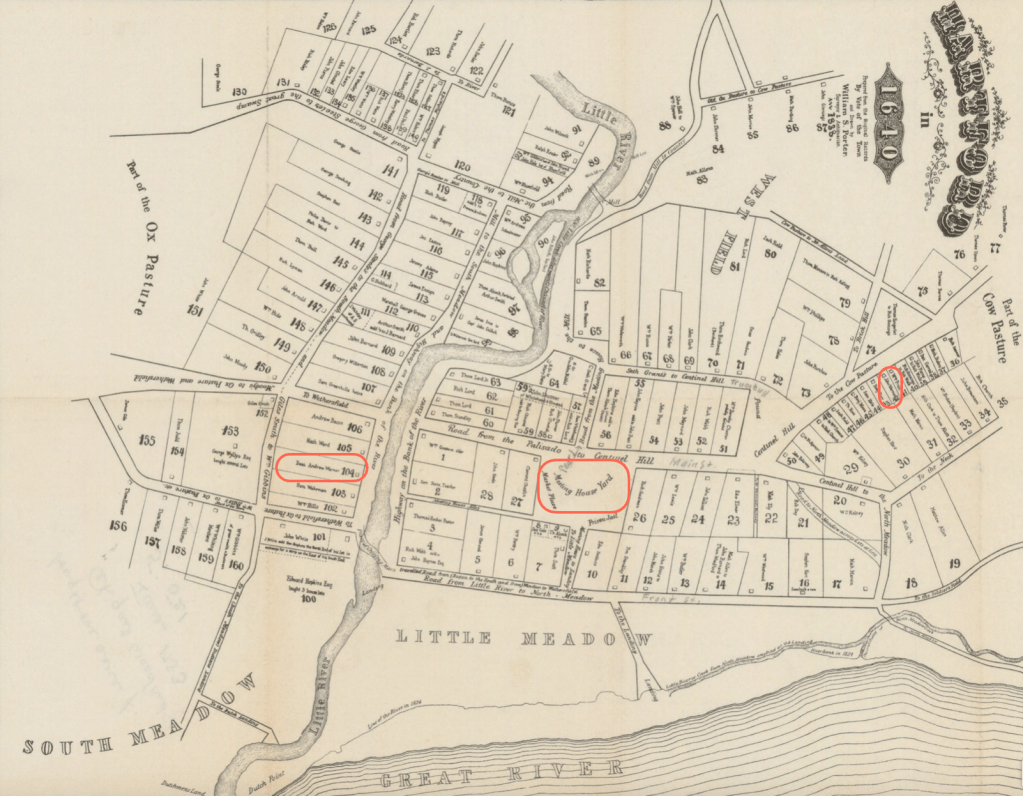
Hartford co-founders Andrew Warner and John Warner lived on opposite sides of the new Hartford colony, Andrew less than a half mile south of the central Meeting House Yard, and John about the same distance to the north. (Andrew’s nephew Robert Sandford was not yet a Hartford landowner, but is also recognized as a founder of Hartford.)
Shown on this re-created 1640 map, Andrew Warner (left) and John Warner (right) lived about a quarter mile from each other on opposite sides of the meeting house (center) owned by Jeremy Adams and later Zachariah Sandford.
On the present day monument to the founding land owners of Hartford, the two founders sharing the same last name, whose descendants would come together three and a half centuries later, are listed an inch apart.
Andrew Warner and John Warner are commemorated alphabetically on the Hartford founders’ monument
The death of Henry Swan; The Richardson family tends to the grieving Sandford/Swan family. The home and the orange grove transfer to Joe and Margaret Sandford
1924
Hotpoint produces the first enameled electric range
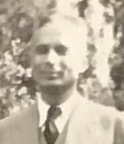
This history emphasizes the life and work of Earl Holmes Richardson, who we’ve seen in the Swan family picnic photo…
E.H. Richardson, third from right, in between poetry readings
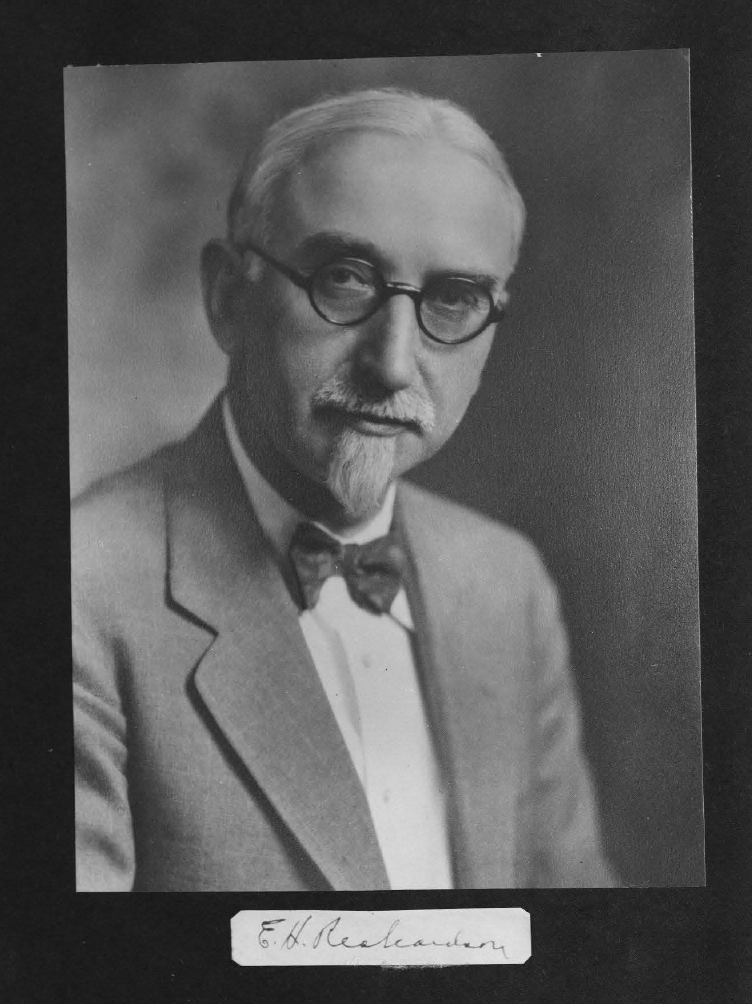
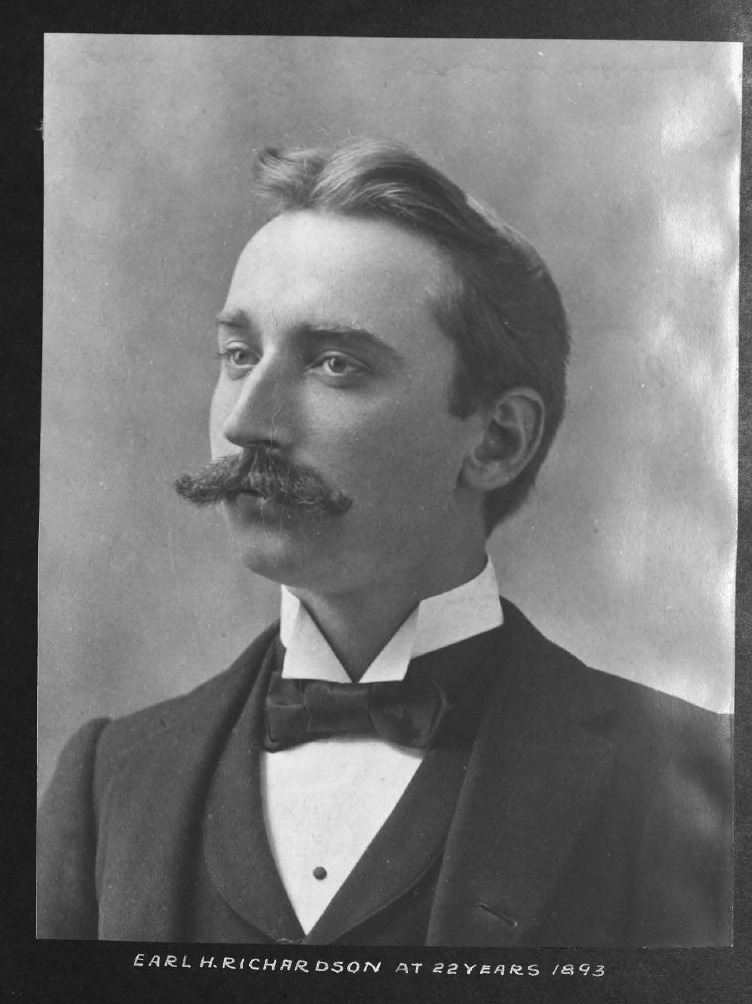
Eight years younger than Henry, Earl was known by most as “E.H.” and was a major force in the history of Ontario and our family. It is worth the time to understand him better. His life is summarized in a 2014 newspaper article…
E.H. Richardson – Inventor, Industrialist and Adelanto Founder
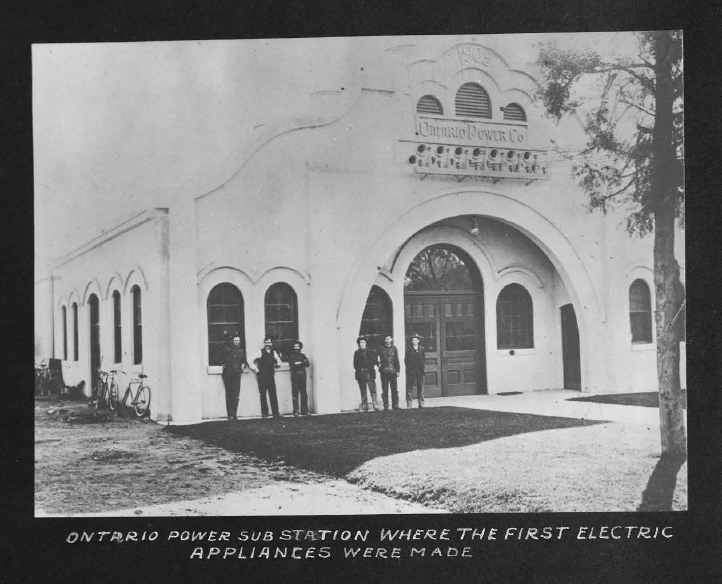
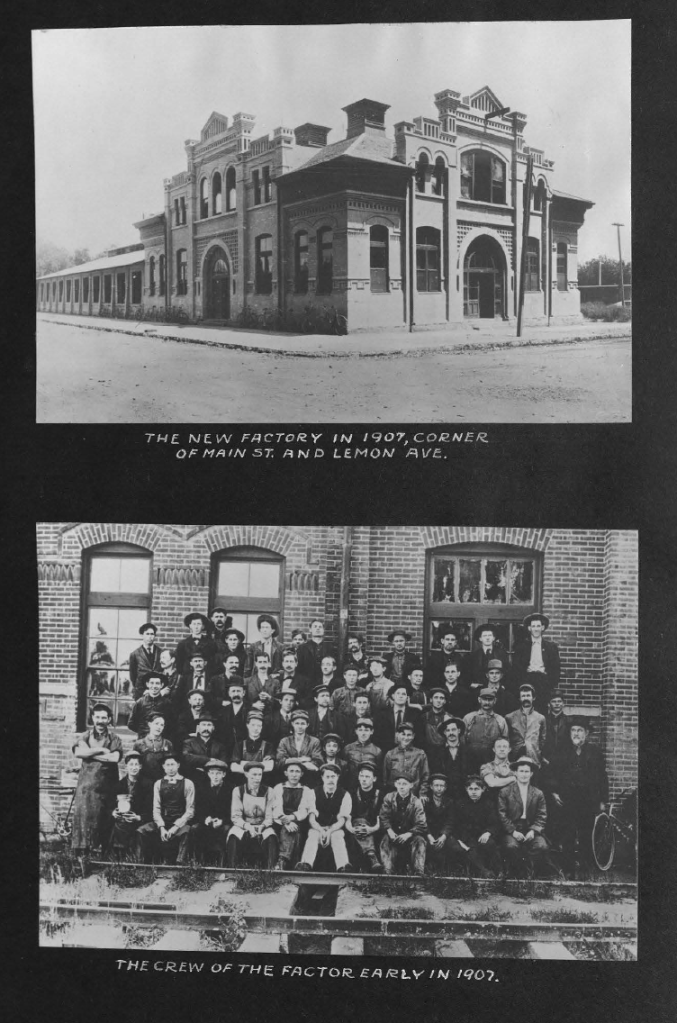
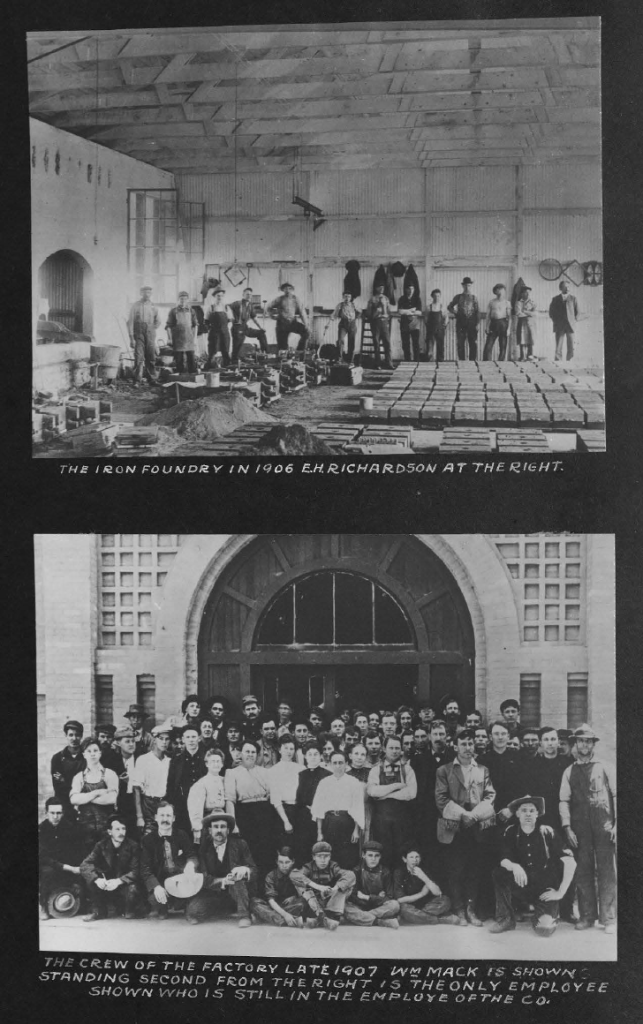
Earl Holmes Richardson is associated with and played a role in two of San Bernardino County’s 24 cities, the geographically disparate municipalities of Ontario and Adelanto. Born in Wisconsin in 1871, Richardson came to age in the era of Nikola Tesla, Thomas Edison and George Westinghouse. As a young man in Milwaukee, which was one of the hotbeds of the latter industrial revolution, Richardson learned a few things about practical science. He made his way to Ontario in 1895 and found a job maintaining and repairing the power plant that electrified the trolley cars that traveled up and down Euclid Avenue. Several years later he would return to the power plant and help to electrify the Model Colony. In the early 1900s, he was employed as a meter reader for the Ontario Power Company. Inspired by his wife, Mary’s lament about the relative inconvenience of having to constantly reheat her traditional clothes iron on the stove, Richardson utilized his knowledge of electricity to experiment with using resistive heating from an electrical current to create an electric flat iron. He designed a small, lightweight model that was easier to wield than the five to ten pound irons of the day. He distributed his model widely around Ontario, convincing his customers that they represented an improvement on the fueled irons of that generation that utilized whale oil, kerosene, ethanol and even gasoline. He then prevailed upon the company he worked for to generate power all day every Tuesday, which he promoted as ironing day, so power customers could use his new iron. He reasoned that if sufficient electric irons were in use, customers would demand more power and through a wider cusomer base and economies of scale the high electrical rates then being levied could be reduced. This proved to be the case. In 1904, Richardson left the power company and started up the Pacific Electric Heating Company on Euclid Avenue just below the railroad tracks to manufacture electric irons. An initial flaw in the early model of his irons was that they grew too hot in the center of the ironing plate. His wife suggested that he redesign the heating element closer to the top point of the iron to facilitate pressing around buttonholes, ruffles and pleats. He fabricated a version incorporating this change and had several local laundresses test it as to its serviceability. They found “the iron with the hot point” to be indispensable. In 1905, he manufactured and sold more electric irons under the “Hotpoint” name than any other company in America. Beginning in 1911 and continuing until 1917, Richardson found other innovative ways to electrify household appliances. These entailed the “El” line of products, with El being short script for “electric.” Among them were the El Perco (an electric coffeepot), El Chafo (a chafing dish), El Tosto (an electric toaster), El Stovo (an early hotplate), El Eggo (an egg cooker), El Teballo (an electric teapot), and El Warmo (an electric heating pad). In 1915, Richardson sold one of his patents and purchased land in what is now Adelanto for $75,000. His intention was to and develop one of the first planned communities in Southern California. Richardson subdivided his land into one-acre plots. Upon America’s entrance into what was then known as the “Great War” but which subsequently was called World War I, many of the combatants, known in America as “doughboys” were exposed to mustard gas. Richardson, in response to the significant number of GIs afflicted in this way, hoped to create in Adelanto a community that would be hospitable to veterans with respiratory ailments suffered while serving their country. He worked toward building a respiratory hospital/sanitarium there. Richardson never fully realized this goal, but his planning and efforts laid the foundation for what is currently the city of Adelanto, which incorporated in 1970 and transitioned into a charter city in 1992. During World War I, Richardson entered into discussions with George Hughes, the owner/inventor of the electric range and with the heating device section of the General Electric Company. The upshot of those talks was a merger of the Richardson’s Hotpoint electric Heating Company with the others, creating the Edison Electric Appliance Company,which featured the GE Hotpoint line of products. That resulted in an expansion of the existing iron manufacturing facility in Ontario. GE Hotpoint became the largest employer in Ontario, employing 25 percent of the city’s labor force. After the merger was in effect, General Electric sought to bring Richardson back to near Milwaukee, asking him to manage its manufacturing operations in Chicago. But he was reluctant to leave Ontario and Adelanto, so he continued to manage the local Ontario plant. Under his direction, new products were designed and sold, such as room heaters. In 1925, in conjunction with Hughes, Hotpoint offered the first all-white, fully enameled electric range. In 1929, GE began selling Richardson’s last significant invention, an early version of the crock pot, which he called the “jug cooker.” Richardson died in 1934, but the Ontario plant continued to manufacture electric irons until it closed in 1982. In 1941, the 20 millionth iron manufactured at the plant, this one gold-plated, was presented to Una Winter, Earl Richardson’s sister. When the 50 millionth iron was produced at the plant in 1956, President Dwight Eisenhower was looking on. In 1969 the 100 millionth iron rolled off the Ontario production line and in 1980, the 150 millionth was manufactured there. According to legend, the last iron manufactured there was buried on the grounds of the Ontario plant rather than being sent back to GE’s Bridgeport Connecticut plant in 1982.
Mark Gutlueck, San Bernardino County Sentinel, 2014
Other than the picnic photo, newspaper accounts of the Richardsons’ support after the death of Henry Swan, and the fact that our grandfather Joe Sandford told stories of E.H. throughout his life, I have not found detailed information on links between the families, but it is difficult to believe that banker Henry Swan would not have been somehow involved in the financing of E.H’s business ventures.
There is not a great deal of information published about E.H. Richardson. He is mentioned in some historical references in General Electric’s and Hotpoint’s web pages, but only perfunctorily. Given the extent of his contributions and innovations, it is something of a mystery that he doesn’t get more historical recognition, and how could there not be a Richardson Avenue somewhere in Ontario?
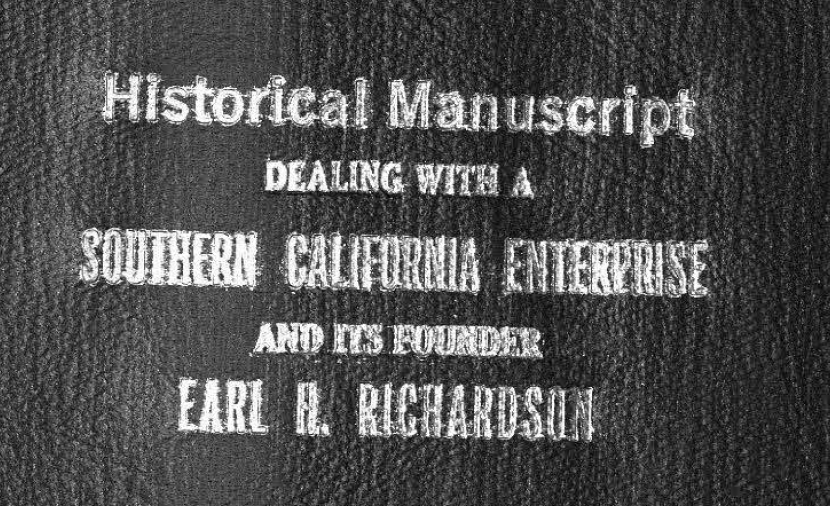
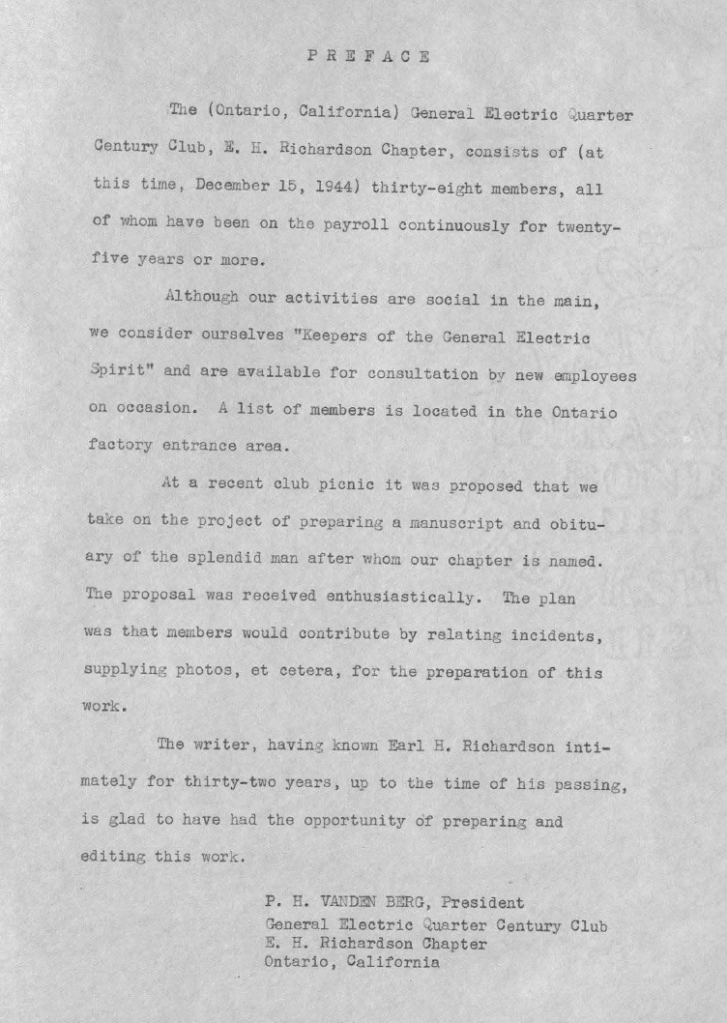
Part of the reason for this lack of recognition seems to be that E.H, himself, placed little importance on taking credit for his accomplishments. A 1945 Huntington Library manuscript sheds some light on this. A 25 page typed manuscript with 25 pages of facing photos, it was written by former colleagues of E.H. who recognized the importance of the accomplishments of their former boss and wanted to ensure that details were not lost to history.
An interesting back story revealed by the manuscript is that when electricity came to Ontario, it was soon realized that its usage was uneven. Demand was heavy at night, but quickly reduced when the lights went out. Investors in the electricity industry soon set about finding ways to increase daytime demand, and succeeded mainly through the introduction of new electric appliances. (This is reminiscent of how the first trolley companies built amusement parks at the end of their lines in order to incentivize off-peak travel in evenings and on weekends.)
So E.H’s entry into the electric appliance industry was somewhat inspired by this “need” to find daytime uses for electricity.
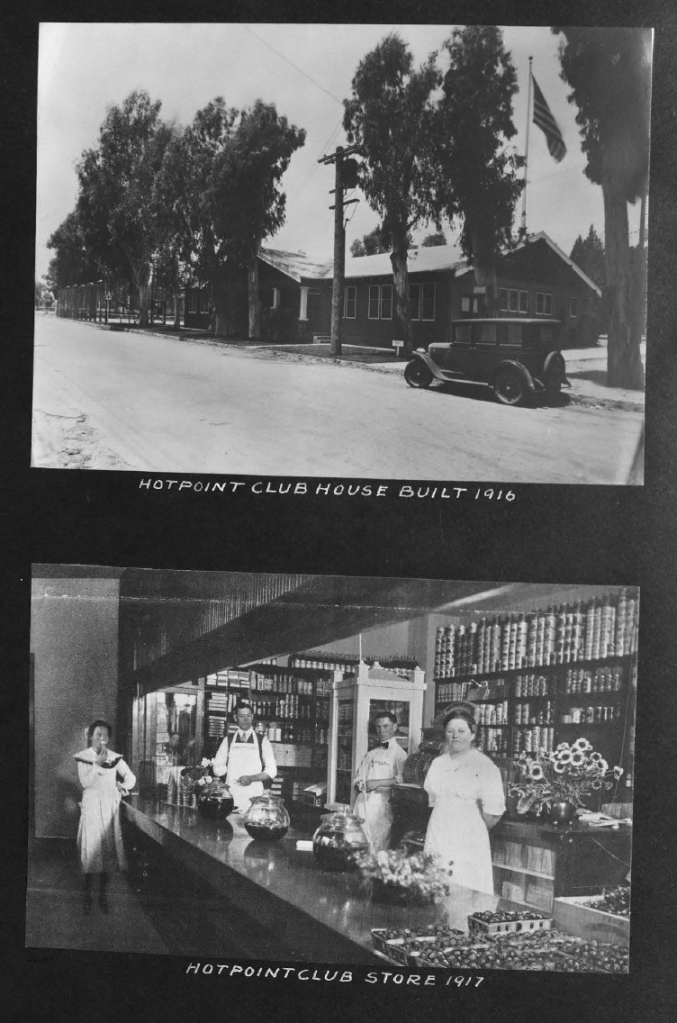
The manuscript also reveals details about an elaborate company culture introduced by E.H. and his peers. Innovative systems of employee benefits were developed and implemented in order to attract and retain top-level talent. A Hotpoint social club, with a cafeteria and male and female social lounges was built. This is all very similar to benefits that IBM had in place for most of the 20th century, but the Hotpoint benefits philosophy seems to have been developed a quarter century earlier before that of IBM.
At it’s peak, Hotpoint employed a quarter of the Ontario workforce.
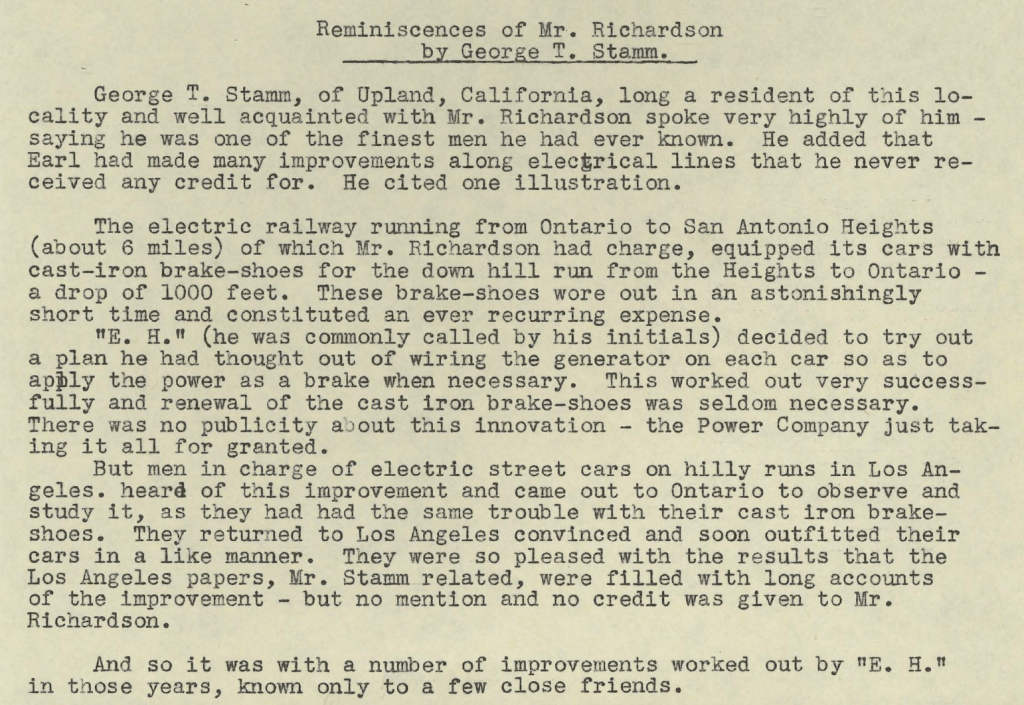
The theme that E.H. did not take personal credit for many of his accomplishments is emphasized in a set of personal reminiscences which are saved with the Huntington Library manuscript.
In the mid 1900’s, E.H. is said to have developed an “orange brusher” to increase the sale value of the fruit from the groves. He never patented it, and a patented version came about from another inventor a few years later.
Perhaps the most astounding example of E.H’s indifference to taking personal credit for his innovations is in the following testament…
Consider the significance of this, that E.H. Richardson either invented, or at the very least, was among the first to put into practical use, an electric braking system that saved the Ontario and Los Angeles trolley companies thousands of dollars and today is standard in train systems as well as the Toyota Prius, and he never took credit for it.
Given these examples, it is not much of a stretch is to imagine friend Henry Swan pleading with E.H. to patent and take financial credit for his innovations.
 The recent public release of 1950 census records provides an additional data point from the lives of great-grandparents James Louis Hynes and Bessie Gordon Hynes. In 1950 they lived at 107-29 134th street in Queens, New York.

 An open question has been how our great grandfather Edward Sandford, who was born, raised, and enlisted in Maine, came to serve in the First Cavalry Regiment of the District of Columbia during the Civil War? I had presumed that it had something to do with his arriving late to the party,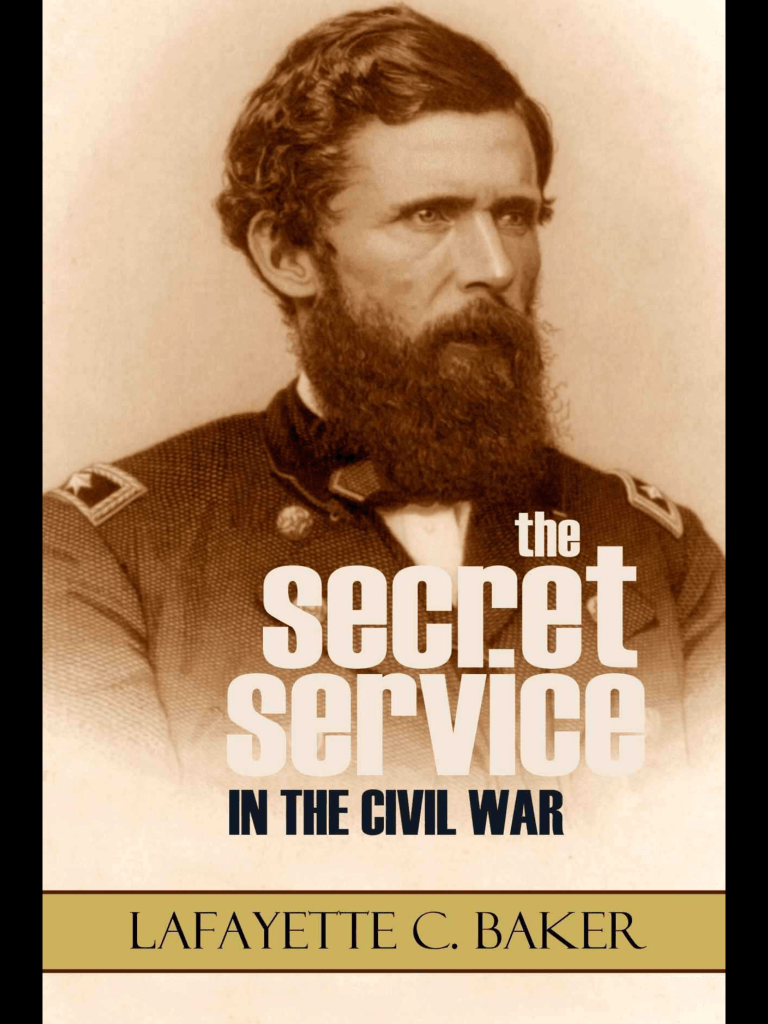

 Let’s step back and review what we’ve learned about the history of Ontario, California. Here is a summary…
 Bridging the Silences