 We have discussed that the Sandford brothers, Thomas, Robert, and Andrew came to America in the mid 1630s with their uncle Andrew Warner. Thomas settled in Milford, Connecticut to form the family branch detailed in Carlton E. Sanford’s Thomas Sanford, The Emigrant to New England, Ancestry Life and Descendants. Robert (our direct ancestor) settled in Hartford as a first- or second-tier city founder and had among his eight children Ezekiel (the Long Island bridge builder, our direct ancestor) and Zachariah (the owner of the Meeting House where the historic Charter Oak incident took place).
What became of the third brother, Andrew Sanford? He too would be recorded in Hartford history, but in a much more sinister way. Numerous sources are in fundamental agreement on the shocking details of Andrew’s life. (Note: Like Thomas, unlike Robert, most sources spell Andrew’s last name without the first “d”. )
Carlton Sanford’s 1911 genealogy sets the stage…
1. Andrew SANFORD (Ezechiell, Thomas, Richard) bapt. Nov. 1, 1617, Stanstad Mountfitchet, Exxex Co., Eng. (See “Midieval Origins of the Sandford” pg. 13.), d 1684, Milford, Ct.; m (1) Mary _____, d. 1662; m (2) Sarah, dau. of Wm. Gibbard of New Haven, Ct. Her mother was a daughter of Edmund Tapp of Milford, and sister to the wife of Gov Robert Treat.
The first record of him is in Hartford in 1651. His residence was on what is now lot 74 on Burr St. On May 21, 1657, he was made Freeman and was Chimney Viewer in June, 1662. It is very likely that he was in Hartford and married as early as 1638 and the first two children born soon thereafter. The records state that Mary, his second chid, was of marriageable age in 1667.
He and wife certainly got into serious trouble in Hartford…
Thomas Sanford, the Emigrant to New England… by Carlton Sanford, 1911. (The sequence “Ezechiell, Thomas, Richard” refers to Andrew’s and his brothers’ earlier ancestry in England.)
When Thomas Hooker, the leader of the founders of Hartford, died in 1647, he left a leadership vacuum that led to serious problems within the colony…
Within the Connecticut Colony an internal rift in the church at Hartford caused increasing difficulty. The Rev. Samuel Stone had led the church since the death of the revered leader, Thomas Hooker, in 1647. Rev. Stone was more authoritarian than Hooker had been and there was friction between Stone and the church elders. This led to an open split in the congregation in 1658 which could not be healed and for the next two years many prominent families left Hartford, moved north up the Connecticut River and settled at Hadley, Massachusetts. Thus, Connecticut entered the sixth decade of the seventeenth century facing an uncertain and insecure future and with the settlement at Hartford torn with bitter dissension and abandoned by many of its leading citizens.
Witchcraft Trials of Connecticut, R.G. Tomlinson, 1978
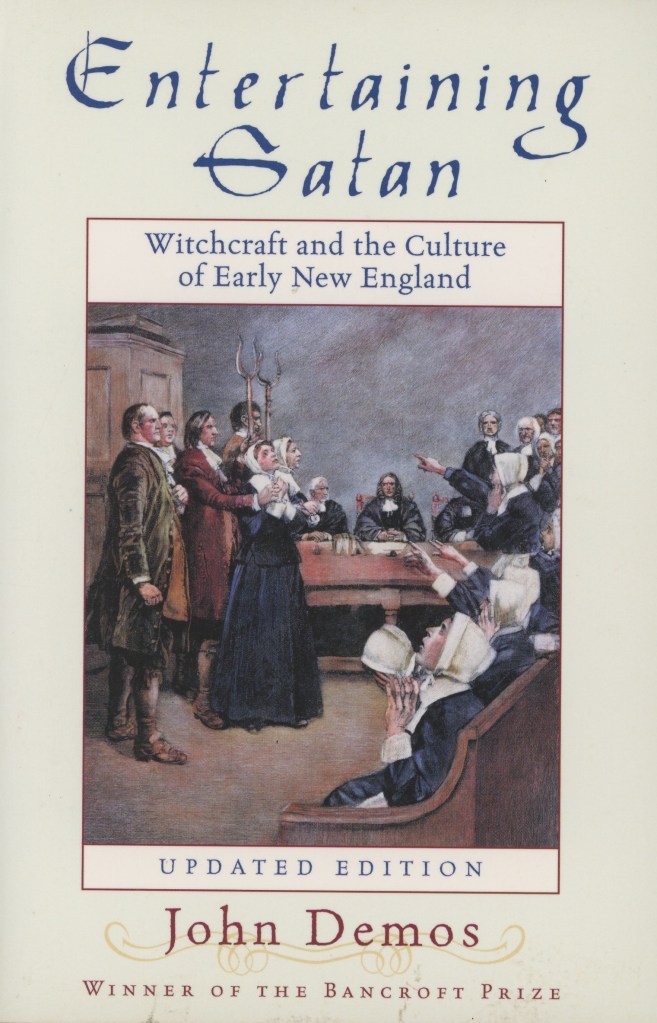
Time-honored traditions of scapegoating, honed over the centuries in mother England, took root in Hartford between 1647 and 1662. Several cycles of witchcraft accusations, trials, and executions took place between 45 and 30 years before the infamous events in Salem, Massachusetts.
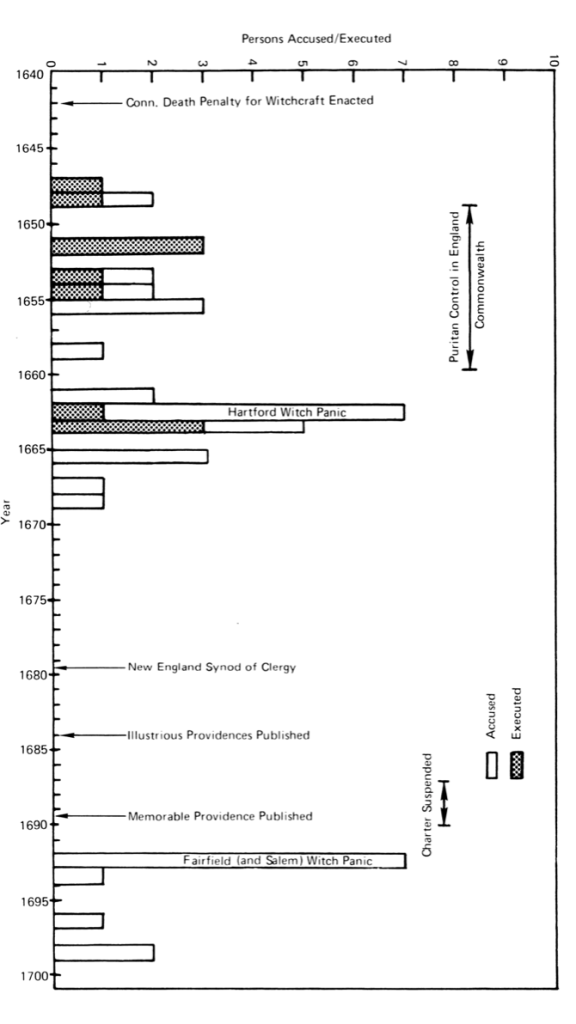
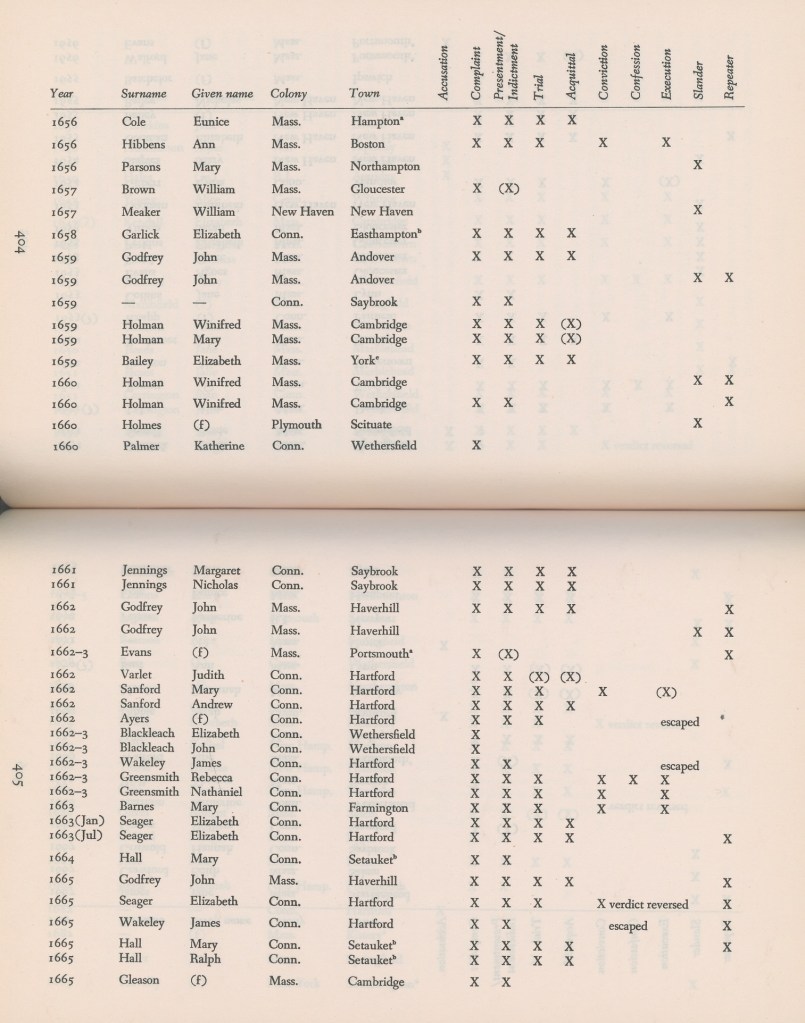
Accounts of the events and proceedings in 1662 and 1663 give many details, but, as is to be expected in witch trials, follow no discernible logical path. Predictably, accusations often originated against women who were viewed as “difficult” in the community, and spread to neighbors and family members. The path leading to the accusation of Mary and Andrew Sanford is never much more clearly explained than in the following.
The origins of the Hartford outbreak are obscure, but the trouble apparently began in the spring of 1662, with the possession and subsequent death of eight-year-old Elizabeth Kelly, who in her fits had cried out on her neighbor, Goodwife Ayres. Convinced that their child had died from bewitchment, her parents demanded an investigation. Ayres was probably the first person named, but two other people, Mary and Andrew Sanford, were brought up for examination not long after. Ayres’s husband, who would eventually come under suspicion himself, accused Rebecca Greensmith, who in turn supported accusations against her own husband and implicated several other Hartford residents. And so it went. The community was caught in the grip of a witchcraft fear that would eventually result in accusations against at least thirteen people, and that would take the lives of four of them.
The Devil in the Shape of a Woman: Witchcraft in Colonial New England by Carol F. Karlsen, 1998
Historical accounts are consistent in concluding that Mary was executed by hanging. Andrew’s charges were eventually grudgingly dropped.
Andrew subsequently moved to Milford to join his long-established brother Thomas, and remarried.
It is difficult to put these events into perspective with the other things going on in 1662 (or in any other frame of reference)…
- Andrew was 45, Mary 39.
- Andrew’s brother, Robert, was 47 and would continue to be a prominent citizen of Hartford until his death 14 years later.
- Uncle Andrew Warner was part of the group that fled Hartford in the late 1650s to go to Hadley, Massachusetts, so was no longer in the picture.
- Robert’s notable sons, Zachariah and Ezekiel, were 18 and 15. It would not be unreasonable to conclude that the incident involving Ezekiel’s aunt and uncle was part of what drove him to leave Hartford and establish his life on Long Island when he came of age (in which case we owe most of our family heritage, indeed our existence, to the 1662 Hartford Witch Panic).
- The Charter Oak incident at Zachariah’s Meeting House Inn took place in 1687, 25 years after the Witch Panic.
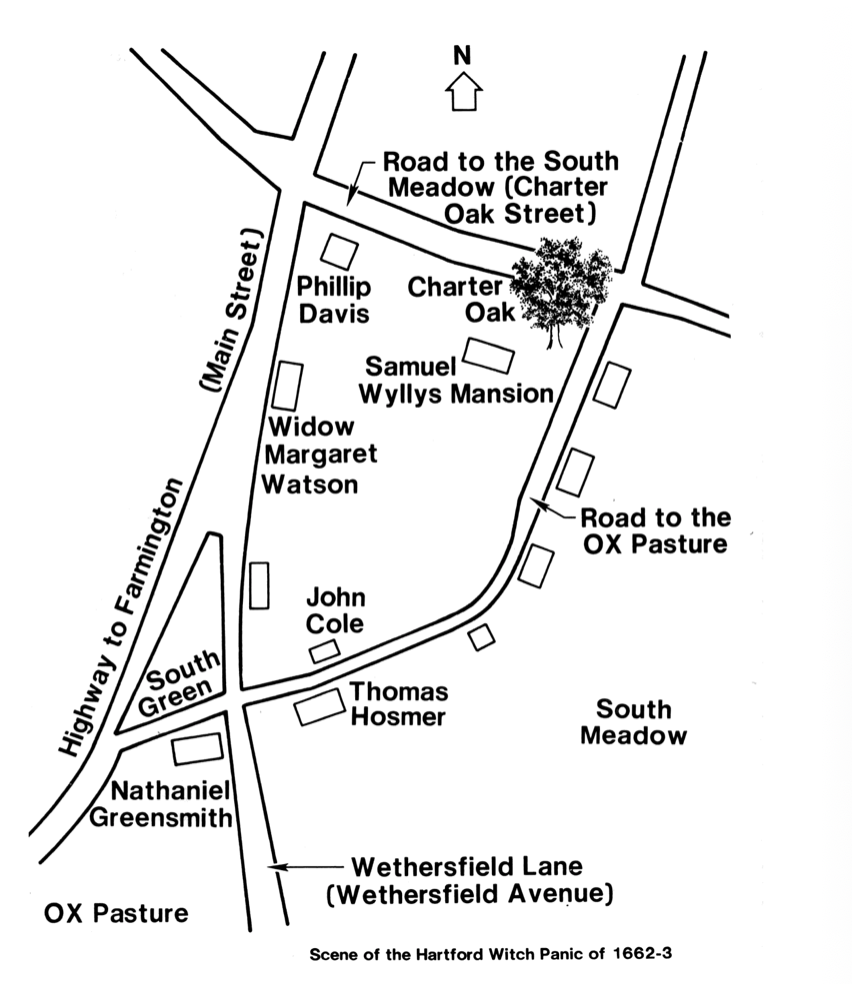
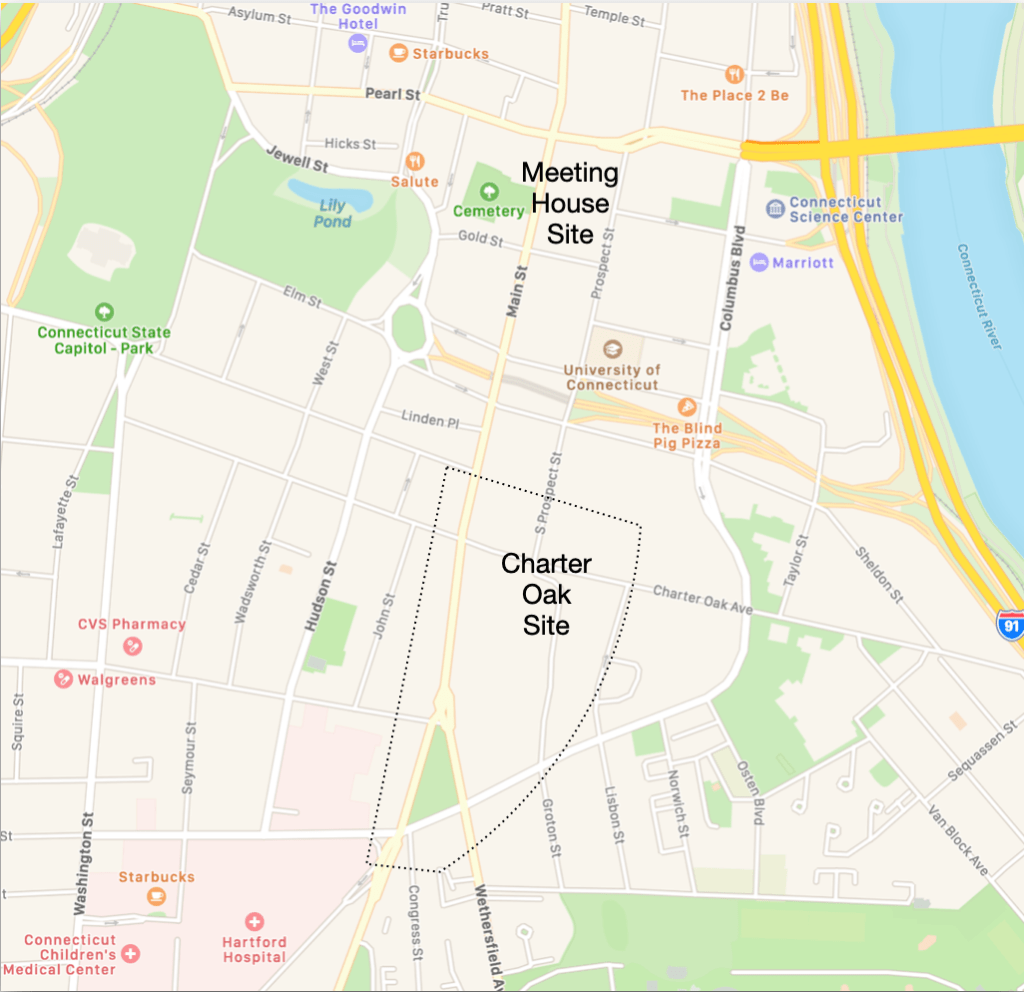
Accounts vary, but Andrew had a dozen or so children (including a few that died young), perhaps 5 with Mary (just adding to the incomprehensibility of the Hartford events), and another 7 in Milford with his second wife Sarah.
Parts of Andrew’s family branch eventually thrived. Carlton Sanford’s 1911 genealogy, even though primarily devoted to Thomas Sanford, contains a partial account of Andrew’s family in a later chapter, showing multiple branches including many Sanford branches surviving through 1911.
 Bridging the Silences
LikeLike