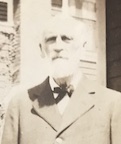
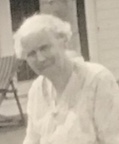
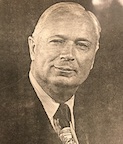
 The Sandford family lives were interrupted in April 1917 when President Woodrow Wilson, followed by the United States Congress, declared war on Germany, ending years of attempts to maintain neutrality. Grandfather Joe Sandford’s draft registration form is dated June 5, 1917. He was 25 years old.
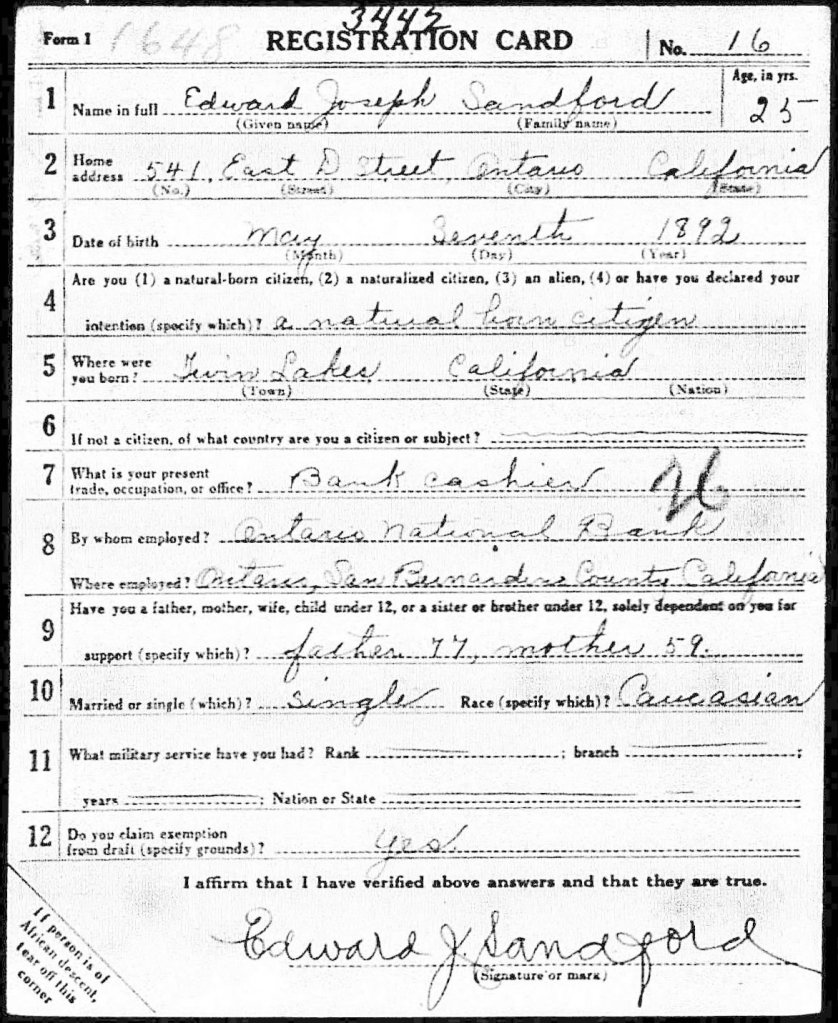
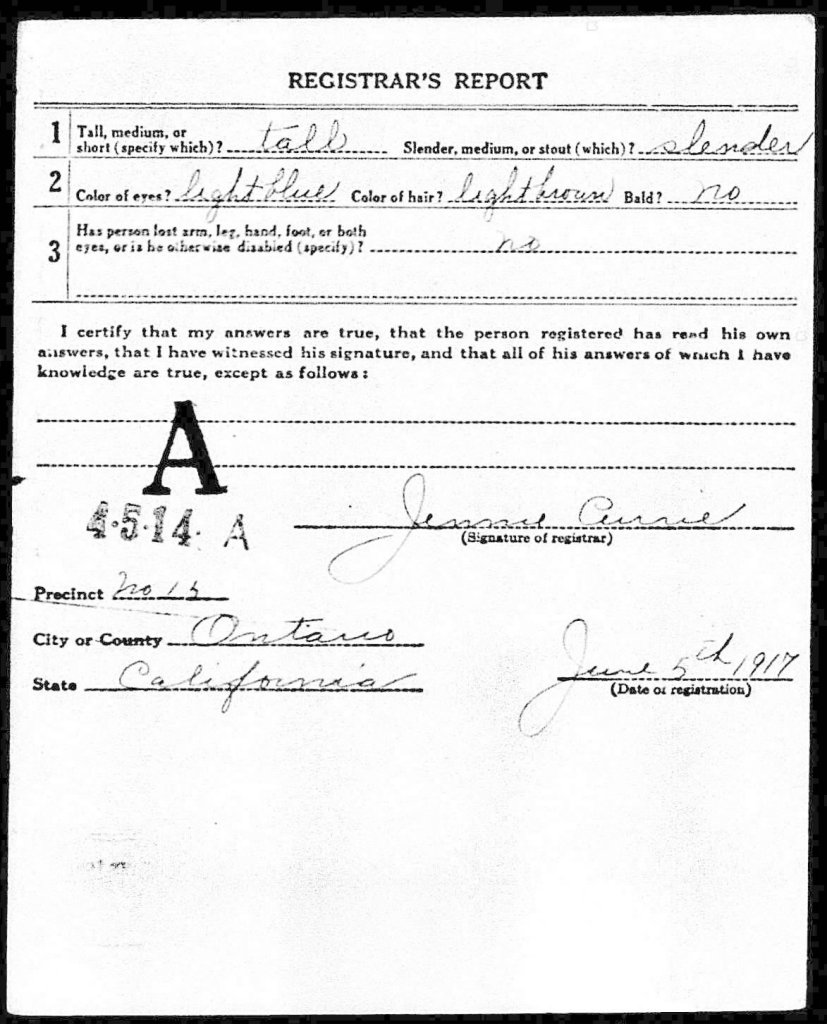
Signing up for the war was in line with popular sentiments of the era. Most of Joe’s friends and contemporaries from Ontario eagerly followed the same path. But for Joe there was an additional source of motivation: Owing to the advanced age of his father, Edward–he was 77 in 1917–Joe was unique in his generation for being the son of a wounded Civil War veteran, the son of a man who had gone on to serve his country in China in the following years. Edward was proud of his service and surely passed this sense of duty to his son.
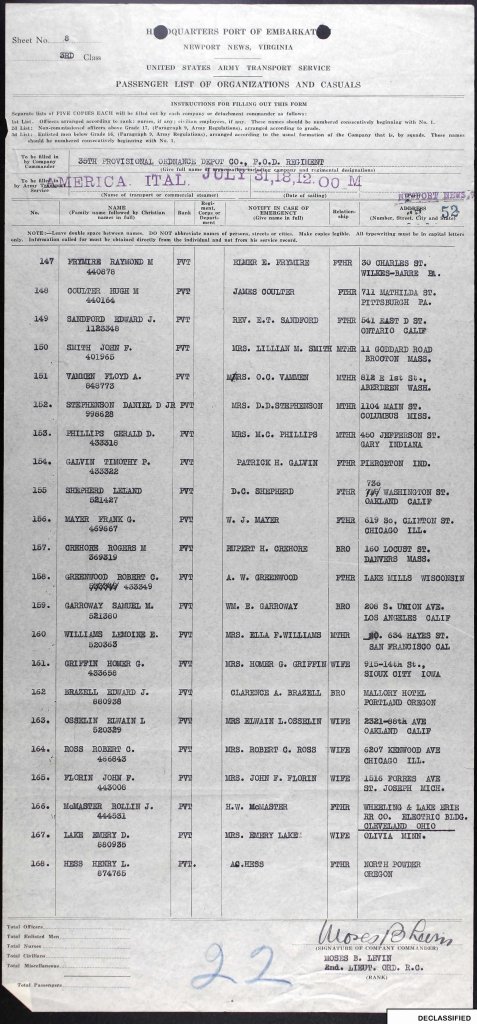
It was another year before Joe departed for France, shipping-off in July 1918 from Newport News, Virginia. Prior to this, he had spent time training in Augusta, Georgia.
Joe was a Private in the 35th Provisional Ordnance Depot Regiment of the Army’s Ordnance Department. The Ordnance Service was responsible for maintaining the flow of armaments and supplies to the war front–procurement, logistics etc. Joe probably drew this assignment because of his background in business and finance.
Recall that Joe’s 1950 Ontario Rotary Club biography included the following parenthetical line: “Imagine Joe a soldier in France–riding in 40 and 8 cars, sleeping in stables–later serving under General Dawes.”
From Joe’s arrival in France to the November 11 Armistice was only about 3 months. It appears that his work was primarily behind the lines, overseeing logistics and shipments. However, the bullet hole/dent in the helmet that always hung at the top of the basement stairs of his Ontario home suggests that he spent at least some time near the front.
“40 and 8” cars were boxcars on the French rail system that became the primary mode of cross-country transportation for troops fighting the war. When they arrived, American soldiers pondered the meaning of the words “40 Hommes / 8 Chevaux” stenciled on the car walls–a notice of the intended capacity of the cars in terms of men or horses. The mode of transportation seems to have been regarded fondly by the young soldiers, at least in the hindsight of veterans looking back on their war experiences. I imagine Joe shuttling across the countryside checking up on supply lines, flagging and riding the trains in a similar manner to what he had done during his younger days in Ontario.
I heard the story only once from Joe (therefore difficult to be sure of the details) about being in Paris on November 11 when the Armistice was announced. Everyone was celebrating, he was near the new (not yet consecrated) Sacré-Coeur Basilica in Montmartre, and he decided he wanted to ring the bell. So he went inside, found the bell tower, and rang the bell on the hill overlooking Paris on the last day of the war.
More than half of Joe’s time in France was after the Armistice. Joe’s mention of his service under General Dawes gives clues to his activities during this time. Charles Gates Dawes (1865-1951) was an American banker, general, diplomat, and composer who became Calvin Coolidge’s Vice President from 1925 to 1929.
Dawes advanced from Major to Brigadier General during the war, overseeing purchasing operations. When the war ended in November, he became part of the Liquidation Commission of the War Department. He developed the Dawes Plan for WWI reparations, for which he won (shared) the Nobel Peace Prize in 1925.
It seems that Joe, after the Armistice, was assigned and/or drawn-into some kind of support of these post-war financial cleanup activities, somewhere within the organization of General Dawes. By December 1918 he was attending some kind of schooling to prepare him for this work.
This is mentioned in a letter to Joe from his boss back at the Ontario National Bank, written in February 1919. The handwritten letter is 6 pages long (3 sheets front and back) and was found in the Sandford file of the Model Colony History Room of the Ontario Public Library. A transcription of the letter is provided below.
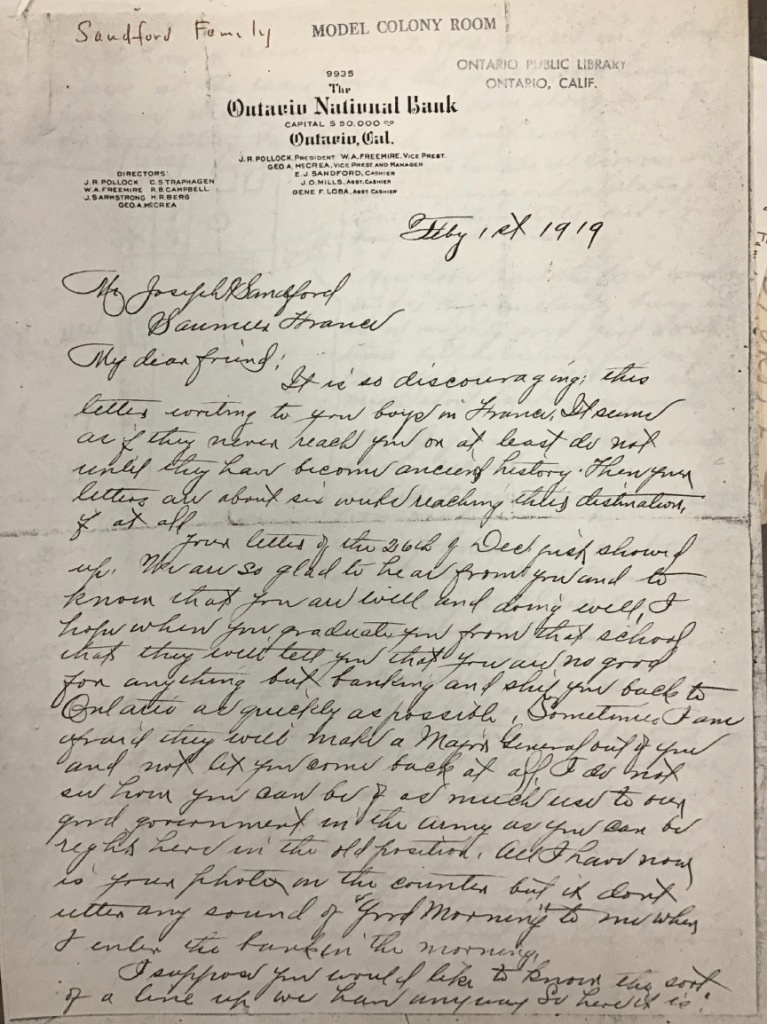
February 1st, 1919
Mr. Joseph Sandford
Saumur (?) France
My dear friend:
It is so discouraging; this letter writing to you boys in France. It seems as if they never reach you or at least do not until they have become ancient history. Then your letters are about six weeks reaching this destination, if at all.
Your letter of the 26th of Dec. just showed up. We are so glad to hear from you and to know that you are well and doing well. I hope when you graduate you from that school that they will tell you that you are no good for anything but banking and ship you back to Ontario as quickly as possible. Sometimes I am afraid they will make a Major General out of you and not let you come back at all. I do not see how you can be of as much use to our good government in the army as you can be right here in the old position. All I have now is your photo on the counter bit it doesn’t utter any sound of “good morning” to me when I enter the bank in the morning.
I suppose you would like to know the sort of a lineup we have anyway, so here it is:
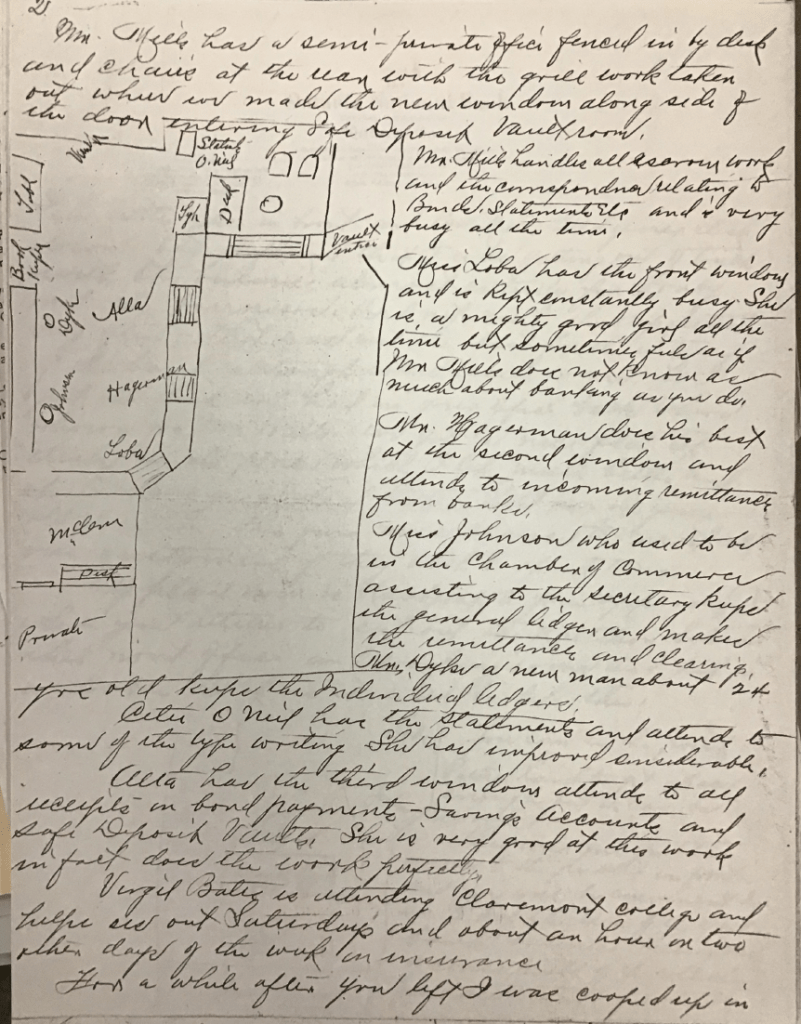
Mr Mills has a semi-private office fenced in by desk and chairs at the ? with the grill work taken out when we made the new window along side of the door entering Safe Deposit Vault room.
Mr Mills handles all escrow work and the correspondence relating to Bank statements, etc, and is very busy all the time.
Miss Loba has the front window and is kept constantly busy. She is a mighty good girl all the time but sometimes feels as if Mr. Mills does not know as much about banking as you do.
Mr Hagerman does his best at the second window and attends to incoming remittances from banks.
Miss Johnson who used to be in the Chamber of Commerce assisting to the secretary keeps the general ledger and makes the remittances and clearings.
Mr. Dyke a new man about 24 years old keeps the Incidental ledgers.
? O’Neil fas the statements and attends to some of the typewriting. She has improved considerably.
Alta has the third window attends to all receipts in bond payments—savings accounts and safe deposit vaults. She is very good at this work in fact does the work perfectly.
Virgil Bates is attending Claremont College and helps us our Saturdays and about an hour on two other days of the week in insurance.
For a while after you left I was cooped up in the little office in front and Mr. Mils held your desk down but I found that I was getting out of touch with the business almost entirely for I only met the borrowers. Did not meet the depositors very often—that was not the best for the entirety of the bank although ? easier on me. So I put the desk we had in your office back where shown for Mr. Mills. We got a nice flat top desk in its place which I like much better and it looks a great deal better. So I am in your old location. This gives me a chance to meet all our customers if they wish to speak to me.
My plan now is (subject to your approval) when you return to cut out the partition between this front office and working room and put in a double desk so it will be like this:
(drawn map)
You can see the point. Rather hard to get space enough but it can be worked.
This will give you the access to the public in front and you will be convenient so as to keep the run of the regular bank business, relieving me of considerably of the collection and settlement of notes, etc.
But as soon as you boys are all back on when you and Russell are here I want a good long rest for a couple of months or more. I am really just tired out. There had been a little more responsibility on me than is real good for my nerves.
Business is improving right along, however. Our holdings are around $725,000.00. Deposits about $600,000.00. Net earnings las year 12%.
On Tuesday the 15th of this month we will hold an adjourned meeting of the shareholders for the purpose of increasing the capital to $75,000.00. The increase issue of stock of $25,000.00 will be sold at $140.00 per share—this will give us additional surplus—at present surplus is $8,000.00 and $2,000.00 undivided profits. So you see we will have $100,000.00 capital and surplus.
With your help and that of Russell and Douglas this new Ontario National will soon exceed the million dollar mark.
Well just now our board of directors is in bad shape.
Judge Pollock has been on his back in bed for three weeks with a very bad heart condition. His pulse has been running at 150 to 160 all the time and no improvements. May drop off anytime although we hope for the best.
Mr. Armstrong is flat on his back with a very bad case of the flu. He is better today and will very likely recover.
Mr. Freemans heart went bad yesterday so he is out of the ring—his pulse is too low and might stop altogether anytime. He is better today.
Mr. Giaconi came awfully near dying with the flu. One day we thought he was dead as we got work in the morning that he had died—but the next day heard hew was still alive but could not recover. But he did get well however and is as smart as ever now.
My old friend in Drayt? Mr. Strong died about two weeks ago—Flu and pneumonia. He had a great funeral, however. I am very sorry about his death. He went off very suddenly.
Rosco is on the way home we think—had four letters from him this week. He was to start for Brest on January 6th and would embark for home as soon as they could from Brest. How glad we will be to see him. No words can tell.
We hear that Douglas Lusin has been placed in the army of occupation. So there is no knowing when he will be home.
Russel Jenkins writes that he will be on the way home very soon.
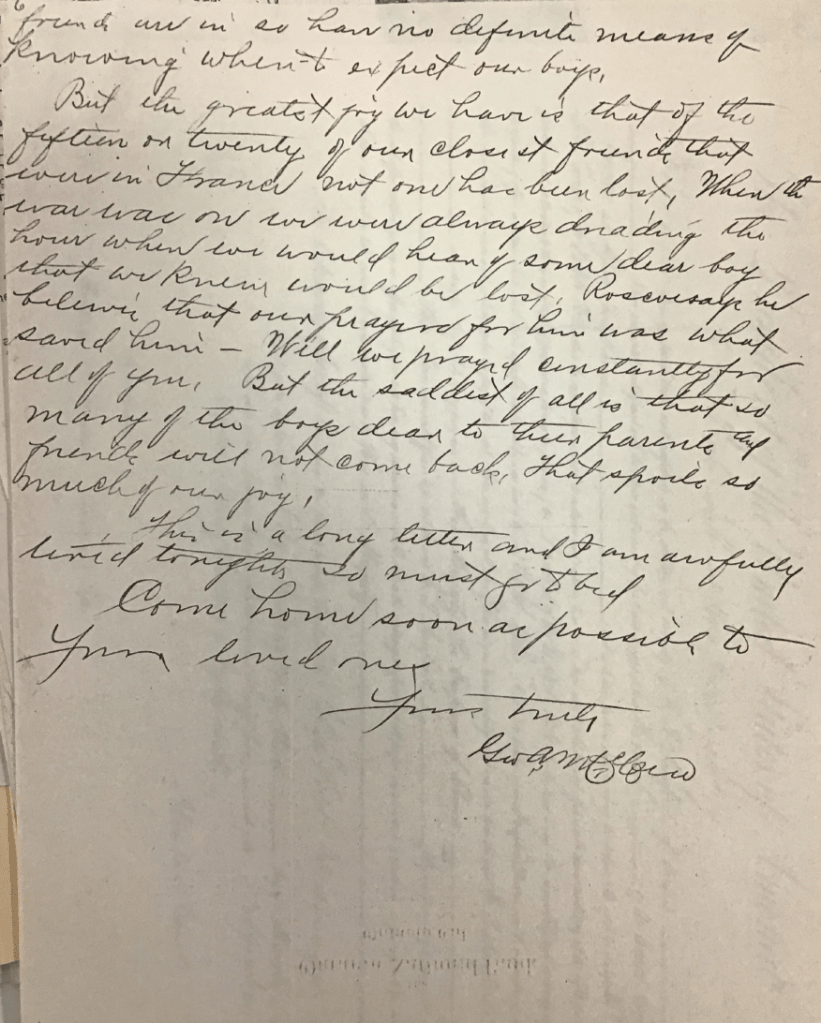
We cannot become familiar with the numbers of regiments and divisions our friends are in so have no definite means of knowing when to expect our boys.
But the greatest joy we have is that of the fifteen or twenty of our closest friends that were in France not one has been lost. When the war was on we were always dreading the hour when we would hear of some dear boy that we knew would be lost. Rosco says he believes that our prayers for him was what saved him. Well we prayed constantly for all of you. But the saddest of all is that so many of the boys dear to their parents and friends will not come back. That spoils so much of our joy.
This is a long letter and I am awfully tired tonight so must go to bed.
Come home soon as possible to your loved ones.
Yours truly,
George McCrea
Transcript of George McCrea letter to Joe Sandford in France, February 1, 1919
There is a lot to unpack from this letter…
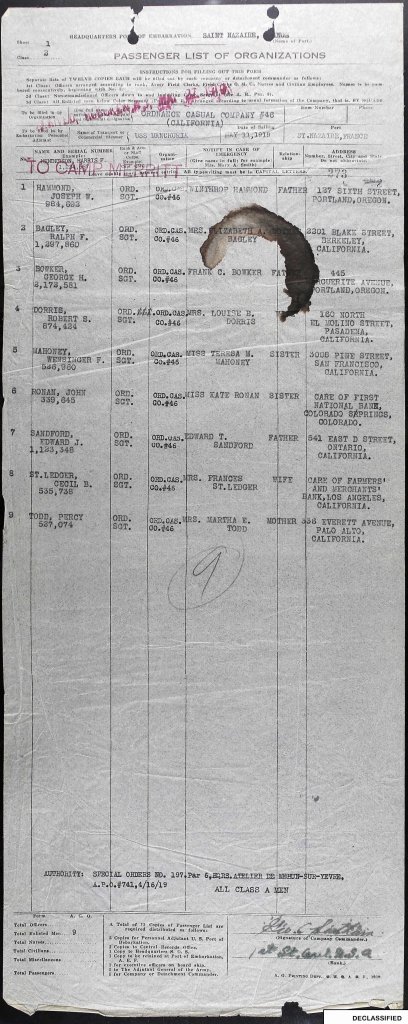
The destination of the letter is difficult to read, but it appears to be Saumur, France, a city far removed from the former WWI battle sites, located on the Loire in French chateau territory. (The region is consistent with the record of Joe’s eventual departure from nearby Saint Nazaire, France.) That Joe was involved in training pertaining to long-term post-war economic recovery support suggests that he was at least considering extending his tour of duty in France to be a part of this effort.
The McCrea letter is an odd mixture of sincere expressions of support with clear attempts to stake a claim on Joe’s post-war career. Later sources will reinforce the idea that the aging McCrea was past his prime as a bank president in dire need of Joe’s young talent to sustain his position.
We can also note the naming of numerous McCrea colleagues stricken with the flu at the time of the Spanish Flu epidemic in the United States (and that Joe eluded the ravages of this same epidemic among the ranks of American soldiers overseas).
Apparently, Joe faced a major decision at this point of his life. He had an opportunity to attach himself in service to the historic effort to manage reparations in post-war Europe–indeed, he had already taken the first steps in this direction. Given his customary work ethic, he must have been in high demand for this work. It would not have been lost on Joe that, had he remained in Europe, his situation would have been very similar to what his father had done in the 1860s, following his war service with years of additional foreign service for his country.
Pulling in the other direction, exacerbated by the McCrea letter, was the stable, comfortable life and continued banking career that awaited him back home in Ontario.
We can’t know whether McCrea’s letter had a significant influence on Joe’s decision. He was surely already grappling with questions of what to do next, regardless of the letter. That Joe kept the McCrea letter for the rest of his life and finally donated it to the Model Colony history file is evidence of its importance. I suspect that the “what-ifs” associated with this decision remained with Joe for many years to come.
Joe made his decision in the months that followed, opting to return to Ontario to resume his position as Vice President of the Ontario National Bank. He left France, as a Sergeant, in June 1919, about a year after he arrived.
 Bridging the Silences
3 thoughts on “Quarante Hommes / Huit Chevaux”