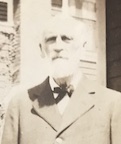
 After a dozen years in Corona, great grandfather Edward Sandford stepped down from his post as pastor of the Corona Baptist Church. The family moved to Chino around 1908. I don’t think Edward took easily to the idea of retirement, but he was 68 years old and his health remained an issue. This was likely a semi-retirement move, trading the Corona church for the smaller First Baptist Church of Chino.
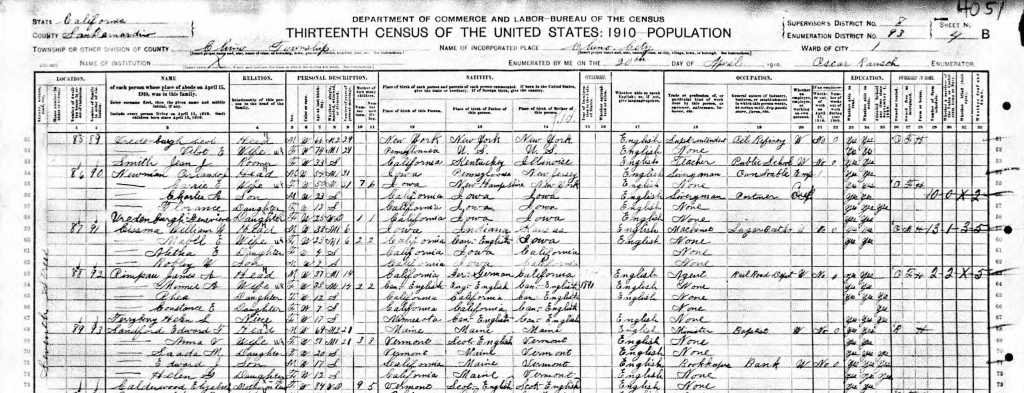
Grandfather Joe Sandford was able to continue building his banking career in Chino, based on his previous experience in Corona. He continues his family’s story in the living history interview recordings he left us.
But anyway, eventually father resigned over there [Corona] and moved to over Chino, he was elderly, you see. And, they found that I’d had a little banking…old Chino State Bank.
And they…I had to get certain credits from the high school that they couldn’t get me at Chino, so I rode a bicycle along the railroad tracks from Chino to Pomona every day. Well Mr. Rhodes, the head of the bank, asked me to do the same for them [as he had in Corona]. So I worked before and after school.
Joe Sandford from 1974 Living History Interview conducted by the Upland Public Library
Joe has dozens of stories from the early frontier days of banking.
I’ll tell you about one of the early day burglar alarms. In the bank at Chino, things were primitive in those days. When we would get ready to lock the vault door, it was a fire door. We’d close half the fire door, then we’d go around and we had a great big bottle of ammonia with a cord tied around the neck. We’d take that bottle and put it clear in the back of the vault on the shelf. The cord was taut. You could see if anybody got in there and pulled that door open, they couldn’t work, because the ammonia bottle would break, and you couldn’t breathe. True story.
Joe Sandford from 1976 Living History Interview with Bryce Denton
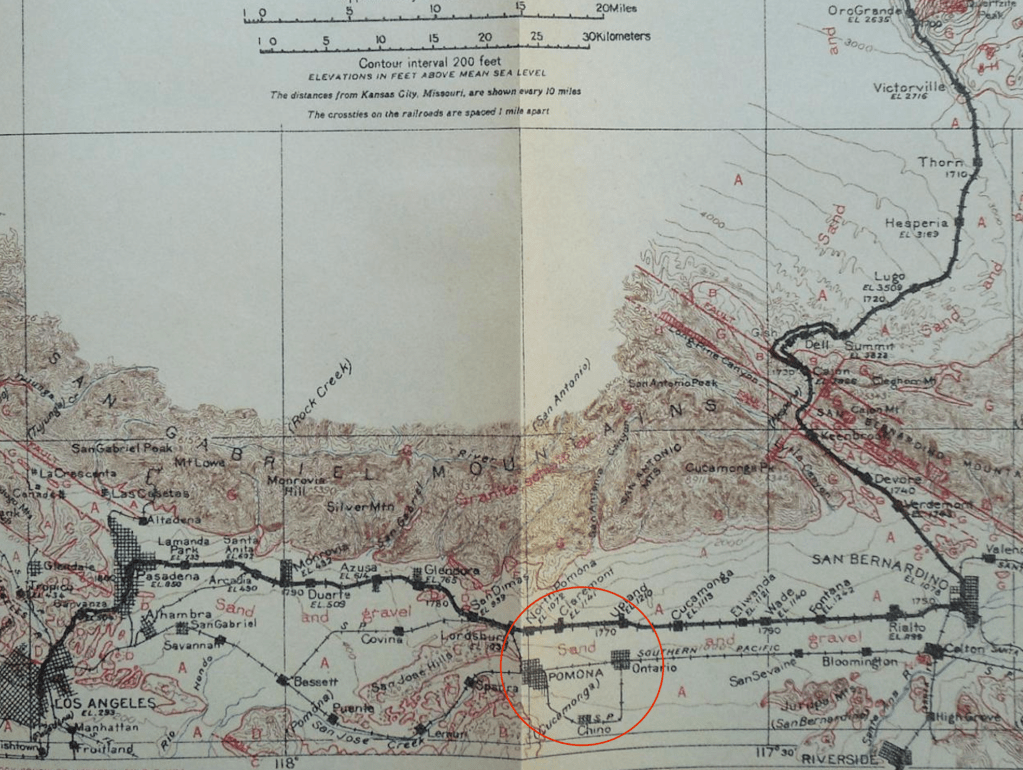
Chino, Pomona, and Ontario form a triangle, each about 5 miles from the other two. Not long distance bike riding by today’s standards, but hard to imagine on 1910 dirt roads, on a 1910 one-speed bicycle, wearing whatever 1910 clothes Joe had to wear. (I recall a day as a child visiting Ontario when we had to find a bicycle shop to repair a flat on my bike, Grandpa’s banter with the bike shop people revealing his substantial familiarity with the subject.) When the family moved to Ontario, Joe’s daily bike ride from Chino to Pomona turned into a daily bike ride from Ontario to Chino…
Ontario, when I arrived here in 1910, was a lovely community, and I’ve mentioned the trains that we have here. There was a stopover; father spent a couple of years in Chino before coming here [Ontario] to retire, and while there, Mr. Rhodes put me to work in the bank and I rode a bicycle every day from Chino to Pomona on the railroad track, for the balance of the year. That was fun, and different and interesting. When we moved up here, Mr. Rhodes was bound [?] that I had to ride the bicycle down and work there anyway. I did. If I did that it was a long ways to pump back, and I found out that I could ride the Southern Pacific train which came from Los Angeles to Pomona down through Chino, check my bicycle for fifteen cents. That beat pumping up here. Frequently, I’d ride on the back with the conductor. In the rainy season, we had to stop for the Union Pacific track. Then we had to pull that long train going to Salt Lake City around the bend. He always wanted to bet as to whether we’d make it or not. Sometimes we had to back up and get a little momentum to go around there. Of course that track is all removed today.
Joe Sandford from 1976 Living History Interview with Bryce Denton
The railroads were an important part of life in Ontario in the 1910s, and especially so for our grandfather who took full advantage of them. They come up again and again in his stories.
Built in the later 1800’s, by 1910 there were two major railroad lines running east-west through Ontario. The Southern Pacific went directly through Ontario and Pomona with a spur looping to the south through Chino. The Atlantic and Pacific (a.k.a. the Santa Fe) followed the foothills to the north through Upland (about the route we know as the Foothills Highway). A north-south electric trolley connected Ontario and Upland. An intersecting trolley line followed followed the foothills route into Los Angeles. (Today the Los Angeles Red Line light rail follows the same route, and has made it about halfway to Ontario–perhaps in another 25 years the system can catch up with where it was in 1910.)
The family remained in Chino for about two years before settling in Ontario, I think by the end of 1910. At age 70, Edward fully retired and the family moved into the house at 541 East D Street.
Recall that by 1910 Henry Swan’s family had lived in Ontario for a decade, and Mabel Swan’s parents, Burton and Jane Tuttle, had lived there for 16 years. In 1910, Henry and Mable lived at 404 West D. Street, nine blocks from the Sandford’s new home.
And then, the folks retired and moved up here. And I’d ride a bicycle down and it was all uphill coming back.
(Interviewer) Your parents moved to Ontario…
…to retire…
(Interviewer) …and you’d ride down to Chino?
Yes, and perhaps take a little lunch along. And incidentally when I didn’t take a little lunch along I’d go into a little restaurant and you’d get a bountiful meal for a quarter, all you wanted you know, and so forth. Well, father Swan, Margaret’s father, learned that I was doing that, and he sent word to me by his cashier, he said tell Joe he doesn’t need to do that, we can use him here. And so, oh yes, I got,… coming up the hill on a bicycle is a long way…
(Interviewer) From Chino, it sure is.
…and the trains, certain trains, used to go down from Los Angeles to Pomona, made the loop down around Chino to Ontario, and on to Chicago. And there was a train came through there about five o’clock. And for fifteen cents, I could come up on that train, check the bicycle. Now you’d say that was impossible but it’s pretty good history.
Joe Sandford from 1974 Living History Interview conducted by the Upland Public Library
Joe turned 18 in 1910. Margaret was 15, not quite in the picture yet. The first contact between the Sandford and Swan families was on a professional level, a job offer to save Joe the daily trip from Ontario to Chino to continue working his job at the bank.
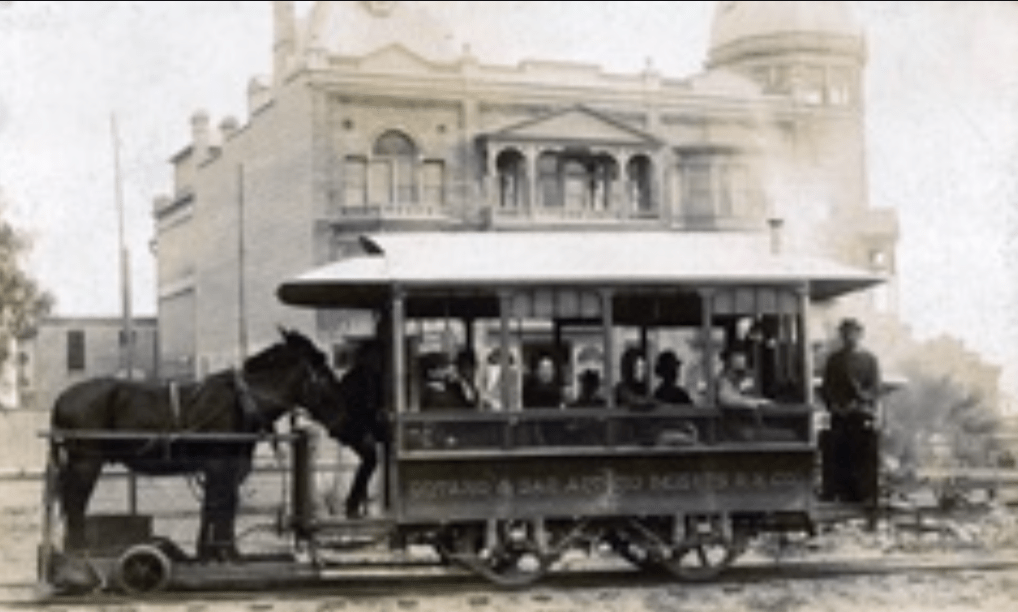
On Euclid Ave, as I’ve probably told you, there was a streetcar here at that time, an electric car. It used to start down at the Southern Pacific tracks, as I recall, the Union Pacific. It went up to Upland and clear on up to the Heights. That was our medium for going to the mountains. It would connect with a “through” electric car running from San Bernardino to Los Angeles. We’d go in there and shop, do business, whatever we had in mind. As you’ve probably been told, before that there was a mule car. Margaret and I never saw the mule car; we’ve seen a replica of it. But the mules would pull the car clear up to the Heights. Then they’d climb on a platform at the rear and coast down. They got a free ride. There are many lovely stories connected with that.
Joe Sandford from 1973 Living History Interview with Esther Boulton Black
Everyone discussing Ontario history, including Grandpa, loves to talk about the mule car. It predated the Sandford’s in Ontario, as well as the Swans, although Mabel is said to have seen it in operation once when there was an electrical outage affecting the trolley.
Then I went to work with father Swan. I was with him a few months, but there were men in there that were very smart, they were older, and they used to pile a lot of work on me, cause I had little experience, and so forth.
(Interviewer) This is in the First National Bank in Ontario?
…in Ontario, um hm. And I couldn’t see any future for myself. And at that time, the First National of Ontario merged, a little savings bank with it. And I’d had to do with that, and so forth. Uh…to make a long story short, I had to combine the books from one bank to the other, alphabetically, half of the ledger. And I did, got all through it at six o’clock and went home. The next morning when I went back to the bank one of the officers said Joe, why didn’t you come back last night. I said what do you mean? He said well we worked till midnight, getting the other half straightened out. Well I’d never even thought of that, it wasn’t my job.
But, anyway, ahh, one day I read in the papers that a man was out here from North Dakota, wanted to start a bank. So, I made a point about meeting him. He said, “Joe, you’re just the man that I needed.” Well, there were just two of us next to the top, you see the point. We were very successful and the experiences were most unusual, and so forth.
Joe Sandford from 1974 Living History Interview conducted by the Upland Public Library
So Joe’s initial employment with Henry Swan lasted only a few months before he ventured into new opportunities on his own. I believe the man from North Dakota was George McCrae, of whom we will hear more in future posts.
 Bridging the Silences
4 thoughts on “Corona to Chino to Ontario”