 After publishing the previous entry on this subject, I rediscovered an item that Claire and I found last summer in the Ontario Model Colony History Room, a page of handwritten notes which it appears to be notes taken by grandfather Joe for one of the speeches he liked to give about his father. A notation at the bottom 2/20 Rotary suggests a Rotary Club meeting speech.
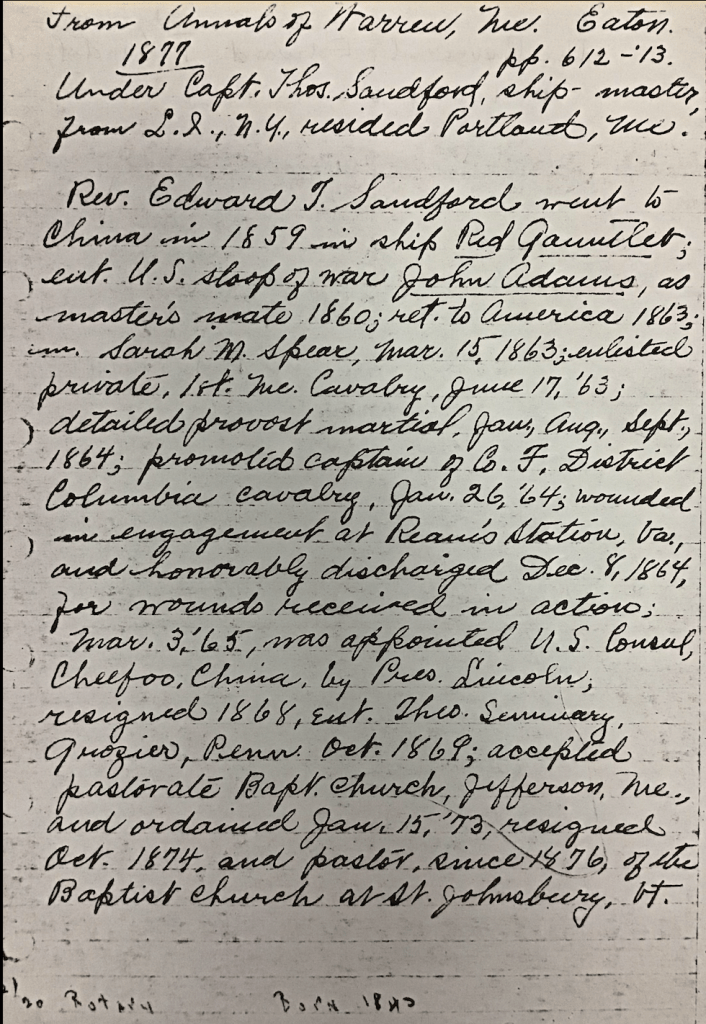
The notes in the first paragraph point to a reference The Annals of Warren, in Knox County, Maine, by Cyrus Eaton, published in 1877, which was easy to find online as a digitized book.
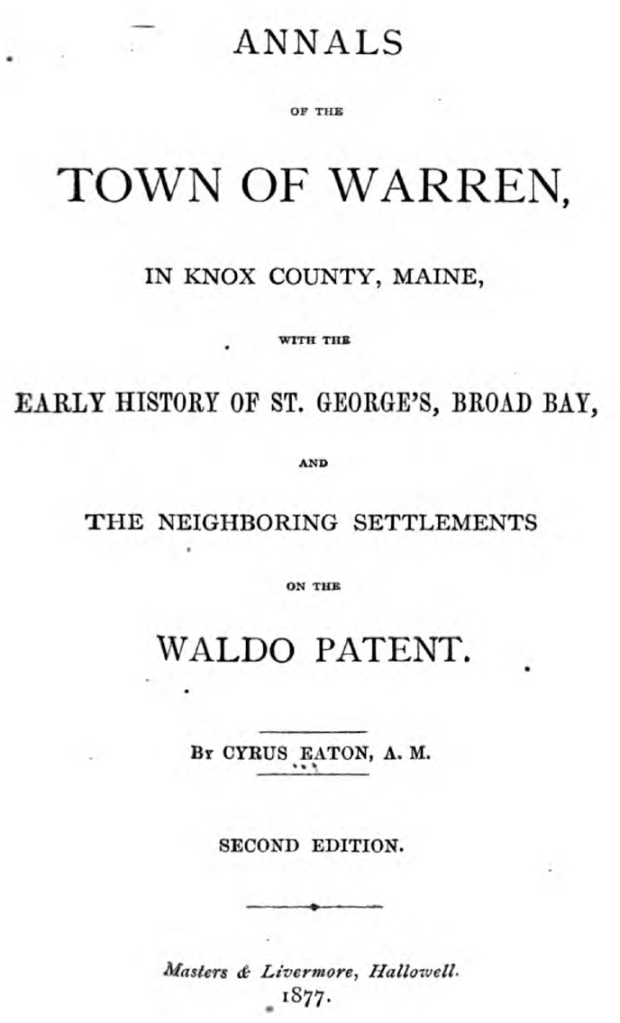
The book is an exhaustive history of the town of Warren Maine, combining many historical sources down to the level of decades of records of detailed town council meetings. There is enough detail to keep a local historian busy for years. Since Edward spent relatively little time in Warren, I’ll leave that task to others. But the book does contain a few pages of references to Edward and other Sandford ancestors. Since the book was published in 1877, it can be viewed as a reliable source for details on things that were, at the time, relatively recent history.
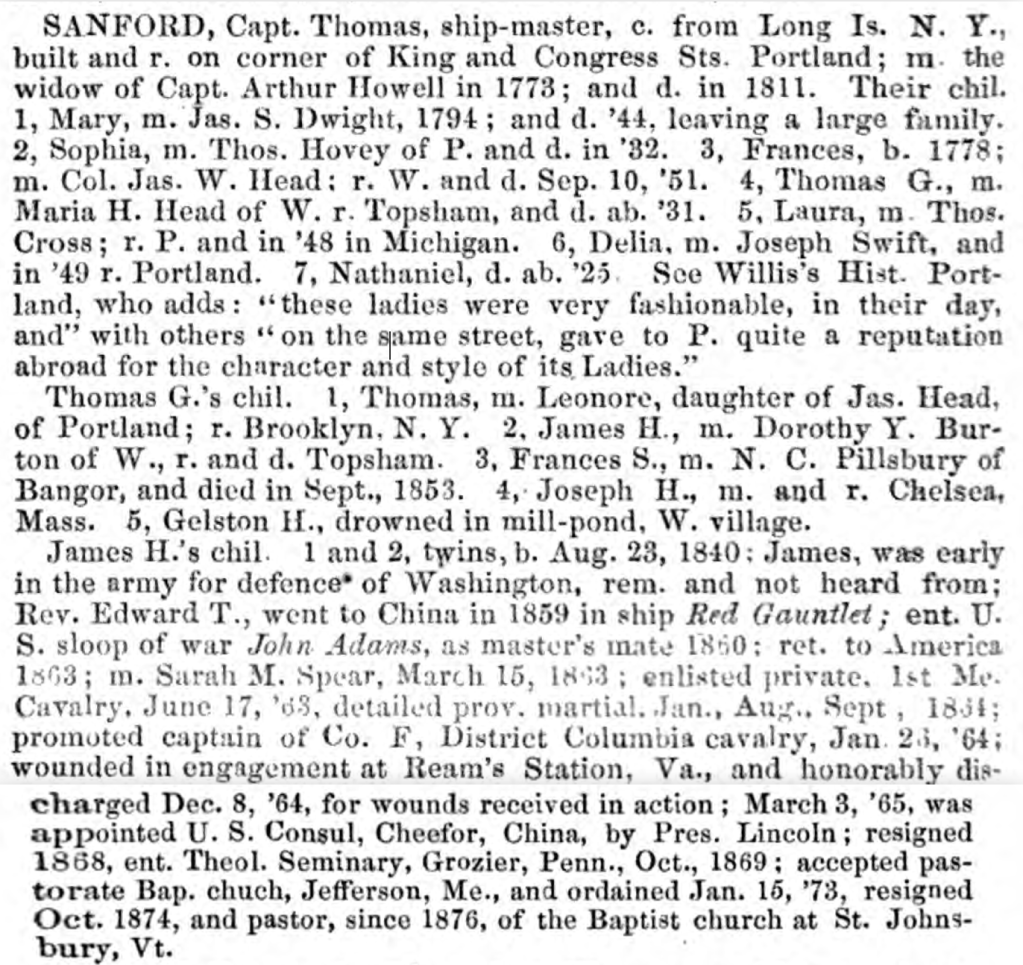
Eaton confirms our Sandford (with the customary misspelling) ancestry as we previously understood it back through Topsham and Portland. He also affirms that the Sandfords came from Long Island, although he sheds no new light on the mystery of Captain Thomas Sandford’s father from Long Island.
I searched in the Willis book, which I already knew from my research, for the odd line about the fashionable women in Captain Thomas Sandford’s family contributing to Portland’s international reputation. I could not find it, so perhaps there is another Willis edition or Eaton confused it with another reference.
Eaton provides new detail on Edward Sandford’s maritime adventures prior to the Civil war. Edward’s first sea voyage began in 1859 when he was 18 years old. His uncle’s ship was named the Red Gauntlet. To return to America he sighed-on with the U.S.S. John Adams as a Master’s Mate in 1860, joining the ship in Siam, returning to America in early 1862. Edward then had about a year to get his affairs in order, marry Sarah Spear, and enlist in the army.
Both ships have interesting stories. The Red Gauntlet was built in Richmond, Maine and commissioned in 1853. There have been several ships by that name, which came from an 1824 novel by Sir Walter Scott entitled Redgauntlet. The ship had been to China prior to Edward’s voyage–a manuscript written by voyage’s Ship’s Carpenter describes the tribulations of that voyage, summarized here in an online sale notice of a rare manuscripts seller.
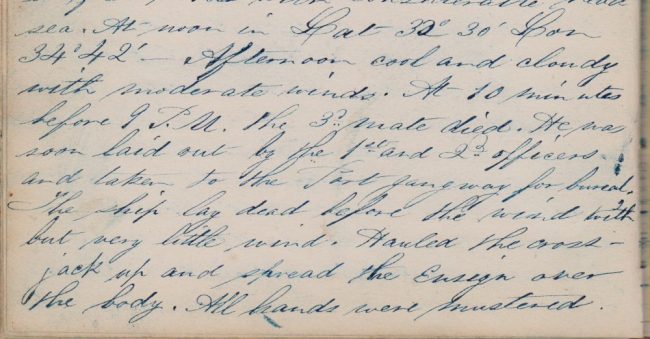
Journal of the Clipper Ship Red Gauntlet, Andrews, Master. Kept by Ship’s Carpenter William F. Harden. August 18, 1855 – December 14, 1856. New York, San Francisco, Sandwich Islands, Canton, Philippines, St. Helena.
Manuscript. Small 4to, Unpaginated. (167) pages of manuscript entries. Price: $5500
This is a remarkable journal, documenting the murder of an American seaman by a gang of Chinese in Canton. It was kept by ship’s carpenter William F. Harden of Chelsea, Mass. Journals kept by men before the mast are scarce, and tend to have a different perspective on events than journals and logs kept by officers. Such is the case with this manuscript. For example, as they were fighting their way around Cape Horn, Harden wrote, “A Ghost was seen last night twixt the hours of 11 & 12… in the shape of a man sitting on the rail.” The “Red Gauntlet” was a 1038 ton clipper ship built in Maine and launched in 1853. She was active until 1863, when she was captured and burned by the Confederate raider “Florida.” This was her second voyage. She departed New York for San Francisco, Hawaii, and Canton in August 18. In November, 1855, the ship nearly sank rounding the Horn, and had to put into Valparaiso for repairs. On their departure they discovered that a boy had stowed away in a bag of potatoes. It was a mostly happy ship, with occasional notations of “splicing the main brace” and such amusements as “A lecture on Woman’s Rights was delivered at the booby hatch… by Miss Jemima Snowflake.” Or, later in their voyage, on an evening when they were caught in a dead calm under a full moon, a boat was lowered. “Captain & Lady and two gentlemen passengers took a pull around the ship to look at her. When they returned, all hands had something to drink just for the fun of the thing.” King Neptune put in the obligatory visit when they crossed the line, and occasional sing-alongs were held. They reached San Francisco at the end of February, 1856 and promptly got stuck in a mud bank off Broadway Wharf. “Went with Johnny Loring to Rowe’s Cricus, which was a beautiful entertainment.” (Much detail about people and activities in San Francisco and Vallejo ensues.) They took on cargo for the Sandwich Islands and reached “Owyhee” on April 16, 1856. There they tied up at Market St. Wharf and Harden and his shipmates went on liberty in Honolulu. Predictably, 5 men deserted. A bounty of $25 was placed on each. Another man swam ashore. The 2nd and 3rd mates “assaulted” one of the crewmen and were discharged from the ship. (It is unlikely that an official account would have been as straightforward.) Similarly, at Canton, where they took on a cargo of tea and silk, Harden gave detailed and factual reports documenting the tensions that existed between foreign traders and the Chinese. On June 12 “a boat came alongside with 4 Chinamen to sell liquor.” They were put in irons and the liquor was confiscated. On June 14 the Chinese longshormen went on strike because of “hard usage.” On August 2 another “Chinaman” was severely beaten and thrown overboard. Four days after that the 3rd mate was set upon by a gang of 200 Chinese and severely beaten, barely escaping with his life. Two months later, at sea, the mate, George F. Wellman died. This potential international scandal was never reported or acted upon, but by this time American naval forces and marines had come into Canton to protect American interests. Harden’s journal goes on in this vein, reporting in considerable detail events on board and adventures ashore in the various ports at which the “Red Gauntlet” put in. In Canton a schooner was launched from “Mr. Cooper’s yard.” A ship’s boy named Bill was found guilty of stealing, given a dozen lashes, and sent off the ship to fend for himself. The Captain’s youngest son got sick and died. The old cook served rotten food. He was forced to eat it, was given 12 lashes, and subsequently was beaten by the Captain for minor offenses. He died a month later, and his possessions were sold at auction to the crew. In November 1856, after leaving St. Helena on the final leg of their circumnavigation, two ship’s boys, Mike and Harry, were made to have a “Prize Fight” for the amusement of the crew. The bout was called a draw after 35 minutes. Harden’s journal ends on December 14, in the mid-Atlantic, as the “Red Gauntlet” approached North America. The journal is bound in fabric over marbled boards. End sheets contain miscellaneous notes regarding money loaned and owed, items purchased, and the names of crewmen and several officers. The writing is clean and legible throughout.
Description of manuscript written by Ship’s Carpenter William harden, 1855 on the Red Gauntlet on its voyage to China prior to that of Edward Sandford. Manuscript sale notice by the Ten Pound Island Book Company.
It seems likely that the ship’s next voyage would have had its own set of adventures and tribulations. At the very least, Edward heard a lot of stories about the ship on his subsequent voyage to China.
Note that this manuscript answers the question about which route Edward would have taken to China–most likely around Cape Horn of South America, following the route taken by the ship on its previous voyage.
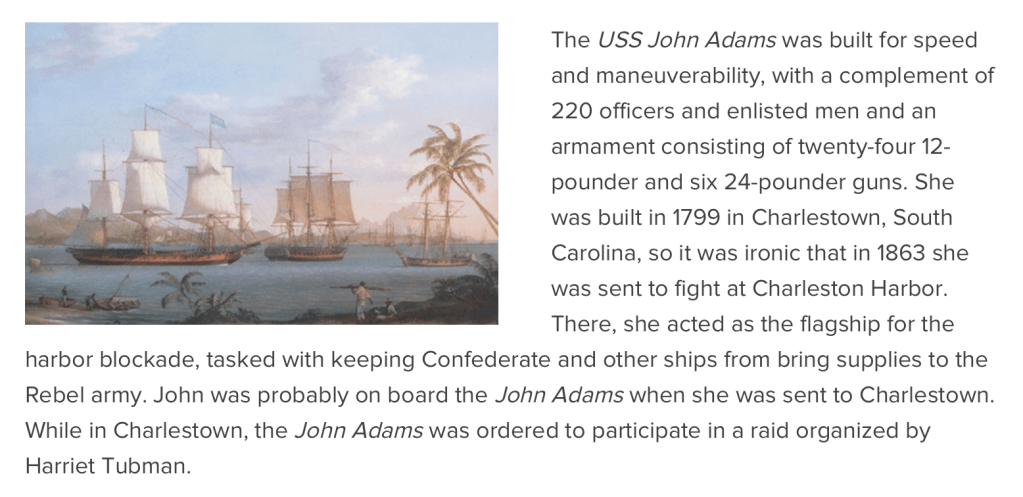
The U.S.S. John Adams, Edward’s transportation back to America, has an important history. Commissioned in 1799, it fought in numerous wars including the War of 1812 and the Mexican-American War. Historical documentation of it’s 1860-1862 voyage from Siam to New York is consistent with Edward’s story. It was later in the Civil War that Harriet Tubman led a convoy of ships led by the John Adams on the famous raid into South Carolina that freed over 750 slaves.
We see also from Eaton’s book that Edward originally joined the Civil War as a private but was promoted to Captain about the time he transferred to the District of Columbia Cavalry. Somewhere along the line he must have quickly convinced someone that he was worthy of the higher rank.
Regarding Sarah Spear, Edward’s first wife, Eaton devotes six pages to the Spear family. Sarah was from a five generation Warren family, originally from Scotland and Londonderry Ireland. Her ancestors fought in the Revolutionary War and the War of 1812.
Information in Eaton’s book on the later phases of Edward’s life will be incorporated into future posts.
One final note. Edward Sandford had a twin brother, James Head Sandford (named after their father; not to be confused with Edward and James’ younger half brother George who established a Sandford family branch in southern California parallel to that of Edward.) Eaton shows James in the Army, “early” ( in the war or early in his life or both) defending Washington. The two battles of Manassas (1861 and 1862), near Washington, suit this description, but I have no other evidence to support this theory. James’ early entry into the war might have been additional motivation for Edward to rush home to get involved.
Eaton does not mention it, which suggests that perhaps the family (who would have been Eaton’s primary source) did not know about it, but there is a record of James’ enlistment in the Navy in Brooklyn in 1864.
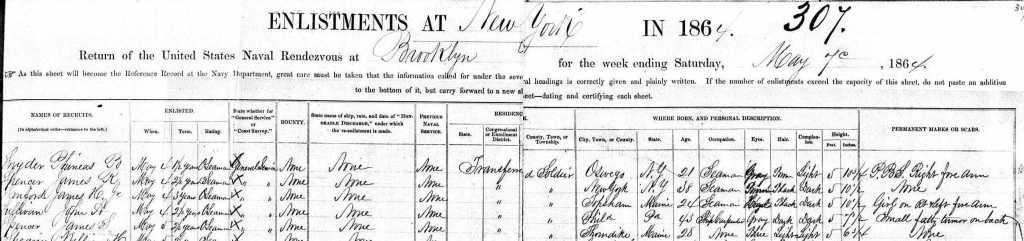
Aside from this, the modern record is in agreement with Eaton that James was not heard from after the War.
 Bridging the Silences
2 thoughts on “New Discoveries on Edward Thomas Sandford and the Civil War”