Having previously traced the ancestry of great grandfather Henry Edson Swan back to Silas Swan and Silas Kenworthy (Vermont, Ohio, Minnesota and California), we now move back to earlier generations. Our Swan ancestry goes back to colonial Massachusetts and Yorkshire England as shown below.
The Swan ancestry back to early colonial Massachusetts and Yorkshire, England
(Another link we have to Yorkshire, England is in the ancestry of great grandmother Laura Wright. Her grandparents William Marshall and Mary Gummersall were both from Yorkshire.)
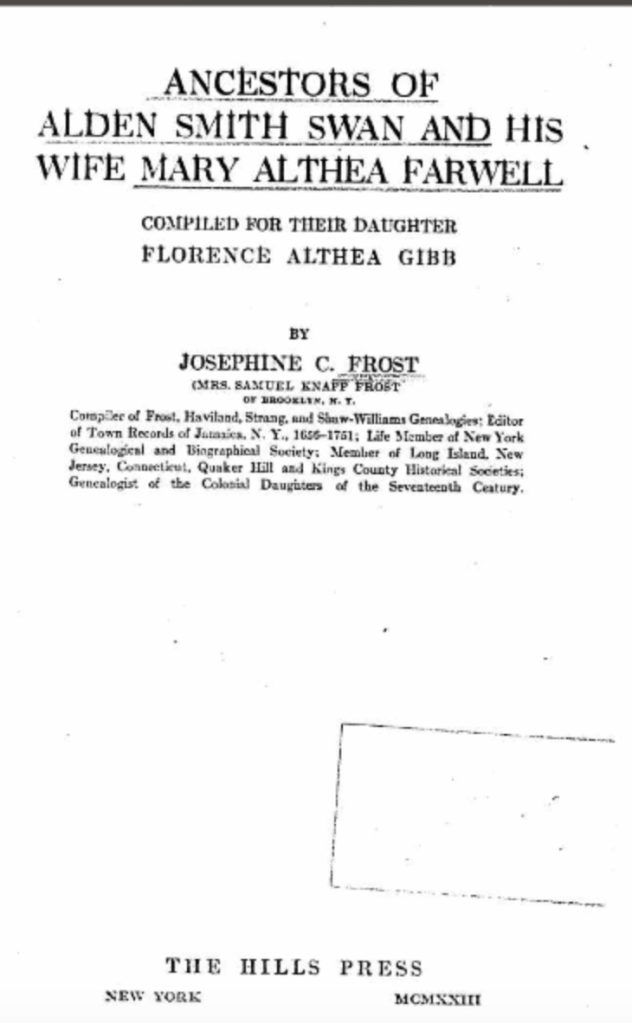
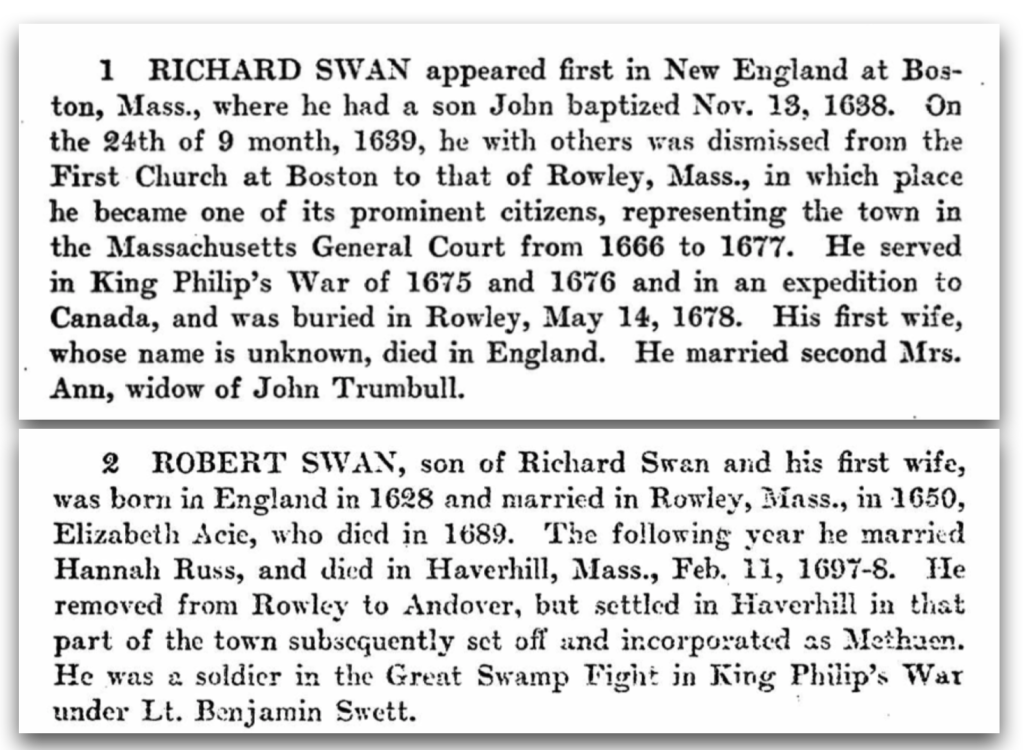
Richard and Robert Swan can be found in Ancestors of Alden Smith Swan… by Josephine Frost, published in 1923. They are noted for their roles in King Philip’s War (1675-1676), one of the final attempts of the Indians of southern New England to drive out the English settlers.
The Swan ancestry diagram also provides hints to another interesting branch of the Swan family. The name Ingalls appears twice–Sarah Ingalls was the wife of the first (Captain) Joshua Swan, and Mary Ingalls was the wife of the second Joshua. (This is not uncommon–there were not very many people in these early colonial settlements and there were often parallel families linked by multiple marriages since there weren’t very many choices of eligible partners. Other examples in our family history include recurring links between the Sandford, Howell, and Topping families in 17th and 18th century Long Island. This can, but does not necessarily, imply marriages between remote cousins.)
In addition to its repetition in the Swan ancestry, the Ingalls name is very familiar. This feeling of familiarity is reinforced by the fact that when the Swan family tree gets close to the Ingalls family the amount of information available in Ancestry goes up by a factor of ten, something that happens when there is a famous family that has been heavily researched. Could we be related to Laura Ingalls Wilder, the author of Little House on the Prairie?
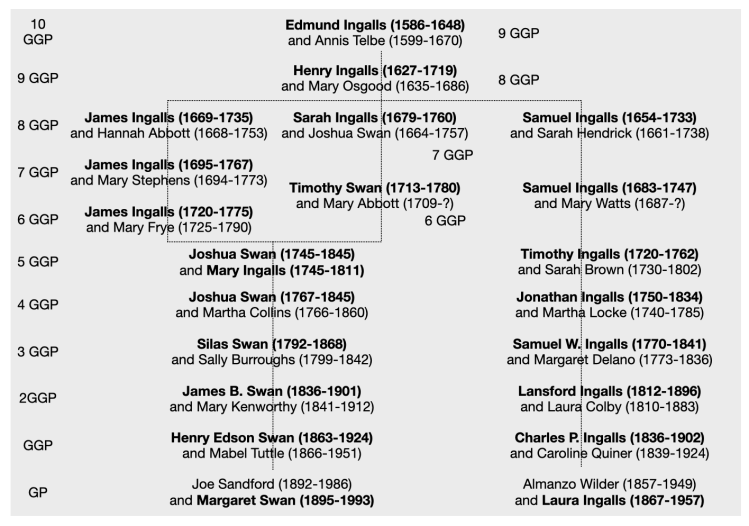
The following diagram provides the answers.
Map of the intersection of the Swan and Ingalls ancestries. The families come together in two places: (1) Sarah Ingalls married Joshua Swan (1644-1757) and (2) Joshua Swan (1745-1845) married his second cousin (once removed) Mary Ingalls.
The diagram shows that, yes, our grandmother Margaret Swan was a seventh cousin of Laura Ingalls Wilder (thus we are seventh cousins twice removed).
The diagram also confirms that there were two connections between the Swan and Ingalls families. Two of the children of Henry Ingalls and Mary Osgood both started lines that linked with Swans (the two Joshua Swans noted above). This means that Sarah Ingalls married Joshua Swan (1644-1757) and, later, Joshua Swan (1745-1845) married his second cousin (once removed) Mary Ingalls.
Finally, the diagram shows that the two paths between the split and reunification of the Swan and Ingalls lines were not of the same length. The leftmost path in the diagram has an extra generation from the center path. This results in a bit of confusion:
Henry Ingalls and Mary Osgood, our eighth great grandparents, are also our ninth great grandparents.
Laura Ingalls Wilder is the seventh cousin of both our grandmother Margaret Swan and our great grandfather Henry Edson Swan, and we are either 7th cousins 2x or 3x removed, respectively.
For simplicity, from here forward, we use the most direct path (the center path) to identify our remote ancestors. So Henry is considered to be our eighth great grandfather and we are Laura’s seventh cousin 2X removed.
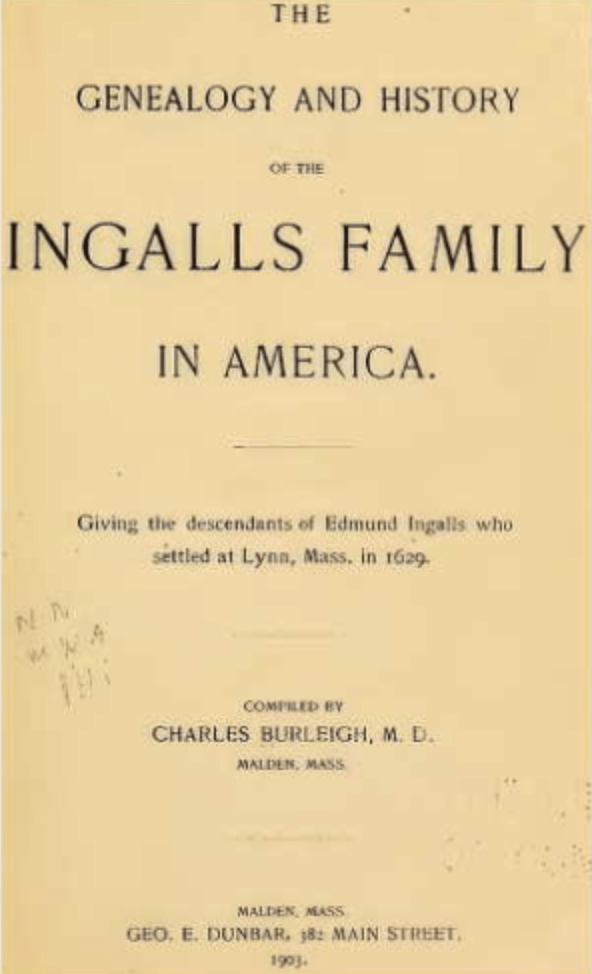
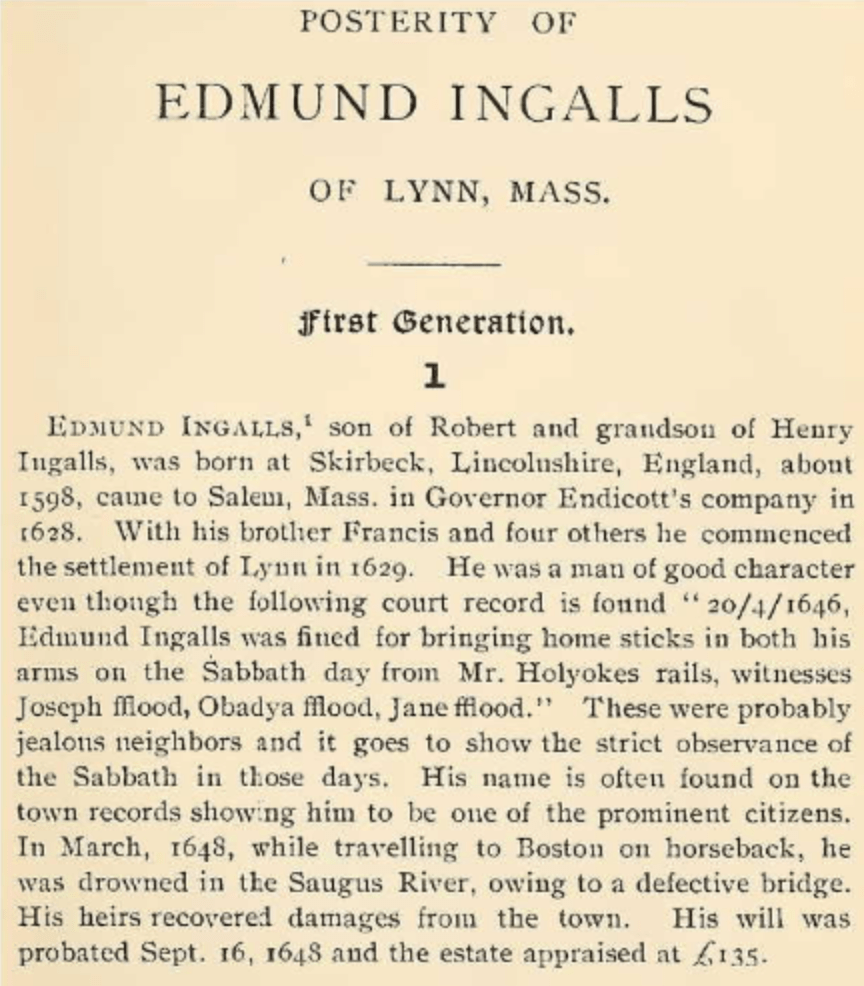
Knowing the connection(s) from the Swan to the Ingalls family opens up new world of distant ancestors to investigate. Ninth great grandfather Edmund Ingalls was a significant ancestor as shown below.
Description of 9th great grandfather Edmund Ingalls from the Ingalls family genealogy.. Edmund was one of the original founders of Lynn Massachusetts.
Edmund Ingalls and his wife Mary Osgood were from Lincolnshire in central England on the North Sea (eastern) side. 1628 was quite early in the timeline of English settlers in the new world. The Mayflower was only 8 years earlier, and most of the our other ancestors who go back to the original American colonization era made the journey at least a decade later in the late 1630s or early 1640s. We can also see that Edmund was one of the original founders of Lynn Massachusetts.
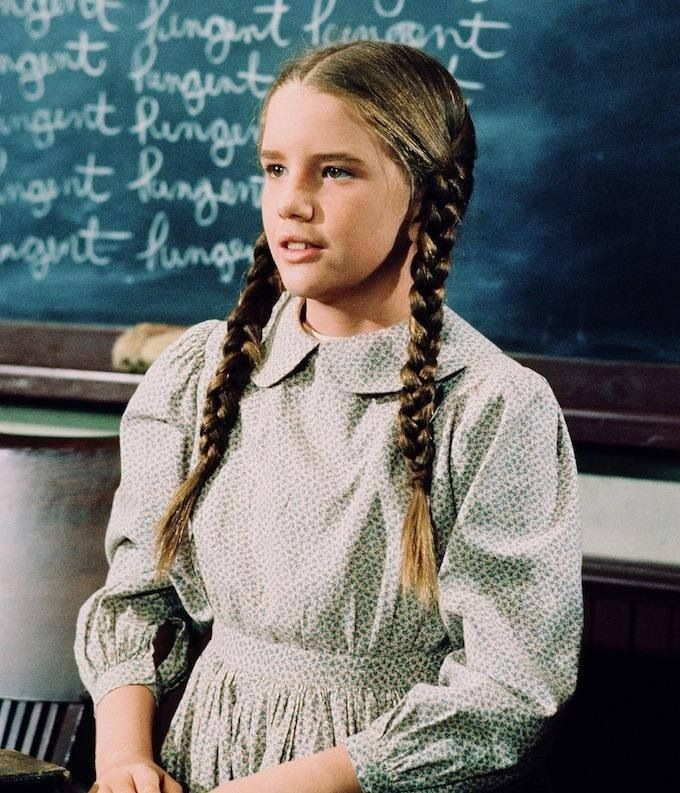
Armed with this new information, we can now watch reruns of Little House on the Prairie with a new perspective.
7th cousin Laura Ingalls Wilder as portrayed by Melissa Gilbert
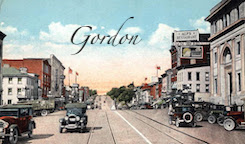
We previously discussed 2nd great grandfather Dr. James Gordon (1838-1912) of Newburgh, New York. He was from Northern Ireland and his parents James Gordon and Susan McClughan originated from Edinburgh, Scotland. There is no earlier trace of this branch of the family.
But there is quite a bit of information on the other half of the Gordon branch. Dr. James Gordon married our second great grandmother Jeanette Johnston (1848-1932) in Washington, Warren County, New Jersey in December, 1872. It is not clear what drew James to Warren County from Belfast. Immediately after the marriage, James and Jeanette moved to Newburgh, probably for the purpose of establishing James’ medical practice there. Great grandmother Bessie Johnson was born in Newburgh in 1873.
Tracing back through the Johnston family tree, five generations of ancestors lived in and around Warren and Essex counties in north-western New Jersey between the early 1700s and 1872. The following diagram shows this family history as far as I can trace it. The green regions indicate settlements in New Jersey.
Ancestry of the Jeanette Johnston branch. Red indicates New York, green indicates New Jersey. Note the red regions to the right, which are in the early days of Jamaica, Queens, New York. Most ancestors in this branch are from Germany and England.
There are no major discrepancies in this branch between this picture and the genealogical research of grandfather Gordon Hynes (conducted in the 1950s), although with modern technology I was able to go further back in several areas.
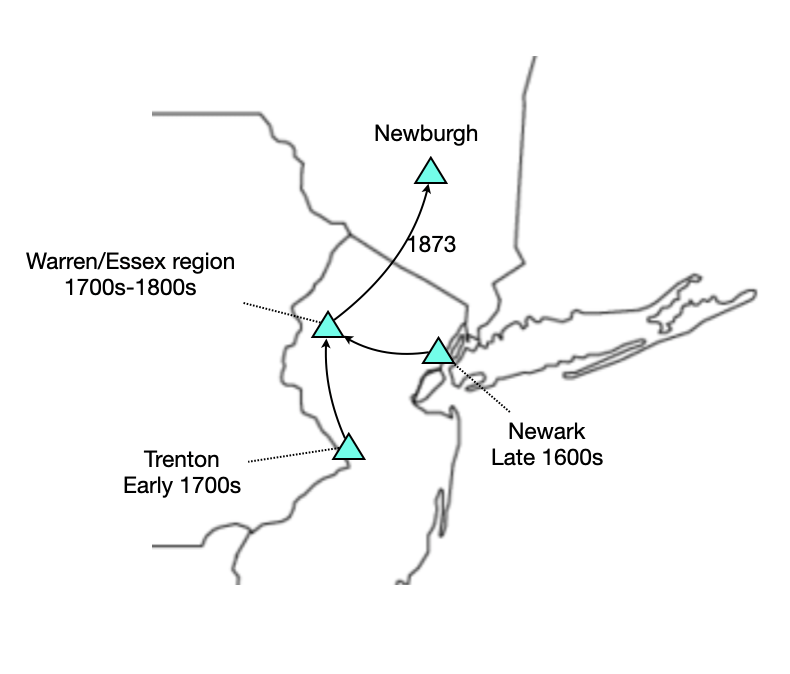
Five generations preceding Jeanette Johnston lived in Warren and Essex counties. William Johnston came via the Hudson River side, and was an early settler of Newark New Jersey (founded in 1683). The Oakley family came via the Delaware River route, sixth great grandmother Sarah being born in Trenton in 1707. (Trenton was founded in 1679, Philadelphia in 1682.)
Our ancestors lived in the region of Warren and Essex counties of north-western New Jersey for more than four generations. Some migrated via the New York/Hudson River side, others via Philadelphia and the Delaware River.
Most of Hannah Winter’s ancestors came directly to Warren/Essex in the early-mid 1700s, many from Germany.
One branch was traceable back to the level of our ninth great grandparents. The family of Sarah Oakley, the wife of sixth great grandfather Samuel Johnston, came from England (Essex, Yorkshire, and Hampshire) in the mid 1600s and became founding pioneers in Hempstead and Oyster Bay, Long Island and Jamaica, Queens, New York. The exact dates are difficult to determine, but Jamaica was founded by the Dutch in 1656 and our seventh great grandparents Captain Thomas Oakley and Sarah Whitehead seem to have been there very early in its history.
This the third family encounter I know of with Queens, New York, the others being the family of Laura Wright before the American Revolution and Queens resident U.S. Senator Nathan Sanford (1777-1838, the topic of a future post).
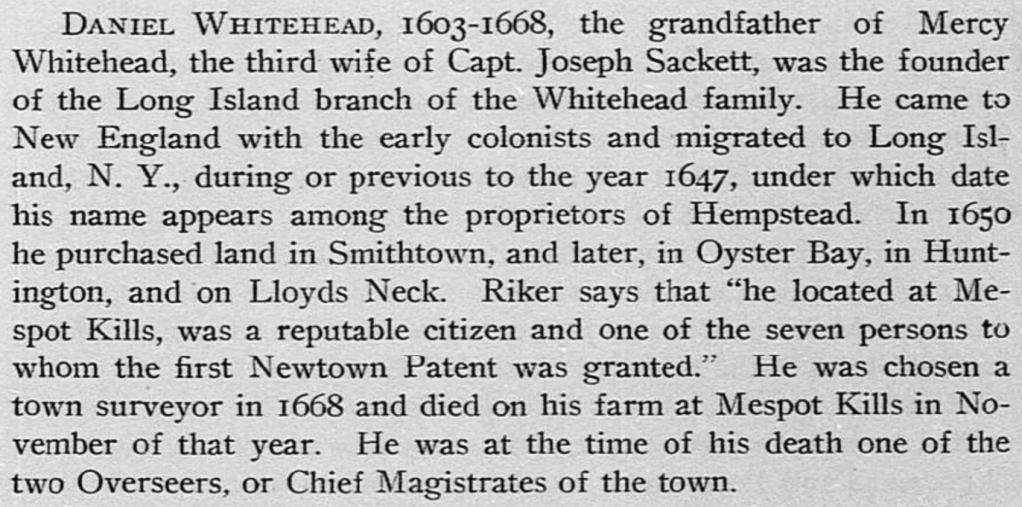
The following description of ninth great grandfather Daniel Whitehead comes from another family genealogy that intersects ours.
A description of ninth great grandfather Daniel Whitehead.
The family migration map has been updated to include more detail on the Gordon/Johnston branch, and can be found here.
Great grandfather James Louis Hynes immigrated from Newfoundland to Newburgh New York with his family sometime between 1890 and 1898 (ages 6-14). Four different United States Census reports give four different years for their arrival. 1895 (age 11) seems like the most credible number because that is the year recorded in the 1900 Census, the first record of the Hynes family in the U.S.
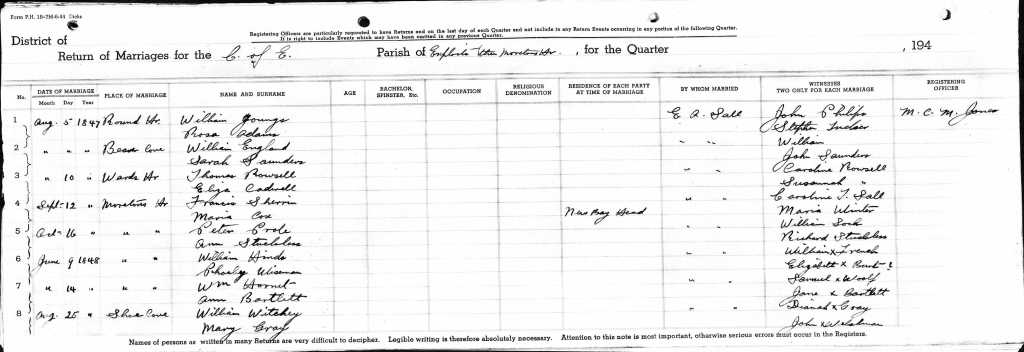
We previously traced our Hynes ancestors back to 4th great grandparents Richard and Ann Hynes, names found in information obtained from the Family History Society of Newfoundland and Labrador. Little is known about them, and when grandfather Gordon Hynes did his genealogical research in the 1950s, he came up with a different name of John Hynes from Manchester England, wife unknown. I have not been able to find the John Hynes from his research. In either case, our Hynes 4th great grandparents probably were the first Hynes’ to make the trip to Newfoundland from England. All sources agree on the identities of our third great grandparents William Hynes and Phoebe Wiseman and those who followed.
Gordon Hynes’ genealogical research, showing the name John Hynes top center, which conflicts with the Richard and Ann names obtained from the Family History Society of Newfoundland and Labrador. My research is in agreement on all other names in the Hynes branch of this tree.
The research is complicated by the fact that there are multiple spellings of the family name, including Hynes, Hinds, Hines, Haynes and Haines. For example, several records of births of children of William and Phoebe Hynes use different spellings–for the same family a few years apart. I think it is fair to say that spelling was not among the highest priorities of life in Newfoundland in the 19th century (nor education, nor record keeping).
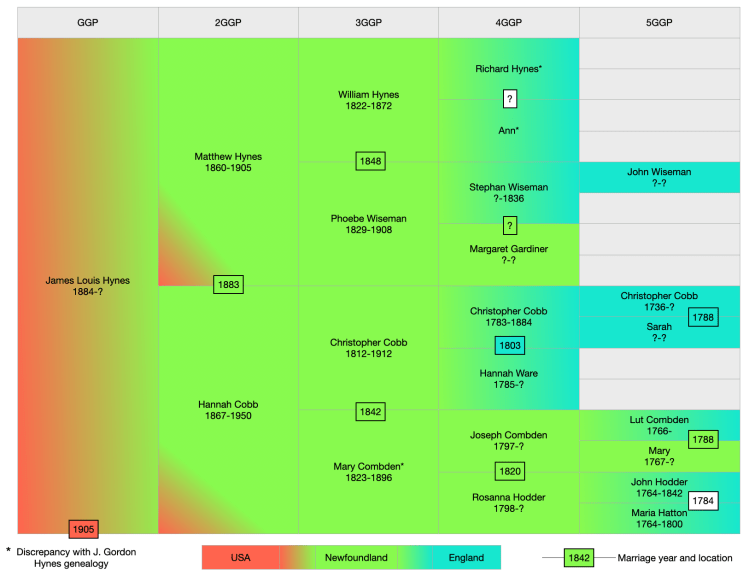
If we broaden our view to all ancestors of James Louis Hynes, we get a better picture of our Newfoundland roots.
The direct ancestors of Jame Louis Hynes, the ones in green having lived in Newfoundland all or part of their lives. Data is from a variety of sources, some more speculative than others, but there is a clear pattern of 3-4 generations of Newfoundland roots.
But by looking at birth, marriage and death dates in the green range, we see three or four generations of ancestors living in Newfoundland as early as 1800, with a few going back to the 1770s and 1780s.
Settlement in Newfoundland was always about the fish industry. Although the British presence there goes back to 1610, its growth was limited for the first 150 years until around 1765-1785 when the industry got on solid footing and began to grow. By this time they had learned how to survive and developed the capabilities needed to fish the large offshore banks of the region, having long since depleted the resources of the inner waters. This was also about the time that French retreated (having problems of their own leading to their first revolution in 1789) leaving Newfoundland and control of its large fishing banks to the British. The resident population of Newfoundland grew from an estimated five thousand in 1765 to ten thousand in 1785 to forty thousand (still very small for a huge island) in 1815. The various branches of our Newfoundland ancestors followed the tide of increased opportunity and demand in the growing international fish market, all migrating from parts of England.
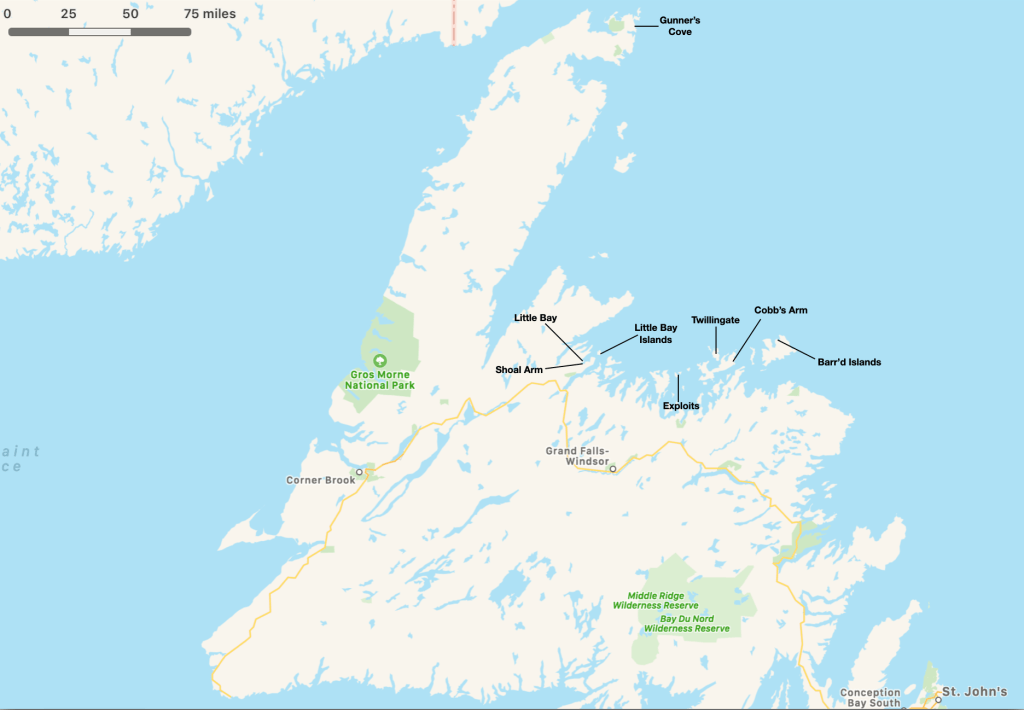
Another pattern becomes clear from comparing birth, marriage, and death records with the Newfoundland map. Our earliest ancestors started out on the right side of Newfoundland’s middle-upper shore, in locations around Barr’d Islands, then gradually moved west toward Little Bay, where James Louis Hynes was born. Note also the existence of Cobb Arm, no doubt named after the family of 4th great grandfather Christopher Cobb, whose granddaughter Hannah was James Louis’ mother.
Our ancestors generally followed the band of locations on the middle north shore from right to left, the first arriving in the area around Barr’d Islands, eventually migrating west toward Little Bay. (Gunner’s cove will be discussed later.)
Newfoundland and Labrador became a Canadian province in 1949, more than 50 years after our ancestors came to the United States.
How deep are our Newfoundland roots? Pretty deep.
A transcription of the record of the marriage of third great grandparents William Hynes (here spelled Hinds) and Phoebe Wiseman, 9 June 1848 in Exploits, NL
An irony of the life story of great grandfather George Sechler is that we know far more about him because of his early death than we would if he had survived the events of April 14, 1907.
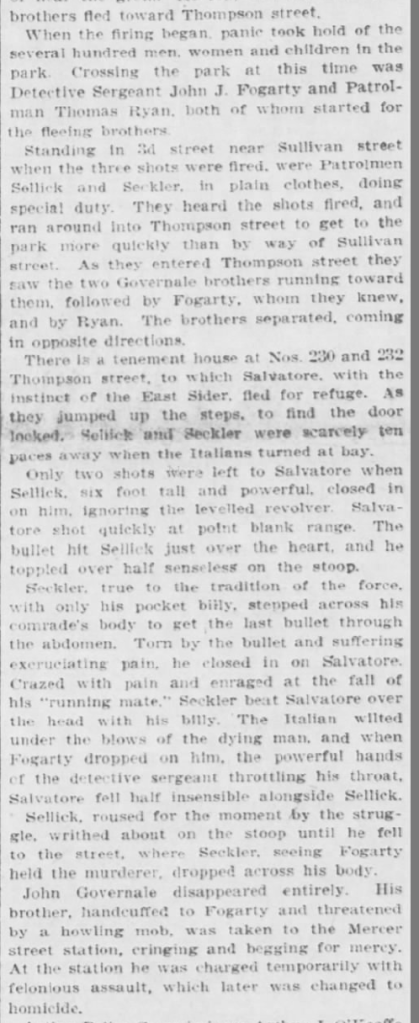
The two best sources of information about George years during and after his police career are newspaper articles and the transcripts of the trial and appeal of his killer Salvatore Governale. Of course, neither would exist if not for the murder.
New York City has done a poor job preserving its early police department records. Many old records were destroyed around 1914 due to a combination of lack of storage space and political eagerness to clean house on some of the force’s darker eras. A police museum and archive was established on the South Manhattan waterfront in 1973, but was wiped out by Hurricane Sandy in 2012, with no prospects for its rebuilding on the horizon thus far. Today George’s name can be found in police archives documenting his hero status, but comprehensive records of even the names of ordinary New York policemen from that era may not exist.
Because of newspaper records, we know today that…
George joined the New York police department in 1905 and was quickly promoted to a detective working plain clothes details in Manhattan
he got the job based on the recommendation of an older relative on the force (who I have not given up on identifying)
he loved the job and was widely respected by the people he worked with
he paid regular visits back to his hometown of Danville, and had been there as recently as the winter of 1906/7.
Among everything that was written about George, two articles stand out as particularly revealing of his personality in daily life.
The Poolroom Terror
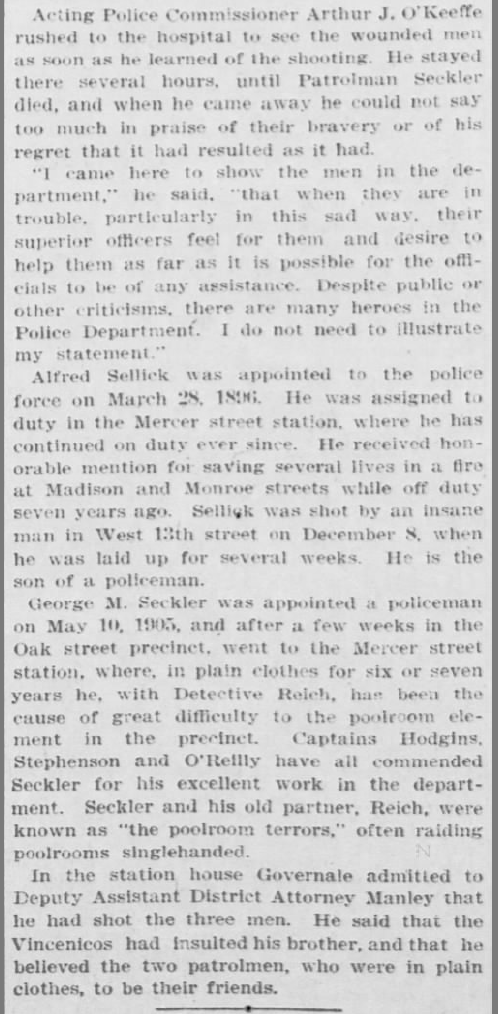
On April 15, 1907, the New York Tribune printed the following account of the previous day’s events.
The second-to-last paragraph of this April 15, 1907 New York Tribune article describes George’s reputation as a “poolroom terror”
Of particular interest, here, is the second-to-last paragraph, describing George as a fearless raider of pool halls.
The Dog Whisperer
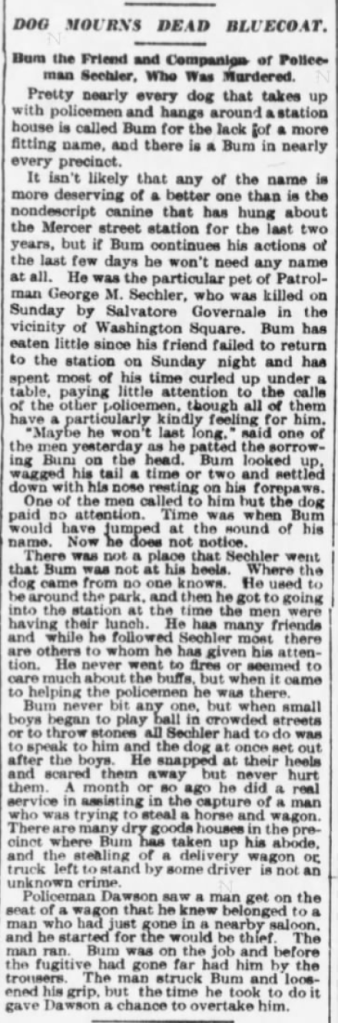
On April 17, 1907, an enterprising reporter reporter for the New York Sun filed the following story.
This New York Sun article from April 17, 1907 describes Bum, the stray dog adopted by George Sechler at his Manhattan precinct house
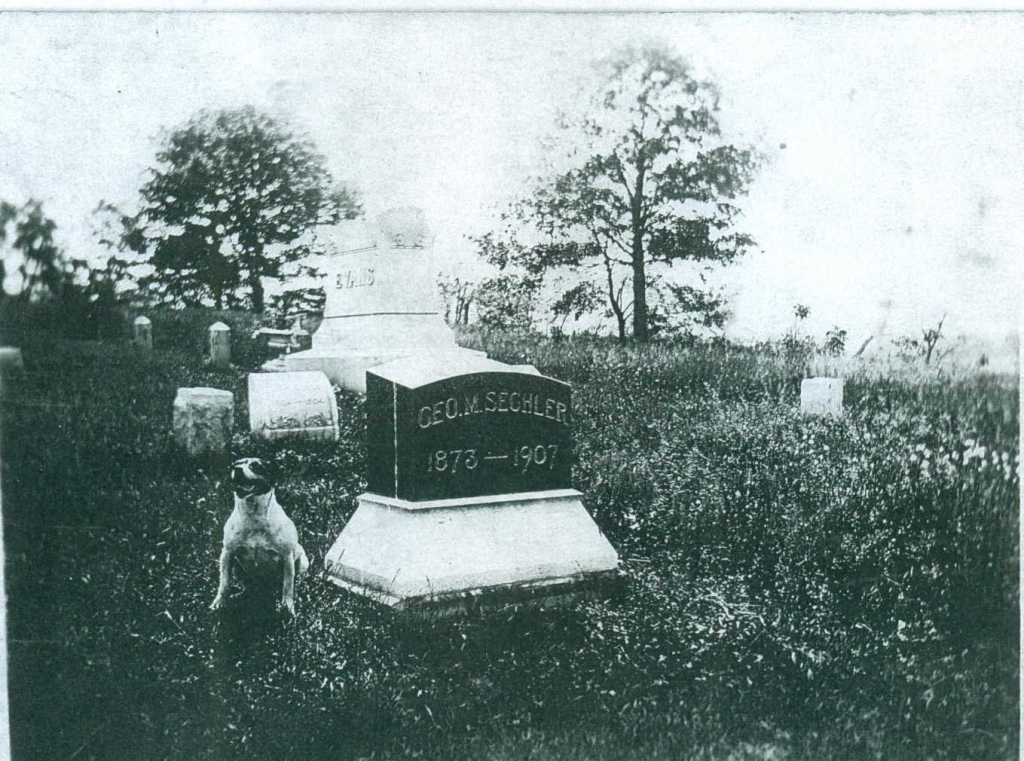
It would be hard not to suspect this story to be at least a little exaggerated, but separately, the following photo turned up on Ancestry, of George’s grave at the Odd Fellows cemetery in Danville being guarded by an unknown dog.
Photograph of unknown origin of unknown dog guarding the grave of George Sechler.
Until proven otherwise, I choose to believe that the reporter and perhaps some of Georgeʼs fellow officers conspired to put Bum on the train to Danville with George’s casket to allow Bum to spend the rest of his days in the Danville countryside with the Sechler family.
So thanks to scores of newspaper articles printed about George, we have a pretty good portrait of him—proud policeman, devoted husband and father, hero and poolroom terror, with a soft spot for stray dogs.
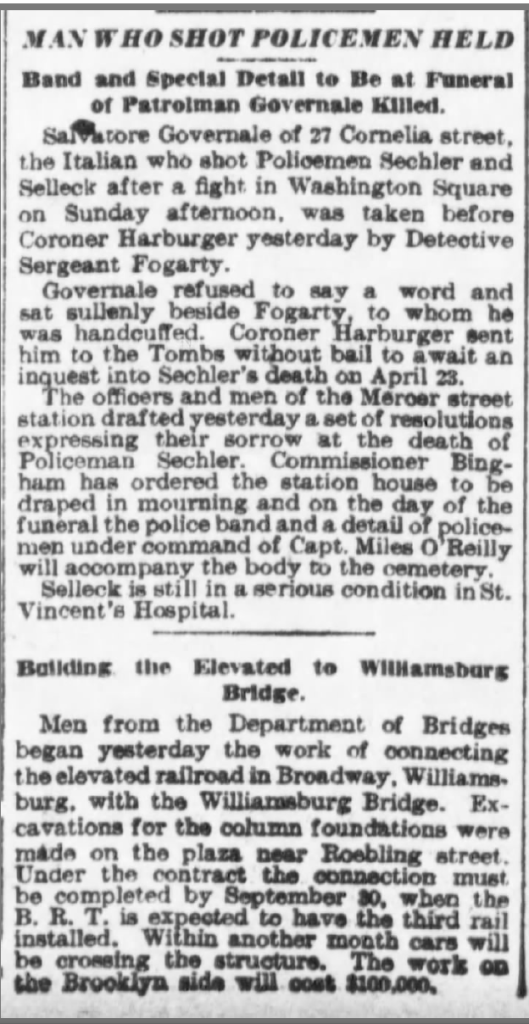
I present this article pertaining to the aftermath of the shooting of great grandfather George Sechler as much for the item that appears below it as for the details on the arraignment of Salvatore Governale. The clipping is from the New York Sun, April 16, 1907.
New York Sun, Tuesday April 16, 1907
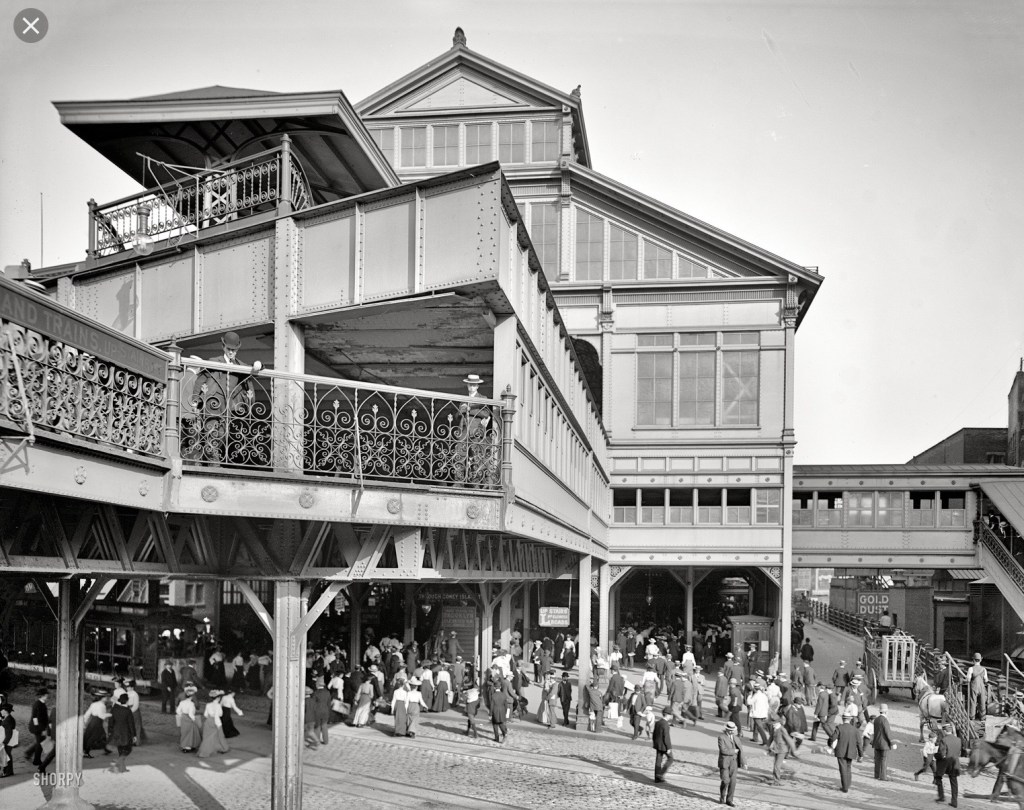
In 1907, the Williamsburg Bridge had been in service for four years, the second crossing of the East River. The Manhattan and Queensborough Bridges were still two years from completion. On the Hudson side, the Holland Tunnel was still 20 years in the future. Although the Brooklyn Bridge was 24 years old, we would not recognize the tangle of railway stations and elevated tracks that existed on the Manhattan side of the bridge near City Hall, all of which are gone today or moved underground. It was a time of incredible change and growth in New York City.
Railway station at the Manhattan end of the Brooklyn Bridge as it looked in 1907. The entrance to the bridge is in the lower right of the photo, while the exit from the bridge must be somewhere amongst all the steel on the left.
Construction of a short elevated connecting railway from existing Brooklyn transit lines to the Williamsburg Bridge in six months for $100,000 is something to think about. Today such a project would take 10 years and we couldn’t lay out the detour signs for $100,000.
During the summer of 1874, four year old Charley Ross and his six year old brother Walter were kidnapped by two men in an affluent Philadelphia neighborhood, resulting in a sensationalized investigation and series of events thought to be the first of its kind (the Lindbergh kidnapping would occur 58 years later). Walter was set free after a few days but Charley was held for $20,000 ransom, which the family could not afford. Intense police searches found no sign of Charley.
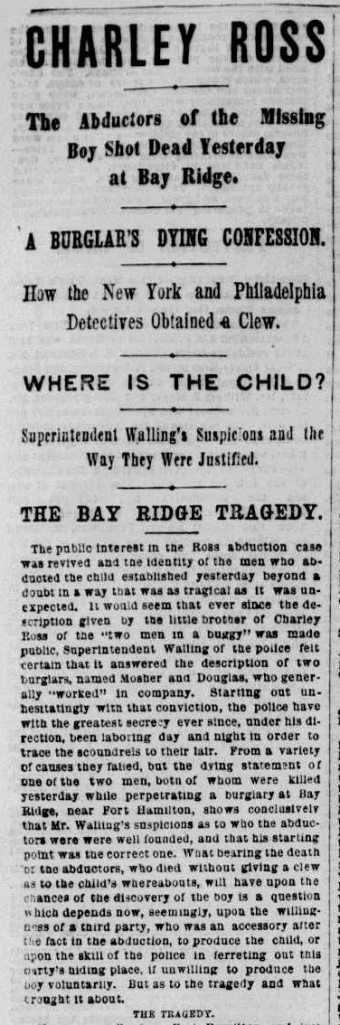
The following December two criminals, Joseph Douglas and William Mosher, were shot during a failed robbery attempt in Bay Ridge, Brooklyn (today just across the bridge from Staten Island). Mosher was killed instantly, but as Douglas lay dying, he confessed that the pair had been responsible for taking Charley Ross and claimed that Mosher alone knew his current whereabouts.
A third suspect, William Westervelt, was later arrested and put on trial. He claimed that Charley had been alive when Mosher was killed, but offered no helpful leads in finding the boy. Westervelt served six years for conspiracy, the best the authorities could do with weak evidence linking him to the kidnapping.
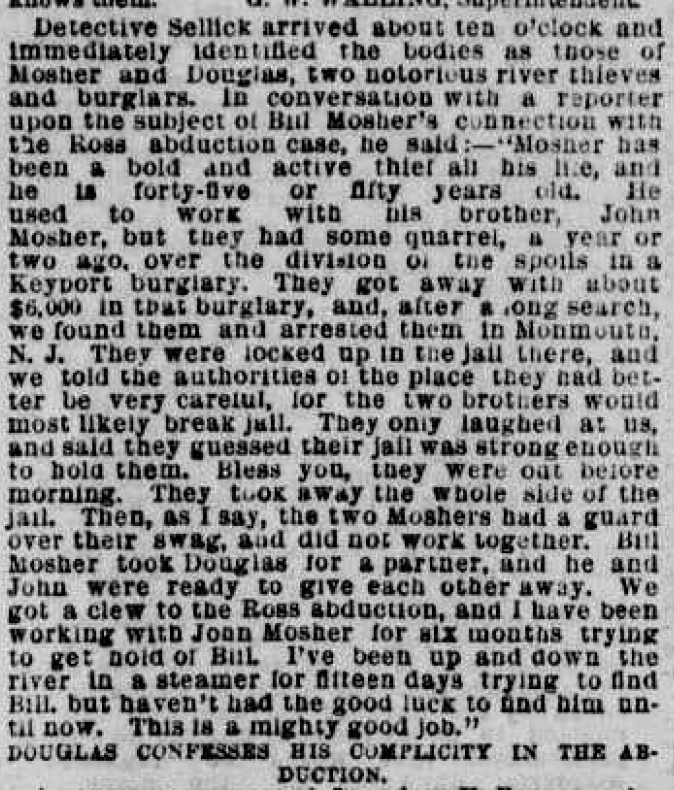
What does this have to do with our family history? One of the detectives on the scene in Bay Ridge was Joseph Selleck, who knew of Mosher from work on the kidnapping that had led to New York. It was Selleck who identified the slain Mosher on the scene. Selleck’s role is described in news accounts such as this one…
New York Herald article from December 15, 1874 describing the deaths and confession of the men who kidnapped Charley Ross…
…and later identifying Detective Joseph Selleck as the man who identified the body of Mosher, killed in the botched robbery in Bay Ridge.
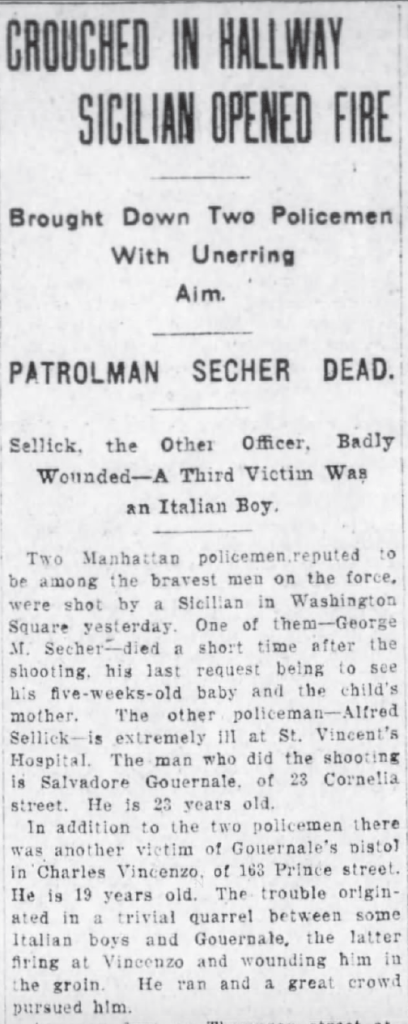
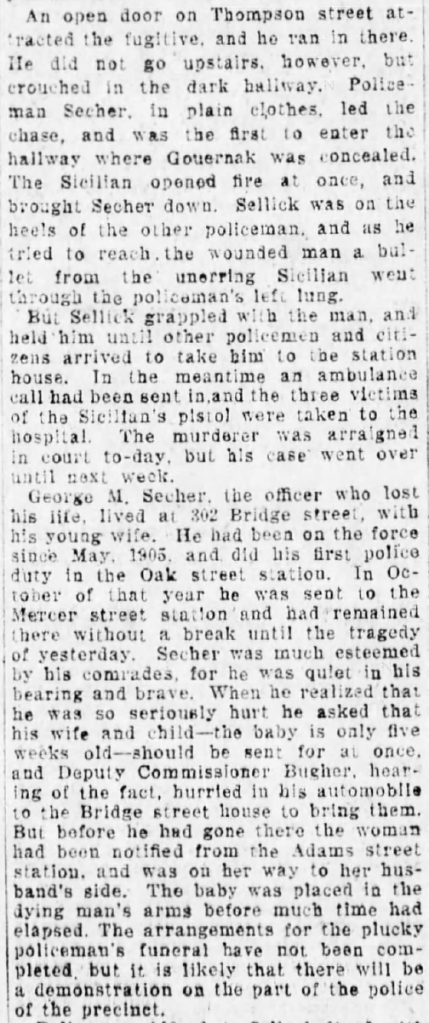
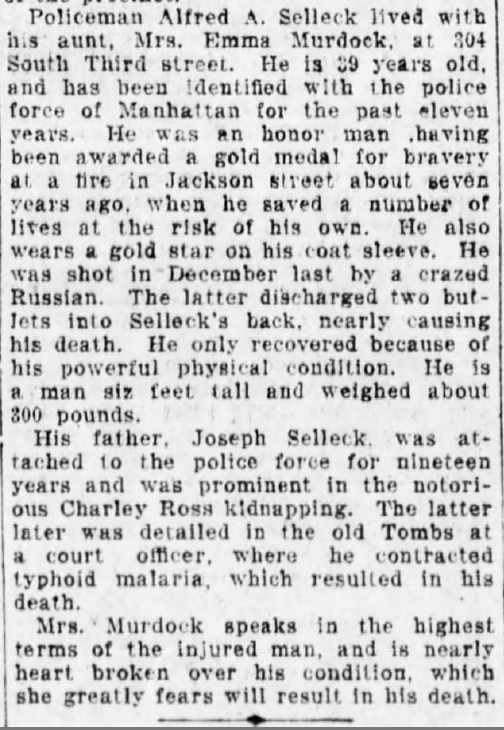
Detective Joseph Selleck was the father of Alfred Selleck, the New York City policeman who was killed on April 14, 1907 with our great grandfather George Sechler. Joseph’s connection to the Sechler/Selleck shooting is described near the end of this April 15, 1907 article in the Brooklyn Daily Eagle.
April 15, 1907 Brooklyn Daily Eagle article identifying Joseph Selleck, a detective involved in the Charley Ross kidnapping, as the father of Alfred Selleck. This article’s version of the events near Washington Square Park was corrected in other later articles. It was Sechler who, after being shot defending Selleck, fought with Governale, dragged him out into the street, and turned him over to other arriving officers.
Selleck was a hero before April 14, having been shot in a separate incident four months earlier as well as saving several lives in a fire seven years earlier. Selleck died a few days after George, and was buried in his family plot in Yonkers, New York.
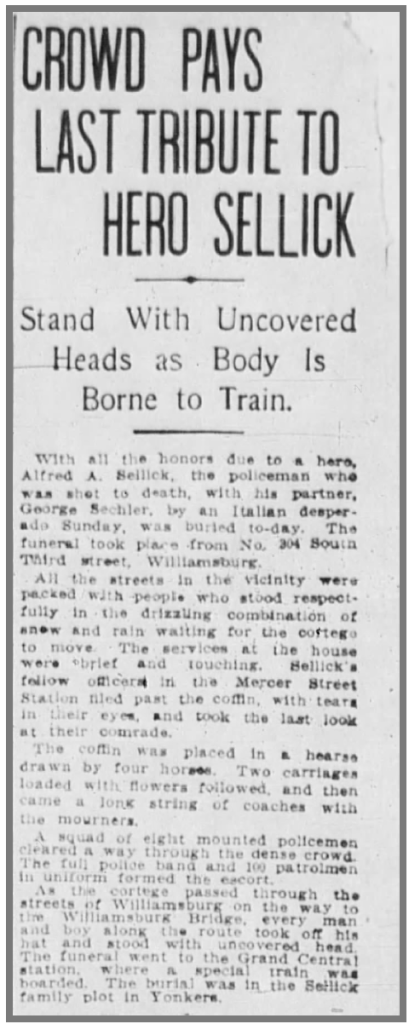
The April 19, 1907 procession and funeral of Alfred Selleck, as described in the New York Evening World
George Sechler and Alfred Selleck were not partners, they both happened to be in the same unlucky neighborhood at the same time, both responding to the commotion they saw coming toward them from Washington Square Park. I have not found anything that would indicate if or how well the two officers knew each other.
Both our Calderwood and Swan ancestors lived in the same small region in northern Vermont in the 19th century. This raises two questions:
Did the two families know each other there?
Is it just coincidence that the two family branches from Vermont would merge in 1921 in Ontario, California with the marriage of grandparents Joe and Margaret Sandford?
Regarding the first question, it is unlikely the two branches encountered each other in Vermont even though the towns where they lived were only dozens of miles apart. But it is possible.
Third great grandparents Silas Swan and Sally Burroughs, both born in Vermont, were married in 1824 in Derby, Vermont, and almost immediately moved to Melbourne, Québec where they started their family. They later moved on to Ohio, and never returned to Vermont.
John Calderwood did not arrive in Vermont from Scotland until 1841, long after the Swans had left. But his wife Elizabeth Smith was born in Vermont in 1826. Her parents were married in Scotland in 1807, so came to Vermont sometime between then and Elizabeth’s birth.
Although the two families mostly missed each other by a decade or two, there are a couple of ways the two families might have overlapped in Vermont. For example, Silas Swan or Sally Burroughs could have had siblings who remained in Vermont after they went to Canada and Ohio. I do not have any information to support this, and it is a less interesting possibility since it would not involve our direct ancestors.
A more compelling possibility is that if the parents of Elizabeth Smith came to Vermont before 1824, they would have lived in a town near the Swans for a few years before the Swans left. This would involve our direct ancestors on both sides. It is not a completely remote situation because we are talking about the parents of Elizabeth Smith Calderwood and the grandparents of Henry Edson Swan plausibly living a few miles apart in the early 1820s. Both Elizabeth and Henry lived in Ontario at the same time and both would have been there for the 1921 wedding joining the two families, so they must have compared notes about Vermont at some point.
The answer to the second question is that it is probably coincidence that the two families came together in California. Even if the families crossed paths in Vermont, it seems unlikely that they would have maintained any kind of correspondence over the years (through Québec, Ohio, Minnesota, and California) that could have eventually contributed to the introduction of Joe and Margaret.
One more slightly less remote possibility, impossible to prove or disprove, is that Henry and Elizabeth could have met each other in the early years in Ontario, realized they both came from Vermont families, and become friends, resulting in a later introduction of Elizabeth’s grandson Joe and Henry’s daughter Margaret, to each other.
Recall that we have two genealogies describing the Sandford family history. Robert Sandford and His Wife Ann Adams Sandford with Some of Their Descendants, 1615-1930, written by Josephine Sandford Ware is the one known by our branch of the family since its 1930 publication. The Sandford/Sanford Families of Long Island, Their Ancestors and Descendants by Grover Merle Sanford is the 1975 publication I learned about in my 2019 visit to Bridgehampton.
In a previous post I discussed the solution to a discrepancy between the two works, that the original Robert Sandford to come to America was not married to the daughter of Jeremy Adams, founder of Hartford, but rather was married to another less well-known Ann. It was Zachariah’s marriage to Jeremy’s granddaughter that explained his inheritance of the Hartford Inn from Jeremy.
This post will discuss another, more significant discrepancy. A few weeks after coming home from Bridgehampton with Grover’s (as a practical matter, I am still respectfully using the authors’ first names to distinguish the genealogies) research in hand, I sat down to compare in depth the two accounts. I expected to compare two chains of ancestors and, with luck, perhaps to be able to go all the way down Grover’s account to our great grandfather, perhaps finding some minor discrepancies with Josephine’s version along the way. Instead I found the following entries:
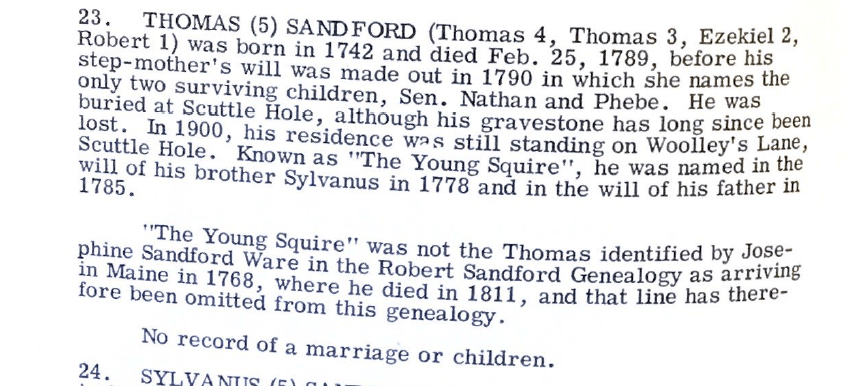
Page 19 of Grover’s genealogy describing the second Thomas Sandford, father of the third Thomas Sandford who was mis-identified in Josephine’s genealogy.
Ouch! Page 26 of Grover’s genealogy, which corrects Josephine’s identification of the third Thomas Sandford and breaks the link from Long Island to our ancestors in Portland, Maine.
It takes a while to figure this out but, in short, Grover is saying that our 4th great grandfather Captain Thomas Sandford of Portland, Maine was not the person Josephine claimed he was. Instead, he was a different Thomas Sandford who can be shown remained on Long Island his entire life. This breaks our family branch’s link back to Long Island from Portland, Maine, and is a major problem in understanding the ancestry of our Sandford branch.
First things first—who to believe? As with the Robert Sandford discrepancy discussed previously, long story short, Grover Merle Sanford’s arguments are solid. The existence of the Thomas Sandford who didn’t move to Portland is convincing.
Up to now our Sandford ancestry chain, as reported by Josephine, looked like this…
8th Great Grandparents: Robert Sandford and Ann… (Hartford)
7th GGPs: Ezekiel Sandford and Hannah Mitchell (Hartford then Bridgehampton)
6th GGPs: Thomas Sandford (1) (1689-1761) and Sarah Pierson (Bridgehampton)
5th GGPs: Thomas Sandford (2) (1715-1787) Esq. and Mary Topping (Bridgehampton)
4th GGPs: Captain Thomas Sandford (3a) (1744-1811) and Jerusha Gelston (Bridgehampton then Portland Maine)
From here down, ample evidence links the Portland Maine Sandfords down to us.
Grover, on the other hand, says:
Robert Sandford and Ann… (Hartford)
Ezekiel Sandford and Hannah Mitchell (Hartford then Bridgehampton)
Thomas Sandford (1) (1689-1761) and Sarah Pierson (Bridgehampton)
Thomas Sandford (2) Esq. (1715-1787) and Mary Topping (Bridgehampton)
Thomas Sandford (3b) (1742-1789) (Bridgehampton)
and this is separate from: –
unknown parents of 3a
4th GGPs: Captain Thomas Sandford (3a) (1744-1811) and Jerusha Gelston (Bridgehampton then Portland Maine)
From here down, there is ample evidence linking the Portland Maine Sandfords down to us.
[Unfortunately, there are a lot of Thomases to keep track of. I have numbered them to help keep them straight.]
Where to go from here? Unfortunately, the standard genealogical sites (Ancestry, etc.) are no help figuring this out because they all repeat the error made by Josephine, amplifying it by repetition. This is one of the major problems with these sites—many/most users do not dig into the details and just believe and propagate what they see.
I considered various alternative theories for the parents of Thomas (3a), including–
Maybe Thomas (3a) came from another Bridgehampton Sandford family (descended from one of the Sandfords further up the chain)
Maybe Thomas (3a) came from another branch of the original 3 brothers (Thomas or Andrew)
Maybe Thomas (3a) came to America at a later time on another boat and is not descended from the original Sandford brothers.
One can also speculate on any number of oddball theories, adoption, illegitimate child, identity theft when showing up in a new city, etc. I’ve tried but, without evidence, this leads nowhere.
Using both Josephine and Grover’s accounts (which vary in the level of detail but don’t seem to have other major disagreements) I traced enough generations of Robert’s descendants to try to identify any other possible Bridgehampton Sandford families that Thomas (3a) could have come from. This is not as difficult a task as it might seem—by the sixth generation down from Robert we go beyond the timeline of interest; we can ignore all female offspring since we are looking for a father named Sandford; the range of dates when any particular candidate might have been having children makes it possible to eliminate quite a few possibilities; and there are quite a few other families that already have a child named Thomas and can be eliminated. The resulting analysis fits comfortably on one page.
I found seven candidate fathers for Thomas (3a) in and around Bridgehampton. Many of these candidates have little known about them. Having no recorded children can be seen as an indication that they lived their lives in ways that eluded detection by the future machinery of the Long Island genealogy industry, which is mostly a matter of not leaving a will. Most of them certainly had children, so there is really no reason not to think that one such child could have been Thomas (3a).
Regarding theory #2 (looking at the branches of the original Thomas and Andrew, Robert’s brothers), there is a third important genealogy out there, Carlton E. Sanford’s Thomas Sanford, The Emigrant to New England, Ancestry, Life and Descendants. This book focuses, obviously, on the second brother who established himself in nearby Milford CT and started his own major branch of Sanfords. It does not cover the Bridgehampton branch at all. Using this source, I have similarly traced the Milford CT Sandfords to identify plausible candidates and found a few, but nothing particularly compelling. (Note: the Carlton Sanford account, even though it does not help with the Robert Sandford branch, contains what I think is the best, most thoughtful account of the Sandfords before they came to America—a topic for a future post.)
The third branch, that of Andrew Sandford, does not have any detailed genealogical documentation I am aware of. This branch got embroiled in the witch trials (another future post topic), and may have simply failed to thrive and eventually disappeared.
I have come to realize that there are few areas of study that have been more thoroughly investigated than Long Island genealogies, and the chances of making new discoveries are minimal. If records cannot be found, it is because they have been lost or never existed.
Returning our attention to Long Island…Although I cannot find direct evidence that Thomas (3a) was born on Long Island and moved to Portland Maine, there is a lot of circumstantial evidence that supports this being the case:
Leaving Long Island during the pre-revolutionary era to get away from British oppression was common, and that Portland Maine was a logical place go. It was full of resources and opportunities, and it was in the opposite direction from most of the activities leading up to the Revolution.
As we have discussed, there is the another Sandford branch that came from Southhampton to Topsham Maine in just before the Revolution. This branch is: Robert—>Ezekiel—>Thomas (1)—>John (1)—>John (2), who was born 1751 in Bridgehampton and died 1840 in Topsham. (John (2) would have been the cousin of Thomas (3a) had he been the son of Thomas (2)). In any case, there is proof of John (2)’s migration so there is precedent for another Sandford migration from Long Island to Maine.
Thomas (3a)’s wife, our 4th great grandmother Jerusha Gelston definitely migrated from Southhampton to Maine. As we have discussed, she was the daughter of Judge Hugh Gelston of Southhampton, and there is ample proof for this. Jerusha’s first husband, Arthur Howell, also provably moved from Bridgehampton to Maine. The theory that Thomas (3a) started as a friend/protege of Howell and went along with him to help with establishing the business is compelling.
If we compare the situation of Thomas (3a) and Jerusha Gelston with that of Thomas (2) and Mary Topping we see that Thomas (2) was married twice, first to Mary Topping and second to Phebe Baker Howell who was previously married to Theophilus Howell. So both Thomas (2) and Thomas (3a) were provably married to Howell widows. At the very least, one can conclude that the Sandford and Howell families were very close over several generations. It would not be impossible, but odd, to see this pattern (of Sandfords marrying Howell widows) repeated between Sandford generations if the generations were from completely different branches of the Sandford tree.
This circumstantial evidence tells me that it is most likely that Thomas (3a) was born in Bridgehampton, not the son of Thomas (2) but of some other nearby Sandford family (from the seven candidates discussed above), that he fell-in as a protege of Arthur Howell, followed him and Jerusha when they moved to Portland to pursue their business, and married his wife when Arthur Howell died. The other possibility, that Arthur Howell and Jerusha Gelston met another non-Bridgehampton Thomas Sandford from another branch after they moved to Portland, seems far less likely.
I have also tried looking at Howell, Gelston, and Topping genealogies, of which there are many, and looking for clues. No luck on this, but kind of a long shot because I really can’t think of specific circumstances for how a Howell will, for example, would have any occasion to notice what was going on in the Sandford world.
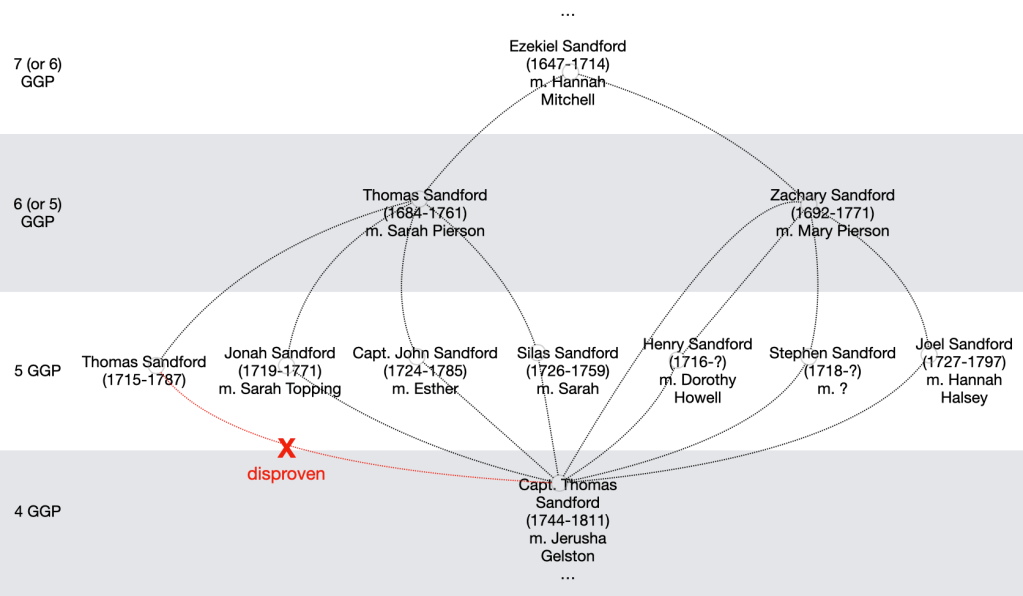
The seven candidate fathers on Long Island for Captain Thomas Sandford are depicted in the following diagram.
Depiction of the seven candidate Long Island sets of parents for 4th great grandfather Captain Thomas Sandford who spent most of his life in Portland, Maine. Note that there is proof that 4th great grandmother Jerusha Gelston was born on Long Island and moved to Maine, later to marry Thomas. In my opinion there is ample circumstantial evidence that Thomas also migrated from Long Island to Maine, even if we are not sure which family he came from.
The nice thing about the seven candidate sets of Bridgehampton parents for Capt. Thomas Sandford is that none of them would change our family tree very much from the one that Josephine claimed—only one or two generations would change:
The first three candidates would only change one name in the family tree — 5th GGP Thomas (2) would change to Jonah, John or Silas and 6th GGP Thomas (1) would be unchanged as 6th great grandfather
The last three candidates would change 5th GGP Thomas (2) to Henry, Stephen or Joel, and change 6th GGP Thomas (1) to Zachary (not the same as the Hartford Inn owner) but Ezekiel would remain our 7th great grandfather
The middle candidate would change 5th GGP Thomas (2) to Zachary who would be 5th great grandfather. Everybody earlier would move down a level i.e. Ezekiel the bridge builder would change from 7th great grandfather to 6th great grandfather, and so on.
For now, and maybe permanently, our Sandford genealogy has an asterisk, acknowledging the lack of proof of the link from Portland back to Bridgehampton, but citing the circumstantial evidence to support the theory that our Sandford branch likely really did come from Bridgehampton (and unquestionably identifies 5th great grandfather Hugh Gelston and 4th great grandmother Jerusha Gelston as Long Island ancestors).
That’s the big mystery of the inconsistent Sandford genealogies and my best thoughts on the solution. Happily, I have not found any other major discrepancies between the Josephine Sandford Ware and Grover Merle Sanford genealogies of the Sandford/Sanford family. I thank Grover Merle Sanford for setting the record straight (and forgive him for throwing us out of his book).
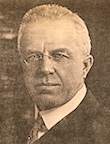
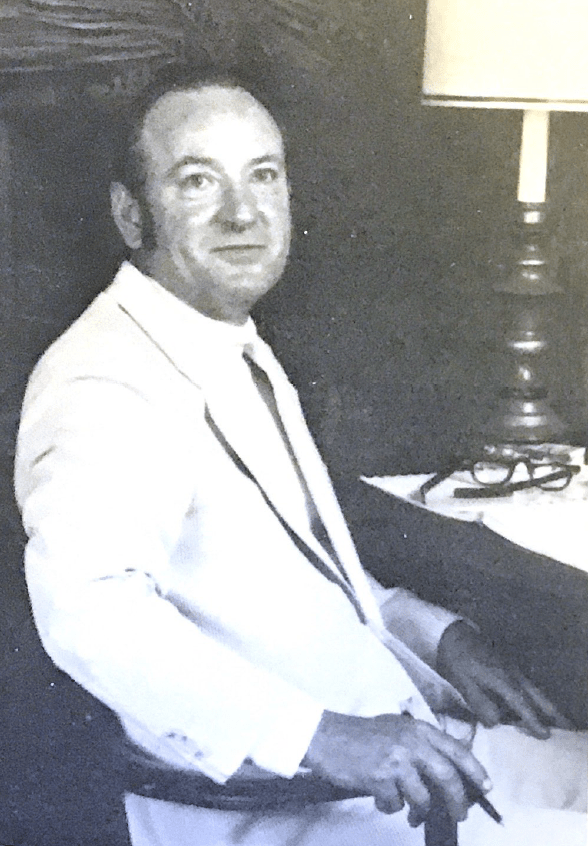
Photo of Grover Merle Sanford from the introduction of his 1975 book.
An additional note. We know that Grover’s genealogy excluded our Sandford branch because he did not find data to support it. It is fair to ask the opposite question—did Josephine’s genealogy recognize Grover Merle Sanford’s branch? The answer is that she didn’t get that far–her research petered-out before she got all the way down to Grover. She identified Robert—>Ezekiel 1—>Ezekiel 2—>Ezekiel 3—>Bethuel but then did not identify further generations that would have led to Grover. She also identified Ezekiel 4, son of Ezekiel 3, but did not identify further generations that would have led to today’s Ann Sandford of Bridgehampton.
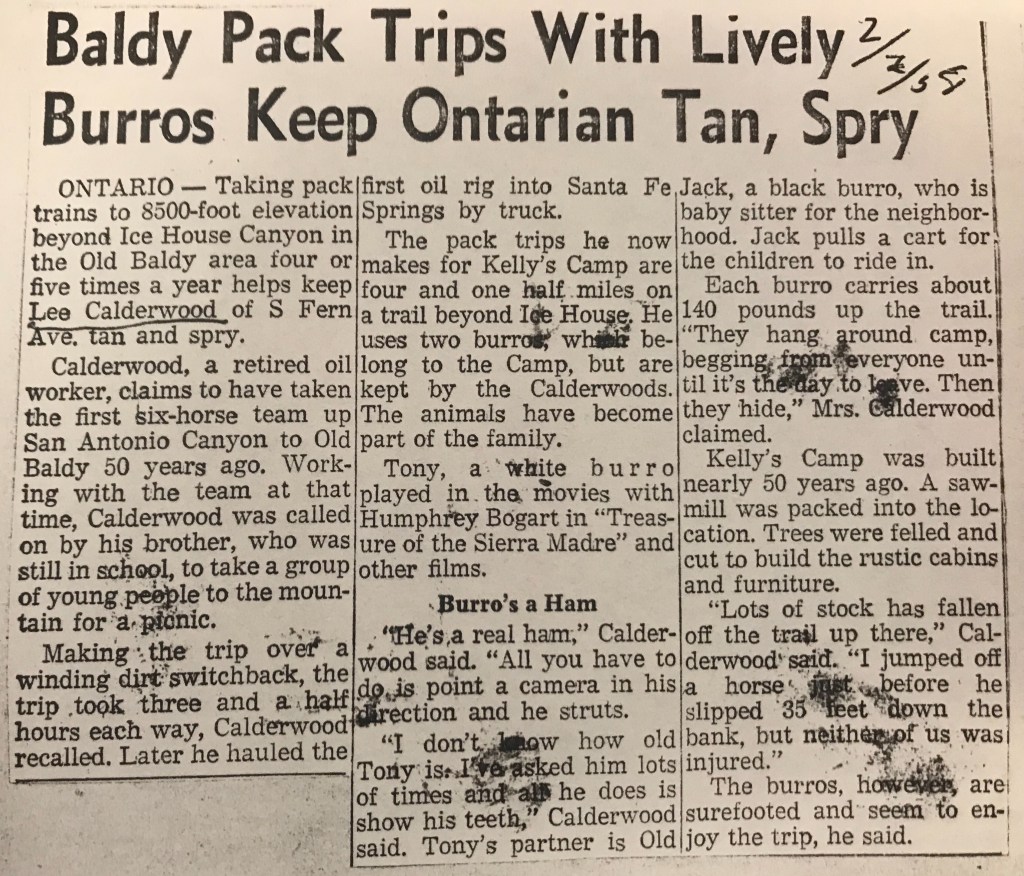
A little more on the family of great grandmother Annie Calderwood. Right after publishing yesterday’s article, I rediscovered this clipping from 1958, copied last summer from the files of the Model Colony History Room at the Ontario Public Library.
Mystery 1958 describing Lee Calderwood from Ontario, California.
The article was surely saved by our grandparents Joe and Margaret. In addition to sharing a family name with Lee, they knew the climb up Mount Baldy very well. There was no Lee Calderwood in the family tree I had constructed thus far–he was not an immediate family member or close cousin. I tried to trace him back to some known part of the family.
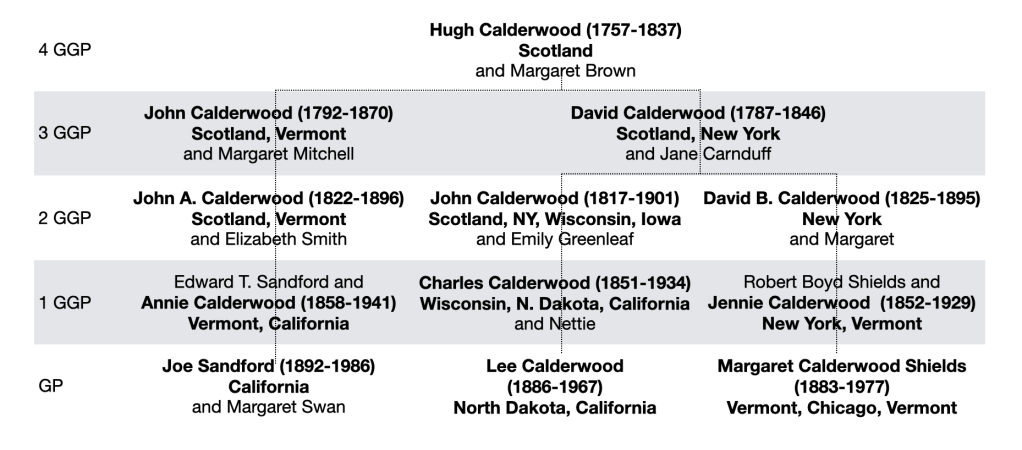
Similar to the problems tracing Annie’s ancestry, Lee’s ancestry gets trickier the farther back you go–that same established Calderwood family reluctance to get involved with government activities that might have left a paper trail. But relying on family trees constructed by others, I was able fill some gaps and trace Lee back to Hugh and Margaret Calderwood of Ayrshire, Scotland. I recognized Hugh and Margaret as our tentative 4th great grandparents because they had shown up in previous theories in tracing Annie’s ancestors. If the traces on both sides are correct, then Lee is our third cousin.
One generation below Hugh and Margaret, I also recognized the names David and Jane Calderwood from my attempts to trace back physicist Margaret Calderwood Shields. This would place Margaret Shields as another third cousin. Lee Calderwood and Margaret Shields would be each others’ second cousins.
Tentative relationship between the Calderwood branches of Annie/Joe, Lee, and Margaret.
These relationships are not rock solid and there is nothing to be done about records that don’t exist, but there is a strong circumstantial case to be made for this being the correct tree linking Annie/Joe, Lee, and Margaret. The locations where people were born, lived, and died line up with what we know about the Calderwood history and migration patterns from Scotland to New York to Vermont, to California. There is a high degree of agreement between the family trees constructed by other in the Ancestry database (although sometimes this can be because people copy each others’ mistakes). And because Annie’s branch is known to have come directly to Vermont, skipping NY, we can say that Annie’s branch must have diverged from the other two in Scotland, not America. Having Hugh and Margaret Calderwood as our common ancestors is the only consistent explanation.
The circumstantial case is made stronger by the existence of the three consistent, parallel branches in the tree. When I was first trying to link Margaret Shields to Annie, there did not seem to be enough evidence to make probable conclusions. But introduction of Lee’s third branch, which would never have come up if not for the newspaper clipping, put new data into the mix that strengthened the conclusions for all three branches. This seems to happen frequently in genealogical research–problems that can’t be solved directly can be solved by following a different, roundabout path.
In 1958 when our grandparents saved the clipping of Lee Calderwood, it is interesting to wonder how much they knew about him. Third cousins are a long way apart, especially when the two sides left Scotland at different times to go to different locations. Did they know the specific path that made him a third cousin or did they just have general awareness that he was a distant cousin?
The family of great grandmother Annavilla (Annie) Agnes Calderwood came from Dunlop, Ayrshire Scotland, about 15 miles southwest of Glasgow. Her father, John Calderwood (1822-1896), arrived in the United States in 1841 at age 18 or 19.
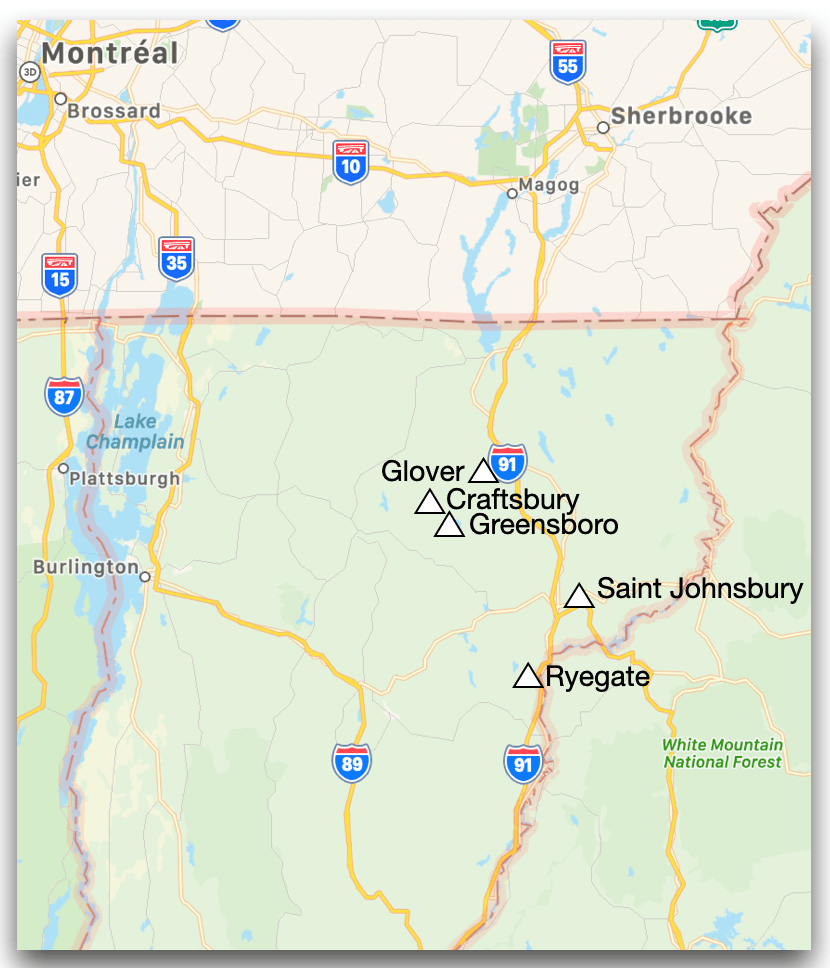
Difficult economic conditions in Scotland, driven by the growth of the industrial revolution, created tides of immigration to the United States throughout the 19th century. For many people from Ayrshire, including several generations of the Calderwood family, one of these currents flowed via the port of New York to Galway, New York (northwest of Albany) and later to Craftsbury, Greensboro, and Glover in northern Vermont (25 miles south of the Québec border).
John Calderwood left Dunlop, Ayrshire, Scotland in 1841…
…and came to Glover, Vermont. In 1848, he married Elizabeth Smith from Ryegate, Vermont
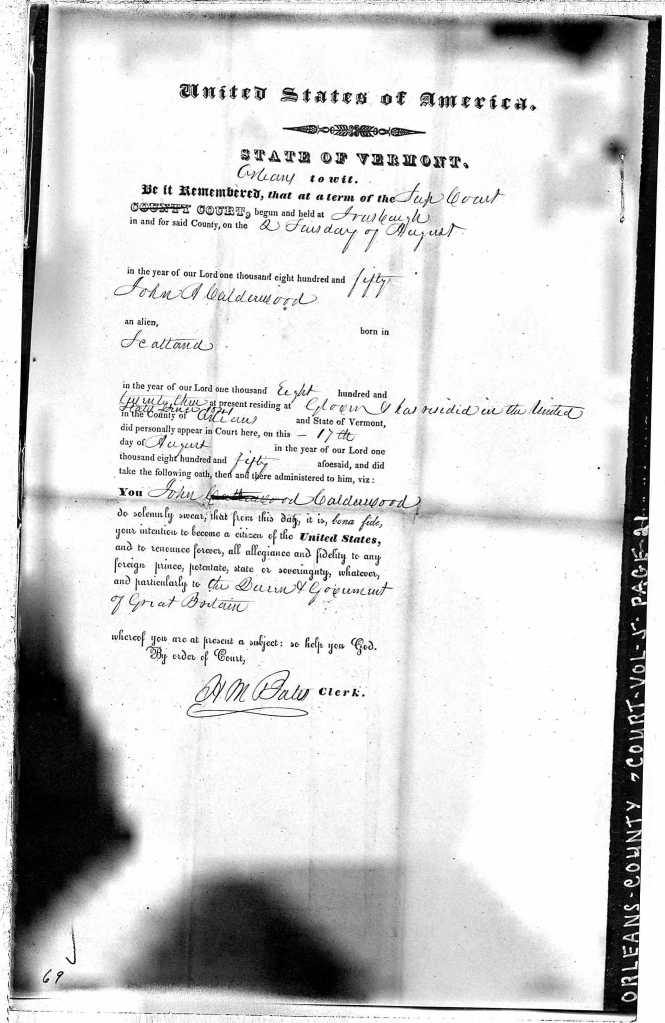
John Calderwood appears to have immigrated directly to Glover, Vermont, following Calderwood generations that had already established a foothold there. John became a United States citizen in 1850.
John Calderwood’s final U.S. citizenship declaration from 1850. The location says the town of Glover in the county of Orleans.
Annie’s mother was Elizabeth Smith (1826-1921), born in Ryegate, Vermont of parents who were both Scottish immigrants. John and Elizabeth were married in 1848 in Greensboro, Vermont.
Annie was born in 1858 in Craftsbury Vermont, She was one of nine children.
Tracing the Calderwood and Smith families back to earlier generations is difficult. There are descendants in the Ancestry databases who think they know who the previous generation were, but there is no documentation to support these claims. It turns out there is a reason for this. The Proceedings of the Vermont Historical society published an article in 1996 entitled Scots Among the Yankees: The Settlement of Craftsbury East Hill, by Bruce P. Shields, which provides an explanation…
While their Vermont destination is known, the route by which these Scots entered the United States is uncertain. Naturalization documents do not exist for most because of the Covenanter heritage of much of the group. The Covenanter Church derived from the Reformation in Scotland. For fifty years during the civil wars, the Long Parliament, and the Restoration, armed forces of the Episcopalian governments both of Scotland and England ravaged the glens of eastern Ayrshire, leaving a legacy of antigovernment feeling. Partly in revulsion to government persecution, Covenanters refused on scriptural authority to take any kind of oath and refused to pledge allegiance to a government not founded on Scripture. A confessional church, the Covenanters held to a detailed set of published standards for both faith and social behavior.
Covenanter refusal to take oaths complicated their U.S. citizenship. Without oaths, they could not be naturalized in the usual way by swearing allegiance to the U.S. Constitution before a justice. East Hill Scots who arrived before 1850 simply never made naturalization declarations, and consequently their port of entry cannot be discovered, except by oral tradition. Some Andersons entered via Montréal, as did the Youngs. The Calderwoods landed at New York City and moved to Schenectady, from which place part of the family came to Craftsbury and Greensboro. Alexander Shields, according to tradition, landed first at Albany, New York, took a barge to Vergennes, Vermont, and then traveled by oxcart to Craftsbury.…
Bruce Shields, 1996
So it seems that deliberate refusal to participate in government-related activities is what led to today’s scarcity of genealogical records for our Calderwood ancestors, and this phenomenon was common among Scottish immigrants from the Ayrshire region during the 19th century. There are U.S. Census records from 1860, 1870, and 1880 which show the family of John, Elizabeth, and Annie, but nothing earlier. Most records from the U.S. Census of 1890 were destroyed by a fire in 1921.
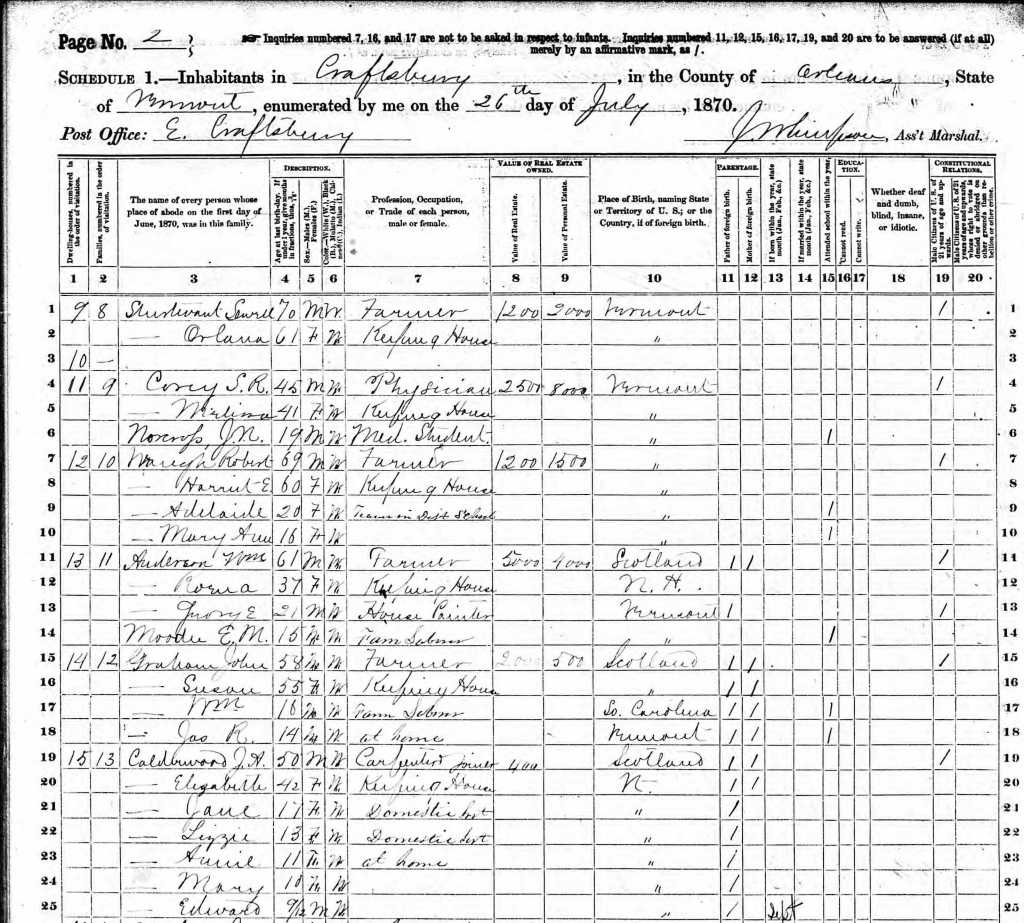
The 1860 census shows the family with five children, including two year old Annie, living in Craftsbury. The same is true for 1870 with the addition of one year old Edward (who apparently only lived a few years). John Calderwood is listed as a mechanic in 1860 and as a carpenter in 1870 and 1880. By 1880, John and Elizabeth were living alone in Saint Johnsbury (now 58 and 54), and Annie is listed in a separate entry as a housekeeper living in the home of Edward and Sarah Sandford (a story to be picked-up later).
1870 U.S. Census record from Craftsbury, Vermont. The Calderwood family is listed on lines 19-25–John A, Elizabeth, Jane (17), Lizzie (13), Annie (12), Mary 10, and Edward (9 months). There are small inconsistencies in John’s and Elizabeth’s ages in various sources.
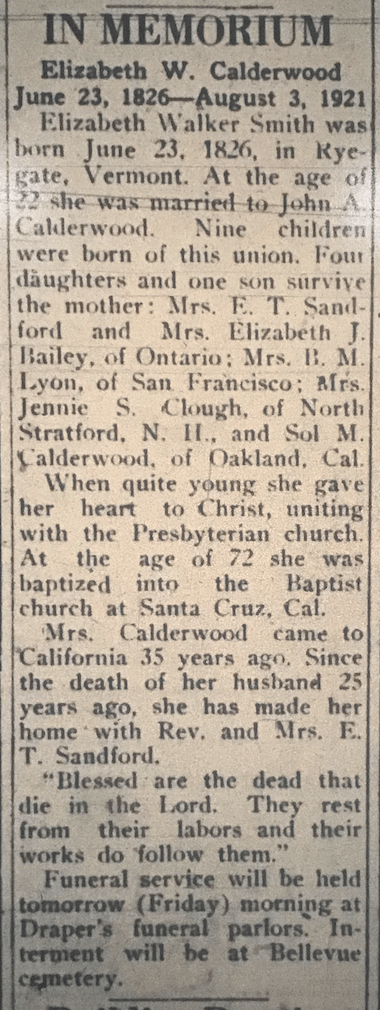
The 1880 census is the last record found of John Calderwood until a note of his 1896 death appearing in Elizabeth’s obituary. The same obituary states that Elizabeth moved to California (no city is named) in 1886, five years before Annie and Edward. So it seems that John and Elizabeth went to California first, and John died ten years after they arrived. Elizabeth shows up again in the 1900 census living with her daughter’s family in Corona, California.
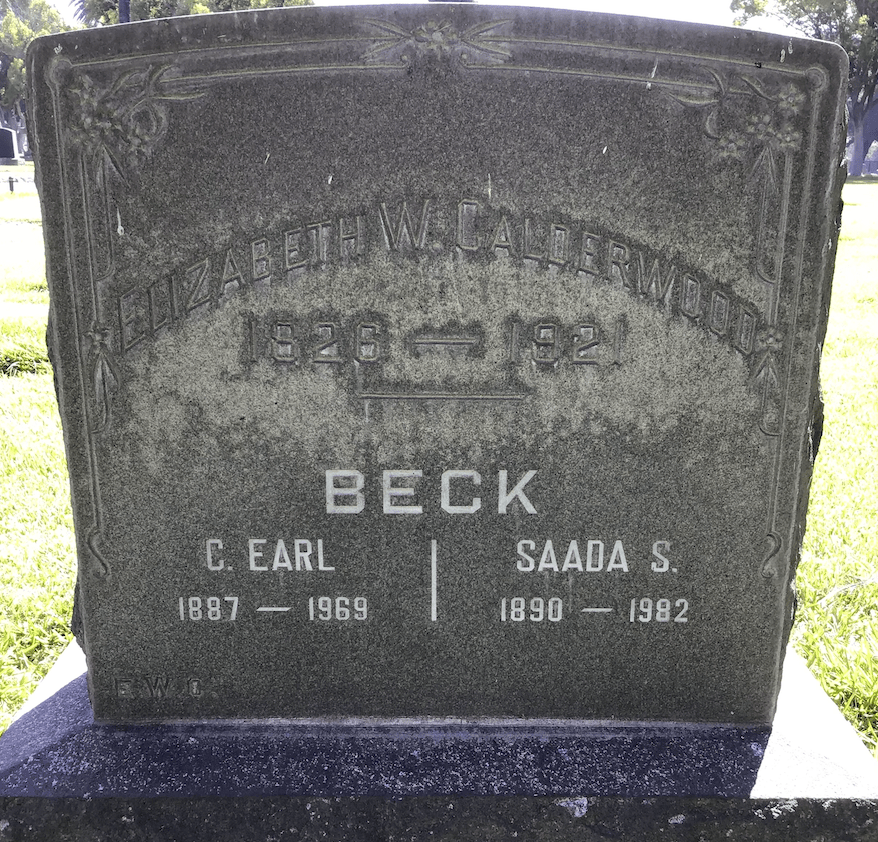
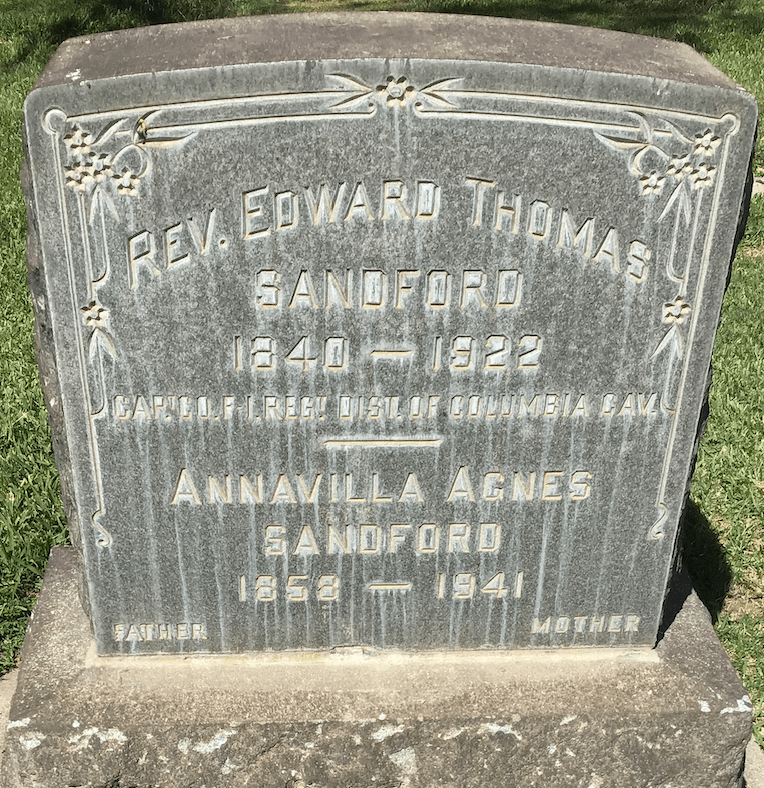
Elizabeth lived with Annie’s family for the rest of her life. She died in 1921, a year before her son-in-law great grandfather Edward T. Sandford. Her name is inscribed on the back of Edward and Annie’s gravestone in the Bellvue Cemetery in Ontario, along with Edward and Annie’s daughter and son-in-law, Saada and Earl Beck.
Elizabeth Calderwood’s name is inscribed on the back of the gravestone of Edward and Annie Calderwood Sandford, along with her daughter and son-in-law Saada and Earl Beck.
At least three of Annie’s siblings also moved to California at various times, all mentioned in Elizabeth’s 1921 obituary. Elizabeth Bailey lived in Ontario (and is buried in Bellvue).
1921 obituary of Elizabeth Smith Calderwood, Ontario, California
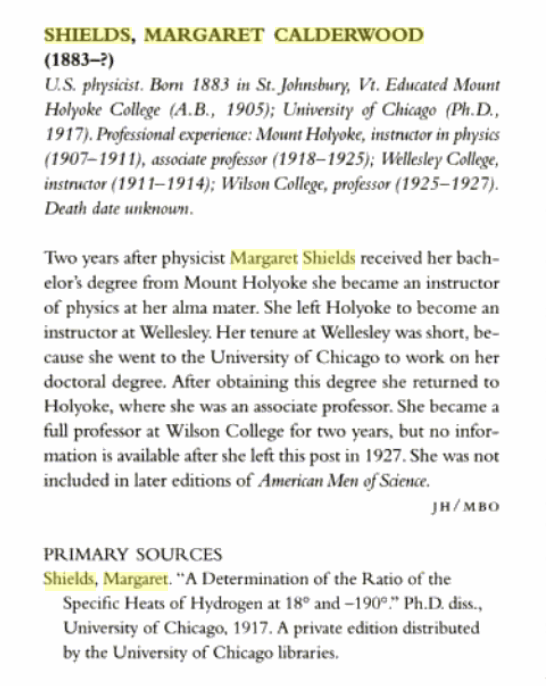
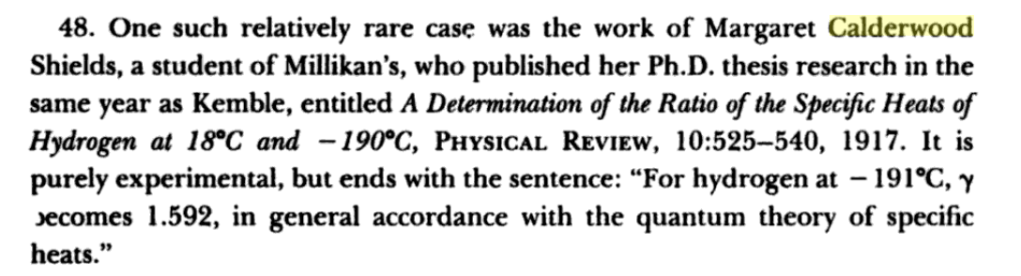
The 1996 Vermont Historical Society’s article by Bruce Shields also mentions a famous Calderwood from Craftsbury, Vermont. Dr. Margaret Calderwood Shields (1883-1977) was born and died in Craftsbury, but during her life she was a physicist at the University of Chicago, a student of Robert Milliken, the Nobel Prize winning physicist. She was one of the first U.S women to receive a Ph.D. in physics.
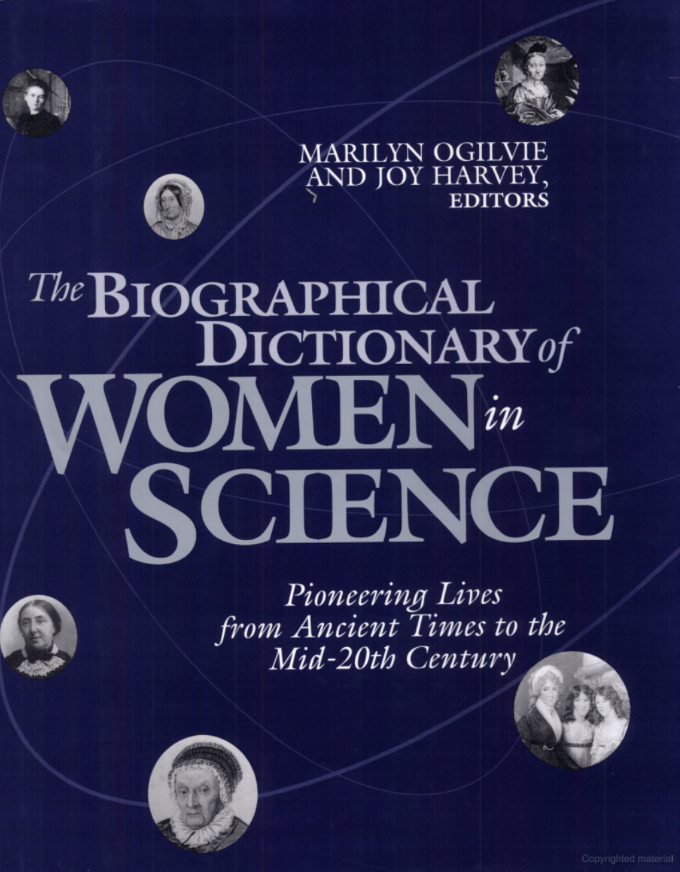
Dr. Margaret Calderwood Shields is recognized in various publications as an early pioneering woman of science.
Probably because of the same Calderwood ancestral reluctance to participate in government activities, I have not been able to determine Margaret’s exact position in the Calderwood family. She is likely of the same generation as our grandparents. It appears that she was descended from those earlier Calderwood immigrants who settled near Albany before coming to Vermont, therefore our common ancestry probably goes back to Scotland and she is probably a second or third cousin.
One final revelation is that Bruce Shields, author of the 1996 Vermont Historical Society article, must be a descendant of Margaret, and therefore also a cousin of ours.
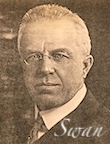 Having previously traced the ancestry of great grandfather Henry Edson Swan back to Silas Swan and Silas Kenworthy (Vermont, Ohio, Minnesota and California), we now move back to earlier generations. Our Swan ancestry goes back to colonial Massachusetts and Yorkshire England as shown below.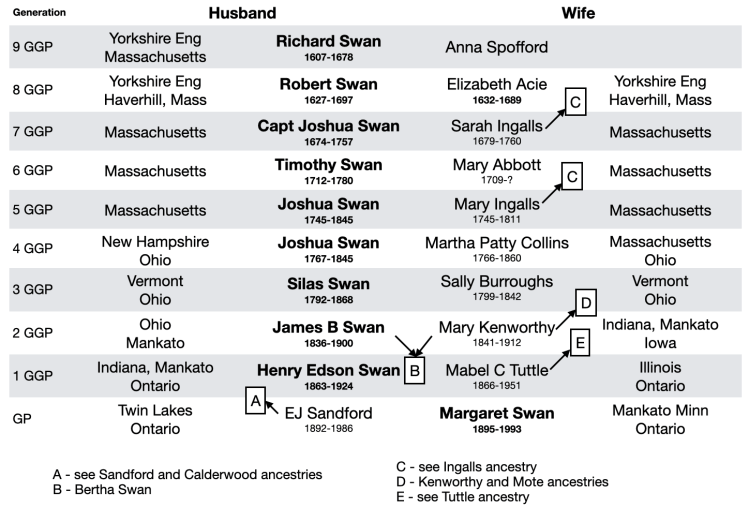
 We previously discussed 2nd great grandfather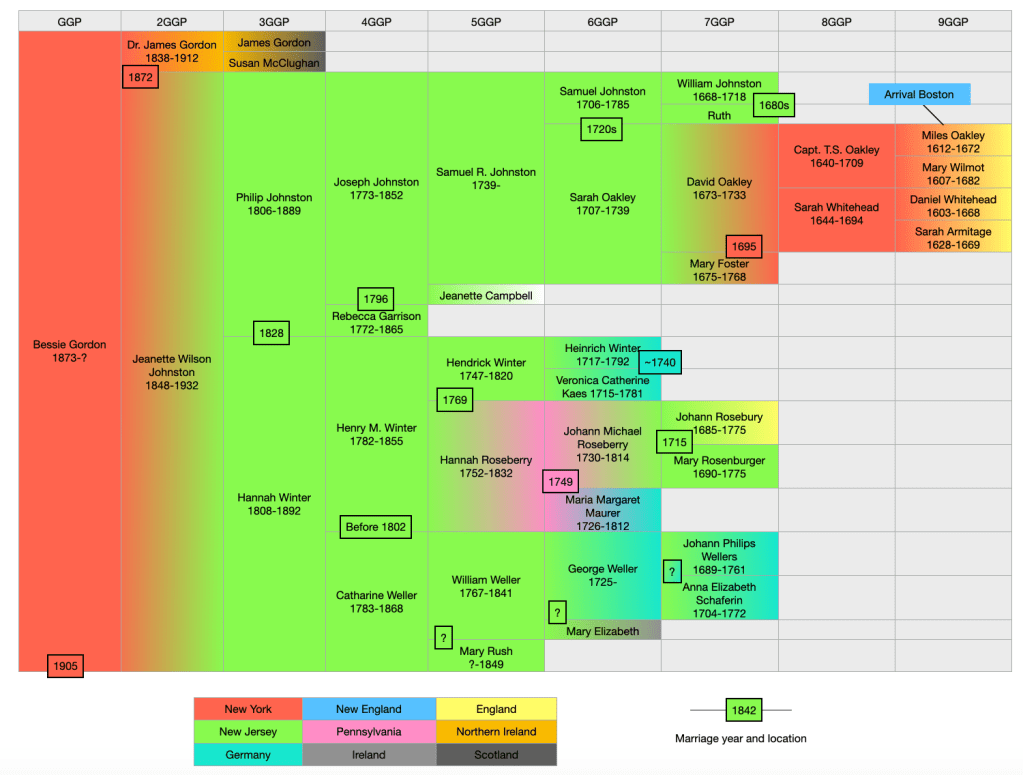
 Great grandfather James Louis Hynes immigrated from Newfoundland to Newburgh New York with his family sometime between 1890 and 1898 (ages 6-14). Four different United States Census reports give four different years for their arrival. 1895 (age 11) seems like the most credible number because that is the year recorded in the 1900 Census, the first record of the Hynes family in the U.S.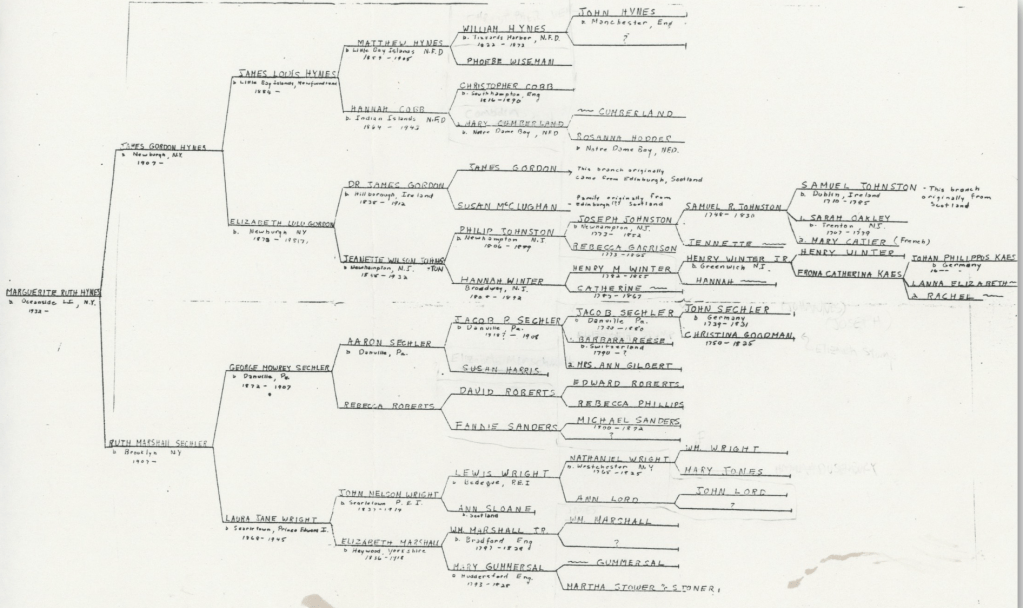
 An irony of the life story of great grandfather George Sechler is that we know far more about him because of his early death than we would if he had survived the events of April 14, 1907.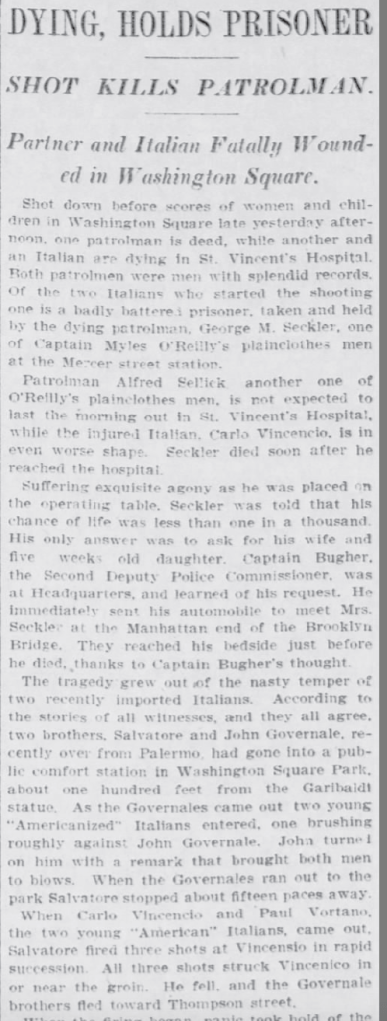
 Both our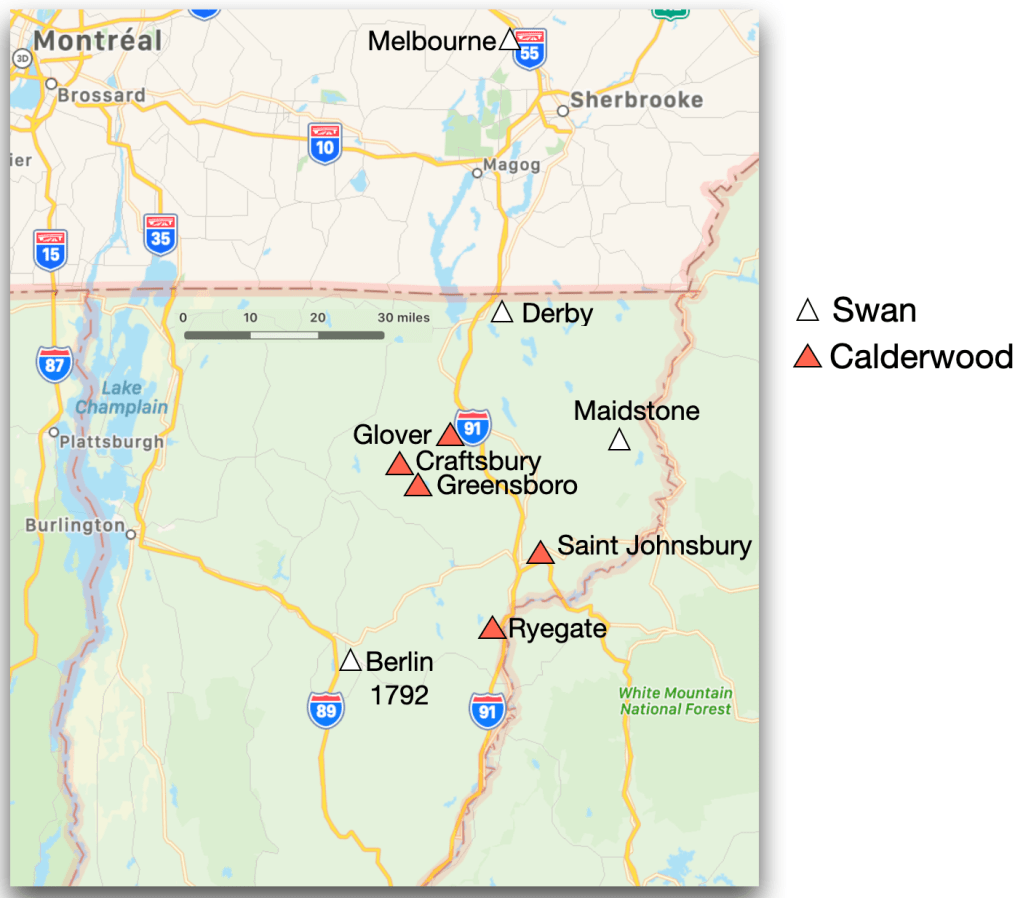
 Recall that we have two genealogies describing the Sandford family history. Robert Sandford and His Wife Ann Adams Sandford with Some of Their Descendants, 1615-1930, written by Josephine Sandford Ware is the one known by our branch of the family since its 1930 publication. The Sandford/Sanford Families of Long Island, Their Ancestors and Descendants by Grover Merle Sanford is the 1975 publication I learned about in my 2019 visit to Bridgehampton.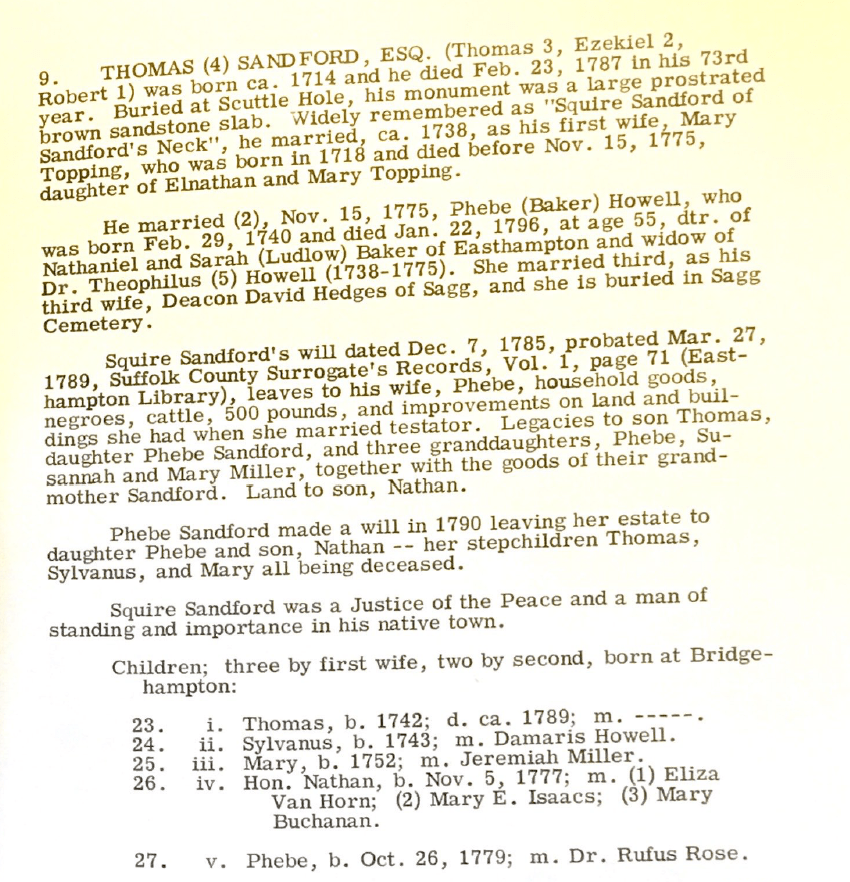
 The family of great grandmother Annavilla (Annie) Agnes Calderwood came from Dunlop, Ayrshire Scotland, about 15 miles southwest of Glasgow. Her father, John Calderwood (1822-1896), arrived in the United States in 1841 at age 18 or 19.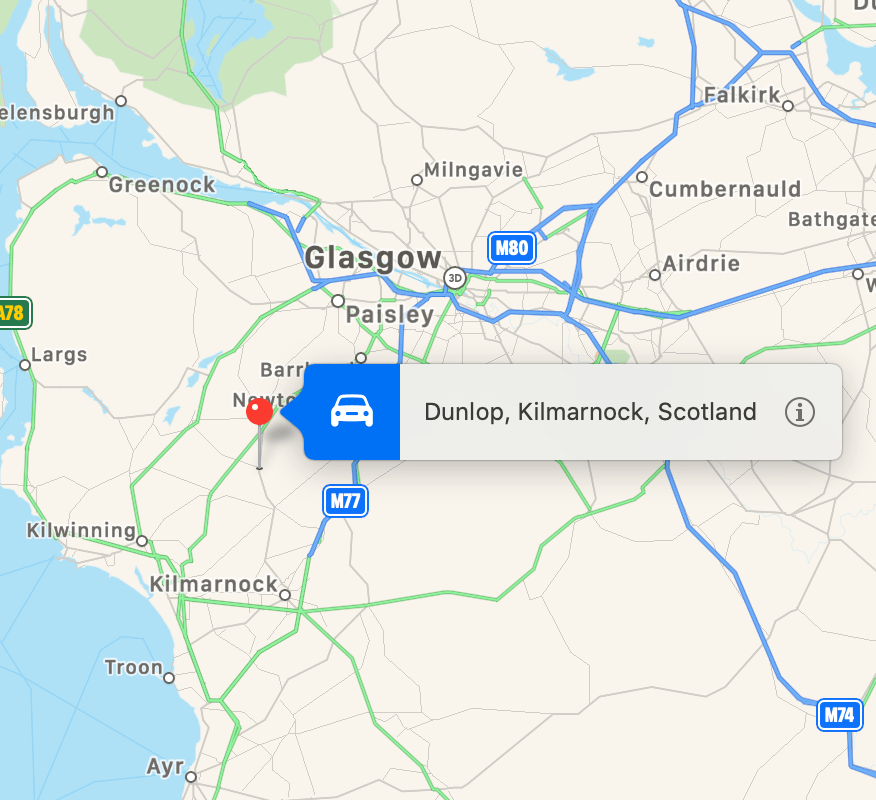
 Bridging the Silences