 Each of us has 64 fourth great grandparents. By the time we work back to the 17th century we are in the realm of eighth and ninth great grandparents, of which each of us has 1024 and 2048, respectively. There are a lot of places to look for interesting ancestors.
Further fueling this math is that, for those of us lucky enough to be able to trace our family roots to the beginnings of colonial America, these many ancestors get squeezed into fewer and smaller colonies as we go back in history. With multiple roots extending so far back in New England, it is virtually impossible that these family roots didn’t bump into each other along the way.
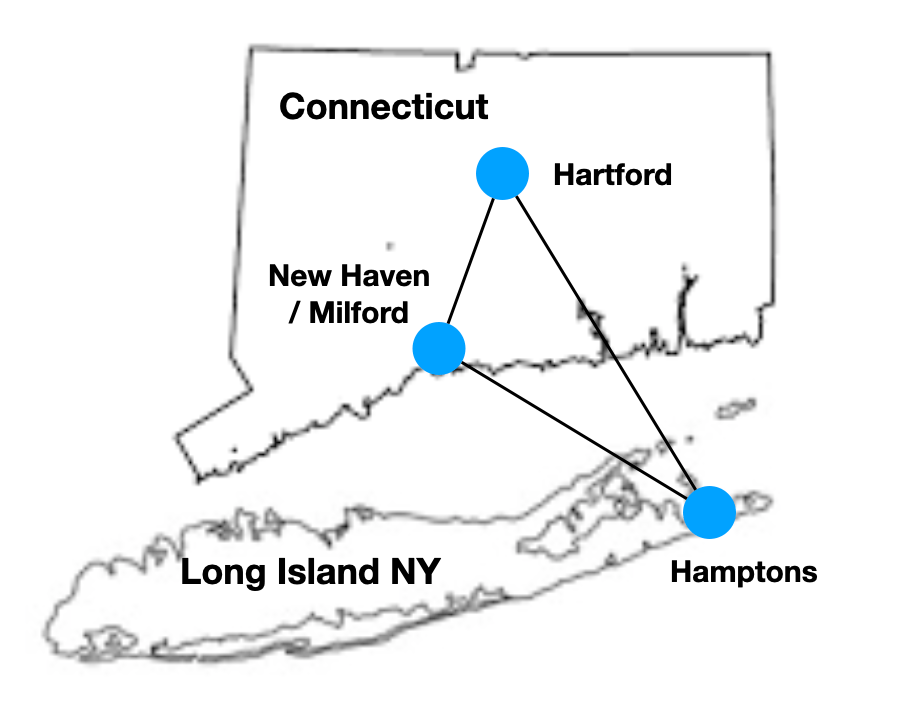
Increasing the chances of intersection even further is that many of our 17th and 18th century family history took place in Connecticut and eastern Long Island–a triangle between the Hartford, New Haven, and Hampton colonies. The deeper one looks at the history of these places, the more evident it becomes that they were very closely linked, with people moving freely between them for trade, work opportunities, marriage partners, and in response to political events. Given favorable tides and winds, the trip from Hartford or New Haven to eastern Long Island was perhaps easier in 1650 than it is today (when traffic on I95 and I495 is never favorable).
We previously introduced Jerusha Gelston, our 4th great grandmother, the daughter of our 5th great grandparents Hugh Gelston and Mary Chatfield. Jerusha and our 4th great grandfather Captain Thomas Sandford both were born on Long Island, followed Arthur Howell to Portland Maine, and were married after Howell’s untimely death. We now trace Jerusha’s branch of the family (one of the 64) to its origins, as best we can.
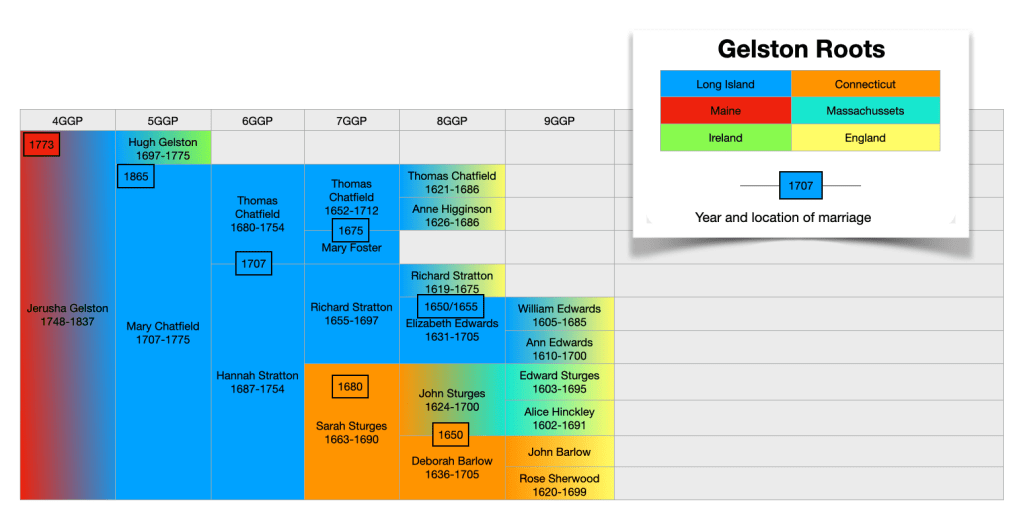
Several branches of Jerusha’s mother’s family tree, take us back to the early 17th century, on Long Island, Connecticut, Massachusetts and Rhode Island, with early settlers immigrating from Sussex, Leicester, Suffolk, Kent and London. Published genealogies help with verification of their details of the Chatfield and Stratton families.
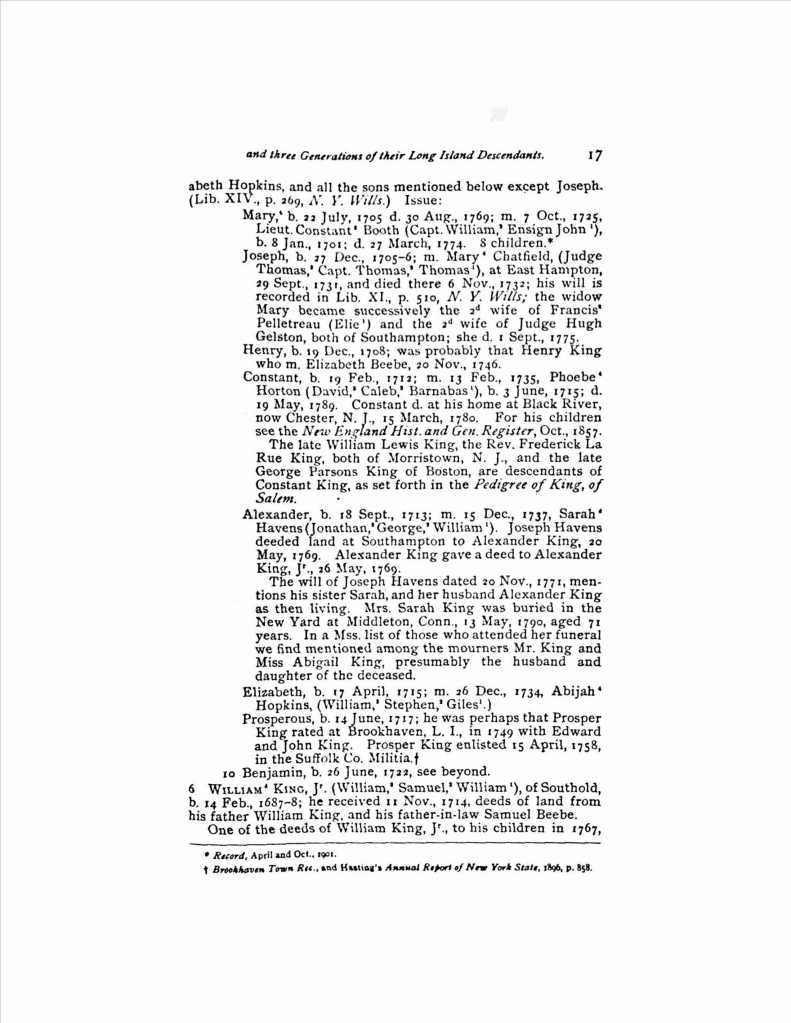
There are two names in Jerusha Gelston’s ancestry that raise questions requiring further investigation are Edwards (Elizabeth and William) and Foster (Mary). Although both of these investigations turn out to be false alarms, I now describe them as illustrations of common genealogical traps, easy to fall into.
The Edwards Red Herring
The name Edwards rings a bell in Connecticut history because of Jonathan Edwards, grandfather to Aaron Burr and great grandson of William Edwards, one of the founders of Hartford. Seeing William Edwards and Elizabeth Edwards in the Gelston ancestry, in the same generation that they appear in Connecticut history raises the question of whether Jerusha Gelston could be descended from this family. The following diagram compares the two families (including known links to our Tuttle ancestors) to examine these possible connections.
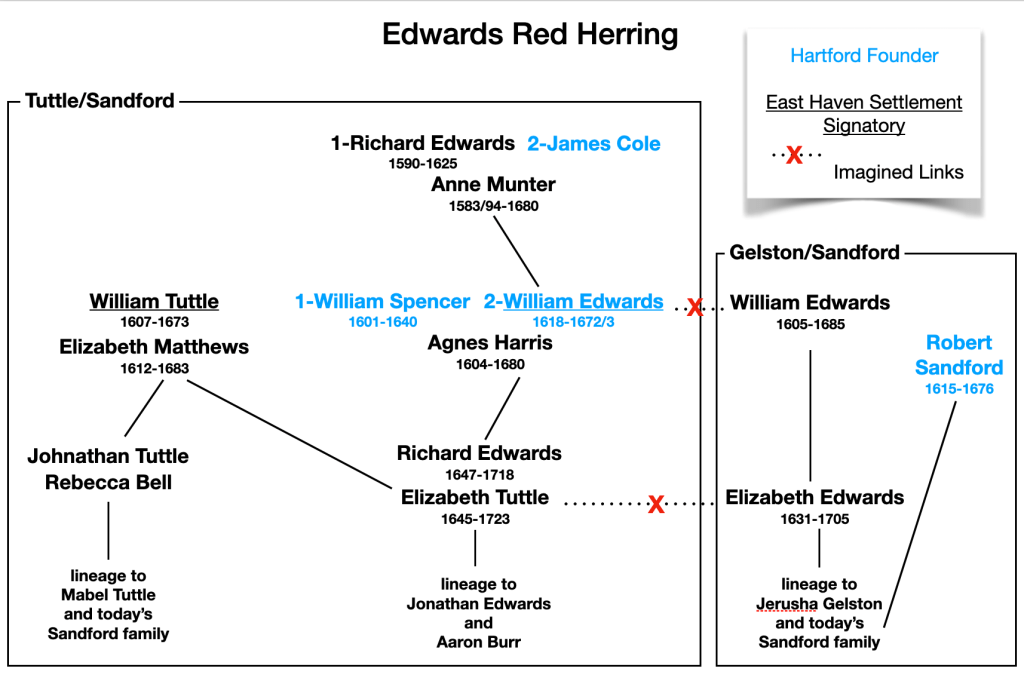
After a few hours of researching and creating this diagram, it become clear that Aaron Burr’s ancestors Elizabeth and William Edwards are not the same people as Jerusha Gelston’s ancestors Elizabeth and William Edwards. The dates don’t quite match up, and Elizabeth Tuttle Edwards is William Edwards’ daughter-in-law, not daughter. Just as well, as this would have greatly complicated the relationships between the Sandford and Tuttle branches of our family tree. We can still see, however, that both branches were closely linked to the origins of Colonial Connecticut.
The Foster Red Herring
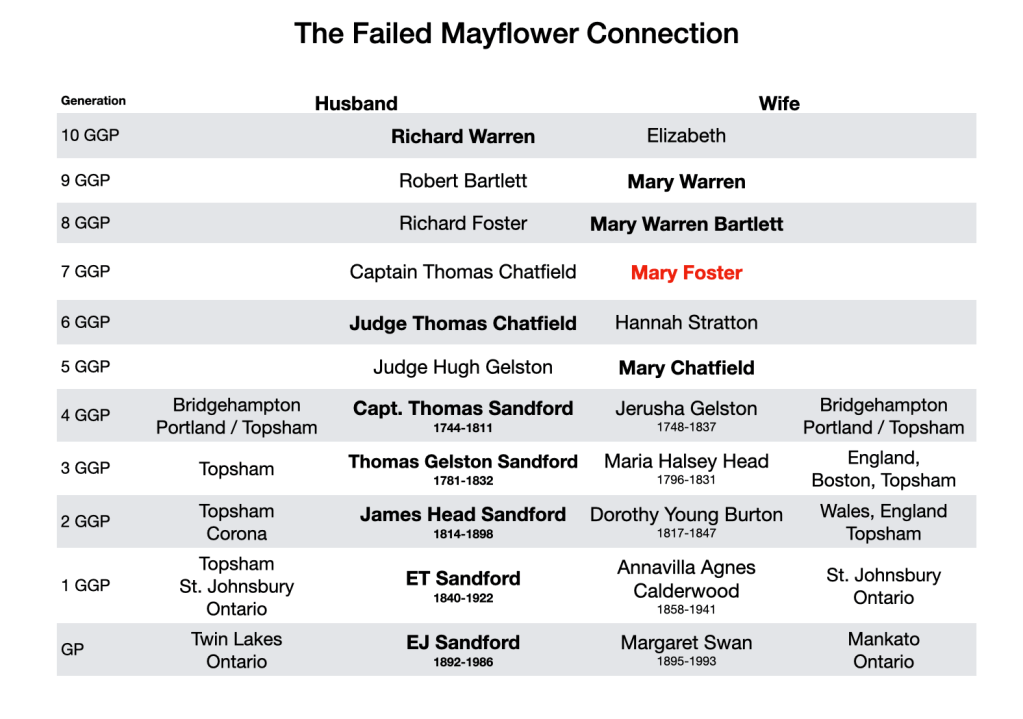
The name Mary Foster sets off alarms in Ancestry databases because it is linked to descendants of the Mayflower. There is probably no subject more studied in North American genealogy, so a soon as such a name comes up in a family tree, one is immediately drawn into all this research and it is very easy to begin believing that perhaps you could be a Mayflower descendant.
The Mayflower carried 102 people to Plymouth in 1620, all of whom have been carefully documented. One passenger was Richard Warren, who had a great granddaughter named Mary Foster.
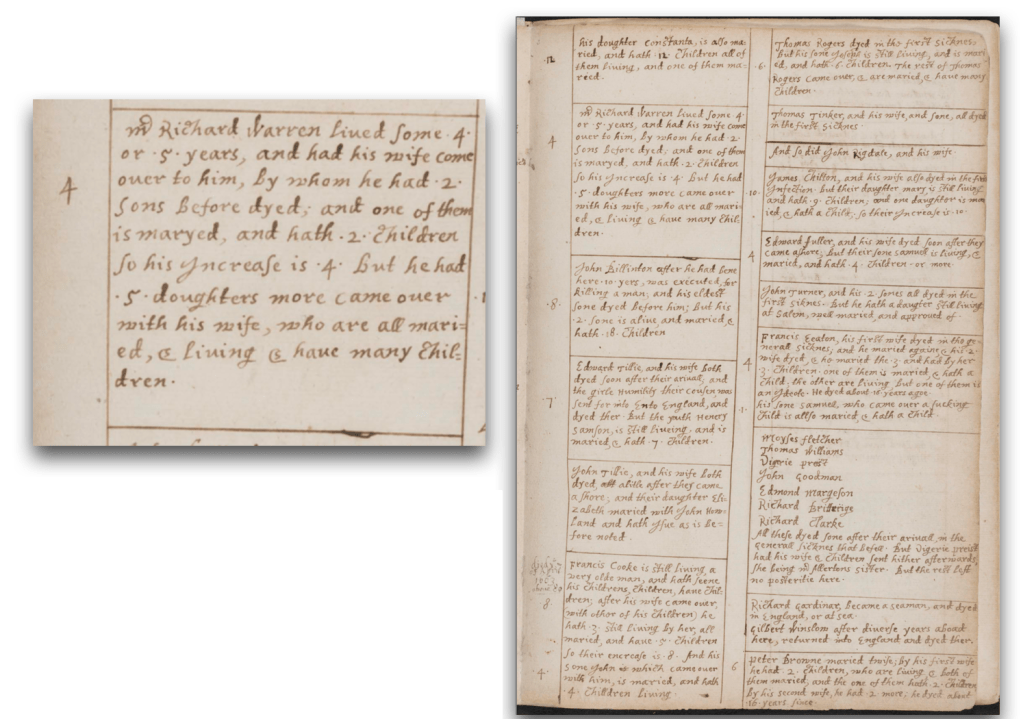
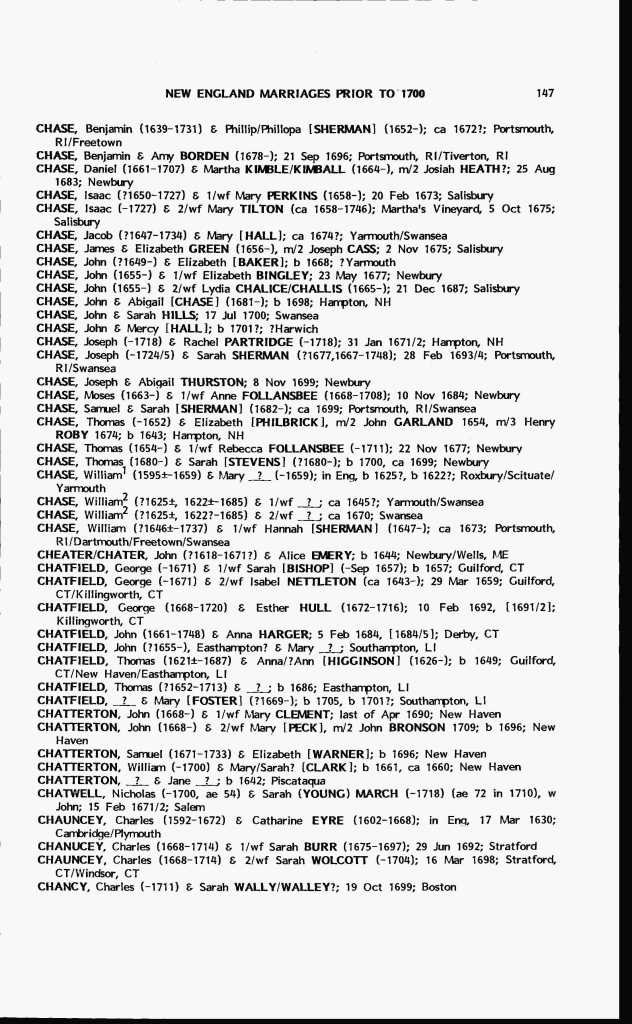
Wishful thinking is easy to find in the Ancestry databases, and there are a number of people who have linked our ancestor Captain Thomas Chatfield II with the Mary Foster descended from Richard Warren, in their family trees. The link begins to look suspicious, however, when nobody seems to have any supporting documentation for this marriage. There is documentation for Chatfield’s marriage to a woman with this name, but she was someone who was born and died on Long Island, whereas the Mayflower descendant Mary Foster was born and died in Massachusetts. It becomes clear that they were two people of the same generation with the same name. (A third Mary Foster seems to have been a victim of the Salem Witch Trials.)
 Bridging the Silences