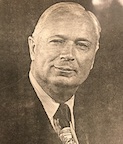
 Grandfather Joe Sandford was President of the Pomona Commercial and Savings Bank from 1924 until his retirement. He approached his life and work with strong ethics learned from his parents, Edward and Annie, and his in-laws, Henry and Mattie Swan. Several of his favorite stories were proudly told and retold during his Living History interviews in the 1970s, in which interviewers were naturally curious about being a banker during the Great Depression. The following quotes and stories speak for themselves.
Interviewer: You were able to weather those times, the depression?
Joe: We came through wonderfully, you might say had no problems…we were small, everything was small in those days. This inflation you see, with current prices got out of hand. We were awfully lucky, we paid dividends all during that time. And then, being small we could do certain things that the big ones couldn’t do. Their problems were colossal, a great hurricane going on with many of these things coming in…and they were scared to death, many of them went broke as a matter of fact.
Joe Sandford from 1974 Living History Interview conducted by the Upland Public Library
It’s been a happy life. I could tell you stories that would make you cry about things we did as bankers. I’ll tell you just one story. I was president of the bank in Pomona during the terrible Depression of ’29, ’30 and so forth. A small bank. Everything was small then. Didn’t have as many dollars. I was all for trying to help others, because they were going through a terrible time. You’ve read about how freight trains were covered with people. Everybody was broke. One day a man came into the bank and introduced himself. I had him come into my office. He said, “Mr. Sandford, I’ve been vice-president of Richfield Oil Company, $25,000 a year.” That was a lot in those days. He says, “I’m fired. We had a nice home over in the Altadena district. I had a loan on that. The bank foreclosed, and took that away from me. The only thing my wife and I have left is the little home that was her folks’ home here in Pomona. Your bank has a loan on it. We can’t even pay the interest on it. We can’t pay the taxes. Are you going to take it?”
I said, “No, our loan doesn’t amount to anything. Let me find out more about you, let’s get you back to work.” He was a man about 55. He had his degree in geology, in oil and so forth. At that time, the schools were all advocating, “Take care of the graduates, let the older fellows sweat.” Well, that’s a pretty hard philosophy. When a young fellow comes out of school, he has book knowledge, but he’s never applied it.
I said, “Now, look here, you’ve got these degrees, you’ve had experience. Let’s get you back on the job.”
I said, “Does your wife, can she work? He said she’s never had to work, she used to be a secretary.” I said, “Can’t we get her a job first, so you can eat?” He cried, right there in my office. Cried.
He said, “The city bankers have no sympathy. They just took my property, everything I had, and told me to get out.” But we were lucky. He was a stranger to me, but I had time. I took a personal interest in him. We got his wife a job. It wasn’t long we got him back on his feet.
Two tellings edited together: (1) Joe Sandford from 1973 Living History Interview with Esther Boulton Black and (2) Joe Sandford from 1974 Living History Interview conducted by the Upland Public Library
Another story I love to tell. A man in town, a very kind man, came over one day. I knew him, and I could see he had a problem. I was busy or something. “Sit down, I’ll get to you pretty quick.” When I got through I called him over and he came and sat down and I said, “What’s going on, Charley?” He was Charlie Rankin. “Well, the president of the bank over at Ontario is going to take my business.” He had a little manufacturing company out here. “I can’t pay the interest, I can’t pay the taxes.” I said, “Charley, you don’t mean to say that he’s going to foreclose?” “Yes.”
I said, “Can you sell your Edison stock?”, because everybody had a little. He said, “I had to sell that a long time ago.”
“Well, Charley, you have a trust deed on your house?” “Yes, he’s going to foreclose.” I was trying to find–he was a kind man.
Finally I said, do you happen to have any life insurance? He said, well yeah, I’ve got $10,000 policy, New York Life. I said, “well where’s that policy, have you borrowed against it?” He said, “Borrowed? Is there a loan value?” I said, “I don’t know, where’s that policy?” He said, “well it’s down at that bank.”
I said Charlie, you go down and get that policy, but don’t let that banker see you. (laughing) He did. There was a $700 loan value. The other fellow had overlooked it. He said, “Good Lord.” This was the last…things were beginning to…the end. He borrowed that $700 and it put him on his feet. It saved his industry, it saved his home. Didn’t mean a thing to me. I knew the man. He was active in scouting here. I could do that.
But they were scared to death–it was a terrible period. Those are very personal things. It was fun. We came through our little bank fine. Paid dividends all the time. We didn’t have any runs here.
Two tellings edited together: (1) Joe Sandford from 1973 Living History Interview with Esther Boulton Black and (2) Joe Sandford from 1974 Living History Interview conducted by the Upland Public Library
Little things, taking an interest in others.
I could go on and tell about another boy here that I helped out that went clear to the top of the barrel. Things you’re doing every day–you fellows have all done it. This young man was a teller in the then—Citizens’ Bank here. He was keeping company with Gladys Gardner, a nice girl, a friend of Margaret’s. Margaret came home one day and said, “Joe, they want to get married, but they can’t afford to. He doesn’t get much for working at the bank.” I said, “Well, let’s find out what he’d like to do.” Come to find out, he wanted to learn the securities business. I said, “Well, that’s easy; we can fix that up.” So I gave him an introduction to John Burbaugh, the head of the bond department of the Citizens’ Bank of Los Angeles. That man went clear to the top of the National City Co. in New York, which was one of the biggest at that time, and after he’d been there a number of years, he resigned. He came back, and he called on Andrew Chaffey. Andrew Chaffey was on the board of the University of Southern California. He told Mr. Chaffey of his experience, and he said, “I wonder if the University wouldn’t like to have me take over their endowment portfolio.” Mr. Chaffey laughed. He said, “Well, we don’t have much in the way of investments other than land, but give me a summary of your experience, leave it with me.” He did. Mr. Chaffey called him up in a couple of weeks and he became the head of the bond department of the Western Bank Corp., that’s UCB and banks all over the West. He’s retired, living in Los Angeles today.
In other words, little things that way you do to help others, it pays off in the long run.
Joe Sandford from 1976 Living History Interview with Bryce Denton
 Bridging the Silences