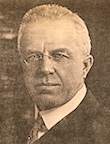
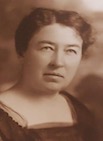
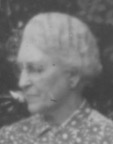
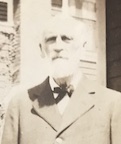
 By early summer 1919, grandfather Joe Sandford had safely returned to his home in Ontario, California from the war in France .
The Sandford and the Swan families had known of each other since 1910 when the Sandfords moved to Ontario and Henry Swan gave Joe a job in his Ontario bank to save him the daily bicycle ride to the Chino bank.
Joe and (grandmother) Margaret Swan had been friends before the war, but no serious relationship formed at the time. Margaret was attending school at the University of California at Berkeley, so the two may just not yet have had much time together. Joe tells of his early encounters with Margaret, both before and after the war, in his Living History interviews.
I had kept company with Margaret a little, before we went to war. She was going to the university, but I didn’t think she had any interest in me. I went away to war, and I was supposed to go up to the university for a course, in the Ordnance Department. Her mother [Mabel Swan] told me she was up there, and I guess she wrote to her and told her I was coming up. Anyway, I got a change in orders and went to Augusta, Georgia. I was overseas for over a year. I returned home in 1919, in June. The next day after I returned home, I had my hobnailed boots <unclear> They put on a great <unclear> for the boys who won the world for democracy. Most of the boys were home. I was perhaps a little later than some. Everybody in the race went down Euclid Ave.
Interviewer: What kind of a race?
An automobile race. The old White Steamer, a little Buick, little cars. I’ve forgotten just where it started. Say it started at Chaffey: I could be wrong there. It went down Euclid Ave. to what’s Holt Ave. now, went west on Holt Ave. to Mountain Ave., which is a mile, up Mountain Ave. to Sixth or Seventh Street and across to Euclid and down. It made quite a place to race. People were everywhere. The town spirit. I was up in front of Chaffey there, with a lot of people.
This girl here [Margaret], Mr. Richardson’s daughter [Ardis] and her pals were there talking. She left that bunch and came over and walked me home. Well, that started things, and here we are.
Joe Sandford from 1973 Living History Interview with Esther Boulton Black
Mabel Swan having tried to set Joe and Margaret up to meet in Berkeley in the spring of 1918 suggests that perhaps there had already been at least a little speculation of Margaret’s interest in Joe going on between mother and daughter.
Joe began writing a diary in 1922, found later by cousin Robert in the crevices of grandpa’s roll-top desk. The first page of the diary has Joe’s terse, rough recollections of the period of their engagement two years earlier…
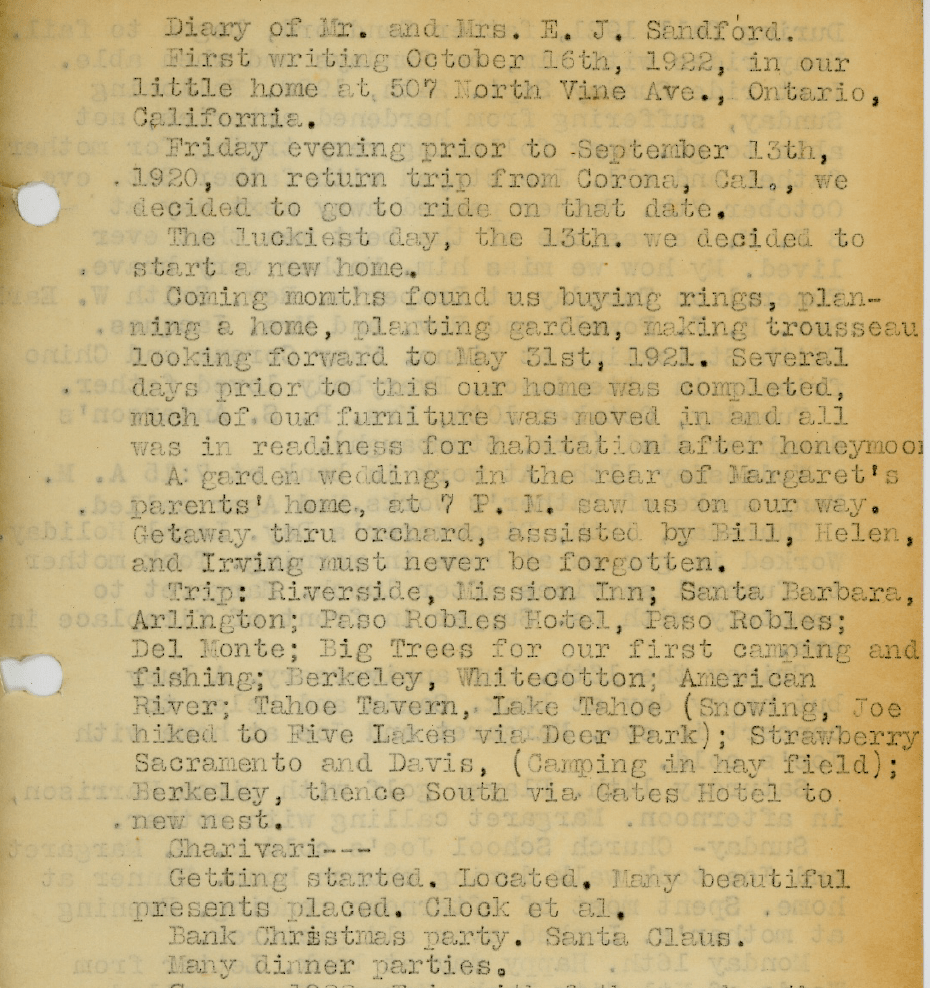
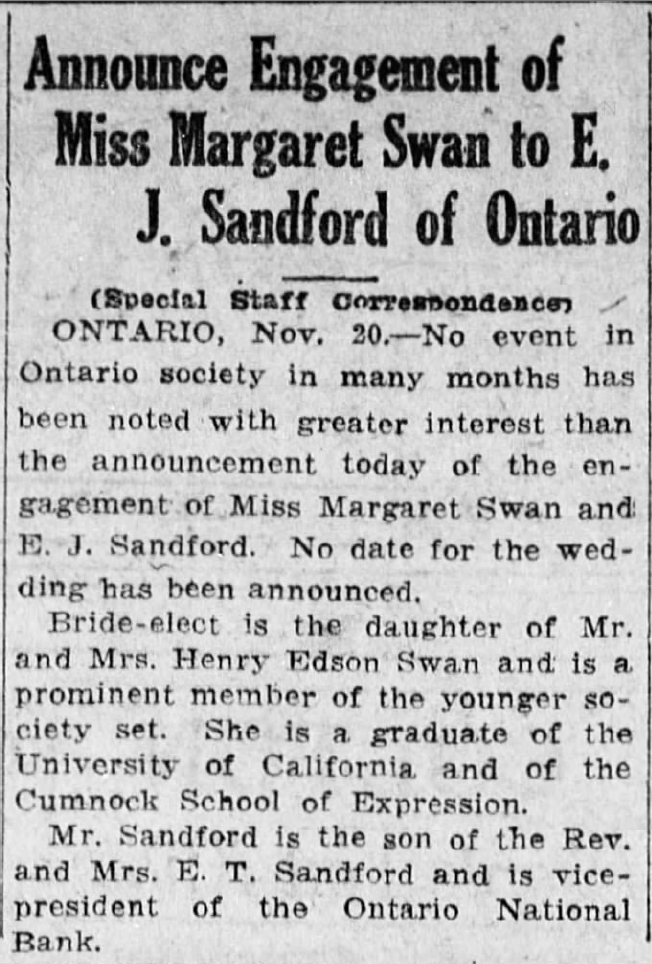
Although not completely clear from Joe’s notes, September 13, 1920 is evidently significant and seems to be the date of their engagement. This is consistent with the November 20 date of the public announcement of the engagement, a year and a half after Joe’s return from the war.
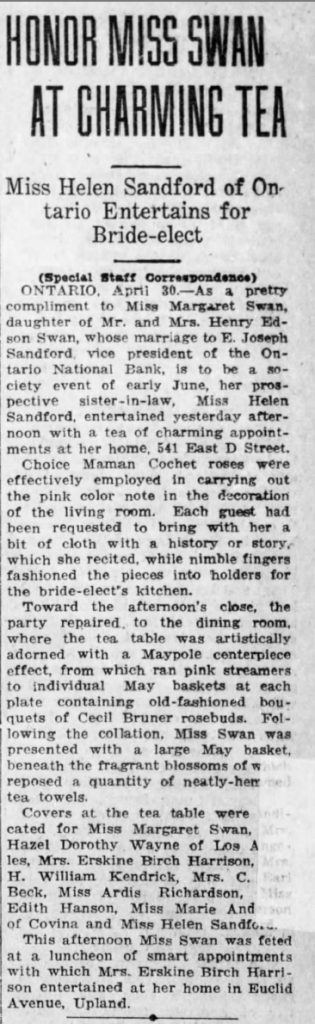
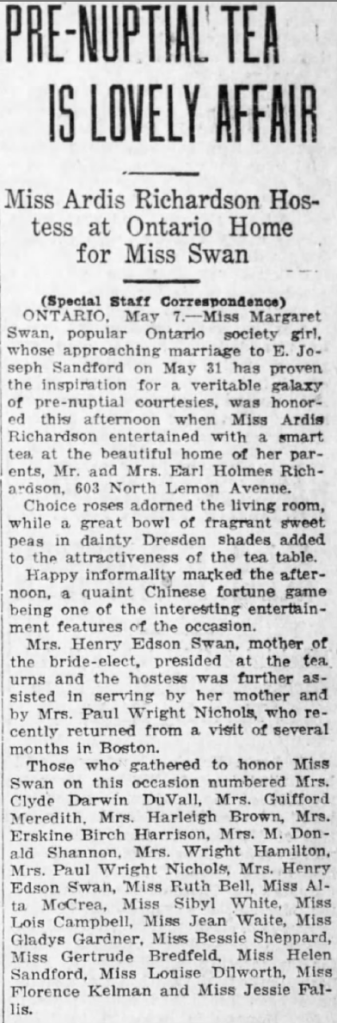
By the spring of 1921, the celebrations of the upcoming wedding were in full swing. Several parties were held for the bride-to-be…
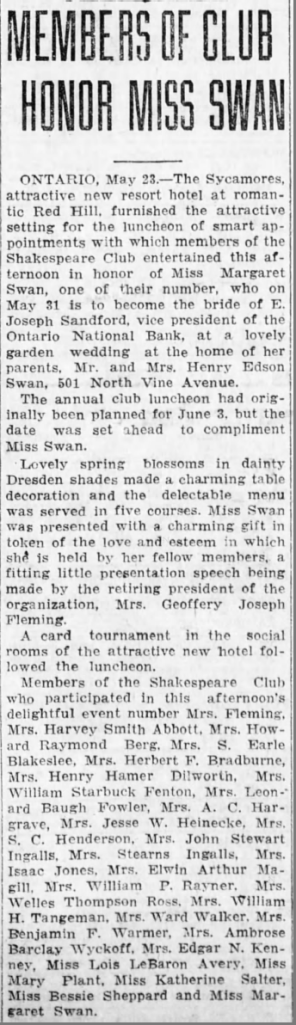
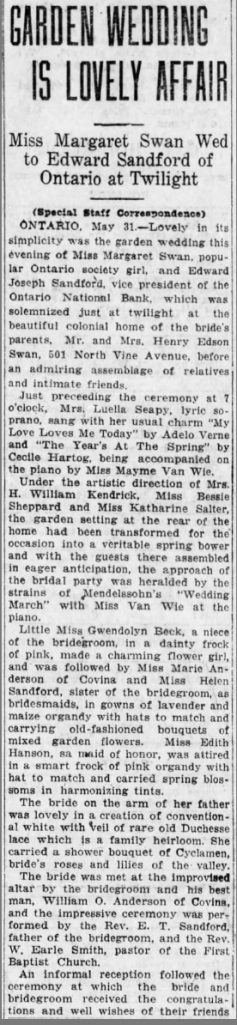
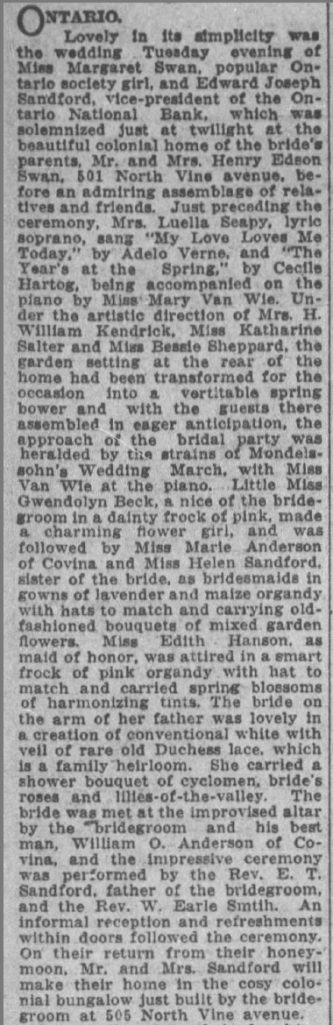
Joe and Margaret were married Tuesday May 31, 1921. The ceremony was held behind the 501 N. Vine Avenue home of Margaret’s parents, Henry and Mabel Swan. Joe’s father, the Reverend Edward Sandford, co-officiated at the ceremony.
Between Joe and Margaret there remained only one living ancestor of their grandparents’ generation at the time of the wedding. Elizabeth Smith Calderwood, Annie’s mother, had lived with Edward and Annie’s family since the family left Vermont, most recently at the house on East D Street. She would die on August 3, 1921, at age 95, two months after the wedding.
I don’t have proof that the other minister that presided over the wedding, the W. Earle Smith named in the news articles, was related to Elizabeth, but it seems quite possible and it would explain the presence of two ministers at the wedding. In Ontario’s Bellevue Cemetery near the family plots there is a marker for Frank P. Smith, 1852-1922. It may be that Frank was Elizabeth’s brother and Reverend Earle was Fran’s son, therefore Annie’s cousin. If so, then Frank would be the founder of another family branch to make roots in California, and would lead to another round of speculation on who followed who there (for example, perhaps the Smiths played a role in leading Edward and Annie to their retirement in Ontario). This will be something to try to prove in the future, although “Smith” is a difficult name to research.
Joe and Margaret’s honeymoon trip up and down California is described in the diary entry. It is interesting to note the low-key nature of both the wedding (held in the back yard) and the honeymoon (which included camping and hiking). We begin to see the transition of Margaret the high-society girl, to Margaret the more down-to earth grandmother that we knew. There was similar change in Joe’s life, as well–in his case, he transitioned from the simple son of a Baptist minister to a prosperous and successful banker. The two seemed to meet happily in the middle of the two worlds.
Once married, Joe and Margaret moved into the new house next door to the Swans at 505 North Vine Ave, which we later knew as the “Finsterbach house”. It is unclear whether the home was built specifically for them as implied in the newspaper articles–if so, it would have had to have been built very quickly following the announcement of the engagement six months earlier.
Concluding this chapter, we recall the story of Joe saving Mr. Bucknell and Saul Wurtzel, the head of Fox Films Corp, $20,000 dollars by traveling by streetcar into Los Angeles to give notice on a higher offer on their Hollywood property, and Bucknell’s subsequent expression of gratitude in the form of the Seth Thomas clock as a wedding present.
Margaret and I were to be married in this place here, in 1921, in this house on the hill. It belonged to her father and mother. They were living here then. We had built the little place next door. Anyway, that day, long about eleven o’clock in the morning, as I remember, Mr. Bucknell came up here with that grandfather clock. That cost a lot of money. That was our wedding present. A little thing, and that was so far-reaching.
Joe Sandford from 1973 Living History Interview with Esther Boulton Black
 Bridging the Silences
4 thoughts on “The Sandford and Swan Families Unite in Ontario”