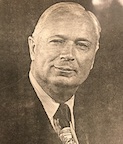
 In 1911, his parents retired, our grandfather Joe Sandford was 18 years old and entering young adulthood with a promising career and social life.
After a brief time working in the Ontario California bank of his future father-in-law Henry Swan, Joe went to work for George McCrea who had come to California from North Dakota to start the Ontario National Bank. George hired Joe, who helped him with the startup and became one of the bank’s first cashiers. Joe would work for George for most of the next 13 years, working his way up to the level of Vice President of the bank.
George McCrea would prove to be an important influence on Joe’s life over this time period. We will see that he comes up at several very significant times.
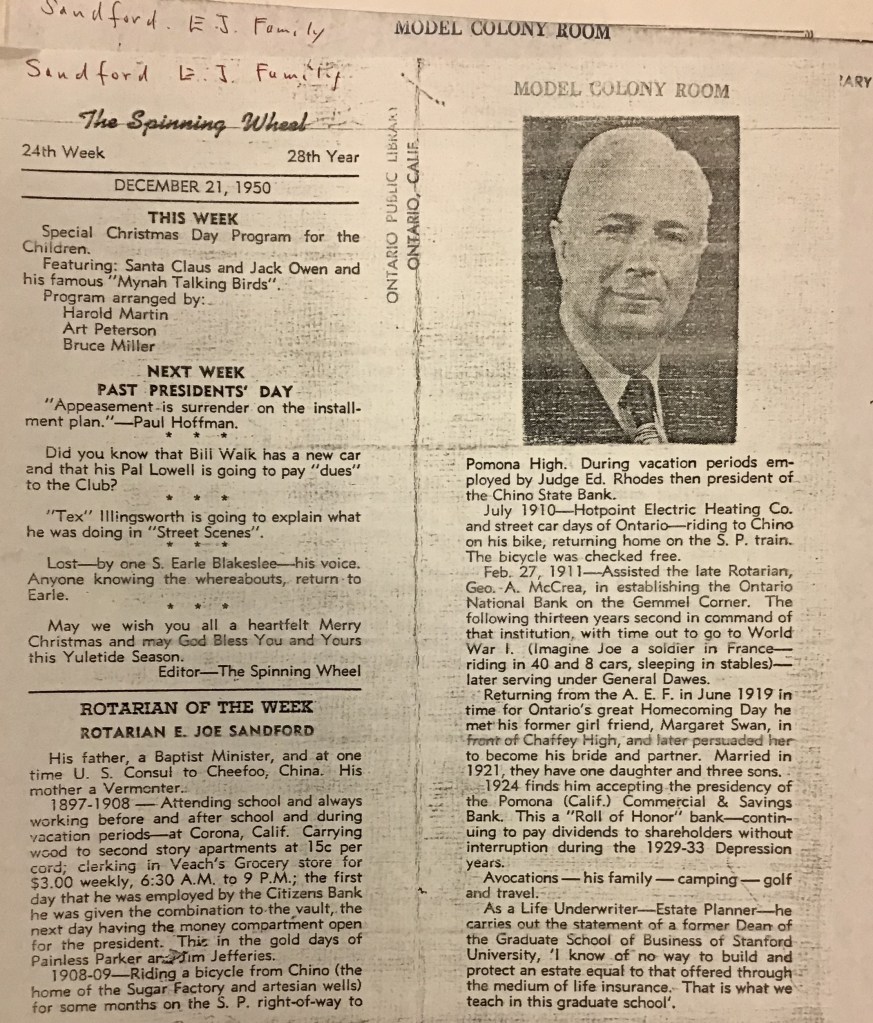
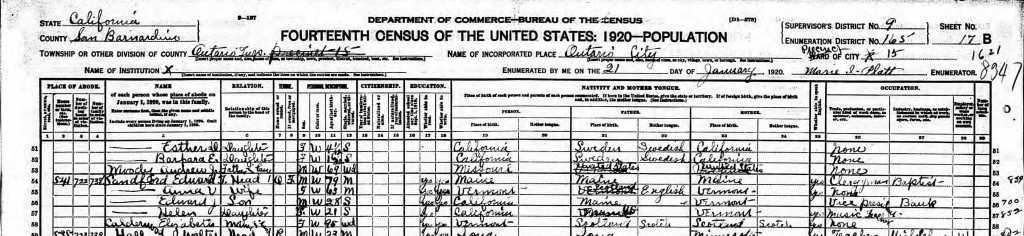
Joe had an established career and independent life, but he remained close to his sizable extended family. The 1920 U.S. Census shows that Joe and his sister Helen remained living at home at 541 East D Street through the 1910s. Joe’s grandmother Elizabeth Calderwood also lived with the family. Joe’s older sister Saada married Earl Beck in 1915 and lived two blocks away at 517 East Nocta Street. By 1920 Saada and Earl had two young children, Earl and Gwen.
Joe continues to be the best source of information about his own life, through the stories he left in his living history interviews…
The young people of the community…we had good times. We used to hike in the mountains, groups of us. A little story that Margaret loves to hear, this was before we were engaged. Me a young man, showing what young people did in those days. A little later on, at this period of the year, maybe four of us or six of us, after a rain, would start here, leave Saturday afternoon or a holiday, and we would hike through the orange groves to Pomona. We’d arrive in Pomona, maybe at 5:30…and there was a very nice cafeteria, just off from about Second and Main there. We could go down and have a lovely dinner for twenty five cents at the cafeteria. Probably at seven o’clock we’d be through, and we’d go over to the picture show…ten cents, maybe, fifteen cents. And in those days you just had one subject, one picture. And about nine o’clock that would be over…of course the pictures were accompanied by a pianist, or something. At nine o’clock we would leave the theater and hustle up to the Union Pacific Railroad…it was called the Salt Lake in those days…and there was a train came through there, going to Chicago, at 9:20. And we’d get on that overland train and ride over here for twenty cents. But we’d had a lot… following the rain, everything was lovely, perhaps the trees were in bloom, the orange blossoms…a supper over there, the picture show, and then the ride back on this trans-continental train.
I remember one night, we were a little late getting there to the depot, and we didn’t have time to buy our tickets. If you paid the conductor on board you had to pay extra. Well that didn’t seem fair, and so we paid under protest. And me a young banker…when I got back the next morning at the bank I wrote a letter to the railroad…and I said I didn’t think that was fair and I recounted the experience. (Laughing) In a few days the traveling passenger agent from Riverside had received a letter. He came over and said Mr Sandford you’re right, but he says the law forbids us to return that overage to you. He said if you should happen to find some money on the counter after I’ve gone you just keep it…(laughing)…I can’t return it. Well, a little experience…
Joe Sandford from 1974 Living History Interview conducted by the Upland Public Library
Joe knew everybody and everybody knew Joe. He was respected throughout the community. He applied his go-getter attitude equally to his work life and social life…
Another thing that has to do with today and the problems we’ve had with younger people…and I was young. I belonged to the Baptist Church over here…and in those early days there was no Baptist Church in Upland, there was no Congregational Church in Upland. There was a Christian Church here, a Baptist Church here, a Methodist Church here, and the members of those churches from Upland came down and were a part of the Ontario congregation, and so forth. Well anyway, I wasn’t too interested in the girls in the Baptist Church. I was very active…meetings, singing, and those things in the church. And I conceived the idea of forming a local organization of the young peoples’ societies of all the churches in the community, and I did, I was president of it. And so the Epworth League from the Methodist, the Christian Endeavors from the Congregational, and the other churches we all came together and once a month we had a union young people’s service, and it went over big. And then probably twice a year we’d have a big social and good times, wonderful times and that way you met everybody. In 1916 we had a very heavy rain here, and Euclid Avenue was all plowed-up, before that it had been dirt and later macadam and so forth and they were getting ready to surface it..
Interviewer (reacting to the pinpointing of the time Euclid Avenue was paved): …oh for heavens…
The rain was terrible and it washed gutters. There were two places you could cross from this side of town to the other. One was up at fourth street, the High School. Another was down at what’s Holt Avenue today. So that night in 1916, the night of the social, the night it was raining. So there weren’t too many there but we had a good social and a good time under those conditions. I just touch on it because it had to do with the early day history, and so forth.
Interviewer: That’s very interesting, what people did.
Joe Sandford from 1974 Living History Interview conducted by the Upland Public Library
The comment about being less interested in the girls in the Baptist Church speaks to a trend in Joe’s young life. Although he lived at home and remained very close to his parents throughout their years, and although he carried his parents’ ethics with him throughout his life, he deliberately followed a different path in life than his parents had. He lived a much less spartan life than his parents. Similar patterns emerged in the lives of Joe’s sisters. There is no evidence that Edward and Annie did anything to discourage this.
Joe had an encyclopedic knowledge of Ontario history (the reason he was in such demand for the Living History projects), including this example…
Something that you might like to know, too. You probably have noticed the rock piles in Upland in the groves.
Interviewer: …yes…
Way back there somewhere probably in 1916, 1917, a group of Hindus came in, that had those turbans, and so forth….might have been 25 or 30 of those Hindus. They all came into the bank that I was vice president of, probably at that time… the Ontario National. Probably 25 or 30 came in, and they all had cash, and they wanted to open accounts. They couldn’t…their name was Singh, perhaps another surname…it didn’t mean anything to us (laughing) they all looked alike to us. But we opened accounts for them all and the only way we could do was to take a thumbprint, and then we’d write something on their card trying to identify them, and so forth. And those men moved into Upland. And they accumulated the rocks from the groves and piled them up, as you’ve seen there. They were here for quite a while. There were little problems because they came from a different country, their lives were different from ours. But they were here for some time. The day came when it seemed best for them to move…and when they moved, they moved. And so they all came into the bank again (laughing), they all wanted their money. Which was some kind of a problem to make sure…we gave the money…and they all wanted money, they didn’t want anything else. But that was a little bit of history that was very interesting.
Interviewer: Yes that is, I hadn’t known that the Hindus did that…
Joe Sandford from 1974 Living History Interview conducted by the Upland Public Library
In reading this story, it may be helpful to keep in mind that Joe’s father had been to Asia twice and lived there for several years. At the time of telling these stories, Joe himself had traveled extensively in Europe and Asia. Despite occasional phrasings that may seem politically incorrect by 21st century standards, he was quite enlightened about cultural differences in the world. I think the fact that they went the extra mile to welcome these men as customers in their bank, at a time when they surely encountered discrimination elsewhere in the community, speaks well to Joe’s inherited ethics and self-made business sense.
In one instance, Joe reveals a personal story. Margaret is sitting there as he tells the story, so she must have heard it many times before…
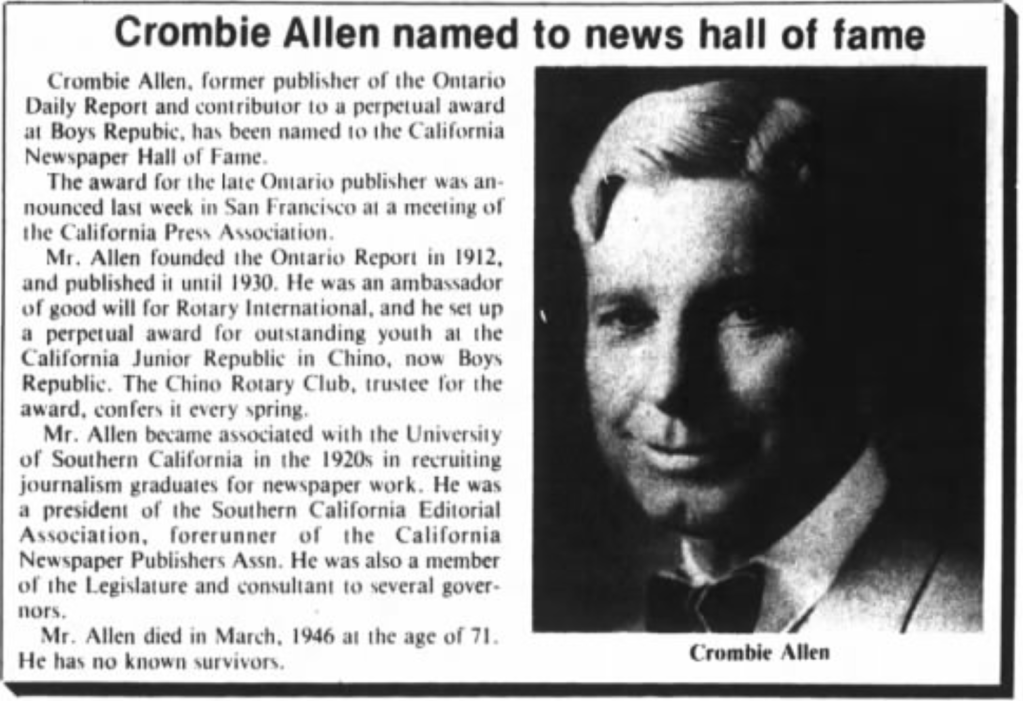
Another thing that’s very personal–you may want to sue me for this. Archie, do you remember Crombie Allen, and Harold Allen, the brothers that used to own the paper here? Wonderful men. They seemed to respect me, and I loved them. Crombie Allen had a lovely wife, then his father and mother lived on Euclid Ave., about F St. One day the mother, dressed like Mrs. Farrell with the long dress and little lace collar, came into the bank. “Joe, we want you to wait for Jane.” In other words, they wanted me to marry Crombie Allen’s only daughter Jane. She wasn’t ready to get married, but that was a compliment. Crombie Allen, as long as he lived, had implicit confidence in me and I in him. He had one of the first televisions and radios and all those things, too.
Joe Sandford from 1976 Living History Interview with Bryce Denton
The Mrs. Farrell reference must have to do with the movies. The life of Crombie Allen (who looks a little like Stilwell in A League of Their Own) is summarized in his 1946 obituary. Apparently Jane did not survive him.
One more amusing story from Joe’s young life makes me wonder what his parents would have thought as he came into the house at 1:30am.
One thing happened one night with the Pacific Electric running to Pomona. You’ll all like the story. I used to keep company with one of the girls that was studying to be a nurse……I took her home about Christmas time probably about 11 o’clock, and I think the last car in Pomona came by there about 11:00 or 11:30, so I was there waiting for that last car. When they came in from Pomona, the motorman had his back to the front, and he was kidding with the conductor, and they went by that crossing fifty miles an hour. I walked home. If I’d had one of these fellows as my attorney, we’d have sued somebody, wouldn’t we? But that’s an actual fact.
Joe Sandford from 1976 Living History Interview with Bryce Denton
Nothing lasts forever. Joe’s carefree life and the world order were about to be interrupted by war, the subject of our next post.
 Bridging the Silences
3 thoughts on “Joe Sandford’s Young Adult Life”