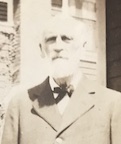
 Before we move on from great grandfather Edward Sandford’s time in Corona, California, there is a loose thread to deal with. Edward’s father, James Head Sandford (our grandfather’s grandfather) died on November 26, 1898 and is buried in Corona. From Edward’s story as we have told it so far, it is not clear that he has seen his father since the 1850s in Maine, so how did James come to rejoin his son in Corona, at the end of his life?
James Head Sandford (1814-1898) was married twice. His first wife, second great grandmother Dorothy Burton Sandford, died at 30 in 1947 after having twins Edward and James Jr. in 1840. James Jr. fought in the Civil War but we have no information about him after his 1864 enlistment in the Navy.
James (Sr.)’s second wife was Arabella Pierce. Their son George Dwight Sandford was born in 1850 in Topsham. George was the one that eventually moved to Long Beach to begin a second branch of the Sandford family living in Southern California, parallel to our branch.
The 1850 Census indicates that Edward went to live with his grandparents, Thomas and Lydia Burton, when his mother Dorothy died.
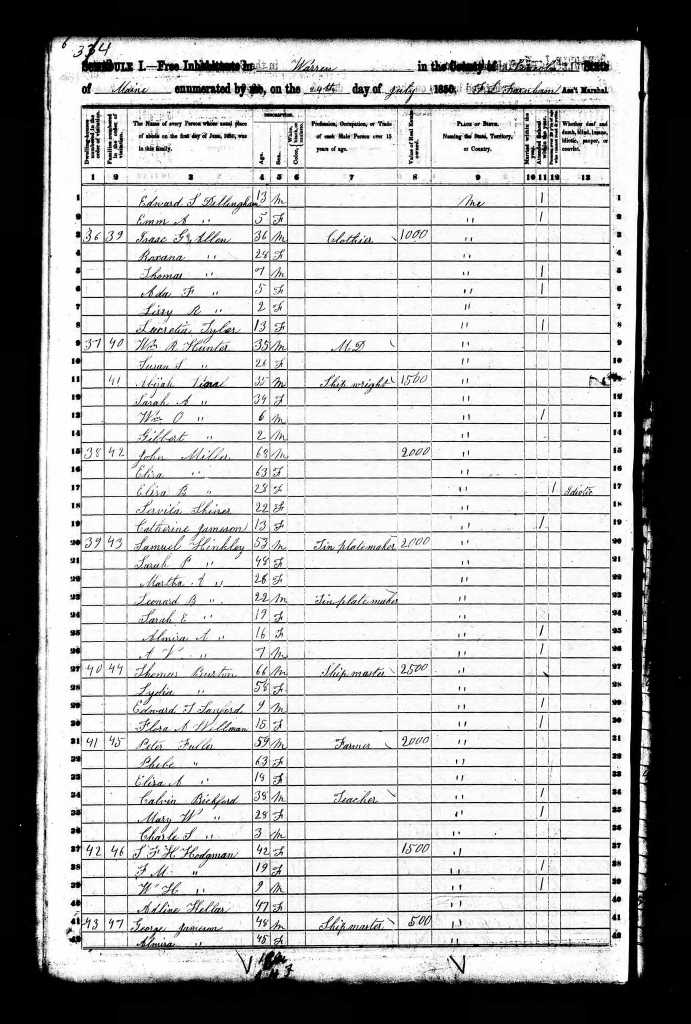
Another record of the 1850 Census which is not legibly printable shows that James Jr. remained with his father and new wife, Arabella. It seems that the twins were separated after the death of their mother, although the families may have lived in close proximity. Half brother George was born in 1850, not quite in time to be recorded by the 1850 Census.
By 1860, when Edward was already on his first trip to China aboard his uncle’s merchant ship, James (Sr.), Arabella, and 10 year old George had moved to Mazeppa Minnesota, in Wabasha County, 40 miles southeast of St. Paul, about 15 miles from the Mississippi River. (This has nothing to do with our Swan ancestors from Mankato, Minnesota, 60 miles to the west, except that that region at that time was an outpost of western migration because of its proximity to the Ohio and Mississippi Rivers.)
As we have seen in other towns of that era, a local history was published containing biographies of its prominent citizens. History of Wabasha County was compiled by Dr. L.H. Bunnell and published in Chicago by H.H. Hill, Publishers, in 1884. It was later republished by Higginson Books.
It contains biographies for father James Head Sandford and son (half brother to Edward) George D. Sandford.
Sandford, Jas. H., (page 968), retired farmer, was born in Topsham, Maine, August 14, 1814. He was kept at school until fifteen years of age, when, shortly after, his father died, when he went to sea, entering the foreign merchant trade. For about twenty-seven years his principal occupation was that of a sailor. Occasionally, however, he would stop at home for a time, and on these occasions he would make a trip or two in some coasting-vessel. He also made several trips into the western wilds in the employ of the fur traders. In 1856 he immigrated to Minnesota, and settled in the town of Mazeppa, where he pre-empted one hundred and sixty acres of land in section 29, on which he continued to reside up to 1882, when he rented his farm and removed into the village of Mazeppa. Mr. Sandford is full of amusing and interesting reminiscences of the early days.
He saw much of the Indians, as his place was near the Zumbro, which afforded fine camping-grounds for them, and who frequently called at his house for the purpose of begging. In those days he had to carry his supplies on his back some four miles, and the idea that the lazy Indians had the face to beg of him, when they knew how he had to pack his provisions, was too much for him, so he told his wife, in the hearing of several of them, that he would not give them anything more, whereupon they, seeming to understand, at once left.
Shaska, one of the Indians hung for the massacre of settlers, at New Ulm, came to his house one day and said he was sick so Mrs. Sandford offered him a bottling containing No. 6, composed of gum myrrh, brandy and capsicum, a very hot, powerful medicine; but Shaska would not take ti till Mrs. Sandford assured him by appearing to take some herself, where upon he raised the bottle to his mouth and gulped down a good dose, before he was aware of how hot it was; it was down, though, and he had to stand it; but his grimaces and antics were amusing for a few moments. It seems the Indian had faith in Mrs. Sandford’s ability as a doctor, for he repeated the dose for several days, till finally one day he came and said he was all right.
On one occasion in the winter, when Mr. Sandford was away, a lot of Indians called at his house to warm themselves, leaving their guns outside; finally, when they left, Mrs. Sandford went to the door with her son George, a small boy, when they suddenly drew up their guns and aimed at Mrs. Sandford, who, instead of darting into the house with fear, stood and laughed at them, believing they meant no harm, while her little boy thought it meant business, and was considerably alarmed.
Mr. Sandford is now in his decling years, enjoying the fruits of an industrious life as he justly deserves, being the owner of several farms; his means are ample. He has been twice married, and had two sons by his first marriage, one of whom is living. His second wife was Miss Arabella Pierce, of Bath, Maine, by whom he had one son, George, who is postmaster of Mazeppa.
History of Wabasha County, compiled by Dr. L.H. Bunnell, 1884
Sandford, George D., (page 994), merchant, is a son of J. H. Sandford, elsewhere mentioned in this work, and was born in Topsham, Maine, June 14, 1850. He was brought to Mazeppa with his father’s family in the fall of 1855, and has dwelt here ever since.
His life was passed on a farm till twenty-one years old, and his education was furnished by the common schools, of whose advantages he made the best use. His natural abilities and energies have made him a successful business man.
In 1871 he went to Lake City, where he spent three years in learning and following the wagonmaker’s trade. In 1874 he built a wagon-shop near the mill in Mazeppa, which he operated five years and then sold, the advent of the railroad spoiling the location. He has dealt considerable in real estate, and is now the owner of a farm near the village, which he rents.
On April 25, 1881, he was deputized as postmaster, and has kept the postoffice ever since. The following year he opened a stock of groceries and boots and shoes in the postoffice building, and does considerable trade in those commodities. He was elected town clerk in 1882, and is now fulfilling the duties of the same office.
He is a republican, and a member of the masonic order. He has been twice married, and was robbed of his first mate by death in July, 1875. Jennie Dickey was the lady’s name before her marriage to Mr. Sandford, which occurred October 22, 1874. On Christmas day, 1879, he was united in marriage with Miss Alice, daughter of J. B. Miller. They have a son, born December 5, 1880, and christened Frank Burnett.
History of Wabasha County, compiled by Dr. L.H. Bunnell, 1884
James Head owned land in Minnesota at least through 1885. In 1885 he was 70 and George was 35. It’s not clear if they moved to California at the same time, but the families must have left Minnesota some time after 1885. James (Sr.)’s second wife, Arabella, died in Mazeppa (year unknown), so she was not part of the westward expedition.
George first appears in Southern California on voter registration rolls in 1896, when he was 46 years old. Edward brought his family to Corona (from Santa Cruz) in 1897 or 1898. So he may have made the move partly on a recommendation from his half brother and/or his father. Recalling the quote from grandfather Joe Sandford…
… father they told us if we would move to Corona that we could have all the oranges we wanted…
Joe Sandford from 1974 Living History Interview conducted by the Upland Public Library
…perhaps is was James or George that put the orange trees into Edward’s mind.
Since James Sr. moved to Minnesota in 1856, about the time Edward was thinking of sailing to China on his uncle’s ship, it is possible that father and son were not reunited for 40 years, until Edward moved to Corona. A vacation to Minnesota from Vermont seems far fetched, and even stopping in Minnesota on his way west to would have been quite a detour for Edward in 1891-1892. Edward lived in Northern California for 5-6 years before coming to Corona, but a trip from Northern to Southern California during this time still would have been a major undertaking.
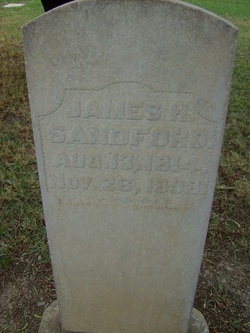
But the proof that Edward was finally reunited with his father a year or two before James’ death in Corona can be found in the Sunnyside Cemetery there.
 Bridging the Silences
One thought on “Father and Son Reunited in Corona”