 Danville is in central Pennsylvania on the north shore of the Susquehanna River, about 50 miles southwest of Scranton, 150 miles west of New York City.
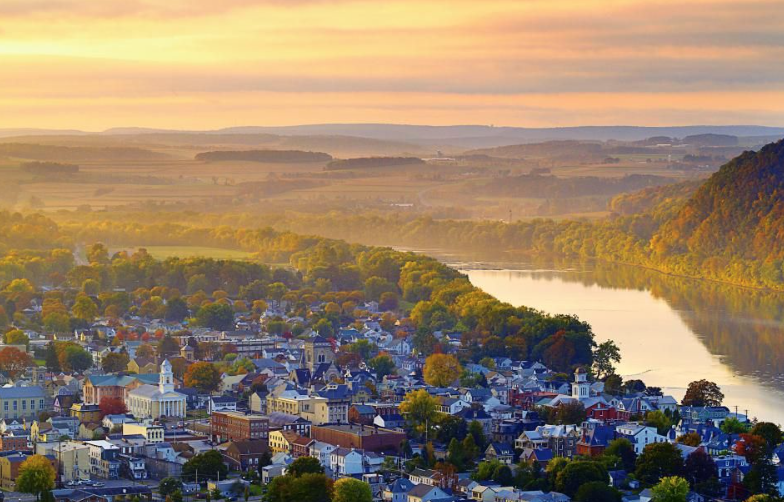
In 1768, the Treaty of Fort Stanwix ceded a swath of Iroquois land to the expanding British colonies. In 1774 William Montgomery–soon to be patriot, statesman, and Revolutionary War General–purchased a plot of land on the river and established a trading post called Montgomery’s Landing. In 1792 he constructed a stone house there, which remains today as a local museum. In the same year, his son Daniel plotted the central section of the town which now bears his name.
Danville became a transportation center in the 19th century, served by several railroads and the river. Coal and iron mines fueled the local economy, and by mid-century Danville was an important iron mill town. Many of the rails of the nation’s expanding railroad system were made in Danville. However, by the end of the century many of the region’s mines and mills fell into decline as they were replaced by the modern methods and materials of the steel industry as it developed further west in Pennsylvania.
In 1869, the Danville State Hospital was built as a state institution for the treatment and care of the mentally ill. Today Danville is known as the home of the first-rate Geisinger Medical Center, founded in 1915.
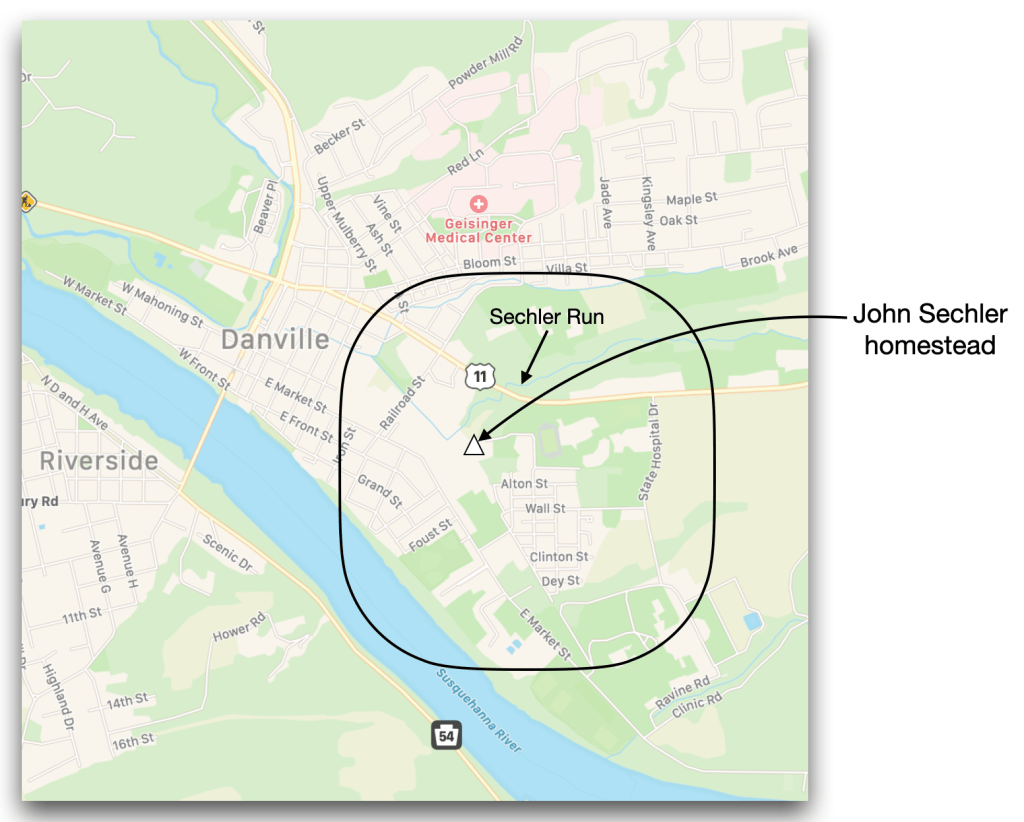
John, Jacob and Joseph Sechler, sons of immigrants Johannes and Anna Sechler, came to central Pennsylvania in the 1780s. We have already discussed fifth great uncle John’s contribution to the Revolutionary War during the winter of Valley Forge. In 1789, John purchased a large section of land just east of the what would become downtown Danville, and the Sechlers are sometimes recognized as the other family involved in establishing the town. The state hospital was later built on the east boundary of the Sechler property. Some of the Sechler land is only now being developed, providing a prime location for new schools, libraries, and other modern city services.
John Sechler’s homestead, built after the family had outgrown its original log cabin, still stands. A 2016 story in the Danville Morning News described its history.
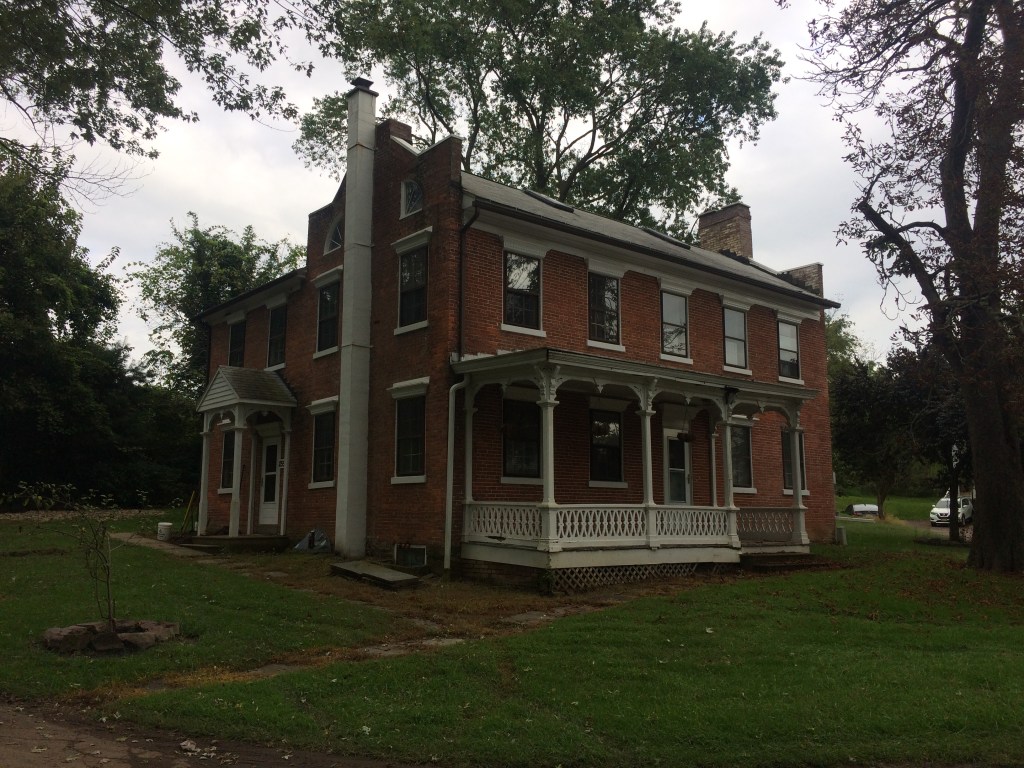
Other Danville designer’s home still stands
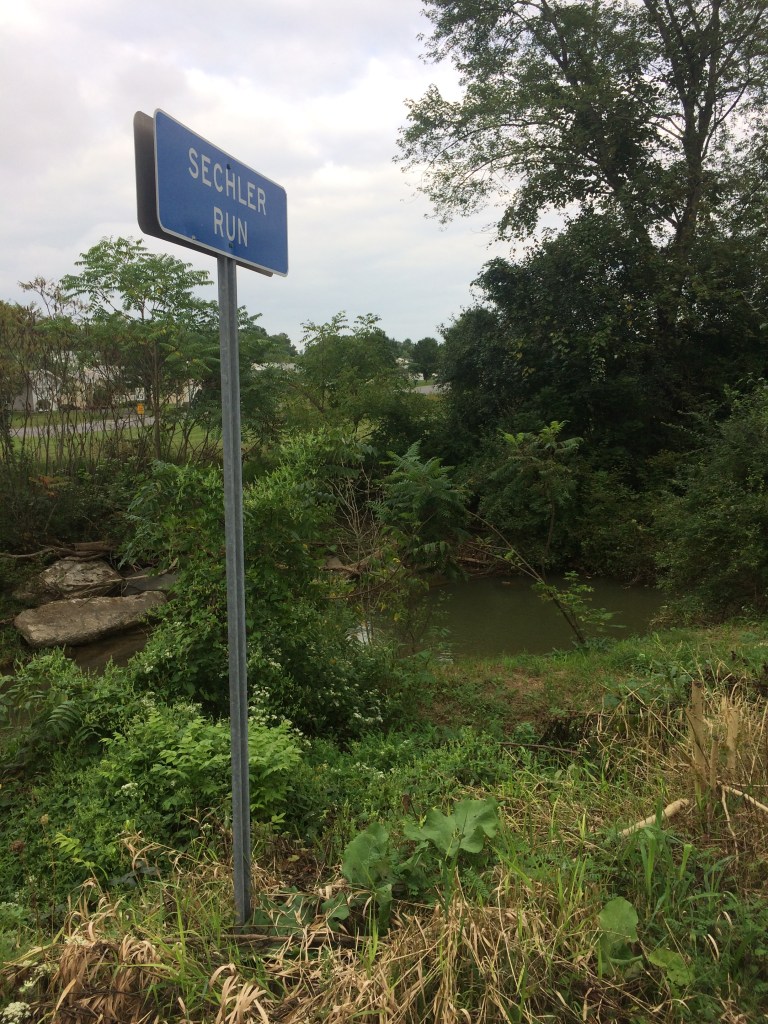
Everyone knows about William and Daniel Montgomery, Danville’s founders. Their stone home, built in 1792 around their original modest log cabin, is the oldest house in Danville and now hosts the Montgomery House Museum and the Montour County Historical Society. It is located at the corner of Bloom and Mill Streets. Few know as much about the Sechler House, however, built by the other family involved in laying out the town of Danville in the 1790s. Sechler Run passes nearby, through a wetland area.
John Sechler bought the land in 1789, but it is not known exactly when the present brick home was constructed. It seems likely that Sechler, too, began with a log home and then moved up before too long to the large brick structure that stands today.
Claire Lawrence and Michael Hardin bought the Sechler house in 1999, when they came to the area for Lawrence to begin work as an English professor at Bloomsburg University.
In the 1790s, Daniel Montgomery set up his part of town from Mahoning Creek to Church Street, spanning the strip of land between Montour Ridge and the Susquehanna River.
John Sechler’s territory began at Church Street and extended past the present Danville State Hospital grounds, bounded on the north by Bloom Road and on the south by the river.
The original property, settled by four Sechler brothers who arrived in Danville at the close of the Revolutionary War in the 1780s, was about 500 acres. Much of the land was wilderness when they started. John Sechler purchased one parcel of that land from John Lynn and his wife Mary, according to a 1789 deed. D.H.B. Brower’s “History of Danville” credits John Sechler as the person who laid out the part of town that lies above Church Street.
About John Sechler
John Sechler was an officer on George Washington’s staff and survived the famous winter at Valley Forge. His son Jacob, born in 1790, fought in the “Danville Blues” in the War of 1812. His brother Rudy, the second postmaster of Danville and later a Justice of the Peace, was famous for his honesty. Another of the Sechler sons, Abraham, organized the first band in Danville.
Their father John was primarily a farmer, and the Sechler barn was still standing in 2008, on an adjoining piece of woodland owned by the Danville School District, until it was taken down to make room for a practice field. The house, though, and the Sechler name live on in the historical record of early Danville.
Mary Bernath for The Danville News, May 4, 2016
Fifth great uncle Jacob Sechler and fourth great grandfather Joseph Sechler also purchased land near Danville. They bought land adjacent to each other, the exact location of which is unclear. Joseph’s 1784 deed provides a location bounded by something like “Towarndia” Creek–neither this nor any similar spellings appear on current maps. Based on various historical geographic descriptions, it seems likely that this is an original name for Sechler Run and that Jacob and Joseph’s properties were located east of John’s, south of the creek.
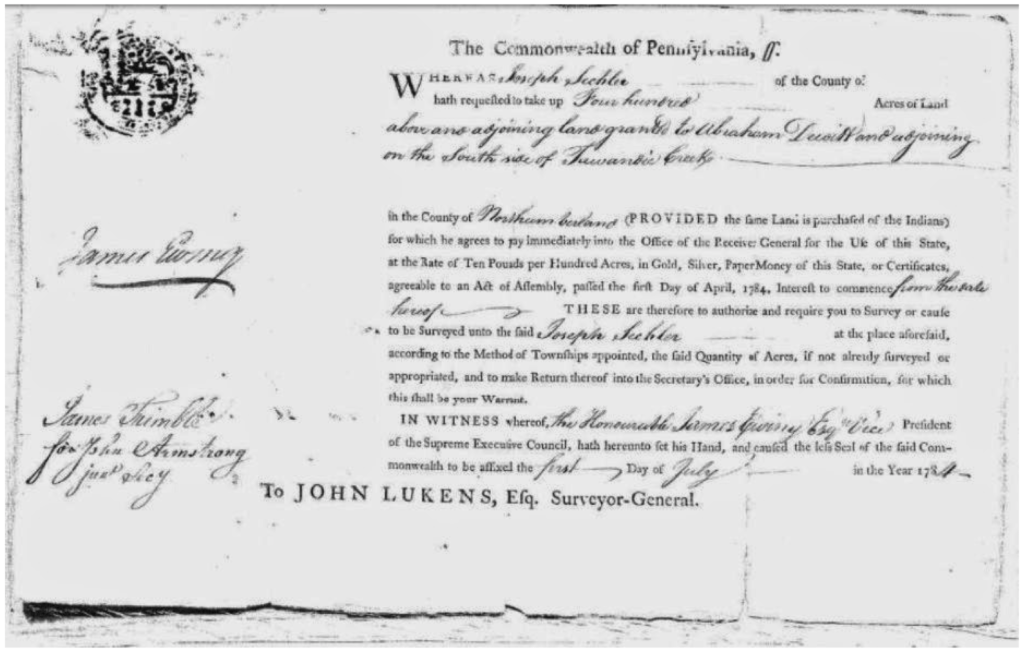
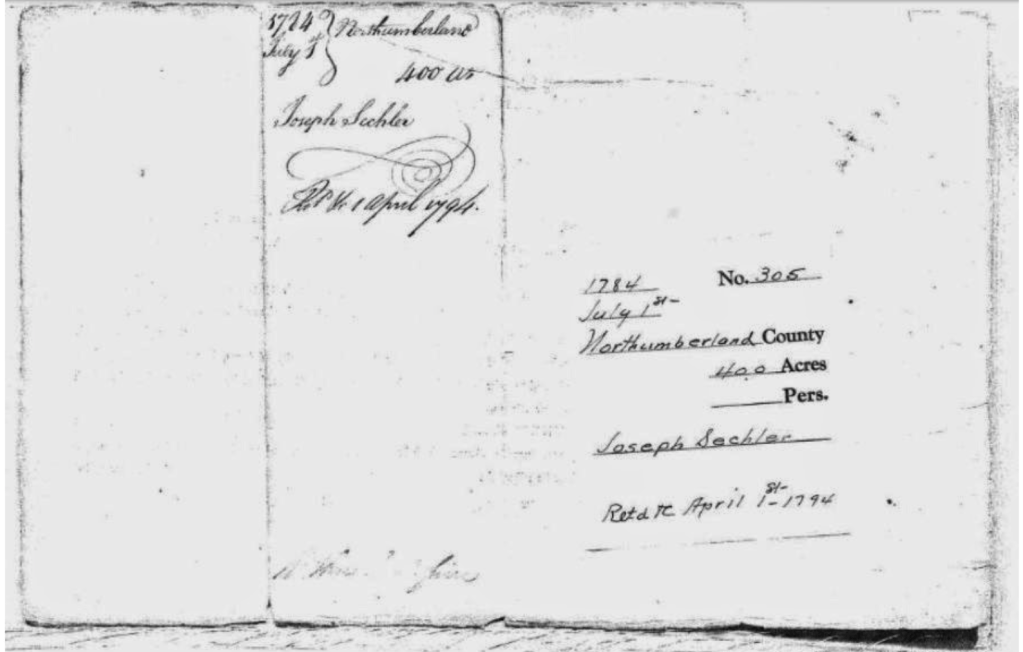
Of course it is the Joseph Sechler branch, our direct ancestral line, in which we are most interested. For this, there is a source in an obscure 1888 book, Portrait and Biographical Album of Stephenson County, Illinois. Stephenson County is the home of distant cousins who’s genealogy intersects ours. A profile of Reverend Joseph Sechler provides information we are looking for. Reverend Joseph was our third great uncle, a brother of our second great grandfather Aaron Sechler. Reverend Joseph’s ancestors are our ancestors, and the profile tells us about them.
To support the discussion which follows, here is a summary of the early Sechler family we have looked at so far. The names in blue are key to the discussion. The existence of the two Jacob Sechlers (uncle and nephew) and the two Joseph Sechler’s (grandfather and grandson) are sources of confusion with which the diagram is intended to help.
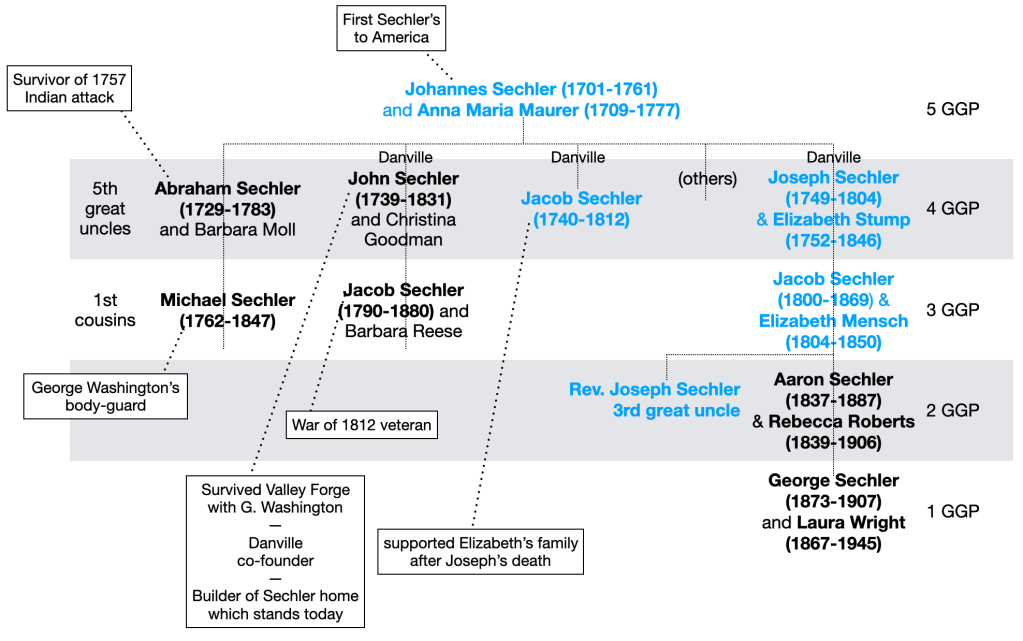
The profile of Reverend Joseph Sechler follows.
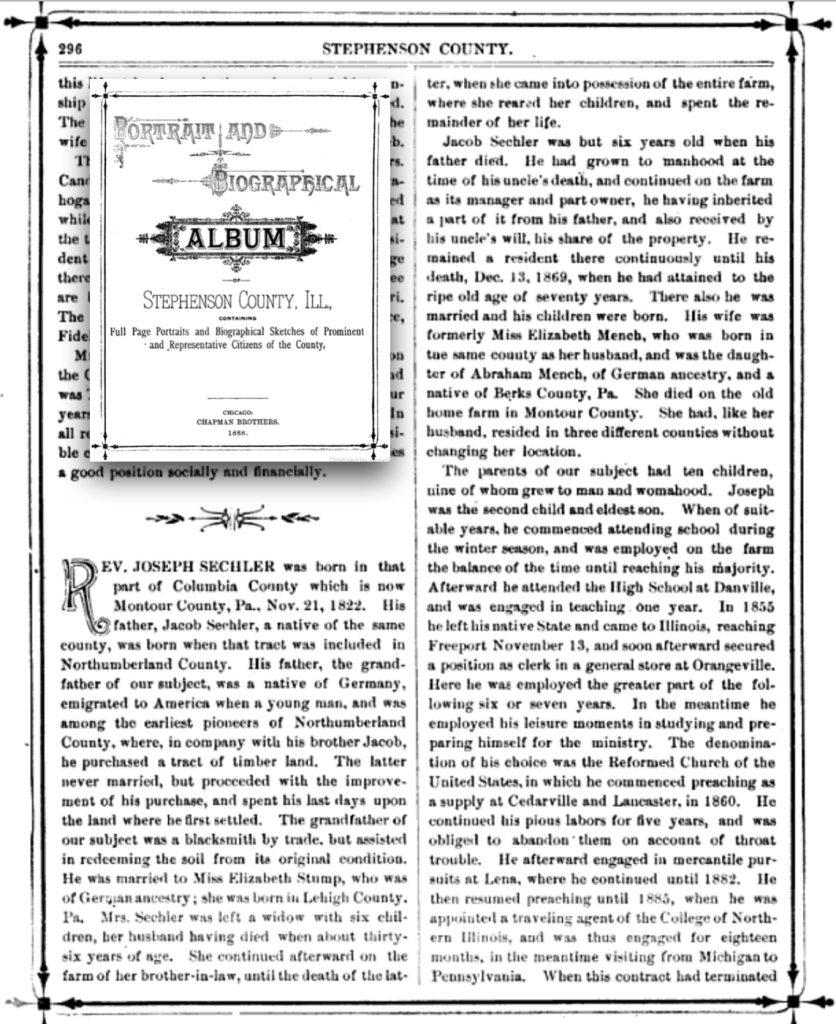
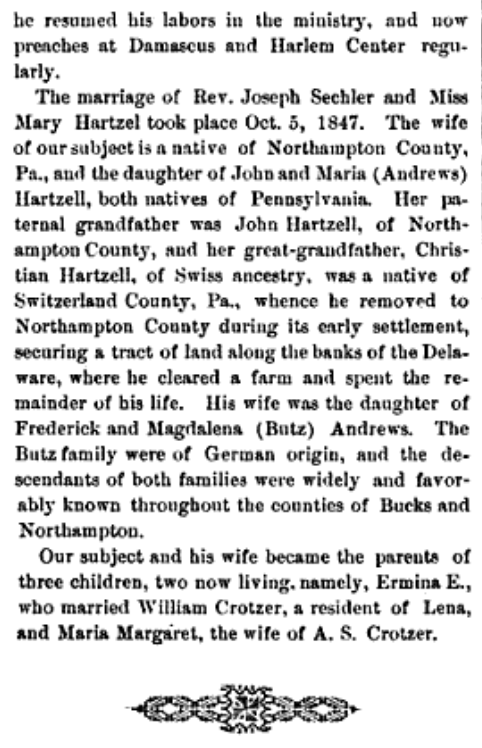
The note about changing counties three times without moving refers to the fact that Danville originated in Northumberland County which was later divided to form Columbia County which was later renamed to today’s Montour County.
There are a couple of problems with the Stephenson County account. Joseph Sechler was not a native of Germany, (his parents Johannes and Anna were). Also, most sources disagree with Joseph being 36 years old when he died–he was older, as evidenced by his name appearing in later tax rolls. But there is good agreement among sources of the rest of the timeline.
Despite these discrepancies, thanks to this account written by the descendants of Reverend Joseph Sechler, we know some things about our line of Sechler great grandparents. Our 4th great grandfather Joseph Sechler was married to Elizabeth Stump. He was a blacksmith. He and his brother Jacob bought land together. When Joseph died Elizabeth carried on, collaborating with Jacob to live on their adjoining lands. After Jacob’s death eight years later, Elizabeth took possession of the entire farm.
Our third great grandfather, the younger Jacob, lost his father when he was young, but his uncle Jacob continued to support Elizabeth and her family, perhaps serving as a surrogate father in some sense. The younger Jacob married our third great grandmother Elizabeth Mensch, the daughter of another fourth great grandfather, Abraham Mensch, a son of German immigrants. Jacob and Elizabeth had ten children including Reverend Joseph and our 2nd great grandfather Aaron Sechler, whose story will be continued in a future post.
 Bridging the Silences
3 thoughts on “Danville”