 Great grandfather James Louis Hynes immigrated from Newfoundland to Newburgh New York with his family sometime between 1890 and 1898 (ages 6-14). Four different United States Census reports give four different years for their arrival. 1895 (age 11) seems like the most credible number because that is the year recorded in the 1900 Census, the first record of the Hynes family in the U.S.
We previously traced our Hynes ancestors back to 4th great grandparents Richard and Ann Hynes, names found in information obtained from the Family History Society of Newfoundland and Labrador. Little is known about them, and when grandfather Gordon Hynes did his genealogical research in the 1950s, he came up with a different name of John Hynes from Manchester England, wife unknown. I have not been able to find the John Hynes from his research. In either case, our Hynes 4th great grandparents probably were the first Hynes’ to make the trip to Newfoundland from England. All sources agree on the identities of our third great grandparents William Hynes and Phoebe Wiseman and those who followed.
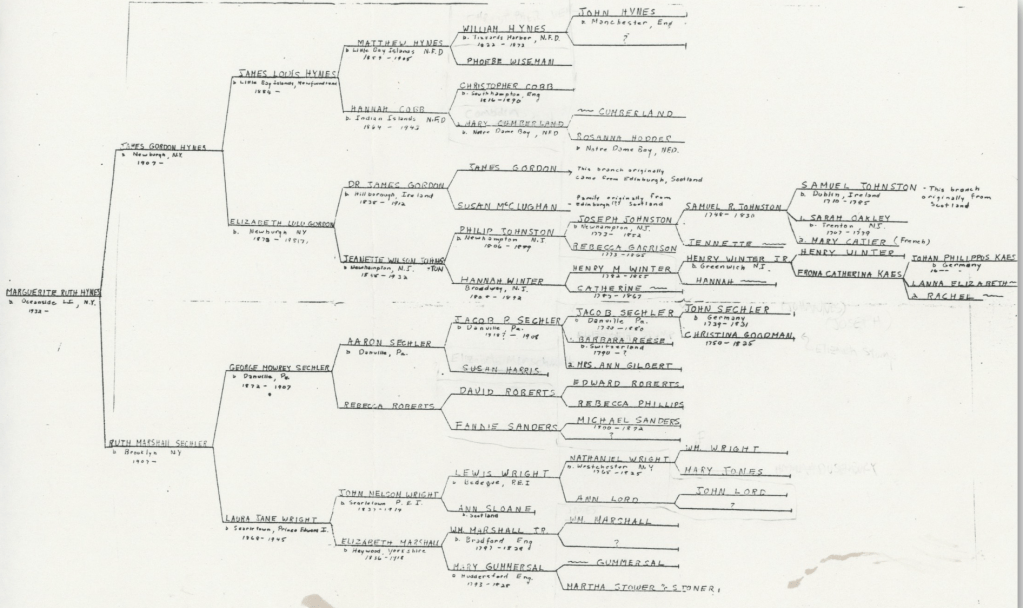
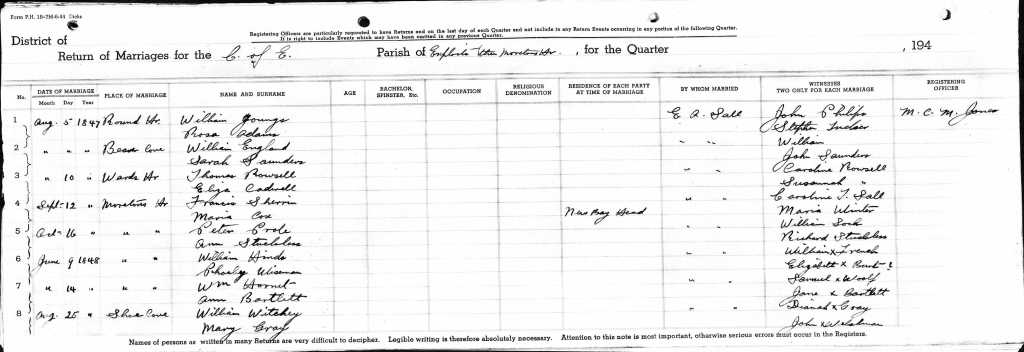
The research is complicated by the fact that there are multiple spellings of the family name, including Hynes, Hinds, Hines, Haynes and Haines. For example, several records of births of children of William and Phoebe Hynes use different spellings–for the same family a few years apart. I think it is fair to say that spelling was not among the highest priorities of life in Newfoundland in the 19th century (nor education, nor record keeping).
If we broaden our view to all ancestors of James Louis Hynes, we get a better picture of our Newfoundland roots.
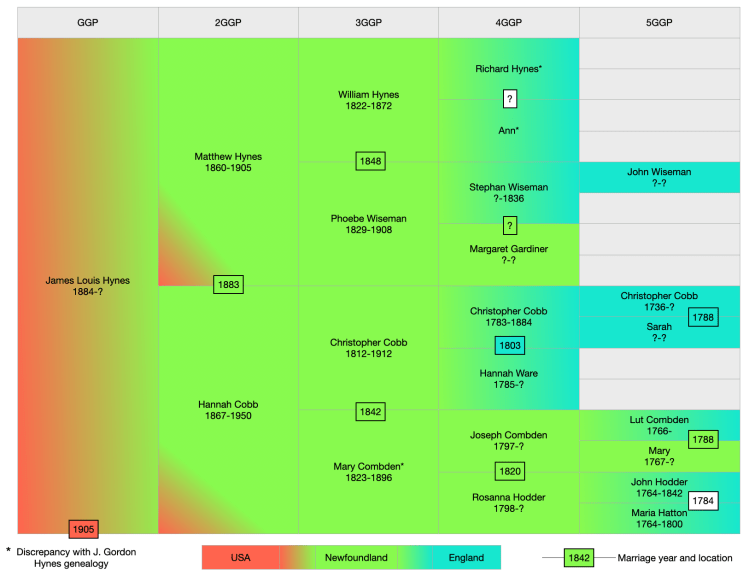
But by looking at birth, marriage and death dates in the green range, we see three or four generations of ancestors living in Newfoundland as early as 1800, with a few going back to the 1770s and 1780s.
Settlement in Newfoundland was always about the fish industry. Although the British presence there goes back to 1610, its growth was limited for the first 150 years until around 1765-1785 when the industry got on solid footing and began to grow. By this time they had learned how to survive and developed the capabilities needed to fish the large offshore banks of the region, having long since depleted the resources of the inner waters. This was also about the time that French retreated (having problems of their own leading to their first revolution in 1789) leaving Newfoundland and control of its large fishing banks to the British. The resident population of Newfoundland grew from an estimated five thousand in 1765 to ten thousand in 1785 to forty thousand (still very small for a huge island) in 1815. The various branches of our Newfoundland ancestors followed the tide of increased opportunity and demand in the growing international fish market, all migrating from parts of England.
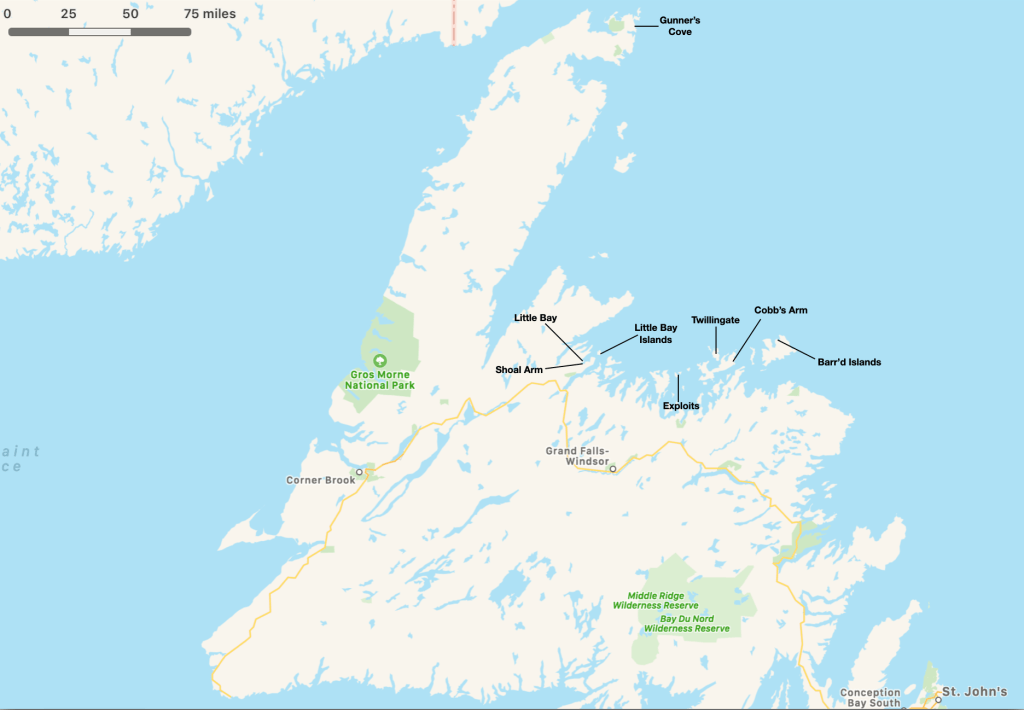
Another pattern becomes clear from comparing birth, marriage, and death records with the Newfoundland map. Our earliest ancestors started out on the right side of Newfoundland’s middle-upper shore, in locations around Barr’d Islands, then gradually moved west toward Little Bay, where James Louis Hynes was born. Note also the existence of Cobb Arm, no doubt named after the family of 4th great grandfather Christopher Cobb, whose granddaughter Hannah was James Louis’ mother.
Newfoundland and Labrador became a Canadian province in 1949, more than 50 years after our ancestors came to the United States.
How deep are our Newfoundland roots? Pretty deep.
 Bridging the Silences
3 thoughts on “How Deep Are Our Newfoundland Roots?”