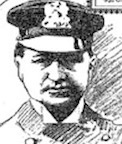
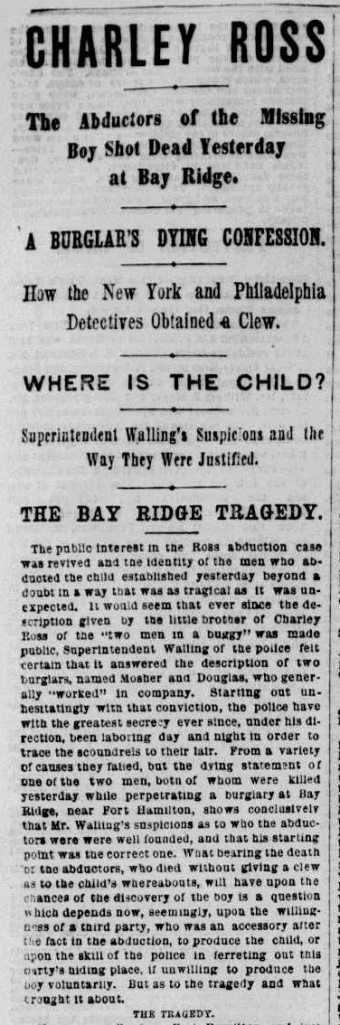
 During the summer of 1874, four year old Charley Ross and his six year old brother Walter were kidnapped by two men in an affluent Philadelphia neighborhood, resulting in a sensationalized investigation and series of events thought to be the first of its kind (the Lindbergh kidnapping would occur 58 years later). Walter was set free after a few days but Charley was held for $20,000 ransom, which the family could not afford. Intense police searches found no sign of Charley.
The following December two criminals, Joseph Douglas and William Mosher, were shot during a failed robbery attempt in Bay Ridge, Brooklyn (today just across the bridge from Staten Island). Mosher was killed instantly, but as Douglas lay dying, he confessed that the pair had been responsible for taking Charley Ross and claimed that Mosher alone knew his current whereabouts.
A third suspect, William Westervelt, was later arrested and put on trial. He claimed that Charley had been alive when Mosher was killed, but offered no helpful leads in finding the boy. Westervelt served six years for conspiracy, the best the authorities could do with weak evidence linking him to the kidnapping.
Charley was never found. A detailed account of the Charley Ross kidnapping can be found here.
What does this have to do with our family history? One of the detectives on the scene in Bay Ridge was Joseph Selleck, who knew of Mosher from work on the kidnapping that had led to New York. It was Selleck who identified the slain Mosher on the scene. Selleck’s role is described in news accounts such as this one…
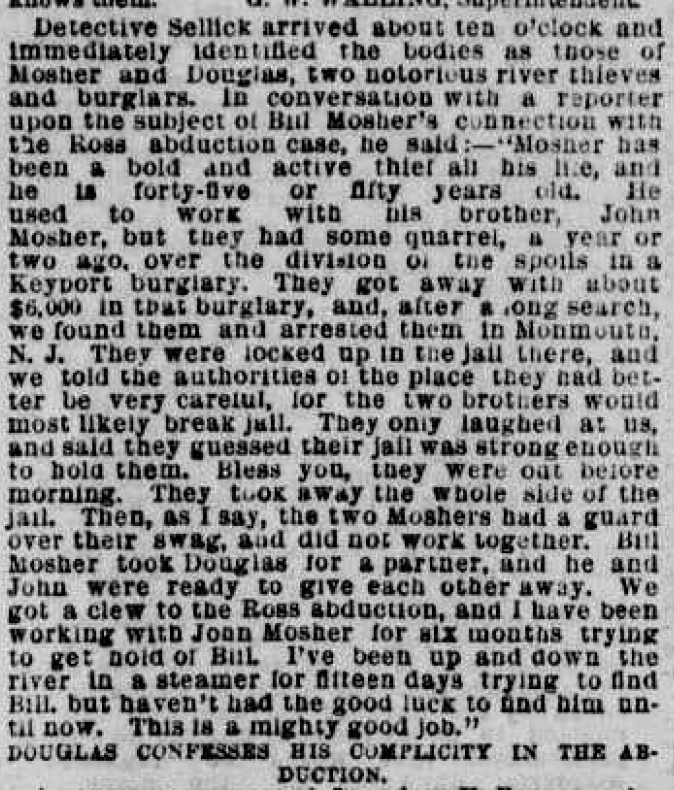
Detective Joseph Selleck was the father of Alfred Selleck, the New York City policeman who was killed on April 14, 1907 with our great grandfather George Sechler. Joseph’s connection to the Sechler/Selleck shooting is described near the end of this April 15, 1907 article in the Brooklyn Daily Eagle.
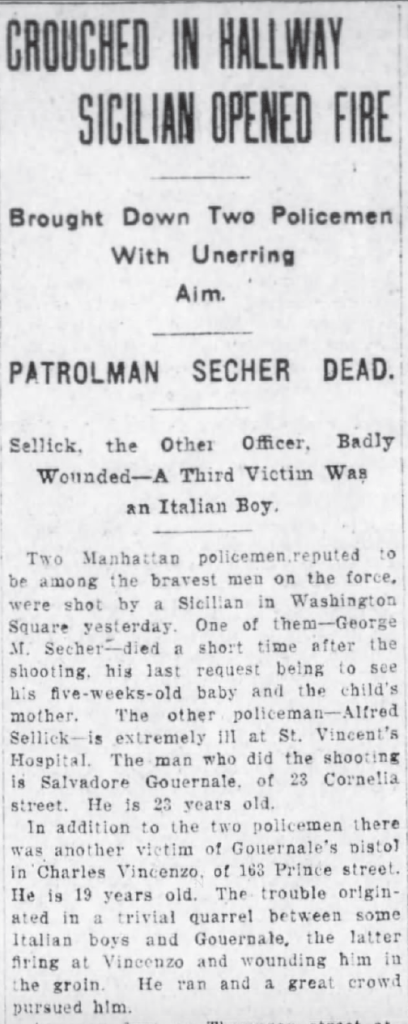
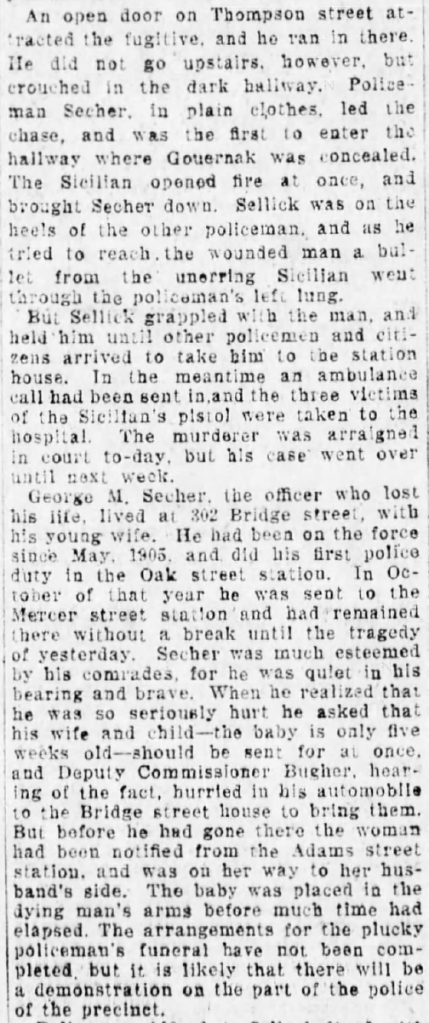
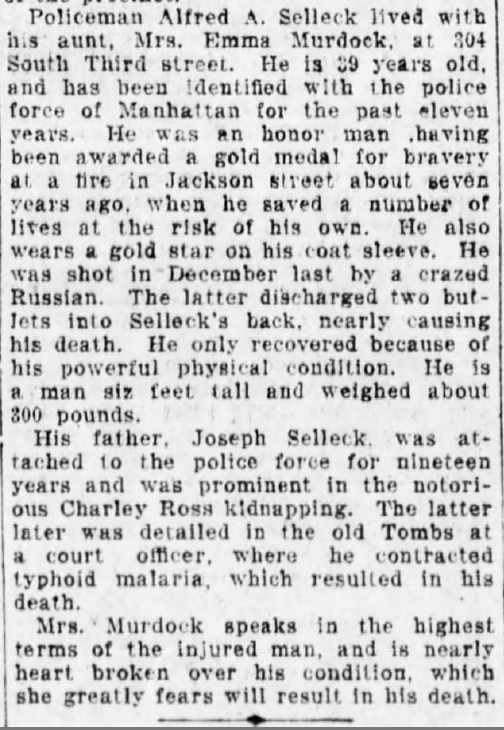
Selleck was a hero before April 14, having been shot in a separate incident four months earlier as well as saving several lives in a fire seven years earlier. Selleck died a few days after George, and was buried in his family plot in Yonkers, New York.
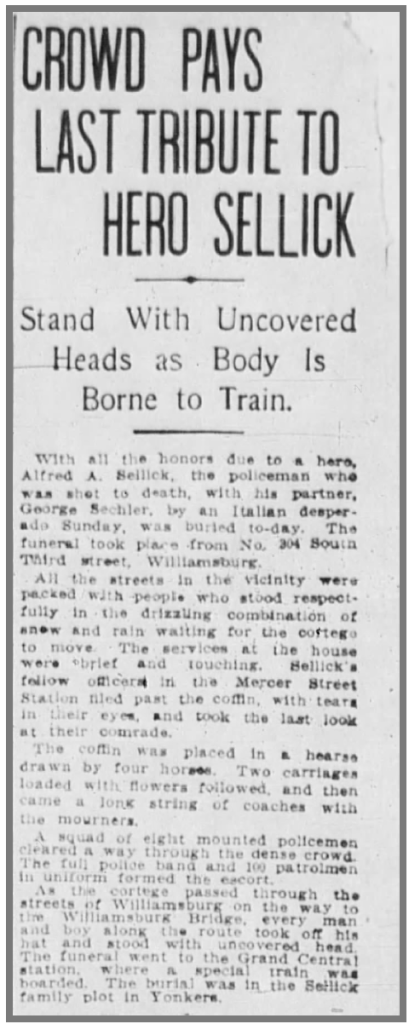
George Sechler and Alfred Selleck were not partners, they both happened to be in the same unlucky neighborhood at the same time, both responding to the commotion they saw coming toward them from Washington Square Park. I have not found anything that would indicate if or how well the two officers knew each other.
 Bridging the Silences