 Recall that we have two genealogies describing the Sandford family history. Robert Sandford and His Wife Ann Adams Sandford with Some of Their Descendants, 1615-1930, written by Josephine Sandford Ware is the one known by our branch of the family since its 1930 publication. The Sandford/Sanford Families of Long Island, Their Ancestors and Descendants by Grover Merle Sanford is the 1975 publication I learned about in my 2019 visit to Bridgehampton.
In a previous post I discussed the solution to a discrepancy between the two works, that the original Robert Sandford to come to America was not married to the daughter of Jeremy Adams, founder of Hartford, but rather was married to another less well-known Ann. It was Zachariah’s marriage to Jeremy’s granddaughter that explained his inheritance of the Hartford Inn from Jeremy.
This post will discuss another, more significant discrepancy. A few weeks after coming home from Bridgehampton with Grover’s (as a practical matter, I am still respectfully using the authors’ first names to distinguish the genealogies) research in hand, I sat down to compare in depth the two accounts. I expected to compare two chains of ancestors and, with luck, perhaps to be able to go all the way down Grover’s account to our great grandfather, perhaps finding some minor discrepancies with Josephine’s version along the way. Instead I found the following entries:
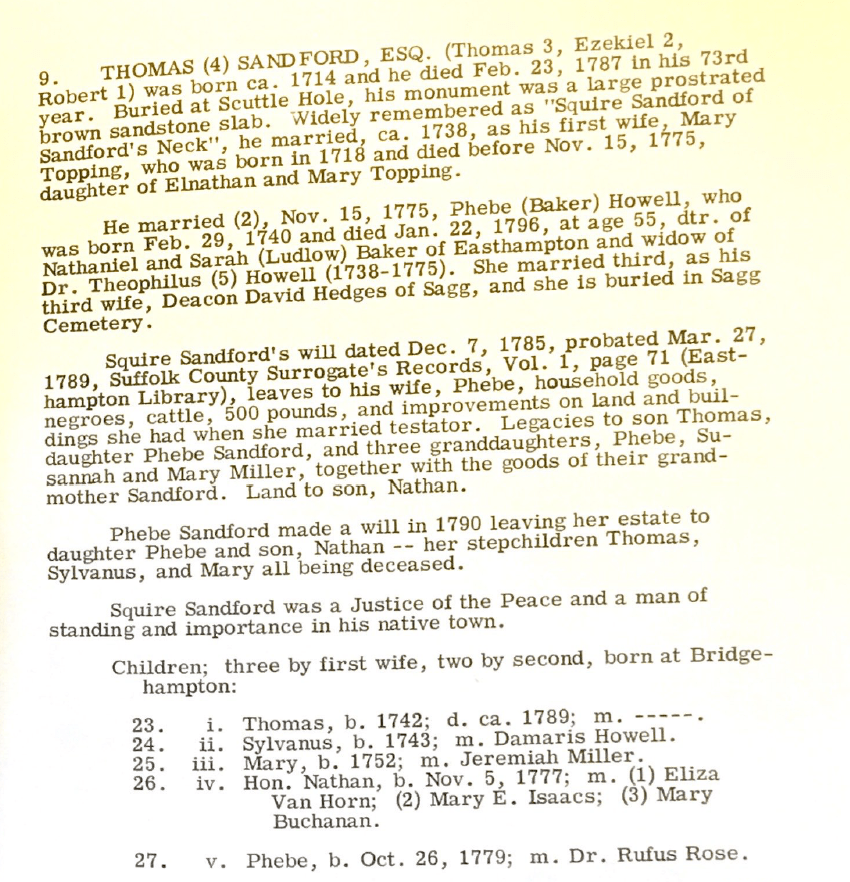
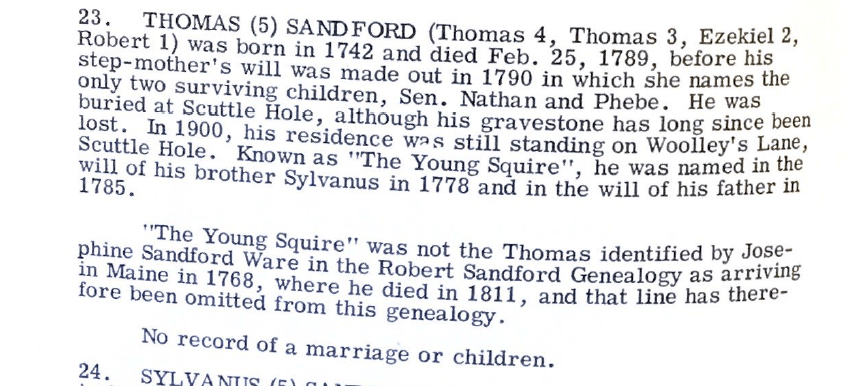
It takes a while to figure this out but, in short, Grover is saying that our 4th great grandfather Captain Thomas Sandford of Portland, Maine was not the person Josephine claimed he was. Instead, he was a different Thomas Sandford who can be shown remained on Long Island his entire life. This breaks our family branch’s link back to Long Island from Portland, Maine, and is a major problem in understanding the ancestry of our Sandford branch.
First things first—who to believe? As with the Robert Sandford discrepancy discussed previously, long story short, Grover Merle Sanford’s arguments are solid. The existence of the Thomas Sandford who didn’t move to Portland is convincing.
Up to now our Sandford ancestry chain, as reported by Josephine, looked like this…
- 8th Great Grandparents: Robert Sandford and Ann… (Hartford)
- 7th GGPs: Ezekiel Sandford and Hannah Mitchell (Hartford then Bridgehampton)
- 6th GGPs: Thomas Sandford (1) (1689-1761) and Sarah Pierson (Bridgehampton)
- 5th GGPs: Thomas Sandford (2) (1715-1787) Esq. and Mary Topping (Bridgehampton)
- 4th GGPs: Captain Thomas Sandford (3a) (1744-1811) and Jerusha Gelston (Bridgehampton then Portland Maine)
- From here down, ample evidence links the Portland Maine Sandfords down to us.
Grover, on the other hand, says:
- Robert Sandford and Ann… (Hartford)
- Ezekiel Sandford and Hannah Mitchell (Hartford then Bridgehampton)
- Thomas Sandford (1) (1689-1761) and Sarah Pierson (Bridgehampton)
- Thomas Sandford (2) Esq. (1715-1787) and Mary Topping (Bridgehampton)
- Thomas Sandford (3b) (1742-1789) (Bridgehampton)
and this is separate from: –
- unknown parents of 3a
- 4th GGPs: Captain Thomas Sandford (3a) (1744-1811) and Jerusha Gelston (Bridgehampton then Portland Maine)
- From here down, there is ample evidence linking the Portland Maine Sandfords down to us.
[Unfortunately, there are a lot of Thomases to keep track of. I have numbered them to help keep them straight.]
Where to go from here? Unfortunately, the standard genealogical sites (Ancestry, etc.) are no help figuring this out because they all repeat the error made by Josephine, amplifying it by repetition. This is one of the major problems with these sites—many/most users do not dig into the details and just believe and propagate what they see.
I considered various alternative theories for the parents of Thomas (3a), including–
- Maybe Thomas (3a) came from another Bridgehampton Sandford family (descended from one of the Sandfords further up the chain)
- Maybe Thomas (3a) came from another branch of the original 3 brothers (Thomas or Andrew)
- Maybe Thomas (3a) came to America at a later time on another boat and is not descended from the original Sandford brothers.
One can also speculate on any number of oddball theories, adoption, illegitimate child, identity theft when showing up in a new city, etc. I’ve tried but, without evidence, this leads nowhere.
Using both Josephine and Grover’s accounts (which vary in the level of detail but don’t seem to have other major disagreements) I traced enough generations of Robert’s descendants to try to identify any other possible Bridgehampton Sandford families that Thomas (3a) could have come from. This is not as difficult a task as it might seem—by the sixth generation down from Robert we go beyond the timeline of interest; we can ignore all female offspring since we are looking for a father named Sandford; the range of dates when any particular candidate might have been having children makes it possible to eliminate quite a few possibilities; and there are quite a few other families that already have a child named Thomas and can be eliminated. The resulting analysis fits comfortably on one page.
I found seven candidate fathers for Thomas (3a) in and around Bridgehampton. Many of these candidates have little known about them. Having no recorded children can be seen as an indication that they lived their lives in ways that eluded detection by the future machinery of the Long Island genealogy industry, which is mostly a matter of not leaving a will. Most of them certainly had children, so there is really no reason not to think that one such child could have been Thomas (3a).
Regarding theory #2 (looking at the branches of the original Thomas and Andrew, Robert’s brothers), there is a third important genealogy out there, Carlton E. Sanford’s Thomas Sanford, The Emigrant to New England, Ancestry, Life and Descendants. This book focuses, obviously, on the second brother who established himself in nearby Milford CT and started his own major branch of Sanfords. It does not cover the Bridgehampton branch at all. Using this source, I have similarly traced the Milford CT Sandfords to identify plausible candidates and found a few, but nothing particularly compelling. (Note: the Carlton Sanford account, even though it does not help with the Robert Sandford branch, contains what I think is the best, most thoughtful account of the Sandfords before they came to America—a topic for a future post.)
The third branch, that of Andrew Sandford, does not have any detailed genealogical documentation I am aware of. This branch got embroiled in the witch trials (another future post topic), and may have simply failed to thrive and eventually disappeared.
I have come to realize that there are few areas of study that have been more thoroughly investigated than Long Island genealogies, and the chances of making new discoveries are minimal. If records cannot be found, it is because they have been lost or never existed.
Returning our attention to Long Island…Although I cannot find direct evidence that Thomas (3a) was born on Long Island and moved to Portland Maine, there is a lot of circumstantial evidence that supports this being the case:
- Leaving Long Island during the pre-revolutionary era to get away from British oppression was common, and that Portland Maine was a logical place go. It was full of resources and opportunities, and it was in the opposite direction from most of the activities leading up to the Revolution.
- As we have discussed, there is the another Sandford branch that came from Southhampton to Topsham Maine in just before the Revolution. This branch is: Robert—>Ezekiel—>Thomas (1)—>John (1)—>John (2), who was born 1751 in Bridgehampton and died 1840 in Topsham. (John (2) would have been the cousin of Thomas (3a) had he been the son of Thomas (2)). In any case, there is proof of John (2)’s migration so there is precedent for another Sandford migration from Long Island to Maine.
- Thomas (3a)’s wife, our 4th great grandmother Jerusha Gelston definitely migrated from Southhampton to Maine. As we have discussed, she was the daughter of Judge Hugh Gelston of Southhampton, and there is ample proof for this. Jerusha’s first husband, Arthur Howell, also provably moved from Bridgehampton to Maine. The theory that Thomas (3a) started as a friend/protege of Howell and went along with him to help with establishing the business is compelling.
- If we compare the situation of Thomas (3a) and Jerusha Gelston with that of Thomas (2) and Mary Topping we see that Thomas (2) was married twice, first to Mary Topping and second to Phebe Baker Howell who was previously married to Theophilus Howell. So both Thomas (2) and Thomas (3a) were provably married to Howell widows. At the very least, one can conclude that the Sandford and Howell families were very close over several generations. It would not be impossible, but odd, to see this pattern (of Sandfords marrying Howell widows) repeated between Sandford generations if the generations were from completely different branches of the Sandford tree.
This circumstantial evidence tells me that it is most likely that Thomas (3a) was born in Bridgehampton, not the son of Thomas (2) but of some other nearby Sandford family (from the seven candidates discussed above), that he fell-in as a protege of Arthur Howell, followed him and Jerusha when they moved to Portland to pursue their business, and married his wife when Arthur Howell died. The other possibility, that Arthur Howell and Jerusha Gelston met another non-Bridgehampton Thomas Sandford from another branch after they moved to Portland, seems far less likely.
I have also tried looking at Howell, Gelston, and Topping genealogies, of which there are many, and looking for clues. No luck on this, but kind of a long shot because I really can’t think of specific circumstances for how a Howell will, for example, would have any occasion to notice what was going on in the Sandford world.
The seven candidate fathers on Long Island for Captain Thomas Sandford are depicted in the following diagram.
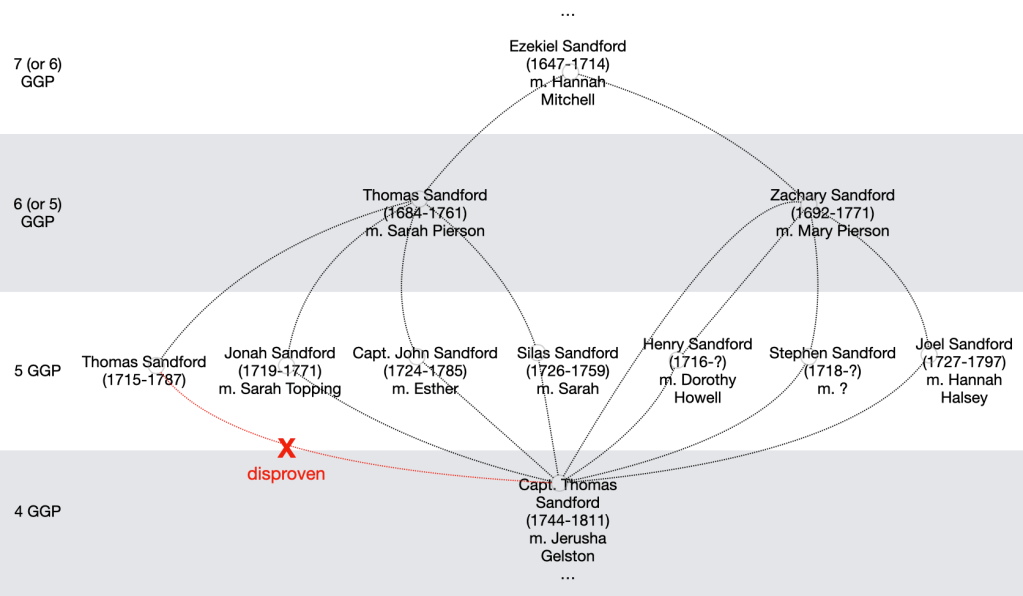
The nice thing about the seven candidate sets of Bridgehampton parents for Capt. Thomas Sandford is that none of them would change our family tree very much from the one that Josephine claimed—only one or two generations would change:
- The first three candidates would only change one name in the family tree — 5th GGP Thomas (2) would change to Jonah, John or Silas and 6th GGP Thomas (1) would be unchanged as 6th great grandfather
- The last three candidates would change 5th GGP Thomas (2) to Henry, Stephen or Joel, and change 6th GGP Thomas (1) to Zachary (not the same as the Hartford Inn owner) but Ezekiel would remain our 7th great grandfather
- The middle candidate would change 5th GGP Thomas (2) to Zachary who would be 5th great grandfather. Everybody earlier would move down a level i.e. Ezekiel the bridge builder would change from 7th great grandfather to 6th great grandfather, and so on.
For now, and maybe permanently, our Sandford genealogy has an asterisk, acknowledging the lack of proof of the link from Portland back to Bridgehampton, but citing the circumstantial evidence to support the theory that our Sandford branch likely really did come from Bridgehampton (and unquestionably identifies 5th great grandfather Hugh Gelston and 4th great grandmother Jerusha Gelston as Long Island ancestors).
Click here to see the full Sandford genealogy reflecting the above findings.
That’s the big mystery of the inconsistent Sandford genealogies and my best thoughts on the solution. Happily, I have not found any other major discrepancies between the Josephine Sandford Ware and Grover Merle Sanford genealogies of the Sandford/Sanford family. I thank Grover Merle Sanford for setting the record straight (and forgive him for throwing us out of his book).
An additional note. We know that Grover’s genealogy excluded our Sandford branch because he did not find data to support it. It is fair to ask the opposite question—did Josephine’s genealogy recognize Grover Merle Sanford’s branch? The answer is that she didn’t get that far–her research petered-out before she got all the way down to Grover. She identified Robert—>Ezekiel 1—>Ezekiel 2—>Ezekiel 3—>Bethuel but then did not identify further generations that would have led to Grover. She also identified Ezekiel 4, son of Ezekiel 3, but did not identify further generations that would have led to today’s Ann Sandford of Bridgehampton.
 Bridging the Silences
5 thoughts on “The Lacuna”